
The River Lethe from Greek myt Myth Meaning & Symbolism
The river of forgetfulness in the Greek underworld, whose waters erase the memories of the dead, offering a profound metaphor for psychic cleansing and rebirth.
The Tale of The River Lethe from Greek myt
Beneath the roots of [the world](/myths/the-world “Myth from Tarot culture.”/), where the sun’s chariot never runs and the air is a permanent, breathless twilight, there flows a river unlike any other. This is not the Acheron of mourning, nor the Phlegethon of fury. This is the [Lethe](/myths/lethe “Myth from Greek culture.”/), [the River](/myths/the-river “Myth from Buddhist culture.”/) of Forgetfulness, whose waters are not [water](/myths/water “Myth from Chinese culture.”/) but liquid silence.
After the final breath is drawn and the soul is ferried by the solemn boatman Charon across the boundary of Styx, the shade arrives in the Asphodel Meadows. Here, in the grey, eternal fields, a profound thirst awakens—a thirst not of the body, which is dust, but of the weary [psyche](/myths/psyche “Myth from Greek culture.”/). The shade is drawn, as if by a silent melody, to a bank where a soft, silver mist perpetually hangs. The river here does not roar; it whispers. It does not sparkle; it absorbs light, holding the twilight in its depths.
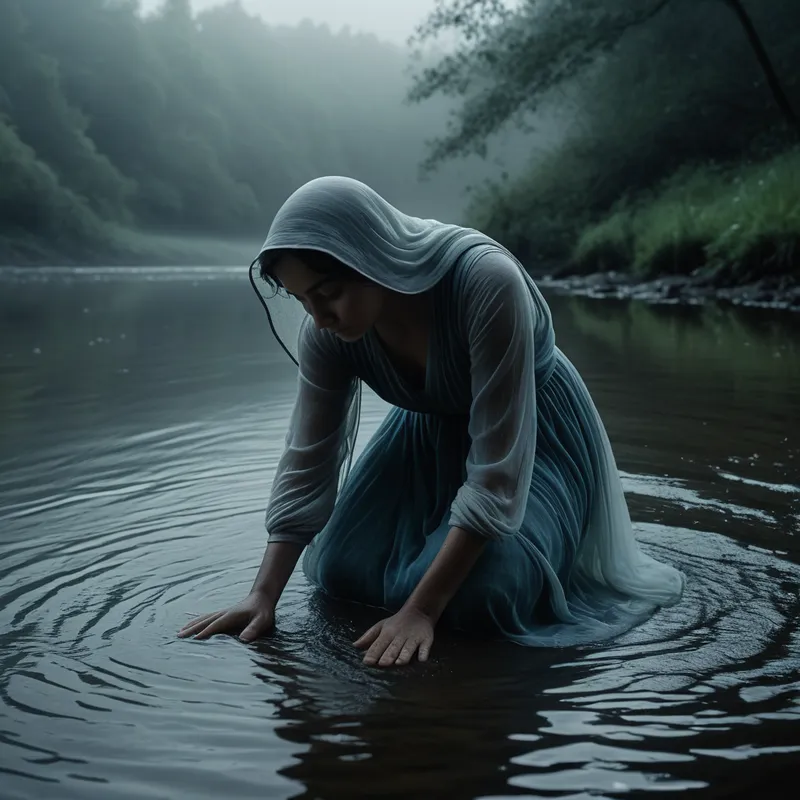
The shades approach, one by one. They kneel on the soft, damp earth. Some hesitate, a flicker of their former passion—love, ambition, regret—crossing their translucent features. But the thirst is overwhelming, a deep, psychic ache for an end to the story. They cup their hands and drink. The water is cool and weightless. As it passes the lips that are no longer lips, a great unraveling begins. The tapestry of a life—the sting of a first betrayal, the warmth of a mother’s touch, the taste of salt on a lover’s skin, the crushing weight of a failure—all of it, thread by luminous thread, loosens, fades, and dissolves into a gentle, grey nothingness. The face of the shade smooths. The eyes, once windows to a tumultuous world, become placid pools reflecting only [the mist](/myths/the-mist “Myth from Celtic culture.”/). The conflict is over. The rising action of a lifetime finds its final, quiet resolution in [the waters of Lethe](/myths/the-waters-of-lethe “Myth from Greek culture.”/). The soul, now truly a shade, turns and wanders deeper into the meadows, free from memory, free from [the self](/myths/the-self “Myth from Jungian culture.”/).
Cultural Origins & Context
The myth of Lethe is woven into the fabric of ancient Greek eschatology—the doctrine of the final things. It is primarily preserved in epic poetry, like [Homer](/myths/homer “Myth from Greek culture.”/)’s Odyssey, and later systematized by poets such as Hesiod and the Roman Virgil in his Aeneid. It was not a myth told to children for simple moral instruction, but a profound narrative for contemplating the ultimate fate of the psyche. It functioned as a cosmological explanation for the state of the dead, answering the haunting question: How could the afterlife bear the infinite weight of all human memory and pain? Lethe provided the answer: it could not, and so it must be washed clean.
The myth was also integral to the rituals of the Eleusinian Mysteries and the practices of the Orphics. For initiates, knowledge of Lethe and its counterpart, the [Mnemosyne](/myths/mnemosyne “Myth from Global/Universal culture.”/), was key. The goal was not to drink from Lethe, but to avoid it, to remember one’s divine origin and thus break the cycle of rebirth. In this context, the myth served a societal function far beyond storytelling; it was a map for the soul’s journey, a sacred geography of the unseen world that offered hope for transcendence to those who were purified and knowledgeable.
Symbolic Architecture
The [River](/symbols/river “Symbol: A river often symbolizes the flow of emotions, the passage of time, and life’s journey, reflecting transitions and movement in one’s life.”/) Lethe is not merely a [location](/symbols/location “Symbol: The symbol of ‘Location’ signifies a sense of place, context, and the environment in which experiences unfold.”/) in a [underworld](/symbols/underworld “Symbol: A symbolic journey into the unconscious, representing exploration of hidden aspects of self, transformation, or confronting repressed material.”/) map; it is a profound [symbol](/symbols/symbol “Symbol: A symbol can represent an idea, concept, or belief, serving as a powerful tool for communication and understanding.”/) of the psyche’s own necessary processes. It represents the unconscious function of selective forgetting, the mind’s innate [capacity](/symbols/capacity “Symbol: A measure of one’s potential, limits, or ability to contain, process, or achieve something, often reflecting self-assessment or external demands.”/) to dissolve the raw, unintegrated [material](/symbols/material “Symbol: Material signifies the tangible aspects of life, often representing physical resources, desires, and the physical world’s influence on our existence.”/) of experience to preserve the integrity of [consciousness](/symbols/consciousness “Symbol: Consciousness represents the state of awareness and perception, encompassing thoughts, feelings, and experiences.”/).
Lethe is the psyche’s mercy. To remember everything is a form of madness; to forget selectively is the foundation of sanity and the possibility of a new beginning.
The river symbolizes the [dissolution](/symbols/dissolution “Symbol: The process of breaking down, dispersing, or losing form, often representing transformation, release, or the end of a state of being.”/) of the [persona](/symbols/persona “Symbol: The social mask or outward identity one presents to the world, often concealing the true self.”/) and the conscious ego-[identity](/symbols/identity “Symbol: Identity represents the sense of self, encompassing personal beliefs, cultural background, and social roles.”/) forged in [life](/symbols/life “Symbol: The symbol of ‘Life’ represents a journey of growth, interconnectedness, and existential meaning, encompassing both the joys and challenges that define human experience.”/). The “thirst” the shades feel is the exhaustion of carrying a singular, fixed narrative of the self. The [water](/symbols/water “Symbol: Water symbolizes the subconscious mind, emotions, and the flow of life, representing both cleansing and creation.”/) itself is the solvent of time and personal [history](/symbols/history “Symbol: History in dreams often represents the dreamer’s past experiences, lessons learned, or unresolved issues that continue to influence their present.”/), returning the [soul](/symbols/soul “Symbol: The soul represents the essence of a person, encompassing their spirit, identity, and connection to the universe.”/) to a state of potential, akin to the [prima materia](/myths/prima-materia “Myth from Alchemical culture.”/) in [alchemy](/symbols/alchemy “Symbol: A transformative process of purification and creation, often symbolizing personal or spiritual evolution through difficult stages.”/)—the undifferentiated, base state from which new forms can emerge. It is a radical symbol of psychic [death](/symbols/death “Symbol: Symbolizes transformation, endings, and new beginnings; often associated with fear of the unknown.”/) that precedes any [rebirth](/symbols/rebirth “Symbol: A profound transformation where old aspects of self or life die, making way for new beginnings, growth, and renewal.”/), the necessary clearing of the slate.
The Dreamer’s Resonance
When [the River Lethe](/myths/the-river-lethe “Myth from Global/Universal culture.”/) flows into modern dreams, it rarely appears as a classical Greek landscape. Instead, it manifests as the process of forgetting. One might dream of erasing a hard drive where all family photos are stored, only to feel relief. One might dream of a flood of clear, cool water washing through a childhood home, leaving everything familiar yet strangely blank and clean. Or one might find themselves in a library where the words in all the books are slowly fading to white.
These dreams signal a profound somatic and psychological process: [the ego](/myths/the-ego “Myth from Jungian culture.”/)’s structure is undergoing a necessary dissolution. The dreamer may be processing a major life transition—the end of a career, a relationship, or a long-held identity. The psyche is engaging in a therapeutic “forgetting,” not of facts, but of the emotional cathexes and outdated self-concepts that bind one to a painful or outgrown past. The somatic sensation upon waking is often one of lightness, emptiness, or eerie calm, reflecting the release of psychic burdens the conscious mind may not even have fully acknowledged it was carrying.

Alchemical Translation
In the alchemical journey of individuation—the process of becoming one’s whole, unique self—the Lethean waters represent the crucial stage of [nigredo](/myths/nigredo “Myth from Alchemical culture.”/), or blackening. This is the stage of dissolution, putrefaction, and despair, where the old, outmoded elements of the personality must be broken down. For the modern individual, this is the painful yet vital process of letting go.
The conscious ego must, like the shade, kneel and drink from its own Lethe. It must willingly forget who it thought it was—the titles, the victories, the story of its wounds—to discover who it might become.
This is not literal amnesia, but an alchemical forgetting: the de-identification from the contents of [the personal unconscious](/myths/the-personal-unconscious “Myth from Jungian Psychology culture.”/). The [triumph](/myths/triumph “Myth from Roman culture.”/) in the myth is not in resisting the river, but in the completion of its work. The modern equivalent is the courage to endure a period of confusion, loss of direction, and identity crisis without rushing to fill [the void](/myths/the-void “Myth from Buddhist culture.”/). This is the “dark night of the soul,” where the waters of Lethe wash away the superficial layers of the self. Only after this dissolution can the next alchemical stage, albedo (whitening), begin. From the blank slate, the purified silver of the soul’s essence can emerge. The individual is not reborn as the same person with a clean memory, but is fundamentally reconstituted, having integrated the lesson that the true Self exists beyond the transient narrative of a single lifetime. The river’s gift is not oblivion, but the freedom to begin again from a place of essential, unburdened being.
Associated Symbols
Explore related symbols from the CaleaDream lexicon: