
The River Myth Meaning & Symbolism
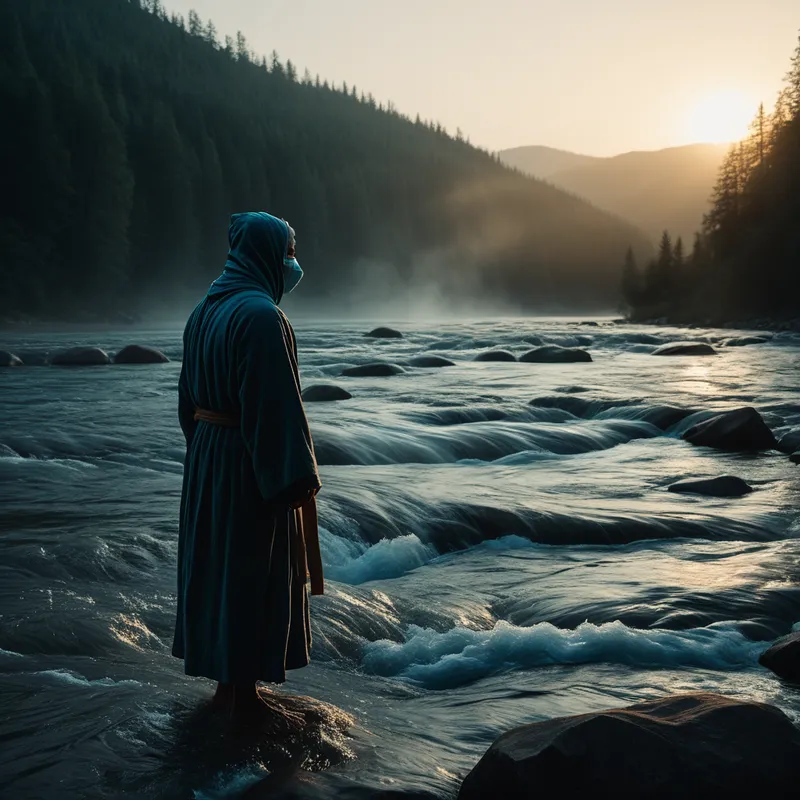
A seeker confronts a raging river, seeking a crossing. The river itself speaks, teaching that to find the other shore, one must first cease to be a separate traveler.
The Tale of The River
Listen. There is a sound older than mountains. It is the voice of the River.
Once, a seeker came to its banks. He had walked far, leaving behind the noise of villages and the weight of names. He sought the Other Shore, a place spoken of in whispers by sages—a land of peace beyond understanding. Before him, the River roared. It was not water as we know it, but a torrent of time itself—carrying leaves of yesterday, branches of tomorrow, and the white foam of moments dissolving as they were born. The current sang a relentless song of change.
The seeker looked for a bridge and found none. He searched for a shallow ford, but the riverbed was an abyss of shifting sand. Despair, cold as river-stone, touched his heart. “How can I cross?” he cried out, not to any god, but to the relentless flow itself.
And the River answered.
Its voice was not a single sound, but the symphony of its flow—the deep groan of boulders turning, the high chatter over pebbles, the hiss of spray. “What seeks to cross?” the River asked. “Is it the feet of dust? The hands that grasp? The name you were given?”
“I seek the Other Shore,” the seeker insisted, clutching his small bundle of possessions—a bowl, a robe, his cherished ideas of enlightenment.
“You carry the shore with you,” murmured the River. “You are a knot of resistance in my current. You fight my nature, which is to flow. To find the far bank, you must first understand the near one. To cross me, you must first cease to be a crosser.”
The seeker sat. Days turned. He watched the River. He saw a leaf whirl in an eddy, trapped, believing itself to be traveling far while going nowhere. He saw a log surrender to the current and glide smoothly toward the sea. He saw his own reflection shattered and remade a thousand times a second.
One evening, as the last light bled into the water, he did not see a river to be crossed. He saw only movement, only process. He saw that his own breath was a tide, his thoughts were fleeting debris on a stream. The fear, the seeker, the distant shore—all were patterns in the endless, seamless flow. He stepped forward, not across, but into.
And where his foot should have met water, it met solid ground. Not because the River had dried, but because the division between the walker and the way, the seeker and the sought, had dissolved. He was, in that step, both the flowing and the still. The Other Shore was not a place he reached, but a realization that dawned: he had never left it.
Cultural Origins & Context
This is not a myth of a single telling. It is the bedrock metaphor of the Buddhist tradition, woven into the very fabric of its teachings. Its primary source is the Pali Canon, where the Buddha repeatedly uses the parable of the raft and the river. He famously stated, “Using the Dharma as a raft, you should cross over, not hold on.” The river is Samsara—the conditioned, phenomenal world of constant change, desire, and suffering. The Other Shore is Nibbana (Nirvana).
This story was not told by bards for entertainment, but by monks and nuns as a pedagogical tool. It was a living map for the mind, used in meditation instruction and philosophical discourse. Its societal function was profoundly practical: to re-orient the human psyche from a mode of grasping and becoming to one of understanding and release. It provided a shared symbolic language for a community dedicated to awakening, making the abstract goal of Nirvana viscerally comprehensible as a “crossing over.”
Symbolic Architecture
The River is the master symbol of conditioned existence. Its waters are not merely H₂O; they are the stream of consciousness, time, karma, and sensory experience.
The river you fear is made of your own resistance to flow.
The Near Shore represents our familiar, suffering-laden state: identified with the ego, clinging to permanence in an impermanent world. The Other Shore is not a geographical location but the unconditioned state of freedom from that clinging. The raft is the Buddha’s teaching—the Dharma. It is crucial, but provisional. To cling to the raft after crossing is to mistake the tool for the goal, to turn wisdom into another piece of debris in the stream.
The seeker’s bundle symbolizes the baggage of the self—views, opinions, attachments, and even spiritual ambition. His despair at the riverbank is the crucial turning point, the “dark night” where conceptual knowledge fails. The final step is the moment of prajna (wisdom), where the paradox resolves not through action, but through a fundamental shift in perception.

The Dreamer’s Resonance
When this myth stirs in the modern unconscious, it often surfaces in dreams of overwhelming currents, impossible crossings, or transformative waters. To dream of a raging river you must cross may signal a psychological process where the dreamer feels carried away by life’s changes—a career shift, a relationship ending, an internal identity crisis. The somatic feeling is often one of being powerless against a force greater than oneself.
A dream of finding a still point within the torrent, or of walking on the water, suggests the emergence of what Jung called the transcendent function. It marks the psyche’s movement from being a victim of the flow to witnessing it. The river in the dream may change from a threat to a teacher. This is the dream-ego beginning to differentiate from the compulsive stream of thoughts and emotions, achieving what Buddhism calls “mindfulness” (sati)—the capacity to observe the river without drowning in it.

Alchemical Translation
The myth models the alchemy of individuation—the process of becoming a whole, integrated Self by confronting and transmuting the contents of the unconscious (the turbulent river).
The alchemical vessel is not the crucible, but the unwavering attention placed upon the flow of the psyche.
First, the recognition (nigredo): The seeker arrives at the bank. This is the conscious ego confronting the vast, chaotic power of the unconscious—the shadow, the anima/animus, the archetypal forces. It feels insurmountable. Then, the surrender (albedo): Sitting and watching. This is the disciplined practice of introspection and meditation, allowing psychic contents to arise and pass without identification. The ego’s rigid stance softens.
The dissolution (citrinitas) is the key: “To cross, you must cease to be a crosser.” This is the de-integration of the ego-complex, the letting go of the persona and its agendas. It feels like death, for it is the death of the old, separate self. Finally, the union (rubedo): The step that finds solid ground. This is the emergence of the Self, the central archetype of wholeness. The opposition between conscious and unconscious, ego and flow, is transcended. The individual no longer fights their own nature but embodies the paradox of being both a unique expression and an integral part of the seamless whole. The river flows, and one is both its water and its witness, forever crossed over, yet forever flowing.
Associated Symbols
Explore related symbols from the CaleaDream lexicon: