The Revealed Quran Myth Meaning & Symbolism
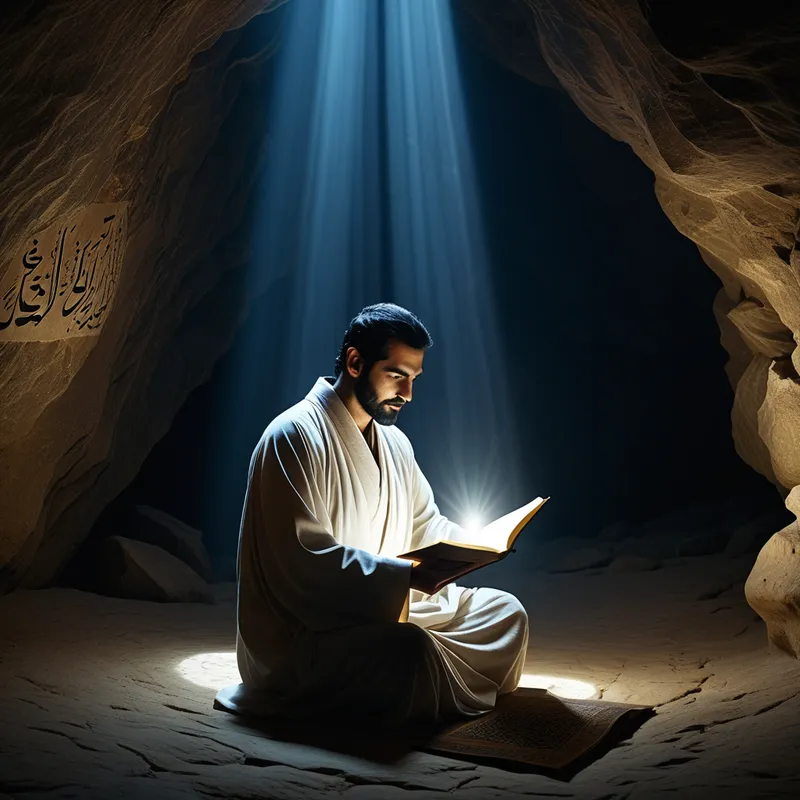
A man in a cave receives the first command of a divine revelation, initiating a transformation of self and society through the power of the spoken word.
The Tale of The Revealed Quran
In the age when [the world](/myths/the-world “Myth from Tarot culture.”/) was heavy with forgetting, a man sought the silence of the mountain. His name was Muhammad, and he carried a weight in his soul—a longing for a clarity that the bustling idol-markets of Makkah could not satisfy. So he climbed. He ascended the barren, sun-bleached flanks of Jabal an-Nour, his breath a cloud in the chill air, until he found its secret heart: [the Cave](/myths/the-cave “Myth from Platonic culture.”/) of Hira.
Here, in a womb of stone, the noise of the world fell away. There was only the scent of dry earth, the feel of cool rock, and the vast, echoing quiet. For years, he returned, dwelling in this solitude, turning over the great questions of his people—their tribal strife, their orphaned cries, their worship of stone gods that held no breath. He was listening, though he knew not for what.
Then came the Night. It was in the month of Ramadan, on a night the world would later call [Laylat al-Qadr](/myths/laylat-al-qadr “Myth from Islamic culture.”/). The cave was a pocket of absolute darkness, a void. And into that void, a Presence descended. It was not seen, but felt—a pressure in the air, a vibration in the stone, a filling of the space with an awe that had texture and weight.
Then, a grasp. A being of overwhelming majesty, Jibril, manifested and held him in an embrace so fierce it squeezed the breath from his lungs. A command thundered in the silence, not through the ears but directly into the center of his being: “Iqra!”—“Recite!”
Terror seized him. “I am not a reciter!” he cried into the darkness, a man confronted by the impossible. The command came again, the embrace tightening. “Iqra!” And a third time, until the terror reached its zenith and broke. Then, from a place beyond his own mind, words began to form—luminous, perfect, and heavy with meaning:
“Recite in the name of your Lord who created— Created man from a clinging clot. Recite, and your Lord is the most Generous— Who taught by the pen— Taught man that which he knew not.”
The words poured through him, etching themselves upon his heart. The angel departed as suddenly as he came, leaving the man alone in the cave, his body trembling, his soul alight with a fire of knowing and a profound fear. He fled down the mountain, the words echoing in his skull, a sacred burden now carried in a mortal vessel. He sought the shelter of his wife, Khadijah, his only words a plea: “Cover me! Cover me!” As she wrapped him in blankets, he told her of the encounter, of the impossible command, of the divine speech now lodged within him. And she, with a clarity born of love, became the first to affirm: “Rejoice! By God, He would not humiliate you. You uphold family ties, speak truthfully, bear others’ burdens… This can only be good.”
The silence of the cave was broken forever. [The Word](/myths/the-word “Myth from Biblical culture.”/) had entered the world, and the man was now its Messenger. The revelation had begun, not as a single event, but as a dialogue that would span decades—a voice from the Unseen, addressing the concrete pains and hopes of humanity, transforming a seeker in a cave into the conduit for a scripture that would reshape the world.
Cultural Origins & Context
This is not a myth of a distant, forgotten age, but the foundational narrative of a living tradition. The story of the first revelation is meticulously preserved within the earliest Islamic sources—the Hadith and biographies (Sira). It was not told by bards for entertainment, but transmitted by companions and scholars as sacred history, the pivotal moment that inaugurated the final prophecy.
Its primary societal function was and remains one of legitimation and orientation. It answers the fundamental question: “Where did the Quran come from?” The answer grounds the text not in human philosophy or poetry, but in a direct, transcendent encounter. This established the Quran’s authority as the literal, uncreated Speech of Allah, revealed, not composed. The story also establishes the human profile of the Prophet—his initial terror, his need for reassurance, his humanity. This made the revelation relatable; it was given to a man, not a demigod, emphasizing that the message was for mankind, delivered through a member of mankind.
Symbolic Architecture
At its core, this myth is an archetypal [drama](/symbols/drama “Symbol: Drama signifies narratives, emotional expression, and the exploration of human experiences.”/) of [Reception](/symbols/reception “Symbol: The symbol of ‘reception’ often signifies the act of welcoming or accepting new ideas, experiences, or people into one’s life.”/). The cave of Hira is the ultimate [symbol](/symbols/symbol “Symbol: A symbol can represent an idea, concept, or belief, serving as a powerful tool for communication and understanding.”/) of the prepared [vessel](/symbols/vessel “Symbol: A container or structure that holds, transports, or protects something essential, representing the self, emotions, or life journey.”/)—the [soul](/symbols/soul “Symbol: The soul represents the essence of a person, encompassing their spirit, identity, and connection to the universe.”/) that has turned [inward](/symbols/inward “Symbol: A journey toward self-awareness, introspection, and the exploration of one’s inner world, thoughts, and unconscious mind.”/), away from the collective [noise](/symbols/noise “Symbol: Noise in dreams signifies distraction, confusion, and the need for clarity amidst chaos.”/) (Jahiliyyah), to create an inner void. This void is not [emptiness](/symbols/emptiness “Symbol: Emptiness signifies a profound sense of void or lack in one’s life, often related to existential fears, loss, or spiritual quest.”/), but potential, a sacred hollow ready to be filled.
The most profound revelations do not come to the crowded marketplace of the mind, but to the silent, emptied chamber of the heart.
The command “Iqra!” (Recite/Read) is multifaceted. It is an [initiation](/symbols/initiation “Symbol: A symbolic beginning or transition into a new phase, status, or awareness, often involving tests, rituals, or profound personal change.”/) by sound and [breath](/symbols/breath “Symbol: Breath symbolizes life, vitality, and the connection between the physical and spiritual realms.”/), linking creation (God’s command “Be!”) to [human](/symbols/human “Symbol: The symbol of a human represents individuality, complexity of emotions, and social relationships.”/) articulation. The [Prophet](/symbols/prophet “Symbol: A messenger or seer who receives divine revelations, often warning of future events or guiding moral direction.”/)’s protest, “I am not a reciter,” represents [the ego](/myths/the-ego “Myth from Jungian culture.”/)’s [resistance](/symbols/resistance “Symbol: An object or tool representing opposition, struggle, or the act of pushing back against external forces or internal changes.”/) to its destined, overwhelming [purpose](/symbols/purpose “Symbol: Purpose signifies direction, meaning, and intention in life, often reflecting personal ambitions and core values.”/). The embrace of Jibril is the necessary compression—the psychic pressure required to break the [shell](/symbols/shell “Symbol: Shells are often seen as symbols of protection, transition, and the journey of personal growth.”/) of the old self so the new [consciousness](/symbols/consciousness “Symbol: Consciousness represents the state of awareness and perception, encompassing thoughts, feelings, and experiences.”/) can emerge. The [revelation](/symbols/revelation “Symbol: A sudden, profound disclosure of truth or insight, often through artistic or musical means, that transforms understanding.”/) itself, beginning with the [theme](/symbols/theme “Symbol: Themes in dreams often represent the overarching ideas or emotions the dreamer is grappling with.”/) of creation and [knowledge](/symbols/knowledge “Symbol: Knowledge symbolizes learning, understanding, and wisdom, embodying the acquisition of information and enlightenment.”/), signifies that this is not merely a new law, but a re-originating [event](/symbols/event “Symbol: An event within dreams often signifies significant life changes, transitions, or emotional milestones.”/). It re-makes the world by redefining its [source](/symbols/source “Symbol: The origin point of something, often representing beginnings, nourishment, or the fundamental cause behind phenomena.”/) and [purpose](/symbols/purpose “Symbol: Purpose signifies direction, meaning, and intention in life, often reflecting personal ambitions and core values.”/), starting with the one who receives it.
The Dreamer’s Resonance
When this mythic pattern stirs in the modern unconscious, it often manifests in dreams of inescapable communication. One might dream of hearing a voice of undeniable authority issuing a command that feels both terrifying and destined. Or of discovering a book written in a luminous, unknown script that one suddenly understands. The somatic experience is one of awe bordering on dread—a racing heart, a feeling of being gripped or compressed, followed by a profound, unsettling clarity.
Psychologically, this signals a moment of archetypal summons. The conscious personality is being called by a deeper, transpersonal authority ([the Self](/myths/the-self “Myth from Jungian culture.”/), in Jungian terms) to acknowledge and articulate a truth it has been avoiding. The initial terror is the ego’s panic at being usurped. The dreamer is in the cave of Hira, facing their own Jibril—perhaps in the form of a life crisis, a creative breakthrough, or a moral imperative that cannot be ignored. The process is one of moving from being a passive subject of life to becoming an active, conscious vessel for a meaning larger than oneself.

Alchemical Translation
The alchemical journey modeled here is the transmutation of the personal into the transpersonal channel. The base metal is the isolated, seeking individual (Muhammad in his pre-prophetic life). The [nigredo](/myths/nigredo “Myth from Alchemical culture.”/), or blackening, occurs in the dark cave—the dissolution of old certainties and identities in solitude. The embrace of the angel is the mortificatio—the symbolic death of the purely egoic will (“I cannot”).
The sacred word is not given to the one who is full of themselves, but to the one who has been emptied, creating a space where the eternal can echo.
The revelation of the Word is the albedo, the whitening—the emergence of a new, luminous consciousness. But the work is not done. The Prophet must return to the world (Makkah), to his community, and live the revelation. This is the [rubedo](/myths/rubedo “Myth from Alchemical culture.”/), the reddening—the integration of the transcendent truth into the blood and soil of daily life, facing rejection, building community, and applying the word to concrete reality. The final gold is not the individual’s glorification, but the creation of a living tradition—a scripture and a community that carries the transformative word forward. For the modern individual, this translates to the process of individuation: hearing one’s own deepest, often daunting, calling (the “Iqra!” of the Self), enduring the crisis of integration, and ultimately finding a way to “recite” one’s authentic truth into the world, thereby transforming one’s personal narrative into something that serves a purpose beyond the self.
Associated Symbols
Explore related symbols from the CaleaDream lexicon: