The Red King and White Queen Myth Meaning & Symbolism
A foundational alchemical myth of the sacred marriage between solar and lunar principles, whose union dissolves the world to birth the perfected Self.
The Tale of The Red King and White Queen
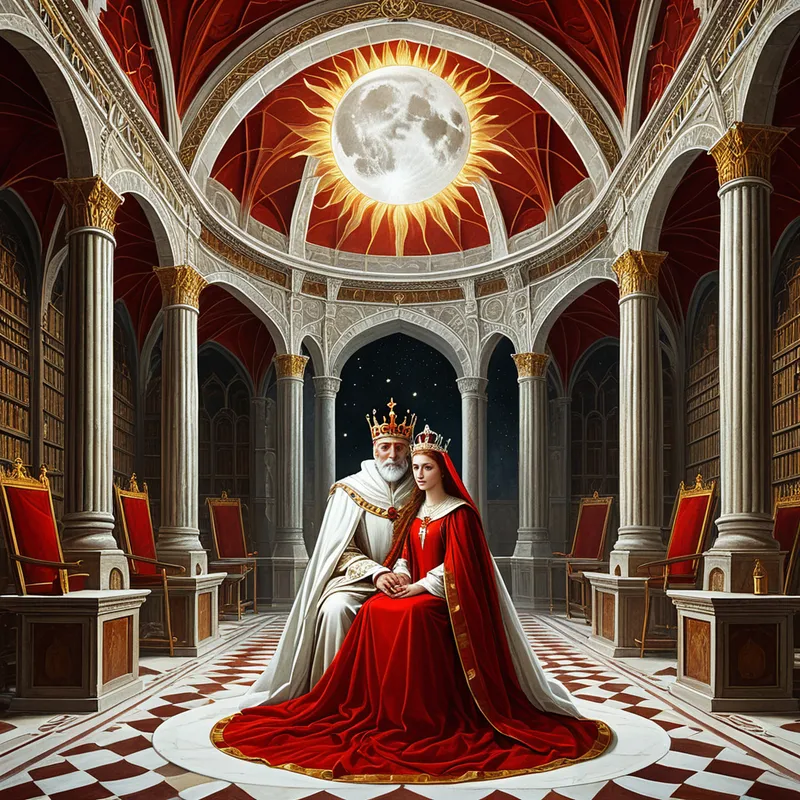
Listen. In the beginning, before [the world](/myths/the-world “Myth from Tarot culture.”/) was fixed in its heavy forms, there was a Great Work unfinished. In the heart of the [Hermetic Vessel](/myths/hermetic-vessel “Myth from Alchemical culture.”/), the universe itself, two sovereigns reigned in splendid, terrible isolation.
He was the Red King, Rex Rubeus. His throne was the Sun, his scepter a shaft of unyielding will, and his cloak the fire of midday. He knew only action, heat, and the relentless drive to conquer and solidify. His kingdom was a desert of brilliant certainty, where every shadow was burned away, and nothing could grow that he did not command.
She was the White Queen, Regina Alba. Her court was [the Moon](/myths/the-moon “Myth from Tarot culture.”/), her crown a circle of cool [pearl](/myths/pearl “Myth from Chinese culture.”/), and her gown [the mist](/myths/the-mist “Myth from Celtic culture.”/) of twilight. She knew only reception, flow, and the endless dance of potential. Her realm was a silver sea of reflection, where forms melted and shifted, and nothing was ever finally grasped.
Between their kingdoms stretched the [Prima Materia](/myths/prima-materia “Myth from Alchemical culture.”/), a chaotic, grey expanse. The King looked upon it and sought to forge it into mountains. The Queen gazed upon it and dreamed it into clouds. Each, in their perfection, was incomplete. The Work was stalled. The world was a tense, silent standoff between fire and [water](/myths/water “Myth from Chinese culture.”/), sword and cup, noon and midnight.
Then, a whisper moved through [the Vessel](/myths/the-vessel “Myth from Alchemical culture.”/)—the first and final law: [Solve et Coagula](/myths/solve-et-coagula “Myth from Alchemical culture.”/). Dissolve and Coagulate. The King, in his solar pride, felt a strange cooling at his core. The Queen, in her lunar solitude, felt an unfamiliar warmth bloom in her breast. Against the logic of their separate natures, they were drawn toward the center, toward the other.
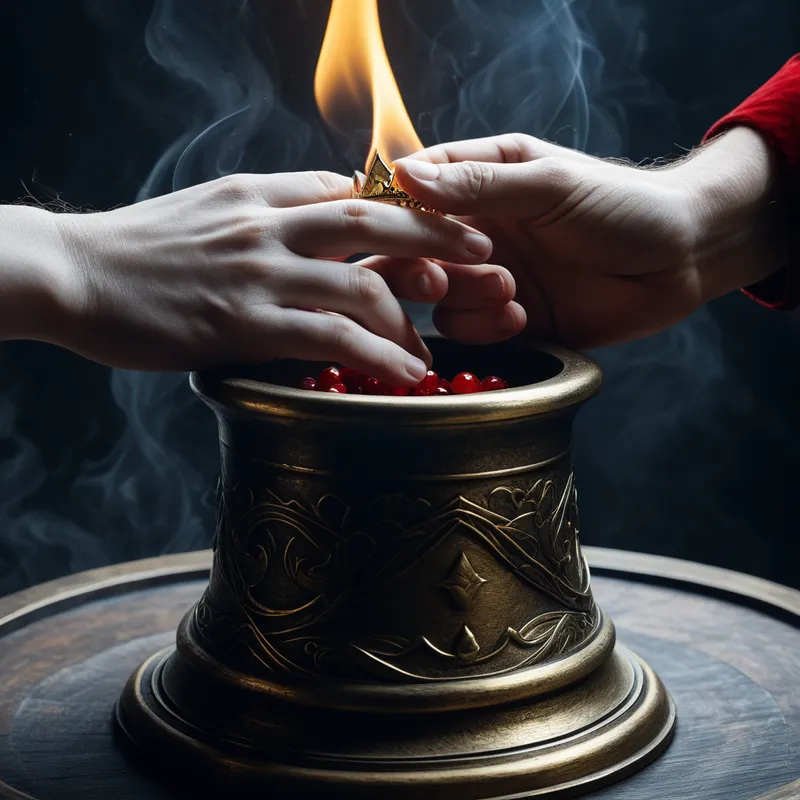
Their meeting was not a gentle embrace, but a cataclysm. Where his crimson radiance touched her silver gleam, a hissing steam arose. His certainty cracked; her fluidity solidified. In a great and terrible sacrifice, they consented to their own undoing. The Red King’s fiery form dissolved into a shower of golden sparks. The White Queen’s liquid body flowed into a river of quicksilver. Their thrones shattered. Their crowns melted.
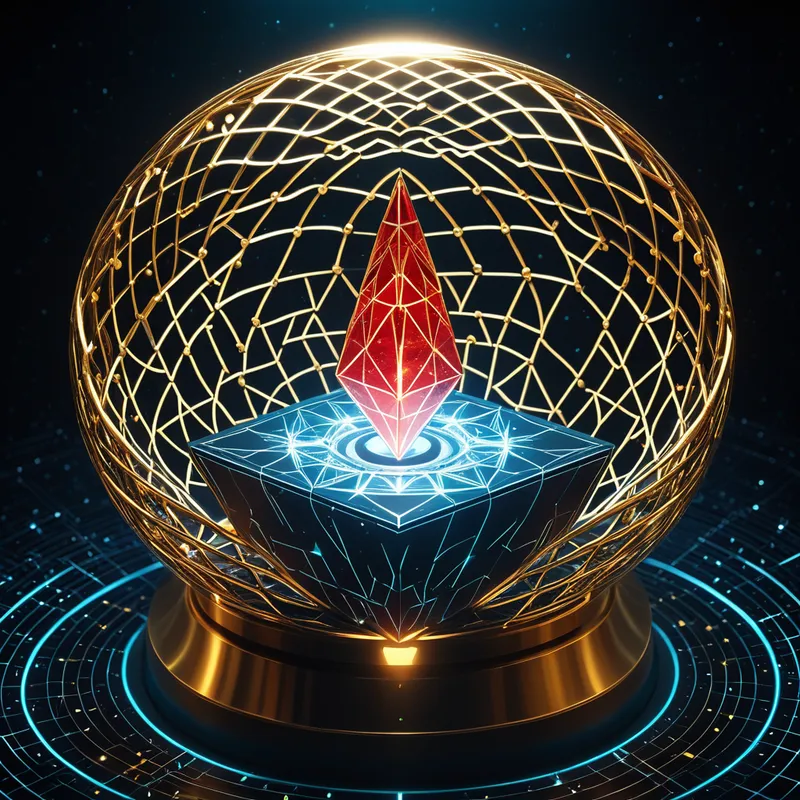
In [the alembic](/myths/the-alembic “Myth from Alchemical culture.”/) of their union, the two streams met—not to mix, but to annihilate each other in a glorious, silent explosion of blackness. The [Nigredo](/myths/nigredo “Myth from Alchemical culture.”/) descended, a cosmic night where all distinctions died. From that fertile void, a new light dawned—not red, not white, but the pure, colorless light of dawn. And from that light, a single, perfect form coalesced: the radiant, many-hued [Philosopher’s Stone](/myths/philosophers-stone “Myth from Alchemical culture.”/). The sovereigns were gone. The Work was complete. In their place reigned [the Rebis](/myths/the-rebis “Myth from Alchemical culture.”/), the two-born-one, the hermaphroditic child of [the sacred marriage](/myths/the-sacred-marriage “Myth from Various culture.”/), who held the sun and moon in a single, steady hand.
Cultural Origins & Context
This myth is not a folktale with a known author, but the core narrative engine of the Western alchemical tradition, spanning from Hellenistic Egypt through the Islamic [Golden Age](/myths/golden-age “Myth from Universal culture.”/) to the Renaissance laboratories of Europe. It was never “told” in a linear sense but was encoded in cryptic texts, enigmatic woodcuts, and the secret oral teachings of Adepts. Its primary societal function was initiatory. It served as a symbolic map for the practitioner’s own spiritual and psychological transformation, a guide hidden from the unworthy (the profane) and revealed through study, meditation, and practical work in [the laboratory](/myths/the-laboratory “Myth from Alchemical culture.”/). The myth was the theory; the boiling of metals and the watching of color changes in the alembic was the practice. Together, they modeled the soul’s journey from a state of inner conflict (the separated King and Queen) to a state of integrated wholeness (the Stone).
Symbolic Architecture
Psychologically, the myth depicts the fundamental schism within the [human](/symbols/human “Symbol: The symbol of a human represents individuality, complexity of emotions, and social relationships.”/) [psyche](/myths/psyche “Myth from Greek culture.”/) and its potential reconciliation. The Red [King](/symbols/king “Symbol: A symbol of ultimate authority, leadership, and societal order, often representing the dreamer’s inner power or external control figures.”/) represents the conscious ego in its raw, undifferentiated state: willpower, [logic](/symbols/logic “Symbol: The principle of reasoning and rational thought, often representing order, structure, and intellectual clarity in dreams.”/), focused [action](/symbols/action “Symbol: Action in dreams represents the drive for agency, motivation, and the ability to take control of situations in waking life.”/), and the drive for [identity](/symbols/identity “Symbol: Identity represents the sense of self, encompassing personal beliefs, cultural background, and social roles.”/). He is [the principle](/symbols/the-principle “Symbol: A fundamental truth, law, or doctrine that serves as a foundation for a system of belief, behavior, or reasoning, often representing moral or ethical standards.”/) of Coagula—to make solid, to define, to separate self from other.
The King is the fire that forges the sword of the will, but without the Queen, he forges only a prison.
The White [Queen](/symbols/queen “Symbol: A queen represents authority, power, nurturing, and femininity, often embodying leadership and responsibility.”/) symbolizes the unconscious, particularly the [anima](/symbols/anima “Symbol: The feminine archetype within the male unconscious, representing soul, creativity, and connection to the inner world.”/) (in a male psyche) or the related lunar aspects of [soul](/symbols/soul “Symbol: The soul represents the essence of a person, encompassing their spirit, identity, and connection to the universe.”/): [intuition](/symbols/intuition “Symbol: The immediate, non-rational understanding of truth or insight, often described as a ‘gut feeling’ or inner knowing that bypasses conscious reasoning.”/), [emotion](/symbols/emotion “Symbol: Emotion symbolizes our inner feelings and responses to experiences, often guiding our actions and choices.”/), imagination, receptivity, and [connection](/symbols/connection “Symbol: Connection symbolizes relationships, communication, and bonds among individuals.”/) to the mysterious. She is the principle of Solve—to dissolve, to soften, to open to the unknown.
Their [separation](/symbols/separation “Symbol: A spiritual or mythic division between realms, states of being, or consciousness, often marking a transition or loss of connection.”/) is the state of neurosis, where reason battles feeling, where doing is divorced from being. The sacred [marriage](/symbols/marriage “Symbol: Marriage symbolizes commitment, partnership, and the merging of two identities, often reflecting one’s feelings about relationships and social obligations.”/) (Coniunctio) is not a peaceful negotiation but a violent, necessary [death](/symbols/death “Symbol: Symbolizes transformation, endings, and new beginnings; often associated with fear of the unknown.”/) of these rigid positions. The ensuing Nigredo—the blackening—is the psychic depression, the dark [night](/symbols/night “Symbol: Night often symbolizes the unconscious, mystery, and the unknown, representing the realm of dreams and intuition.”/) of the soul, that follows when our cherished self-concepts are dissolved. From this fertile [despair](/symbols/despair “Symbol: A profound emotional state of hopelessness and loss, often signaling a need for transformation or surrender to deeper truths.”/), a new center of [personality](/symbols/personality “Symbol: Personality in dreams often symbolizes the traits and characteristics of the dreamer, reflecting how they perceive themselves and how they believe they are perceived by others.”/) is born: the [Philosopher’s Stone](/symbols/philosophers-stone “Symbol: The ‘Philosopher’s Stone’ represents the ultimate goal of transformation and enlightenment, symbolizing the quest for knowledge, wisdom, and the attainment of one’s true potential.”/), or in Jungian terms, the Self.
The Dreamer’s Resonance
When this myth stirs in the modern dreamer, it signals a profound somatic and psychological process of integration. One may dream of a passionate but conflictual relationship (the attraction and clash of opposites), of a marriage ceremony in a strange laboratory, or of two distinct colors (red and white) merging into a third, unknown color.
Somatically, this can feel like a tension between heat and coolness in the body, or a sensation of dissolution—a “falling apart” that is terrifying yet strangely necessary. Psychologically, it is the process of the conscious mind surrendering its tyrannical control to the wisdom of the unconscious, and the unconscious gaining form and expression through the structures of consciousness. The dreamer is in the alchemical vessel, experiencing their own Coniunctio. The conflict in the dream is not a problem to be solved, but the materia prima of the transformation itself.

Alchemical Translation
For the modern individual seeking individuation, the myth provides a non-linear map of psychic transmutation. It teaches that wholeness is not achieved by the victory of one principle over another (the King conquering the Queen, or the Queen drowning the King), but through their mutual sacrifice and rebirth into a new form.
The first step is recognition: seeing the internal Red King (our rigid opinions, our need to be right, our compulsive doing) and the internal White Queen (our repressed emotions, our intuitive hunches we ignore, our fluid creativity). The second step is confrontation: allowing these opposites to engage, which in life feels like cognitive dissonance, emotional upheaval, or the breakdown of old life structures. This is the fire and steam of their meeting.
The crucible of transformation is not comfort, but the conscious endurance of paradox.
The third and most critical step is submission to the process: enduring the Nigredo, the dark, formless time when the old self is gone and the new has not yet appeared. This is a time of depression, meaninglessness, and waiting—the fertile black earth. Out of this, the new consciousness, the Stone, gradually crystallizes. It is the ability to hold tension without prematurely resolving it, to contain both will and surrender, logic and poetry, in a single, resilient psyche. The reborn Self is not a bland compromise, but a transcendent third [thing](/myths/thing “Myth from Norse culture.”/) that possesses the virtues of both King and Queen, yet is fundamentally neither. It is the person who can act with conviction yet remain open, who can define themselves while forever evolving. The myth, therefore, is an eternal promise: from the sacred conflict of our deepest opposites, our golden wholeness is born.
Associated Symbols
Explore related symbols from the CaleaDream lexicon: