The Red-crowned Crane Myth Meaning & Symbolism
A celestial crane descends to guide a lost emperor, offering wisdom and transcendence, only to be betrayed by mortal greed and fear.
The Tale of The Red-crowned Crane
Listen, and let the mists of time part. In an age when emperors were sons of heaven and [the veil between worlds](/myths/the-veil-between-worlds “Myth from Celtic culture.”/) was thin, there lived a sovereign named Yao. His reign was long, his burdens immense. The weight of [the world](/myths/the-world “Myth from Tarot culture.”/) had bowed his shoulders and clouded his mind with a fog of weariness and doubt. He felt the slow creep of mortality in his bones, a cold whisper that even [the Mandate of Heaven](/myths/the-mandate-of-heaven “Myth from Chinese culture.”/) could not silence.
One evening, as the sun bled into the western mountains and the first star, Canopus, pricked the twilight, the emperor walked alone in his vast gardens. The scent of night-blooming [jasmine](/myths/jasmine “Myth from Persian culture.”/) and damp earth filled the air. It was then he heard it—a sound that cleaved the silence of his soul. Not a bird’s call, but a melody, a single, pure note that seemed to vibrate from the heavens themselves. It was the song of [the void](/myths/the-void “Myth from Buddhist culture.”/), of primordial stillness.
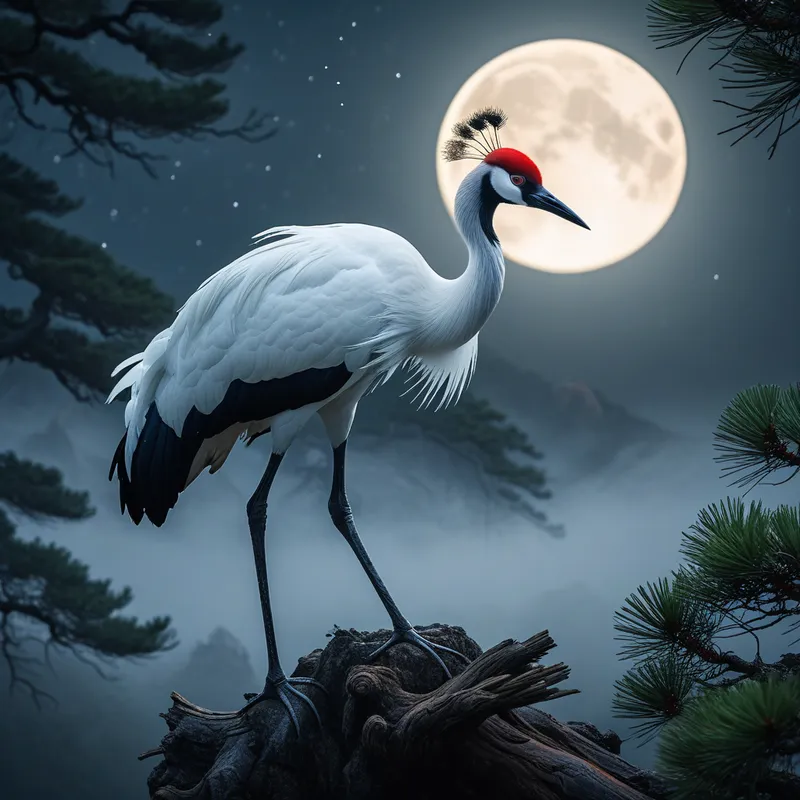
He looked up. Descending through the violet dusk on wings that caught the last embers of the sun was a creature of impossible grace. It was a crane, but unlike any earthly bird. Its plumage was not white, but the luminous absence of color, like captured moonlight. Upon its head burned a crown of crimson, a spot of vital fire that pulsed like a distant heart. This was the Red-crowned Crane, a messenger from the Isles of the Blest.
It landed before him without a sound, its dark, knowing eyes holding galaxies of untold wisdom. It did not speak in words, but in impressions that blossomed in the emperor’s mind: images of timeless mountains, of scholars who had become one with the Dao, of a path that led beyond the cycle of toil and decay. [The crane](/myths/the-crane “Myth from Japanese culture.”/) offered a choice, not with demand, but with serene presence. It would be his guide, his companion on the path of transcendence, if he had the heart to follow.
For a season, the crane stayed. It danced in the courtyard at dawn, its movements a treatise on balance. It stood sentinel by the pine tree, a lesson in endurance. The emperor’s spirit began to lift. The fog receded, replaced by a clarity he had not known since youth. He started to see the patterns of heaven in the affairs of earth. But the court watched. The ministers saw their ruler’s gaze turning inward and upward, away from petitions and palaces. Fear, that gremlin of the mortal realm, took root. They whispered of abandonment, of sorcery, of a bewitching beast leading the Son of Heaven astray.
The conflict crystallized on a night of the full moon. The crane stood at the garden’s edge, ready to lead the emperor on a nocturnal journey to a sacred peak. But the ministers intervened, their faces masks of concerned loyalty hiding terrified ambition. “It is a demon!” one cried. “It will steal your essence!” another warned. Torn between the celestial call and the earthly throne, between the promise of wisdom and the fear of the unknown, the emperor hesitated. In that moment of human doubt, a young, fearful guard, seeking to prove his loyalty, loosed an arrow.
It did not strike true. It grazed a primary flight feather, sending a single, luminous plume spiraling to the ground. The crane did not cry out. It turned its head once, its eyes holding not anger, but a profound, sorrowful understanding—the understanding of eternity looking upon the fleeting panic of time. Then, with a beat of its mighty wings that stirred the very air into a sigh, it ascended. It became a stroke of white ink against the dark sky, then a star, and then it was gone, taking its song with it.
The emperor fell to his knees, clutching the single, now-dull feather. The whisper of mortality returned, louder than ever, now laced with the bitter taste of a paradise glimpsed and lost by his own hand, and the hands of those bound to him.
Cultural Origins & Context
The myth of the Red-crowned Crane is woven from many threads in the vast tapestry of Chinese culture. It is not a single, codified story from one text, but a potent archetype that emerges from Daoist philosophy, imperial symbolism, and folk belief. Its earliest roots intertwine with Daoist xian (immortal) lore, where cranes are the favored steeds and companions of transcendent beings. They are creatures of the Dao, embodying its qualities of effortless action ([wu wei](/myths/wu-wei “Myth from Taoist culture.”/)), longevity, and purity.
The story gained its poignant, narrative form as a parable for rulers and scholars. Passed down through historical anecdotes, poetry, and painting, it served as a moral and spiritual lesson. It was told not to chronicle an event, but to illustrate a tension central to Confucian-Daoist thought: the conflict between worldly duty (ren shi) and spiritual aspiration (xian xin). The crane’s visit represents a rare moment of grace, an invitation to align one’s personal governance with the celestial order. Its tragic departure underscores the fragility of such moments and the ease with which societal fear and personal hesitation can sever the connection to the numinous.
Symbolic Architecture
Psychologically, the myth constructs a powerful symbolic [architecture](/symbols/architecture “Symbol: Architecture in dreams often signifies structure, stability, and the framing of personal identity or life’s journey.”/). The Red-crowned [Crane](/symbols/crane “Symbol: A majestic bird symbolizing longevity, wisdom, and spiritual ascension across many cultures, often seen as a messenger between earthly and divine realms.”/) is the embodiment of [the Self](/myths/the-self “Myth from Jungian culture.”/)—the Jungian [archetype](/symbols/archetype “Symbol: A universal, primordial pattern or prototype in the collective unconscious that shapes human experience, behavior, and creative expression.”/) of wholeness and the central, organizing principle of the [psyche](/myths/psyche “Myth from Greek culture.”/). It is not a part of [the ego](/myths/the-ego “Myth from Jungian culture.”/), but a transcendent totality that occasionally makes its [presence](/symbols/presence “Symbol: Presence in dreams often signifies awareness or acknowledgment of something significant in one’s life.”/) known. Its crimson [crown](/symbols/crown “Symbol: A crown symbolizes authority, power, and achievement, often representing an individual’s aspirations, leadership, or societal role.”/) is the [rubedo](/myths/rubedo “Myth from Alchemical culture.”/), the final stage of the [alchemical process](/symbols/alchemical-process “Symbol: A symbolic transformation of base materials into spiritual gold, representing inner purification, integration, and the journey toward wholeness.”/), symbolizing the integrated, vitalized [spirit](/symbols/spirit “Symbol: Spirit symbolizes the essence of life, vitality, and the spiritual journey of the individual.”/)—the achieved individuality.
The crane does not argue; it is. Its offer is not a transaction, but an unveiling of a state of being already available to the soul that can perceive it.
The aging Emperor represents the conscious ego at a critical [juncture](/symbols/juncture “Symbol: A critical point of decision, transition, or convergence where paths, choices, or timelines meet, demanding action or reflection.”/)—successful in the outer world, yet spiritually impoverished, feeling the “midlife” [crisis](/symbols/crisis “Symbol: A crisis symbolizes turmoil, urgent challenges, and the need for immediate resolution or change.”/) of meaning. The garden is the [temenos](/myths/temenos “Myth from Greek culture.”/), the sacred, enclosed [space](/symbols/space “Symbol: Dreaming of ‘Space’ often symbolizes the vastness of potential, personal freedom, or feelings of isolation and exploration in one’s life.”/) of the psyche where such a momentous meeting can occur. The fearful ministers and the guard are the voices of the personal and collective [shadow](/symbols/shadow “Symbol: The ‘shadow’ embodies the unconscious, repressed aspects of the self and often represents fears or hidden emotions.”/): the parts of ourselves and our internalized society that are terrified of transformation, that equate change with [chaos](/symbols/chaos “Symbol: In Arts & Music, chaos represents raw creative potential, uncontrolled expression, and the breakdown of order to forge new artistic forms.”/), and that would rather sabotage transcendence than risk the unknown.
The single, lost [feather](/symbols/feather “Symbol: A feather represents spiritual elevation, lightness, and the freedom of the spirit. It often symbolizes messages from the divine and connection to ancient wisdom.”/) is the ultimate [symbol](/symbols/symbol “Symbol: A symbol can represent an idea, concept, or belief, serving as a powerful tool for communication and understanding.”/). It is the synchronicitic sign, the tangible proof of the numinous encounter that the ego is left with after the [vision](/symbols/vision “Symbol: Vision reflects perception, insight, and clarity — often signifying the ability to foresee or understand deeper truths.”/) fades. It is both a [treasure](/symbols/treasure “Symbol: A hidden or valuable object representing spiritual wealth, inner potential, or divine reward.”/) and a [torment](/symbols/torment “Symbol: A state of intense physical or mental suffering, often representing unresolved inner conflict, guilt, or psychological distress.”/)—a reminder of what was offered and what was lost through fear.

The Dreamer’s Resonance
When this myth pattern appears in modern dreams, it signals a profound somatic and psychological process. To dream of a majestic, otherworldly bird—often white, often silent, always imbued with a sense of sacred authority—is to experience a visitation from the Self. The dreamer is likely at a point of existential fatigue, successful on the surface but feeling a deep, spiritual aridity.
The somatic experience might be one of awe mixed with anxiety—a tightening in the chest, a feeling of being both drawn to and overwhelmed by the figure. This is the ego’s tremor in the presence of the numinous. If, in the dream, the dreamer or another figure attacks or frightens the bird away, it is a direct manifestation of active resistance. The psyche is showing the dreamer their own “ministers of fear”—the internalized critics, the practical anxieties, the fear of losing social standing or identity—that are sabotaging a call to a deeper life.
The dream is not a condemnation, but a diagnosis. The lingering image of the feather, the sound of the call, the feeling of loss upon waking—these are the psyche’s way of highlighting the cost of the refusal, urging the dreamer to identify and confront the internal guards who shot the arrow.

Alchemical Translation
The myth models the alchemical process of psychic transmutation, or individuation, with stark clarity. The initial state of the emperor is the [nigredo](/myths/nigredo “Myth from Alchemical culture.”/)—the blackening, the leaden feeling of spiritual depression and meaninglessness. The crane’s arrival initiates the albedo—the whitening, the illumination. A new possibility, a vision of wholeness (the white crane) crowned with vitality (the red crown), is revealed.
The conflict with the court is the crucial, often failed, stage of citrinitas—the yellowing, the confrontation with [the shadow](/myths/the-shadow “Myth from Jungian culture.”/). Here, the gold of the new consciousness must be tested against the base metals of fear and old identity. The myth shows the consequence of failing this test: the transcendent energy recedes, and the individual is left with only a symbol of their potential (the feather) and the painful awareness of their participation in its loss.
Individuation is not an ascent without cost. It requires the emperor to leave his garden and face his court, to translate the crane’s silent wisdom into a new way of ruling his inner kingdom.
For the modern individual, the alchemical translation is this: when the “crane” calls—in a moment of insight, a compelling creative urge, a pull toward a more authentic path—one must be prepared to do more than admire it from a safe distance. One must be willing to follow, even when internal and external voices scream in protest. It demands a conscious, often difficult, negotiation with the “ministers” of one’s life—the obligations, fears, and old self-concepts—not to destroy them, but to transform their role. The goal is not to become the crane, but to learn its song, so that one’s earthly life becomes a reflection of that celestial harmony, and [the crown](/myths/the-crown “Myth from Various culture.”/) of vitality burns from within, not as a distant hope, but as a lived reality.
Associated Symbols
Explore related symbols from the CaleaDream lexicon: