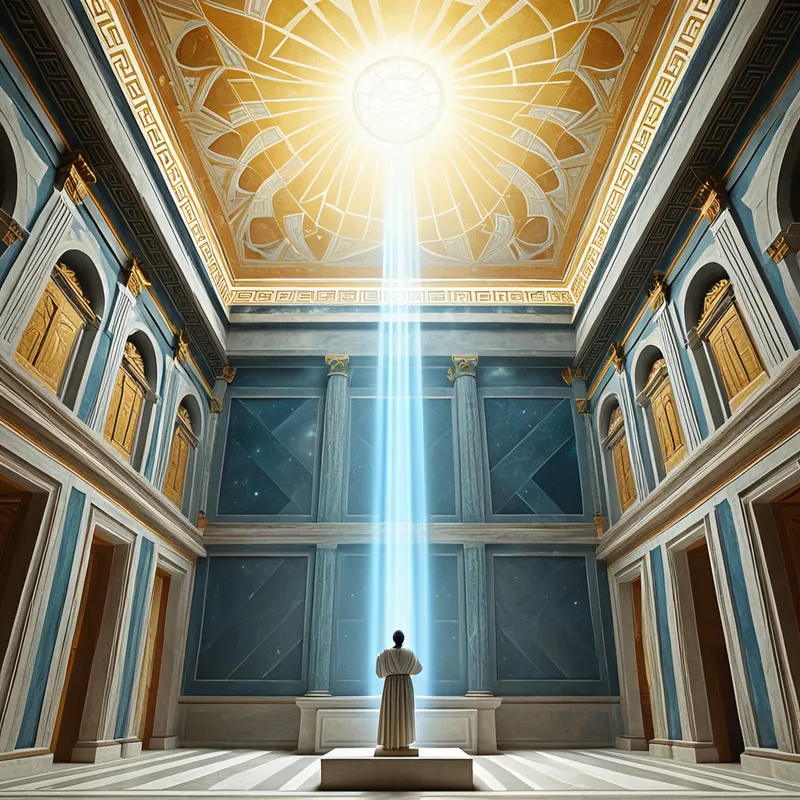
The Realm of Forms Myth Meaning & Symbolism
A philosopher's journey from shadow to light, seeking the eternal, perfect archetypes behind the fleeting world of appearances.
The Tale of The Realm of Forms
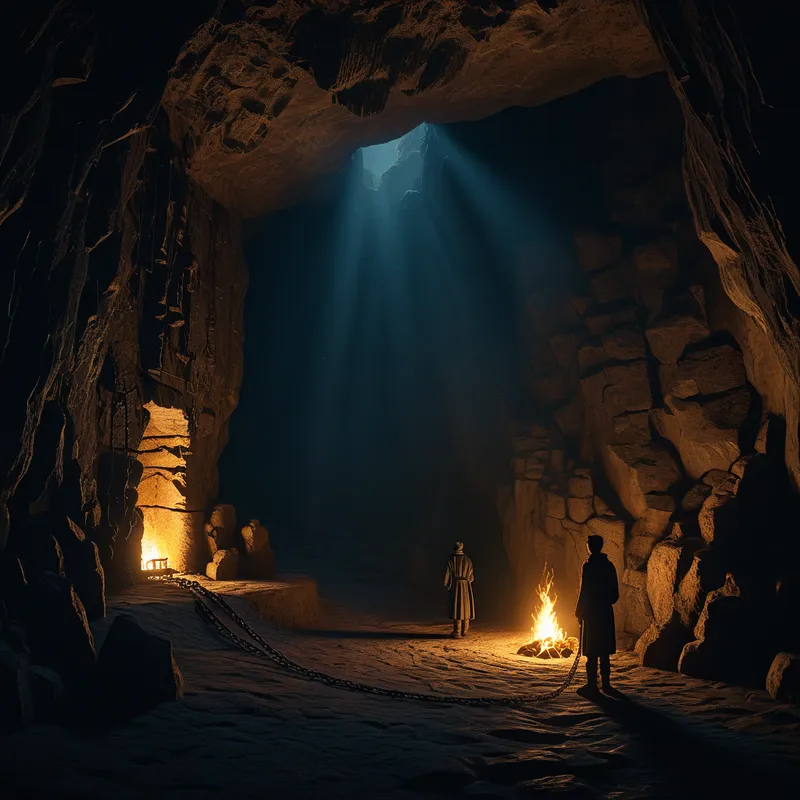
Listen, and I will tell you of a world behind [the world](/myths/the-world “Myth from Tarot culture.”/), a truth behind all truths. It begins not in the sun, but in the deep earth. Imagine a cavern, vast and echoing, its walls damp with the breath of the imprisoned. Here, since childhood, a people dwell, bound by neck and limb, facing a blank stone wall. They cannot turn their heads. Behind them, a great fire roars, and between the fire and their backs, a parapet runs. Along this walkway, figures pass, carrying aloft shapes of men and beasts, of vessels and trees, all carved from wood and stone. The fire casts the shadows of these puppets onto the wall before the prisoners. For them, these flickering, silent shades are the whole of reality. They name [the shadow](/myths/the-shadow “Myth from Jungian culture.”/) of a bird, the echo of a step, the ghost of a cup. They believe in nothing else.
But sometimes, a sound is heard—not the echo of a puppet-carrier’s footfall, but a different music, faint and pure, drifting down from a place beyond [the cave](/myths/the-cave “Myth from Platonic culture.”/)’s mouth. One prisoner, whose soul is restless, feels a strange tugging. Perhaps in a dream, or in a moment of profound disquiet, the bonds that seemed immutable begin to chafe. With a terrible effort, born of a pain he does not understand, he breaks free. He turns.
The light of the fire assaults his eyes, a painful, confusing blaze after a lifetime of dim shadows. The puppets and their carriers seem crude, ugly, less real than the elegant shadows they cast. He is bewildered, lost. The other prisoners mock his confusion, warning him not to spoil their sight with his madness. But the music from above grows stronger. Drawn by a compulsion he cannot name, he begins the arduous climb up the steep, rocky passage leading out of the cave.
The ascent is agony. His eyes [water](/myths/water “Myth from Chinese culture.”/) and burn. His limbs, weak from disuse, scream in protest. He stumbles in the near-darkness, guided only by a faint, growing luminance and that haunting melody. Just as he feels he can go no further, he breaches [the threshold](/myths/the-threshold “Myth from Folklore culture.”/).
The world outside is an explosion of being. First, he sees the reflections of things in pools of water—trees, animals, [the moon](/myths/the-moon “Myth from Tarot culture.”/)—and these are already more vivid and true than anything in the cave. Then, lifting his gaze with trembling awe, he beholds the things themselves under the light of the moon and stars. He sees living trees, their leaves rustling in a real wind; he hears the true song of a nightingale. He weeps at the beauty.
Finally, as his eyes grow accustomed, he dares to look upon the source of all this clarity: the Sun itself. Not as an image, but as the very cause of visibility, of life, of growth. In its light, he understands. The tree is beautiful because it partakes of the Form of Beauty. The just act is noble because it mirrors the Form of [Justice](/myths/justice “Myth from Tarot culture.”/). Every particular [thing](/myths/thing “Myth from Norse culture.”/) in this world is but a flawed, ephemeral copy of an eternal, perfect, and singular reality that exists in a realm beyond space and time—the Realm of Forms.
His heart swells with a philosopher’s love, a desire to dwell forever in this contemplation of the true, the good, and the beautiful. But remembrance of those still chained in the cave pierces his joy. Duty, a new form of justice, calls him back. He descends into the darkness, his eyes now blind to the shadows his companions prize. He tries to tell them of the Sun, of [the Forms](/myths/the-forms “Myth from Platonic culture.”/), of the real world. They do not understand his babbling. They see only his blindness in their world. And in their fear and derision, they resolve that anyone who would try to free another and lead them upward should be seized and put to death.
Cultural Origins & Context
This is not a myth of Olympus, sung by bards at a feast. It is a philosophical allegory, crafted in the mind of Plato, and given voice through his teacher, [Socrates](/myths/socrates “Myth from Greek culture.”/), in the dialogue Republic. It was born in 4th century BCE Athens, a society wrestling with the nature of truth in the wake of sophistry and the execution of [Socrates](/myths/socrates “Myth from Greek culture.”/) himself. The tale was not passed down by oral tradition but through the written word, in the specialized context of the Academy—a school for those seeking wisdom.
Its societal function was radical education. It was a tool to shock the student out of conventional thinking (doxa) and toward philosophical insight (episteme). It served as a foundational narrative for Platonic culture, explaining why the physical world is unsatisfactory and pointing toward the true object of the soul’s longing. It was a myth for intellectuals, a story that justified the philosopher’s often-ridiculed pursuit of abstract truth and his fraught relationship with the political world.
Symbolic Architecture
The myth is a perfect map of the [human](/symbols/human “Symbol: The symbol of a human represents individuality, complexity of emotions, and social relationships.”/) [psyche](/myths/psyche “Myth from Greek culture.”/)’s [relationship](/symbols/relationship “Symbol: A representation of connections we have with others in our lives, often reflecting our emotional state.”/) with [reality](/symbols/reality “Symbol: Reality signifies the state of existence and perception, often reflecting one’s understanding of truth and life experiences.”/). The Cave represents the phenomenal world of sensory experience and unexamined [opinion](/symbols/opinion “Symbol: An opinion in a dream symbolizes personal beliefs and thoughts about oneself and the world, often reflecting inner conflicts or uncertainties.”/)—the personal and [collective unconscious](/symbols/collective-unconscious “Symbol: The Collective Unconscious refers to the part of the unconscious mind shared among beings of the same species, embodying universal experiences and archetypes.”/) where we are bound by inherited patterns, cultural assumptions, and biological drives. The Shadows are the projections of our [psyche](/myths/psyche “Myth from Greek culture.”/), the simplified narratives and distorted perceptions we mistake for [reality](/symbols/reality “Symbol: Reality signifies the state of existence and perception, often reflecting one’s understanding of truth and life experiences.”/).
The journey from the cave is not a movement in space, but an awakening in consciousness.
The Fire is the light of conventional understanding, [the ego](/myths/the-ego “Myth from Jungian culture.”/)’s constructed world, which illuminates only copies. The difficult [Ascent](/symbols/ascent “Symbol: Symbolizes upward movement, progress, spiritual elevation, or striving toward higher goals, often representing personal growth or transcendence.”/) is the painful process of anamnesis (recollection) and dialectic, where the [soul](/symbols/soul “Symbol: The soul represents the essence of a person, encompassing their spirit, identity, and connection to the universe.”/), through questioning and intellectual struggle, remembers its [origin](/symbols/origin “Symbol: The starting point of a journey, often representing one’s roots, source, or initial state before transformation.”/) in the [realm](/symbols/realm “Symbol: The symbol of ‘Realm’ often signifies the boundaries of one’s consciousness, experiences, or emotional states, suggesting aspects of reality that are either explored or ignored.”/) of pure being. The Sun is the ultimate [symbol](/symbols/symbol “Symbol: A symbol can represent an idea, concept, or belief, serving as a powerful tool for communication and understanding.”/)—the Form of the Good. It is [the Self](/myths/the-self “Myth from Jungian culture.”/) in its fullest Jungian sense, the central [archetype](/symbols/archetype “Symbol: A universal, primordial pattern or prototype in the collective unconscious that shapes human experience, behavior, and creative expression.”/) of order and meaning, the [source](/symbols/source “Symbol: The origin point of something, often representing beginnings, nourishment, or the fundamental cause behind phenomena.”/) from which all other archetypal patterns (the Forms) derive their coherence and value. It is not a god, but the divine principle of intelligibility itself.
The Return to the Cave is the most psychologically profound element. It represents the [integration](/symbols/integration “Symbol: The process of unifying disparate parts of the self or experience into a cohesive whole, often representing psychological wholeness or resolution of internal conflict.”/) of enlightenment back into [life](/symbols/life “Symbol: The symbol of ‘Life’ represents a journey of growth, interconnectedness, and existential meaning, encompassing both the joys and challenges that define human experience.”/). The enlightened one must endure the [blindness](/symbols/blindness “Symbol: Represents a lack of awareness, insight, or refusal to see truth, often tied to emotional avoidance or spiritual ignorance.”/) of being misunderstood, carrying the light of the Self into the darkness of the world. This is the archetypal [pattern](/symbols/pattern “Symbol: A ‘Pattern’ in dreams often signifies the underlying structure of experiences and thoughts, representing both order and the repetitiveness of life’s situations.”/) of the wounded [healer](/symbols/healer “Symbol: A figure representing restoration, transformation, and the integration of physical, emotional, or spiritual wounds. Often symbolizes a need for care or a latent ability to mend.”/) or the prophetic voice that is rejected by its own [community](/symbols/community “Symbol: Community in dreams symbolizes connection, support, and the need for belonging.”/).
The Dreamer’s Resonance
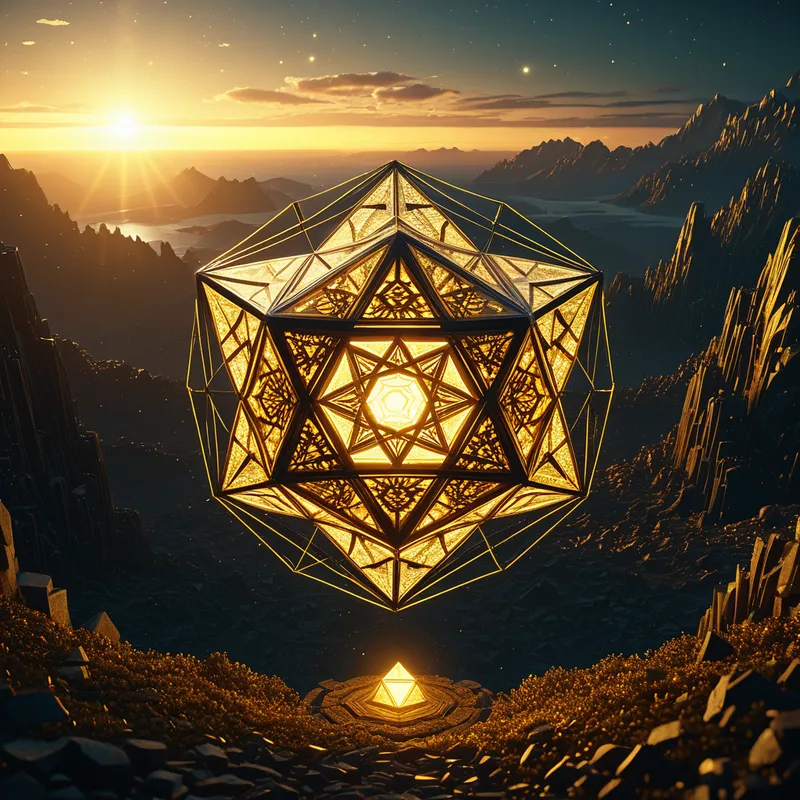
When this myth stirs in the modern dreamer, it often manifests as dreams of ascent or liberation. Dreaming of climbing a steep, dark staircase toward a light; of breaking chains; of emerging from a tunnel, basement, or subway into blinding daylight—these are somatic echoes of [the cave allegory](/myths/the-cave-allegory “Myth from Platonic culture.”/). The psyche is signaling a readiness to move from a confining psychological state (a job, a relationship, a self-concept) toward greater awareness.
Conversely, dreams of being trapped in a basement, of walls closing in, or of trying to explain something vital to people who only laugh, mirror the pre-ascent or post-return phases. They speak to the feeling of being imprisoned by circumstance or misunderstood in one’s growth. The somatic process is one of tension—the muscular strain of the climb translated into the anxiety of transformation, the nausea of old certainties dissolving. The dream is the soul’s dialectic, playing out the conflict between the comfort of the known shadow and the terrifying call of the unknown light.
Alchemical Translation
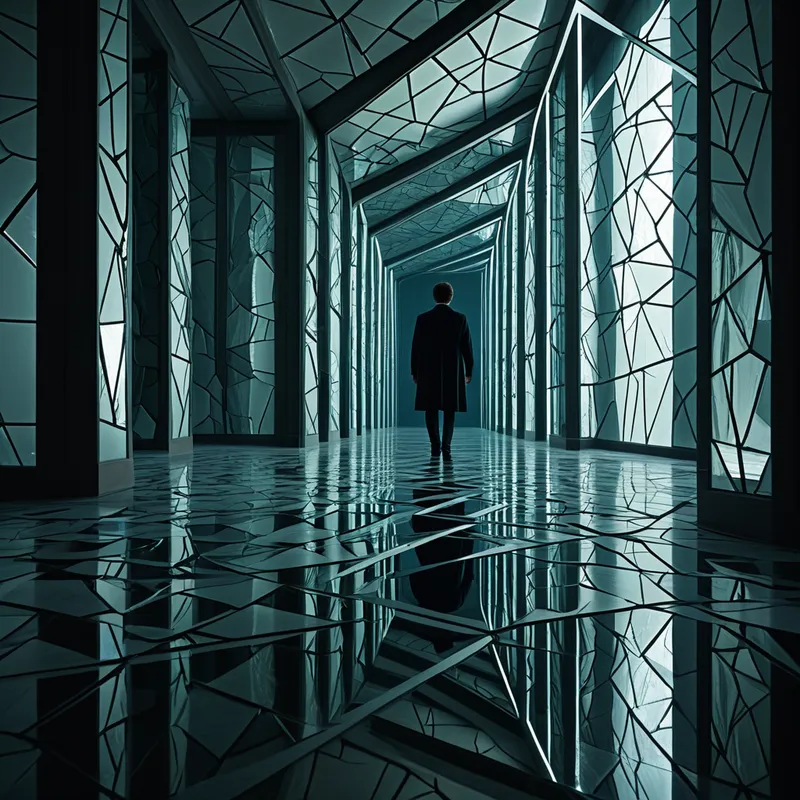
The alchemical process mirrored here is the opus magnum—[the Great Work](/myths/the-great-work “Myth from Alchemical culture.”/) of transforming leaden, unconscious existence into golden, conscious life. The initial state ([nigredo](/myths/nigredo “Myth from Alchemical culture.”/)) is the blackness of the cave, the [prima materia](/myths/prima-materia “Myth from Alchemical culture.”/) of confused and shadow-bound identity. The turning toward the fire is the first stirrings of introspection, the calcinatio that burns away naive projections.
The ascent is the long stage of albedo, whitening, where the soul is purified through the hard work of self-examination and confronting painful truths. Seeing the reflections in water represents sublimatio, where spirit begins to separate from base matter. The vision of the Sun is the culmination of citrinitas, the yellowing or dawn, the direct apprehension of the archetypal Self.
The final and most critical stage is not the vision of gold, but the voluntary return to the leaden world, carrying the golden tincture. This is the rubedo, the reddening, where the achieved consciousness is tested and integrated in the fires of life and relationship.
For the modern individual, this models the journey of individuation. One must first become disillusioned with the “shadows” of [persona](/myths/persona “Myth from Greek culture.”/), social status, and material pursuit (leaving the cave). One then engages in the difficult inner work of therapy, reflection, and shadow integration (the ascent). The goal is not to escape the world permanently, but to achieve a stable connection to the inner Form of the Good—one’s own core meaning and values. Then, one must “return to the marketplace,” bringing that hard-won wisdom back into one’s work, relationships, and community, even at the risk of being misunderstood. The [triumph](/myths/triumph “Myth from Roman culture.”/) is not in solitary enlightenment, but in the ability to hold the tension between the perfect Form and the imperfect copy, between the soul’s true home and its earthly duty.
Associated Symbols
Explore related symbols from the CaleaDream lexicon: