The Pyramids of Giza Myth Meaning & Symbolism
The pyramids are not mere tombs, but mythic mountains of stone built to launch the divine king's soul on its eternal voyage to the imperishable stars.
The Tale of The Pyramids of Giza
Listen, and hear the tale not of stone, but of starlight made solid. In the time when gods walked with kings, when the Nile was the vein of the world, a whisper grew into a command in the heart of Khufu. It was not a whisper of mortality, but of destiny. The sun, Ra, sailed his barque each day from the eastern horizon, through the perilous Duat of night, to be reborn at dawn. So too must the king, the son of Ra, make his journey.
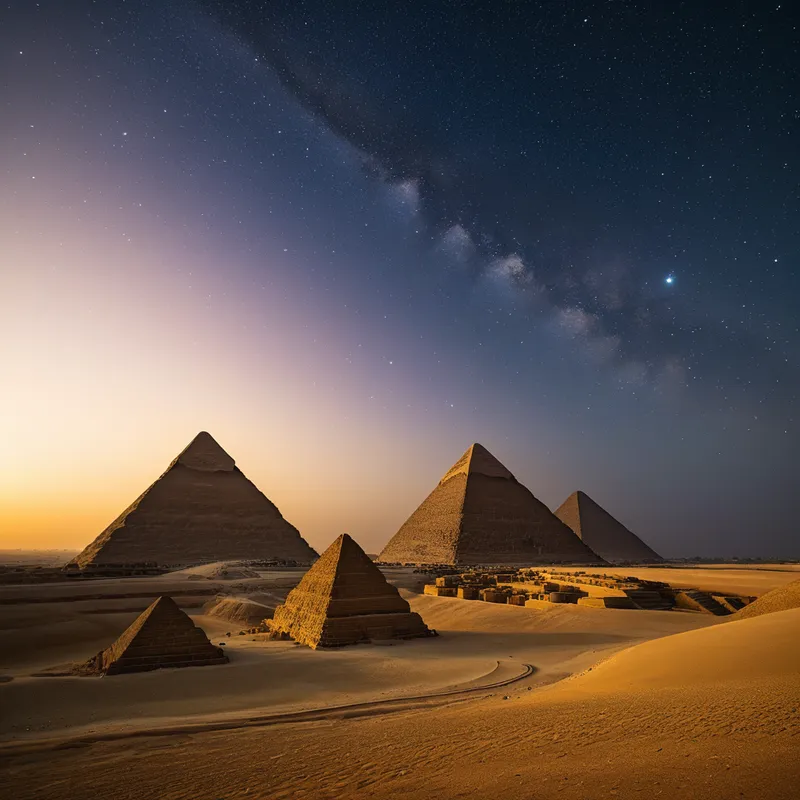
But his vessel would not be of reeds. It would be a mountain of white Tura limestone, a Benben stone grown vast, a ramp to the heavens. For twenty years, the land held its breath. The desert air thickened with the dust of countless quarries, the groan of sledges on dampened earth, the chant of laborers who were not slaves, but participants in a sacred act. They built a perfect, four-sided triangle, each face aligned to a cardinal direction with a precision that humbled the stars themselves. They called it Akhet Khufu, “The Horizon of Khufu.”
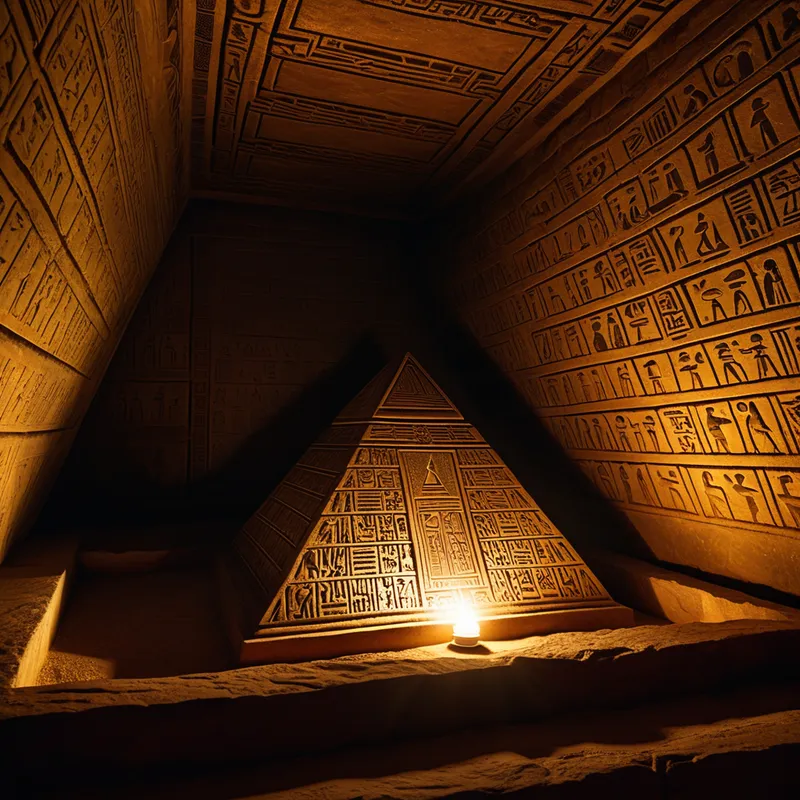
Within its hidden heart, they carved passages not for the living, but for the king’s Ba. The Grand Gallery soared upward, a steep, polished corridor pointing like a finger to the northern circumpolar stars, the Ikhemu-sek. In the King’s Chamber, they placed a sarcophagus of red granite, harder than time. And on the walls of later pyramids, priests would inscribe the words of power—the Pyramid Texts—spells to arm the king against the demons of the Duat, to call the gods by their secret names, to transform him into a being of light.
On the day of the king’s death, the ritual began. His mummy was borne into the pyramid’s dark belly. The priests performed the rites, their voices echoing in the still, heavy air. The entrance was sealed with mighty granite plugs, and the causeway was scoured clean. To the world, the mountain was silent, a tomb.
But in the myth, this was the moment of ignition. The pyramid was not a prison, but a launch complex. The king’s Ba, armed with the sacred texts, ascended through the narrow star shafts. It burst forth from the pyramid’s apex, that perfect point where the four triangular planes met the sky, and shot like an arrow to join the eternal, unchanging stars. The pyramid stood then, and forever, as his launchpad, his ladder, his solidified ray of sunlight connecting the ordered earth to the imperishable cosmos. It was his horizon, not his end.
Cultural Origins & Context
The myth of the pyramid as a resurrection machine is not a single story, but a theological framework embedded in the fabric of Old Kingdom Egypt (c. 2686–2181 BCE). It was born from the confluence of solar theology (the cult of Ra), stellar beliefs (the cult of Osiris and the imperishable stars), and the absolute ideology of kingship. The pharaoh was the living Horus, the son of Osiris, and upon death, he became Osiris himself, King of the Dead.
This myth was not for the populace in a narrative form; it was enacted. The priests of the royal cult were its custodians and performers. The primary “texts” of this myth are the architectural form itself and the later Pyramid Texts. These spells, first inscribed in the pyramid of Unas, provide a chaotic, poetic, and terrifying script for the soul’s journey. They are a mix of incantation, map, and defensive weaponry, revealing a profound belief that the afterlife was an active, perilous achievement, not a passive given. The pyramid’s societal function was dual: it was the ultimate engine of state religion, guaranteeing the king’s divine transition, which in turn maintained Ma’at—the cosmic balance—for the entire nation. Its construction mobilized and unified the country’s resources and identity around this sacred, central purpose.
Symbolic Architecture
The pyramid is perhaps humanity’s most potent geometric symbol of ascent, order, and the materialization of spirit. Psychologically, it represents the structured psyche orienting itself toward a transcendent goal.
The pyramid is the ego’s ambitious project to build a permanent monument to the Self, a geometric prayer in stone that seeks to fix the fleeting soul in eternity.
Its square base, aligned to the four directions, symbolizes the ordered world, the conscious realm of Ma’at, and the fourfold structure of reality. The apex, where all four triangular sides converge, represents the transcendent point—the goal of individuation, the unified Self, the spark of divinity. The entire structure is a massive symbol of directional energy: everything in it is designed to channel force upward. The narrow ascending passages, the Grand Gallery, the star shafts—all are architectural metaphors for the focused, often difficult, journey of consciousness from the earthly and mundane (the base) to the celestial and eternal (the apex). It is the ultimate “axis mundi,” a world pillar connecting the underworld (the subterranean chamber), the earth (the mortuary temple), and the heavens (the apex).
The Dreamer’s Resonance
To dream of a pyramid is to encounter the psyche’s own ancient, monumental architecture. It often appears during periods of life where one is attempting to consolidate a great achievement, build a lasting legacy, or structure a chaotic inner world into something durable and meaningful.
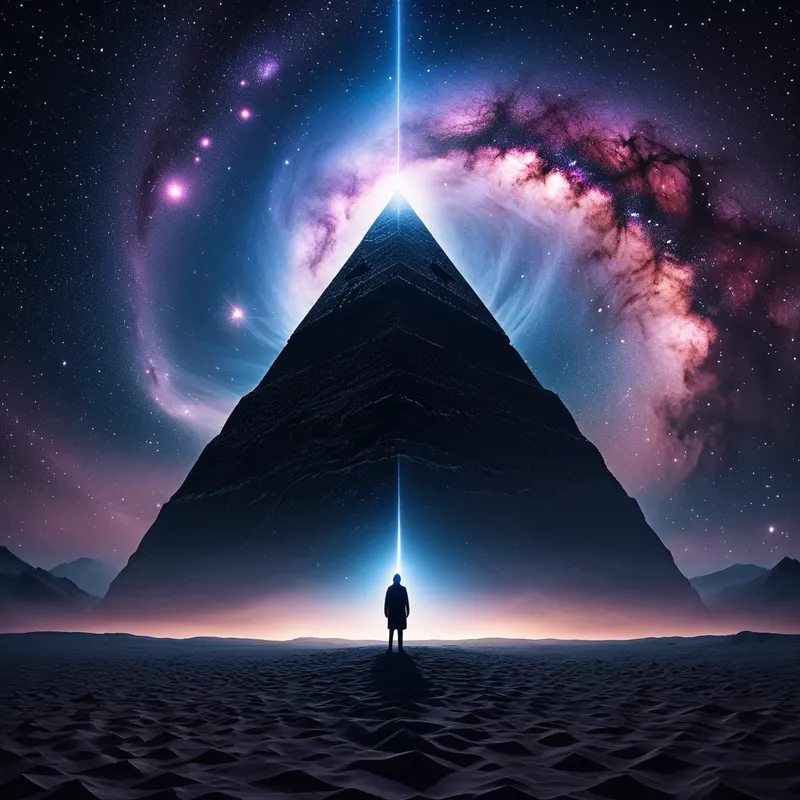
The somatic feeling can be one of awe mixed with dread—the sheer scale is humbling. Climbing the smooth, steep sides in a dream speaks to an arduous, perhaps solitary, process of self-refinement and ascent toward a goal. Finding oneself inside the pyramid, in its dark, narrow passages, may reflect a journey into the deep, confined chambers of the personal unconscious or the collective past, seeking a hidden treasure (the integrated Self) or confronting a mummified aspect of one’s own history. A pyramid glowing or emitting light from its apex suggests a successful connection between the conscious ego and the transcendent Self, a moment of profound insight or spiritual alignment. Conversely, a crumbling or obscured pyramid may point to a fear that one’s life’s work or foundational beliefs are unstable or losing their sacred meaning.
Alchemical Translation
The alchemical process mirrored in the pyramid myth is the opus magnum itself: the transformation of base matter (the mortal body, the chaotic psyche) into incorruptible, eternal spirit (the stellar Akh). The pyramid is the alchemical vessel, the vas hermeticum, sealed and perfect.
The king does not escape his tomb; he uses its perfect geometry as a crucible to forge his soul into a star.
First comes the nigredo: the death of the old king, the descent into the Duat, the confrontation with chaos. This is the necessary dissolution. Then, within the sealed pyramid (the sealed alchemical flask), the work begins. The spells of the Pyramid Texts are the incantations, the precise formulas applied to the raw material of the soul. The ascent through the passages is the albedo—the whitening, the purification, the rising toward clarity. The Grand Gallery represents a sublime, elevated state of understanding just before the final union.
The bursting forth from the apex to join the circumpolar stars is the rubedo and the final stage of individuation: the creation of the lapis philosophorum, the philosopher’s stone—here imagined as the radiant, imperishable Akh. For the modern individual, this myth models the process of building a conscious life structure (career, relationships, beliefs) that is not an end in itself, but a launchpad. Our “pyramids”—our great projects, our disciplined practices, our hard-won wisdom—are ultimately vessels designed not to entomb us in our achievements, but to transform and project the essence of who we are into a broader, more eternal pattern of meaning. We are called to align our personal geometry with the cosmic order, to build so precisely that when the moment of transition comes, our spirit finds its pre-ordained shaft to the stars.
Associated Symbols
Explore related symbols from the CaleaDream lexicon: