The Purification Stage Myth Meaning & Symbolism
A myth of the soul's descent into the corrosive waters of dissolution, where all false forms are stripped away to reveal the incorruptible essence within.
The Tale of The Purification Stage
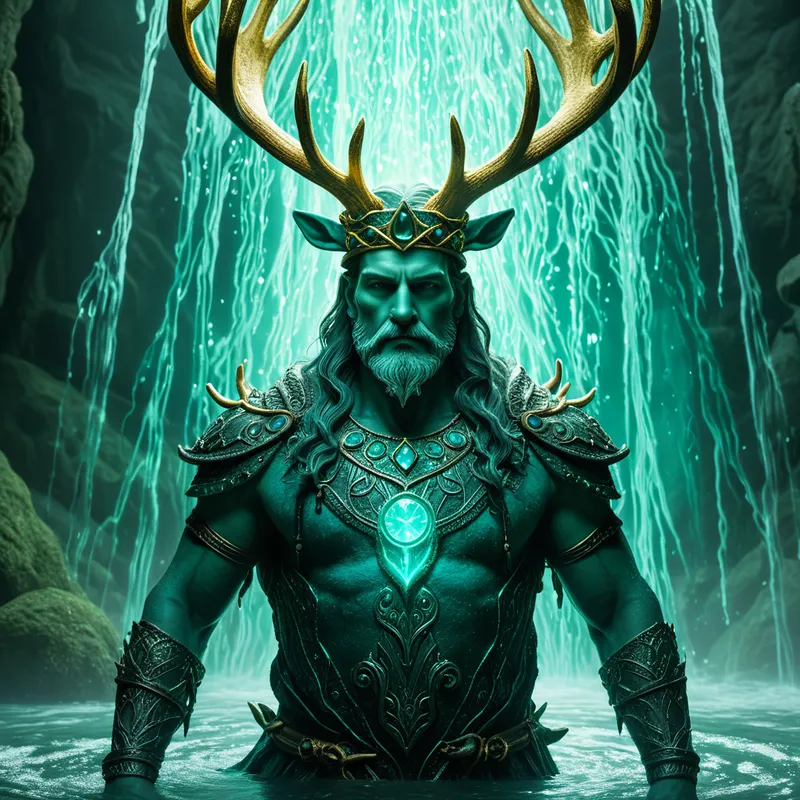
In the time before time was measured, when the world was a crucible and the sky a vast, dark bell jar, there lived a king of a forgotten realm. He was not a king of flesh, but of substance—a sovereign of prima materia. His name was Rex Corvus, and he wore a crown of heavy, dark lead, twisted into the shape of barren antlers. His palace was not of stone, but of all the calcified things: pride that had hardened into armor, grief crystallized into jewels, and desire forged into chains of glittering fool’s gold.
He ruled a land of splendid stagnation, where everything was fixed, defined, and forever. The rivers ran thick with honeyed wine, and the trees bore fruit of polished brass. It was a kingdom of no hunger, no thirst, and no change. And in its perfect stillness, Rex Corvus felt a hollow wind whistle through the chambers of his metallic heart.
One night, a dream came to him not as an image, but as a taste—the acrid, piercing flavor of salt and sharp green. It spoke in a voice of dissolving stone: “Your kingdom is a lie built upon a forgotten truth. To remember, you must forget. To be born, you must die.” When he awoke, his leaden crown had begun to sweat a cold, viscous dew.
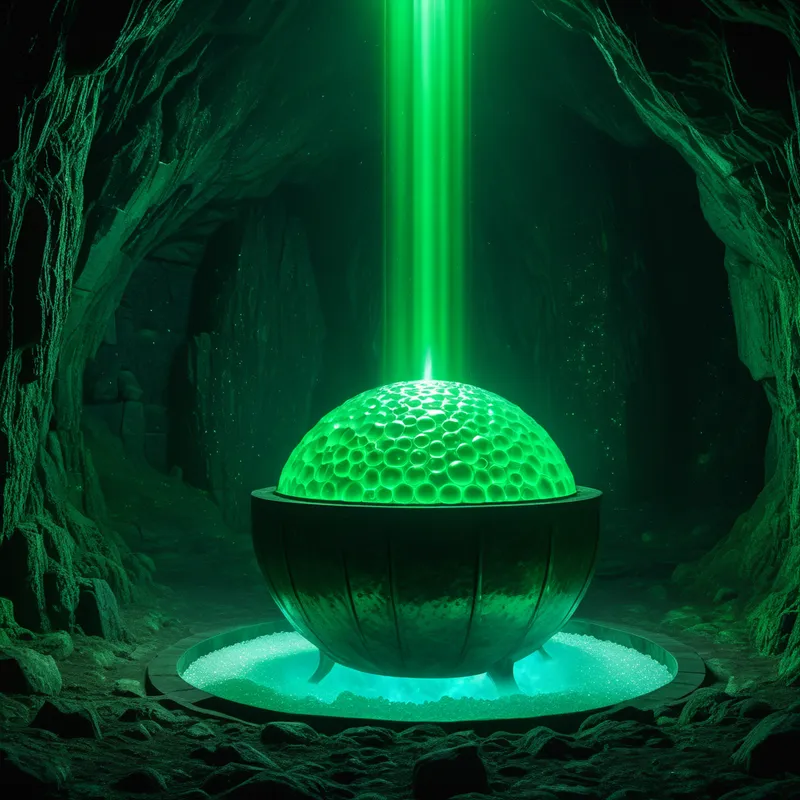
Driven by a longing he could not name, Rex Corvus abandoned his static throne. He journeyed to the heart of the world-mountain, to the Chamber of the Athanor. In its center stood a great, egg-shaped vessel of glass, and within it churned the Aqua Regia—a seething, emerald-green torrent that smelled of lightning and tears. This was the solvent of kings, the water that does not cleanse but unmakes.
The voice from his dream echoed in the steamy air. “The only path to your throne is through the flood. The only way to keep your crown is to lose it.”
Without a cry, Rex Corvus climbed the steps to the vessel’s lip. He looked down into the corrosive abyss, seeing his own reflection warp and bubble. Then, he stepped in.
The pain was not fire, but an infinite unraveling. The Aqua Regia did not burn; it drank. It drank his leaden crown, reducing it to a black smoke. It drank his brazen armor, turning it to a blue-green froth. It drank the jewels of his crystallized grief and the chains of his foolish desires. Layer by layer, all that was compounded, all that was “Rex Corvus,” dissolved away. He felt his very form become fluid, a screaming current in a greater current, identity dissolving into essence.
For seven cycles of the moon, the great alembic churned. All that remained in the kingdom above was a terrible silence, a throne room empty of its king. Then, on the eighth dawn, the torrent within the vessel stilled. The corrosive green faded, becoming clear as a mountain spring. And there, at the very bottom, resting on a bed of pure white Salt, was a small, rough, and utterly unremarkable nugget of metal. But when the first light from a crack in the mountain ceiling touched it, it glowed with a soft, unwavering, inner gold.
Cultural Origins & Context
The myth of the Purification Stage, known in older scrolls as the Nigredo or the Solutio, finds its roots not in a single culture, but in the transnational, clandestine brotherhoods of early laboratory alchemists spanning from Hellenistic Alexandria to Medieval Europe and the Islamic Golden Age. It was not a story told to children or sung in public squares, but a narrative cipher passed between adepts in dimly lit scriptoriums and smoky workshops. It functioned as both an allegorical instruction manual for their physical experiments with acids and solvents, and as a sacred map for an inner, spiritual ordeal.
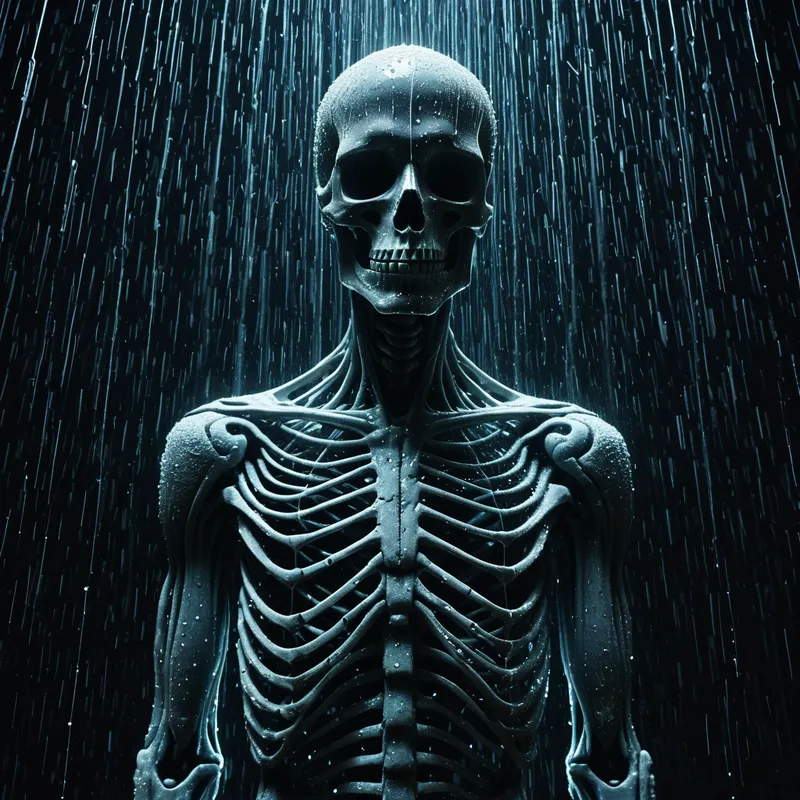
The myth was preserved in cryptic texts, often illustrated with haunting woodcuts of kings drowning in flasks or skeletons seated on thrones. Its transmission was oral and experiential; a master might recount the tale to an apprentice only after the novice had witnessed the terrifying power of aqua fortis to dissolve silver, providing a visceral, physical metaphor for the psychological process. Its societal function was subversive: it proposed that true sovereignty came not from worldly power or fixed identity, but from the courageous submission to a process of utter dissolution. It was the anti-myth to the standard hero’s journey, where victory came through surrender, and the crown was gained only after it was utterly destroyed.
Symbolic Architecture
At its core, the myth is a masterful depiction of the psyche’s necessary confrontation with its own shadow and rigidity. Rex Corvus is the ego-complex in its most solidified state—a personality structure that has become a prison of its own making. His kingdom of calcified forms represents the psychological defenses, compulsive behaviors, and inflated self-images we mistake for our true selves. The leaden crown symbolizes the heaviness and toxicity of an unlived life, where potential has been weighed down and rendered inert.
The Aqua Regia is the archetypal solvent of the soul. It represents the unbearable truth, the profound grief, the searing insight that has the power to dissolve the armature of the persona.
The descent into the vessel is the ultimate act of humility and courage—the conscious decision to undergo a psychic death. The dissolution is not annihilation, but a separation of the essential from the accidental. The Salt left behind is the irreducible core, the caput mortuum or “death’s head” that cannot be corrupted—the individual’s unique and eternal essence. The final, dull nugget that glows with inner light is the first glimpse of the Lapis Philosophorum, the Philosopher’s Stone, in its nascent, unprojected state. It is not yet the glorious, transmuting gold, but the proof that such gold exists in potentia within the ruins of the old king.

The Dreamer’s Resonance
When this myth stirs in the modern unconscious, it often announces itself not as a narrative dream, but as a somatic or atmospheric experience. The dreamer may find themselves in a place of eroding structures—a house with melting walls, teeth falling out without pain, or standing under a rain that washes away their features. There is a profound sense of identity loss, of being stripped bare. One might dream of swimming in an ocean that is also an acid, feeling their outer self dissolve while a calm, observing core remains untouched.
These dreams coincide with life phases where our constructed self is breaking down: the end of a defining career, the collapse of a long-held belief system, a period of depression or “dark night of the soul.” The body often echoes this through feelings of fatigue, lightness, or strange sensitivities, as if the psychic dissolution has a literal, metabolic counterpart. The dream is not a prophecy of doom, but a sign from the deep psyche that the necessary, terrifying, and ultimately liberating process of solutio—of return to the fluid, primal state—is underway. The ego is being invited, or forced, to take the plunge into its own Aqua Regia.
Alchemical Translation
For the modern individual seeking wholeness, the Purification Stage is the non-negotiable heart of the individuation process. We all build kingdoms of Rex Corvus—identities forged from parental expectations, societal rewards, and trauma responses. These kingdoms provide stability, but eventually, their walls become the boundaries of our soul. The myth models the path of psychic transmutation by insisting that growth is not an additive process, but a subtractive one.
The first step is the recognition of the “hollow wind”—the feeling of meaninglessness within a seemingly perfect life. This is the call to the Chamber of the Athanor, which in modern terms is the therapeutic container, the journal, the meditation cushion, or any disciplined space of self-confrontation. The Aqua Regia is the work done therein: the brutal honesty, the grieving of lost selves, the admission of shadow qualities. It is the emotional and intellectual solvent that breaks down our complexes.
To be purified is not to become perfect, but to become permeable. It is to exchange the solid, defensive crown of lead for the fluid, receptive essence of Salt.
The triumph is not in avoiding dissolution, but in surrendering to it with conscious awareness. The “gold” revealed is not a new, shinier ego, but the discovery of the Self—the central, organizing principle of the psyche that was always there, buried under layers of persona. It is the moment we realize our true identity is not the armor we wore, nor even the pain of its removal, but the silent, witnessing consciousness that endures through both. We cease to be the king of a small, hard kingdom and become, instead, a citizen of the vast, flowing mystery. The myth ends not with a coronation, but with the first, quiet gleam of an inner sun that was waiting, all along, to dawn.
Associated Symbols
Explore related symbols from the CaleaDream lexicon: