The Prophets Myth Meaning & Symbolism
The story of individuals seized by a divine voice, tasked with delivering urgent, often unwelcome, truths to a people straying from their covenant.
The Tale of The Prophets
Listen. In the land between the river and the sea, under a sky that baked the earth to clay, the people had a covenant. It was a story written in fire and law, a promise between them and a voice that spoke from the whirlwind. For generations, they knew the shape of this story. They built temples of stone and rituals of brass to contain it.
But the heart is a wanderer. The story grew dusty. The law became a cage for the powerful and a burden for the poor. Kings built thrones of cedar and gold, forgetting the story was written for shepherds. The people turned to gods of harvest and war, small gods who asked for grain but not for justice, who promised victory but not righteousness. The covenant thrummed, a plucked string in the silent heavens, vibrating with a forgotten frequency.
And then, the rupture.
It never came in palace halls. It came in the sheepfold, to a boy startled by the silence of the night. It came to the farmer, plowing his field, when the furrow seemed to open into an abyss. It came as a hand, seizing the innards, a fire kindling in the bones. The Voice. It was not a whisper, but a command that filled the skull like honey, thick and inescapable. It was a vision that scorched the eyes—chariots of fire in the terebinth trees, a scroll eaten that turned the stomach sweet, a valley of dry bones rattling like pottery.
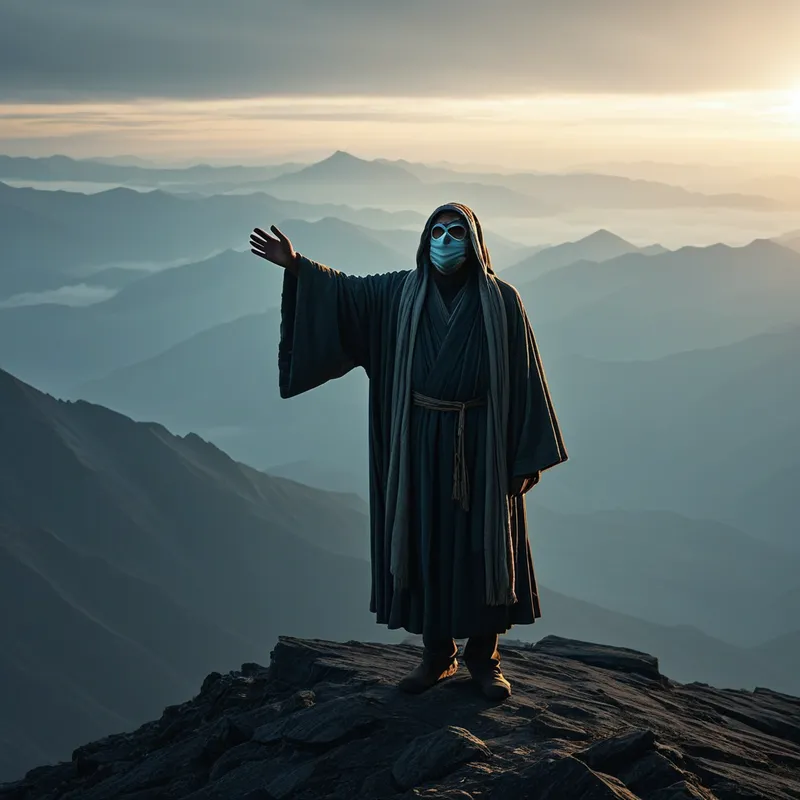
The one seized—the prophet—was ruined for ordinary life. The Voice gave a message, but it was a message of thorns and lamentation. “Go, speak to the house of Israel.” And the words were not of comfort, but of a plumb line held against a crooked wall, of a husband accusing an unfaithful wife, of a lawsuit filed by heaven itself. The prophet became a living sign, acting out the coming rupture: walking naked for three years, lying on one side for hundreds of days, marrying a woman who would be unfaithful.
He stood in the city gate, this ragged, haunted figure, and his voice, now an instrument of the Voice, cut through the market’s din. “Hear the word of the YHWH!” He spoke of altars splintering, nations rising like beasts from the sea, walls crumbling. The priests mocked him. The kings plotted to silence him. The people covered their ears. He was a traitor, a madman, a bearer of bad news. His only companions were loneliness and the unrelenting pressure of the truth he carried—a truth he often begged to be released from. He was sent to a people who would not listen, to speak words that would seal their fate, yet within the judgment blazed a impossible, stubborn ember: a promise of return, of a new heart of flesh replacing the heart of stone, of a remnant that would remember the story.
His journey ended often in obscurity or violence. Yet, the words remained. Scratched on scrolls, remembered in exile, they became the conscience of the nation, the record of the covenant’s terrible, loving demand.

Cultural Origins & Context
The prophetic tradition emerged in the kingdoms of Israel and Judah during the Iron Age (roughly 1200-586 BCE), a period of intense political upheaval, Assyrian and Babylonian imperialism, and internal social stratification. These were not remote mystics but public figures embedded in the crises of their day. Their words were first oral performances, delivered at the city gate—the center of legal and commercial life—or at the temple precincts.
They stood in a tense relationship with established power structures: the monarchy, the priestly cult, and the wealthy elite. While some prophets were associated with royal courts (like Nathan), the classical writing prophets (Amos, Isaiah, Jeremiah) were often outsiders, critiquing the state’s foreign alliances, economic exploitation, and hollow ritualism. Their societal function was ultimately one of covenant enforcement. They served as divine attorneys, calling the people back to the foundational story of liberation and ethical monotheism, interpreting national disaster not as the caprice of foreign gods, but as the consequence of broken relationship.
Symbolic Architecture
The prophet is the archetype of the awakened conscience, the part of the psyche that can no longer tolerate the comfortable lies of the ego or the collective. The prophetic call symbolizes the eruption of the Self (Jung’s term for the total, integrating center of the psyche) into a life organized around a smaller, more manageable story.
The prophet is not a person with a message, but a message that has taken possession of a person.
The Voice represents the autonomous, numinous content of the unconscious, which demands recognition and integration. It is disruptive, non-rational, and carries ultimate authority. The unwelcome message symbolizes the shadow of the culture—and the individual. It is the truth we have collectively agreed to ignore: our greed, our hypocrisy, our spiritual sleepwalking. The prophet’s loneliness is the inevitable isolation of individuation, of seeing what others refuse to see. The persistent theme of a remnant and future restoration symbolizes the psyche’s inherent drive toward wholeness. Even in the midst of acknowledging brokenness (judgment), the prophetic imagination holds a vision of reconciliation and new creation.
The Dreamer’s Resonance
When this myth stirs in the modern dreamer, it often manifests as dreams of urgent, disruptive communication. You may dream of a phone ringing incessantly with no one on the line but a profound sense of dread or importance. You may find yourself in a familiar place—your office, a family gathering—and be compelled to stand and shout a truth that shocks everyone into silence, filling you with both terror and cathartic release.
Somatically, this can feel like a pressure in the chest or solar plexus, a “fire in the bones.” Psychologically, this marks a critical point where a deep, authentic part of the self (the Voice) can no longer be contained by the adapted personality. You are being called to acknowledge a truth you’ve been avoiding—about your life’s direction, a relationship, a personal compromise. The dream stage becomes the city gate, and the sleeping ego is both the reluctant prophet and the hostile crowd. This is the psyche initiating its own course correction, often preceding a major life transition or crisis of integrity.

Alchemical Translation
The prophet’s journey is a precise map for the alchemical process of psychic transmutation, the opus of turning leaden unconsciousness into golden awareness.
The Call (Calcinatio) is the burning away of the old identity. The fire of the Voice reduces the former life to ash, creating the essential “ruined” state where transformation can begin. The Reluctance & Struggle (Mortificatio) is the dark night, the confrontation with the shadow. The prophet’s arguments with God mirror the ego’s fierce resistance to the painful but necessary insights from the unconscious. The Delivery of the Message (Sublimatio) is the distillation of this raw, often chaotic, unconscious content into a communicable form—a vision, a poetic oracle, a symbolic act. This is the spirit rising above the personal complaint to articulate a transpersonal truth.
The triumph is not in being heard, but in having spoken the truth that was given. The integration is of the Voice itself, not the crowd’s applause.
Finally, the Vision of Restoration (Coniunctio) represents the ultimate goal of individuation. After the judgment (consciousness of what is broken) comes the promise of the new covenant: “I will put my law within them, and I will write it on their hearts.” This is the alchemical marriage, where the divine demand (the Self) and the human heart (the ego) are no longer in opposition but are integrated. The prophet’s lonely path models how we must each become the vessel for our own deepest truth, carrying it through the desert of misunderstanding, so that we might eventually speak—and live—from a heart that has been remade.
Associated Symbols
Explore related symbols from the CaleaDream lexicon: