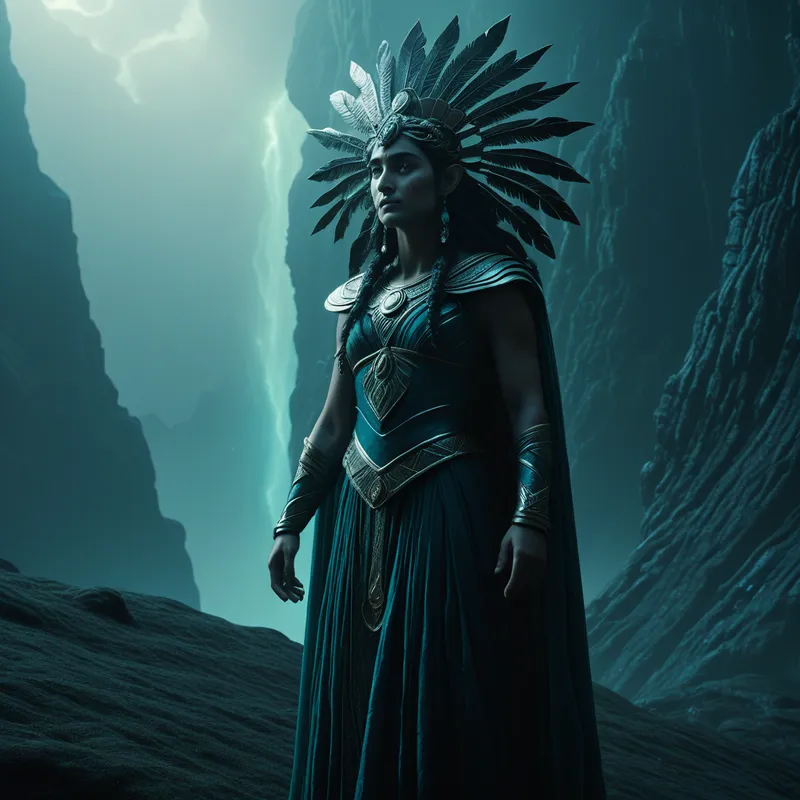
The Prophet Isaiah's Vision
A Hebrew prophet's awe-inspiring vision of God's throne, seraphim, and a burning coal that purifies his lips, commissioning him to speak divine messages.
The Tale of The Prophet Isaiah’s Vision
The year King Uzziah died, a profound silence fell upon the prophet [Isaiah](/myths/isaiah “Myth from Abrahamic culture.”/), a silence not of peace but of a throne left empty, a world unmoored. It was in this hollowed-out hour, within [the temple](/myths/the-temple “Myth from Jewish culture.”/)’s solemn shadows, that [the veil](/myths/the-veil “Myth from Various culture.”/) of the ordinary was torn asunder.
He did not merely see; he was enveloped. The foundations of [the threshold](/myths/the-threshold “Myth from Folklore culture.”/) shook, and the air grew thick with a presence that filled the space, not as [water](/myths/water “Myth from Chinese culture.”/) fills a cup, but as the ocean contains a continent. There, towering in the heart of the sanctuary, was the Lord, seated upon a throne, high and exalted. The hem of His robe filled the temple, a cascading fabric of majesty that spoke of a sovereignty encompassing all things. Above Him stood the [seraphim](/myths/seraphim “Myth from Christian culture.”/), each with six wings. With two they covered their faces, unable to bear the direct gaze of the Holy. With two they covered their feet, a gesture of humility before the Ultimate. And with two they flew, ceaselessly calling to one another across the fiery expanse:
“Holy, holy, holy is the Lord of hosts; the whole earth is full of his glory.”
Their voices were not sound but substance, shaking the doorposts, filling the house with smoke—the visible breath of the divine word. And in that moment, Isaiah’s inner world shattered. The vision did not exalt him; it undid him. The absolute purity, the terrifying otherness of the Holy, became a mirror in which he saw himself, and all his people, with devastating clarity. “Woe is me!” he cried, his voice lost in the seraphic chant. “For I am lost; for I am a man of unclean lips, and I dwell in the midst of a people of unclean lips; for my eyes have seen the King, the Lord of hosts!”
His confession was his truth: in the face of the Real, the prophet recognized the profound dissonance of his own being. He was not a sage on a mountain but a man in a broken world, his very capacity for speech—his instrument of prophecy—tainted by that same brokenness. Then, a movement within the fire. One of the seraphim flew to him, bearing in its hand a glowing coal taken from the [altar](/myths/altar “Myth from Christian culture.”/) with tongs. It did not speak words of comfort. It acted. Touching the coal to Isaiah’s mouth, it seared away not flesh, but fault. “Behold, this has touched your lips; your guilt is taken away, and your sin atoned for.”
The pain of that touch was the pain of birth. The burning was not destruction but a terrible, necessary purification. The impurity was cauterized, leaving not a wound, but a cleansed vessel. Only then did the voice of the Lord itself ring out, a question echoing in the newly cleared space of Isaiah’s soul: “Whom shall I send, and who will go for us?” From a mouth now touched by fire, from a self that had been unmade and remade, came the answer, simple and irrevocable: “Here I am. Send me.”
The commission that followed was not a promise of [triumph](/myths/triumph “Myth from Roman culture.”/), but a burden of painful truth. He was to speak to a people who would hear but not understand, see but not perceive. His prophecy would harden hearts, a paradoxical mission where the divine word would reveal by concealing, until cities lay in ruins and the land was utterly desolate. Yet, a seed was planted within that desolation—a holy stump, a remnant that would hold the promise of return. The vision ended, leaving Isaiah not with euphoria, but with a sacred charge forged in the fire of contradiction, bearing a word that was both judgment and the faint, unkillable germ of hope.
Cultural Origins & Context
The vision is recorded in the sixth chapter of the Book of Isaiah, a [cornerstone](/myths/cornerstone “Myth from Biblical culture.”/) of the Nevi’im (Prophets) in the Hebrew Bible. Its opening timestamp—“In the year that King Uzziah died” (c. 740 BCE)—is profoundly significant. Uzziah’s reign was a long period of military success and economic prosperity for Judah, but it ended in tragedy with the king struck by leprosy for overstepping priestly boundaries. His [death](/myths/death “Myth from Tarot culture.”/) marked the end of an era of perceived stability, with the aggressive Assyrian empire rising like a storm cloud on [the horizon](/myths/the-horizon “Myth from Various culture.”/). The vision, therefore, erupts at a moment of national anxiety and political vacuum.
This context is essential. Hebrew prophecy is not abstract mysticism; it is a divine response to concrete historical and communal crisis. Isaiah’s call occurs not in a wilderness retreat, but in the [Jerusalem](/myths/jerusalem “Myth from Biblical culture.”/) Temple, the epicenter of Judah’s religious and political identity. The vision redefines that center. True kingship is not Uzziah’s failed dynasty, but the Lord on His throne. True security is not in armies or alliances, but in the terrifying, holy presence that fills the sanctuary. The prophet’s role, as established here, is to be the intermediary between this transcendent, holy reality and the flawed, geopolitically vulnerable nation. He is called to speak a word that cuts against the grain of royal policy and popular sentiment, a word rooted in the vision of a holiness that judges all human pretension.
Symbolic Architecture
The [vision](/symbols/vision “Symbol: Vision reflects perception, insight, and clarity — often signifying the ability to foresee or understand deeper truths.”/) constructs a layered cosmology of [separation](/symbols/separation “Symbol: A spiritual or mythic division between realms, states of being, or consciousness, often marking a transition or loss of connection.”/) and mediation. The [Throne](/symbols/throne “Symbol: A seat of authority, power, and sovereignty, representing leadership, divine right, or social hierarchy.”/) signifies absolute, sovereign [authority](/symbols/authority “Symbol: A symbol representing power structures, rules, and control, often reflecting one’s relationship with societal or personal governance.”/), the unmoved center around which [history](/symbols/history “Symbol: History in dreams often represents the dreamer’s past experiences, lessons learned, or unresolved issues that continue to influence their present.”/) turns. The Seraphim (from the Hebrew saraph, “to burn”) are beings of pure, consuming fire, yet they mediate the divine [presence](/symbols/presence “Symbol: Presence in dreams often signifies awareness or acknowledgment of something significant in one’s life.”/) through a liturgy of awe and veiling. Their six wings embody the [paradox](/symbols/paradox “Symbol: A contradictory yet true concept that challenges logic and perception, often representing unresolved tensions or profound truths.”/) of the sacred: two for worship (covered faces), two for service (flying), and two for humility (covered [feet](/symbols/feet “Symbol: Feet symbolize our foundation, stability, and the way we connect with the world around us, often reflecting our sense of direction and purpose.”/)). They are dynamic flames that yet observe a perfect, reverent order.
The Smoke that fills the [temple](/symbols/temple “Symbol: A temple often symbolizes spirituality, sanctuary, and a deep connection to the sacred aspects of life.”/) is the tangible [atmosphere](/symbols/atmosphere “Symbol: Atmosphere can signify the emotional and sensory environment surrounding an experience or situation.”/) of the divine kavod (glory), both revealing and concealing God’s presence, much like the cloud on [Mount Sinai](/myths/mount-sinai “Myth from Biblical culture.”/). It represents the threshold of [human](/symbols/human “Symbol: The symbol of a human represents individuality, complexity of emotions, and social relationships.”/) [perception](/symbols/perception “Symbol: The process of becoming aware of something through the senses. In dreams, it often represents how one interprets reality or internal states.”/)—we sense the presence, but cannot grasp its form.
The Burning Coal is the central alchemical agent of the narrative. Taken from the altar—the place of sacrifice and atonement—it becomes the instrument of personal transformation. It does not merely forgive sin; it actively purges the organ of speech, suggesting that true prophetic utterance must be born from a painful, purifying encounter with the sacred. The guilt is taken away; the sin is covered (atoned). This is an act of grace, but a severe one, preparing the prophet not for comfort, but for a devastating mission.
The entire vision establishes a profound theology of Holiness (kadosh). God’s holiness is not merely moral perfection; it is radical otherness, a qualitative [difference](/symbols/difference “Symbol: Difference symbolizes diversity, change, and the contrast between ideas or people.”/) in being. Isaiah’s [reaction](/symbols/reaction “Symbol: A reaction in a dream signifies the subconscious emotional responses to situations we face, often revealing our coping mechanisms and fears.”/)—a sense of personal and communal ruin—is the only authentic human [response](/symbols/response “Symbol: Response in dreams symbolizes how one reacts to situations, often reflecting the subconscious mind’s processing of events.”/) to this [reality](/symbols/reality “Symbol: Reality signifies the state of existence and perception, often reflecting one’s understanding of truth and life experiences.”/). The vision thus dismantles any casual familiarity with the divine, re-establishing the holy as awe-ful, consuming, and fundamentally transformative.
The Dreamer’s Resonance
For the modern [psyche](/myths/psyche “Myth from Greek culture.”/), Isaiah’s vision maps the terrifying yet necessary journey of ego dissolution before a reality greater than itself. We may not call it “God,” but we encounter analogous moments: facing an overwhelming truth about our lives, a profound work of art, the raw force of nature, or the depths of our own conscience. In such moments, like Isaiah, we cry “Woe is me!” We feel our “unclean lips”—our inadequacy, our complicity in systems of harm, our fractured integrity.
The seraphim’s chant of “Holy, holy, holy” resonates as the psyche’s encounter with something of ultimate value and wholeness, which simultaneously reveals our own fragmentation. This is not a pathology, but a moment of profound psychological accuracy. [The ego](/myths/the-ego “Myth from Jungian culture.”/)’s defensive structures are shattered by a vision of a more complete pattern. The subsequent “burning coal” experience is the painful but integrative process that follows. It is the searing insight, the difficult confession, the therapeutic breakthrough, or the creative inspiration that, while painful, cleanses a blocked channel of expression. It allows a new, more authentic voice to emerge from the ashes of the old self. The call that follows—“Here I am”—is the birth of a conscious, responsible Self, willing to bear the burden of a difficult truth into [the world](/myths/the-world “Myth from Tarot culture.”/), even in the face of certain resistance.

Alchemical Translation
In the alchemical vessel of the soul, Isaiah’s temple becomes the [temenos](/myths/temenos “Myth from Greek culture.”/), the sacred space where [the great work](/myths/the-great-work “Myth from Alchemical culture.”/) occurs. The vision initiates the [nigredo](/myths/nigredo “Myth from Alchemical culture.”/), the blackening: the death of King Uzziah (the old order) and the prophet’s cry of “I am lost” signify the dissolution of the old, identified self. The encounter with the Holy is the confrontation with the lapis, the ultimate, uncanny reality that reduces the ego to ash.
The seraphim, with their dual nature of fiery movement and veiled reverence, represent the coniunctio oppositorum—the union of opposites necessary for transformation. They are the agents who apply the fire. The coal, taken from the altar of sacrifice, is the prima materia transformed into the elixir. Its application to the lips is the precise, painful operation of separatio and purificatio, burning away the dross of the “unclean” (the false, the adapted, the defensive) to isolate the pure essence of the individual’s voice.
The prophet’s commissioning represents the [albedo](/myths/albedo “Myth from Alchemical culture.”/), the whitening, where a new, clarified consciousness is born, capable of bearing the paradoxical mandate. His task—to speak a word that will harden—is the embodiment of the [rubedo](/myths/rubedo “Myth from Alchemical culture.”/), the reddening. It is the conscious acceptance of the suffering inherent in the work, carrying the transformed substance back into the flawed world to act as a catalyst, even if that catalysis initially looks like destruction. The “holy stump” is the promise of the [quintessence](/myths/quintessence “Myth from Alchemical culture.”/), the indestructible seed of new life that survives the fire, guaranteeing that the alchemical process is ultimately one of regeneration, not annihilation.
Associated Symbols
Explore related symbols from the CaleaDream lexicon:
- Vision — A direct, overwhelming perception of a numinous or ultimate reality that reconfigures the seer’s understanding of self and world.
- Fire — The element of purification, divine presence, and transformative energy that consumes impurity to reveal essential truth.
- Altar — The sacred point of contact between the human and the divine, the place of sacrifice where transformation is enacted and received.
- Throne — The symbol of absolute sovereignty, foundational order, and the ultimate center of authority around which all reality revolves.
- Temple — The constructed sacred space that serves as a container for the encounter with the divine, mirroring both cosmos and psyche.
- Prophet — One who is called, often through a severe initiation, to serve as an intermediary, speaking a disruptive and necessary truth from a transcendent source.
- Purification — The often painful process of cleansing or burning away that which is false or impure to prepare a vessel for a sacred function.
- Voice — The capacity for authentic utterance, which must be forged and cleansed through ordeal to carry a transformative message.
- Threshold — The liminal space, often marked by shaking and smoke, where one reality gives way to another, and [the self](/myths/the-self “Myth from Jungian culture.”/) is fundamentally altered.
- Coal — A humble substance ignited by [sacred fire](/myths/sacred-fire “Myth from Various culture.”/), becoming an instrument of precise, searing grace that removes guilt and enables new speech.
- Chimeric Visions — Composite, awe-inspiring manifestations of the numinous that defy singular categorization, integrating multiple forms of power and awe.
- Veiled Prophecy — A divine message that is simultaneously revealed and concealed, designed to be understood only by those whose hearts are prepared for its difficult truth.