The Process of Separation Myth Meaning & Symbolism
An alchemical myth where the unified Prima Materia is shattered into soul and shadow, initiating the eternal quest for conscious reconciliation.
The Tale of The Process of Separation
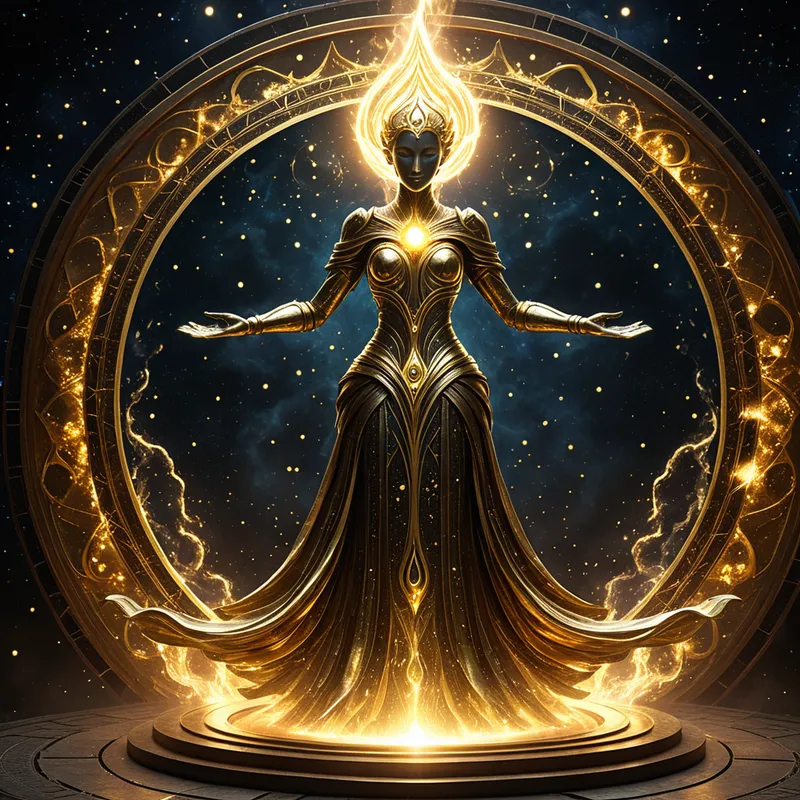
In the beginning, before the first fire was kindled in the furnace of the world, there was only the One Thing. The alchemists, in their hushed and smoke-filled chambers, knew it as the Prima Materia. It was not a god, but the substance of godhood; not a being, but the potential for all being. It hung in the void, a perfect, silent sphere of swirling contradiction—light married to darkness, spirit fused with matter, consciousness asleep in its own infinite womb.
But within that perfect unity, a longing stirred. A question formed in the heart of the unformed. To know itself, it realized, it must see itself. And to see, there must be separation: a subject to gaze, and an object to be gazed upon.
Thus began the great and terrible sigh. The sphere did not explode, but wept. It convulsed in an agony of becoming. From its own substance, it forged the first and only tool: the Sword of Discrimination. With a motion that was both will and surrender, it turned the blade upon itself.
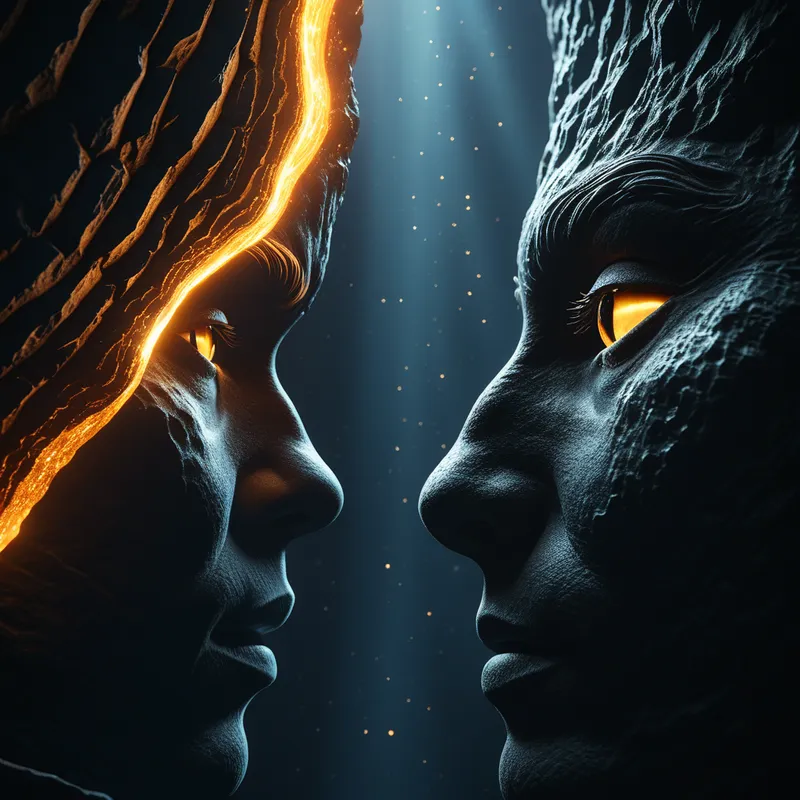
There was no sound, but the universe felt the cut. The One Thing was cloven in twain. From the wound poured not blood, but the first duality. One half ascended, luminous and yearning, becoming the Anima Mundi, the World Soul. It was all light, music, and the pure desire for the heavens. The other half descended, dense and resonant, becoming the Corpus Obscurum, the Shadow Body. It was all weight, silence, and the memory of the earth.
They flew apart, these twin children of the One, across the nascent cosmos. The Soul wept tears that became stars. The Body bled drops that became stones. Between them stretched the vast, echoing desert of the Mercurial Sea, a shimmering, deceptive expanse that reflected each but allowed no lasting union.
And there, in that first moment of shattered peace, the great work was set. The Soul, gazing back, felt a piercing loneliness for its dark twin. The Body, looking up, felt a dull ache for its light. The original unity was now a memory, and that memory became a longing. The longing became a quest. They were doomed, or perhaps destined, to spend eternity seeking each other, yearning to become the One Thing once more, yet forever changed by the cut that made them two.
Cultural Origins & Context
This myth is not found in a single sacred text but is the foundational narrative woven through the practical and philosophical manuscripts of the European alchemical tradition, from the Hellenistic Hermetica to the symbolic diagrams of the Renaissance. It was never a story for the public square; it was the secret heart of the laboratory, passed from master to apprentice alongside recipes for acids and alloys.
The tellers were not bards, but natural philosophers and artisans—men and women like Maria Prophetissa or Paracelsus—who saw in the processes of dissolution, separation, and coagulation a mirror of the soul’s journey. Its societal function was esoteric and psychological. It provided a cosmological framework for the inner work of transformation, justifying the intense, often dangerous, and socially marginal pursuit of the Philosopher’s Stone. The myth taught that the chaos and “death” of materials in the retort were not failures, but necessary stages in a sacred, replicable drama of cosmic origins.
Symbolic Architecture
The myth maps the primordial trauma of consciousness itself. The Prima Materia represents the original, unconscious wholeness of the infant psyche, or the undifferentiated potential within the collective unconscious.
The first act of consciousness is an act of violence against the peace of the whole.
The Sword of Discrimination symbolizes the birth of ego, the necessary faculty of judgment, distinction, and separation that allows us to navigate the world. It is the intellect that names, categorizes, and, in doing so, creates duality: good/evil, self/other, spirit/matter. The resulting separation into Anima Mundi (Soul) and Corpus Obscurum (Body/Shadow) is the fundamental psychic split. We identify with the light, the aspirational, the “spiritual” self, and disown the dark, the material, the instinctual, and the flawed—casting it into the inner shadowlands. The Mercurial Sea is the liminal space of relationship, communication, and the transformative process itself—the tricky, ever-flowing medium through which reconciliation must be attempted.
The Dreamer’s Resonance
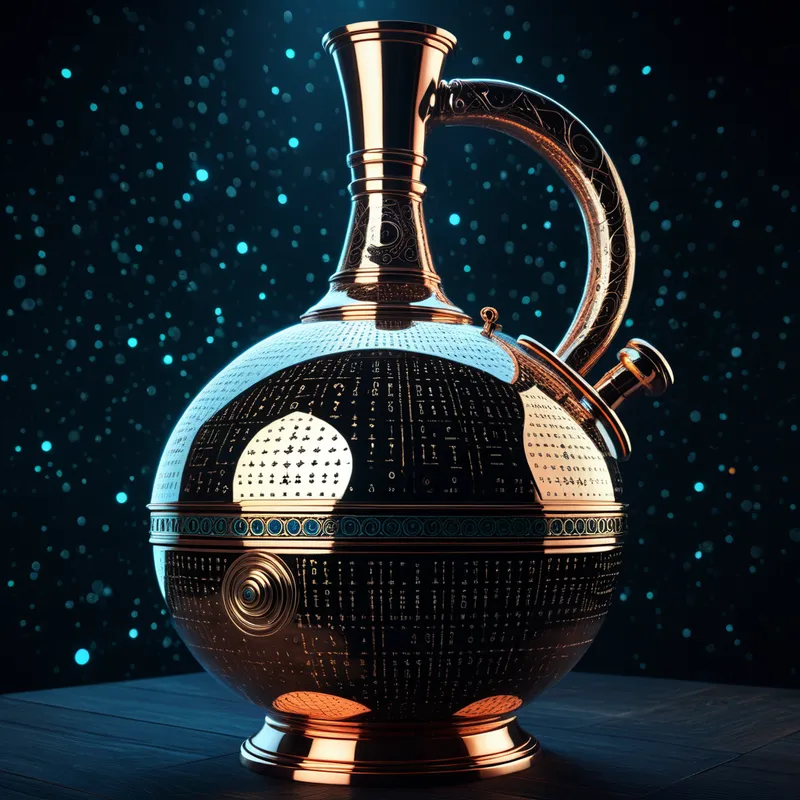
When this myth stirs in the modern dreamer, it announces a critical juncture in psychic development. One may dream of a precious object breaking in two, of a house dividing down the middle, of twins being separated at birth, or of one’s own reflection splitting in a mirror. These are somatic signals of the “separatio” at work.
Psychologically, this corresponds to a necessary, often painful, process of differentiation. It is the end of naive identification. The dreamer may be separating from a fused family system, distinguishing their own values from internalized parental voices, or confronting a repressed aspect of their personality that can no longer be ignored. The somatic feeling is often one of tearing, rending, or profound loneliness—the cost of the Sword of Discrimination’s cut. This is not pathology, but the psyche’s innate alchemy initiating the “opus,” the great work of becoming an individual. The dream confirms the wound, but also hints at the deeper pattern: the separation is the first, mandatory step in a destined return to a higher unity.

Alchemical Translation
For the modern individual seeking individuation, the myth of Separation provides the foundational blueprint. It models the painful but essential death of psychic naivete. We must, like the Prima Materia, have the courage to apply the sword to our own unconscious wholeness.
This means consciously differentiating from collective norms, familial expectations, and the persona we present to the world. It requires us to separate the gold from the lead within ourselves—to acknowledge our noble aspirations (Anima Mundi) while also consciously engaging with our base instincts, our anger, our shame, our creative darkness (Corpus Obscurum). We cannot integrate what we do not first acknowledge as separate.
The goal is not to undo the separation, but to become the vessel that consciously contains both the light and the dark, the soul and the shadow, in a dynamic, living tension.
The Mercurial Sea is then translated as the therapeutic dialogue, the creative act, the mindful relationship, or the active imagination—the volatile medium where the separated parts can finally meet and communicate. The myth assures us that the loneliness and conflict born of this separation are not the end of the story, but the very engine of the quest for the true Philosopher’s Stone: a fully realized, conscious Self that has remembered its original unity not through regression, but through the hard-won integration of all it has become.
Associated Symbols
Explore related symbols from the CaleaDream lexicon: