
The Process of Separatio Myth Meaning & Symbolism
An alchemical myth where the prima materia is shattered, its elements divided, and the soul is purified through a crucible of necessary chaos.
The Tale of The Process of Separatio
Listen. In the beginning, before the alembic and the athanor, there was only the One Thing. The Prima Materia. It was not a substance, but a state—a swirling, dreaming chaos of potential, containing all opposites in a slumbering embrace: fire and water, spirit and lead, light and a profound, fecund darkness.
But the One Thing dreamed of knowing itself. And for that, it had to break.
Thus arose the Separator. Some tales say it was an ancient god with hands of granite and eyes of cold, clear quartz. Others whisper it is not a being at all, but the first law of the cosmos: that to become, one must first be unmade. The Separator approached the dreaming Prima Materia, not with malice, but with a terrible, necessary love. It reached into the heart of the chaos.
And it began to pull.
This was not a gentle sundering. It was a cosmic agony. The fiery essences screamed as they were wrenched from the watery depths. The volatile spirits, like captive birds, struggled against the pull of the dense, earthly soul. The process was one of immense violence and profound precision. The Separator did not destroy; it distinguished. It isolated the sulphurous from the mercurial, the fixed from the volatile, the pure from the corrupt. The once-unified matter fractured into a constellation of disparate elements, each falling into its own sphere of influence, its own kingdom of isolation. The heavy dregs, the Caput Mortuum, sank into a cold, silent abyss. The luminous spirit trembled in a realm of unbearable brightness, alone.
For an acon, there was only the silence of division. The separated elements languished, each incomplete, each yearning for the wholeness they once knew but could no longer remember, only feel as a ghost-limb of the soul. The process was complete. The One was now the Many, adrift in the void of their own specificity.
Cultural Origins & Context
The myth of the Separatio was never a single story told around a fire. It was the underlying narrative etched into the soot-stained walls of medieval and Renaissance laboratories, encoded in cryptic emblems, and whispered between adepts. It belonged to the “Alchemical” culture—a transnational, centuries-spanning tradition of natural philosophers, mystics, and proto-scientists who saw the transformation of matter as a mirror for the transformation of the soul.
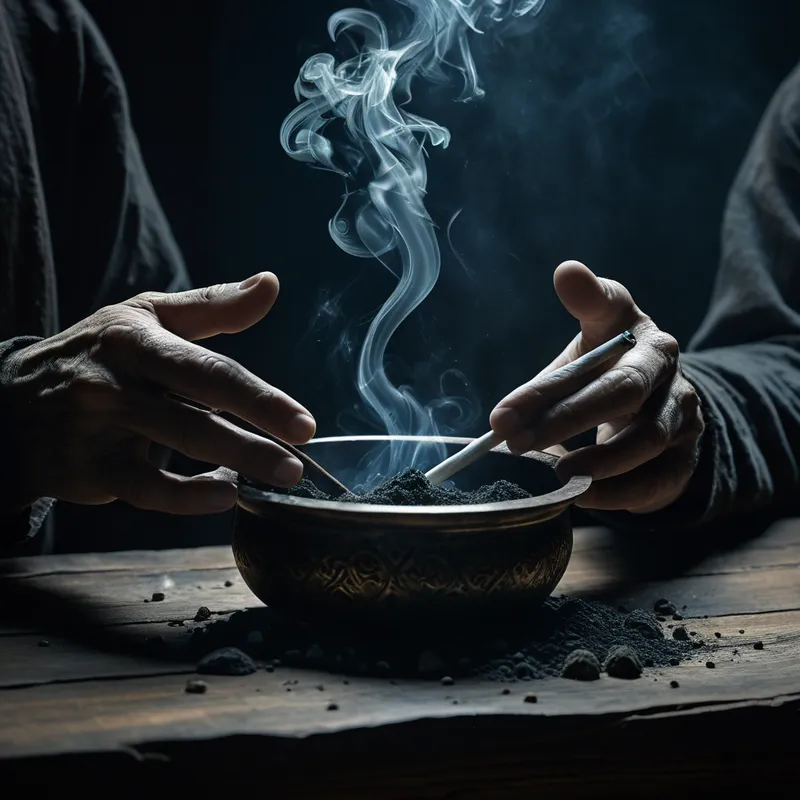
Its primary “texts” were not scrolls but processes. An apprentice learned of Separatio by watching his master patiently distill a solution, watching the pure spirit rise, leaving the dregs behind. He felt it in the crushing of ore, the grinding of ingredients in a mortar. The myth was performed, not recited. Its societal function was initiatory. It served as a warning and a map: the path to the Philosopher’s Stone, or to spiritual gold, necessarily passed through a stage of utter disintegration. It legitimized the dark night of the soul, the crisis of faith, the feeling of being pulled apart, as a sacred and required step in the Great Work.
Symbolic Architecture
Psychologically, Separatio represents the indispensable, often brutal, process of analysis that must precede any true synthesis. It is the death of unconscious identification.
The ego, comfortable in its familiar chaos, must be broken down into its constituent parts so that what is essential can be discerned from what is merely habitual.
The Prima Materia symbolizes the unconscious, undifferentiated state of the psyche—a messy amalgam of drives, complexes, potentials, and inherited patterns. The Separator is the awakening consciousness itself, or the relentless drive toward individuation, which initiates this painful but necessary discrimination. The volatile spirits represent our transitory emotions, inspirations, and spiritual yearnings. The fixed, earthy soul is our body, our instincts, and our ingrained character. The sulphurous principle is our passion and will, while the mercurial is our intellect and adaptability.
The horror of the myth lies in the fact that the Separator is not an external enemy, but an internal principle of order and clarity. We are both the chaos being torn apart and the force doing the tearing. The sinking Caput Mortuum is not evil, but that which is no longer viable—outmoded self-concepts, childish dependencies, and psychic toxins that must be acknowledged and relinquished.
The Dreamer’s Resonance
When this myth stirs in the modern unconscious, it manifests in dreams of radical division and sorting. One may dream of a house where walls suddenly vanish, revealing all rooms at once in a confusing jumble, followed by a compulsive need to sort every object into perfect, isolated piles. Another may dream of their body dissolving, with bones separating from flesh, and blood from water, floating in a dark space.
Somatically, this can feel like a literal pulling sensation in the chest or gut, a sense of being “stretched thin,” or acute anxiety that feels like coming apart at the seams. Psychologically, the dreamer is likely in a life phase where a previously cohesive identity—a relationship, a career, a belief system—is undergoing a necessary deconstruction. The psyche is instinctively performing its own Separatio, sorting the components of a complex to see what is truly “self” and what is internalized “other,” what is vital spirit and what is dead weight. The terror in the dream is the fear that the separation is final, that reintegration is impossible—a stage the alchemists called the Nigredo.

Alchemical Translation
For the modern individual seeking wholeness, the myth of Separatio models the non-negotiable first phase of psychic transmutation. We cannot integrate what we have not first distinguished.
Individuation begins not with adding, but with subtracting; not with building the new, but with courageously dismantling the old.
The urge to skip this stage—to seek immediate enlightenment, healing, or a new identity without first undergoing the honest, often ugly, work of self-analysis—is the great temptation. The alchemical process insists that the gold is hidden within the lead, but it can only be retrieved by breaking the lead apart. Translated into a life process, Separatio is the conscious decision to examine a compulsive behavior, not to condemn it, but to understand its emotional, historical, and somatic components. It is the therapy session that breaks a monolithic “depression” into specific griefs, angers, and fears. It is the artistic process of taking a vague inspiration and breaking it into form, color, and line.
The triumph of the myth is not in the separation itself, which is a state of existential loneliness, but in the purpose it serves. The elements are separated so that they may be purified. The dross is removed so that the essential can remain. Only after the Separatio can the next operation, the Ablutio or purification, begin. The myth assures us that the feeling of being shattered is not a sign of failure, but the signature of the Separator at work, preparing the soul for a recombination at a higher level of being. The Many will become One again, but next time, consciously.
Associated Symbols
Explore related symbols from the CaleaDream lexicon: