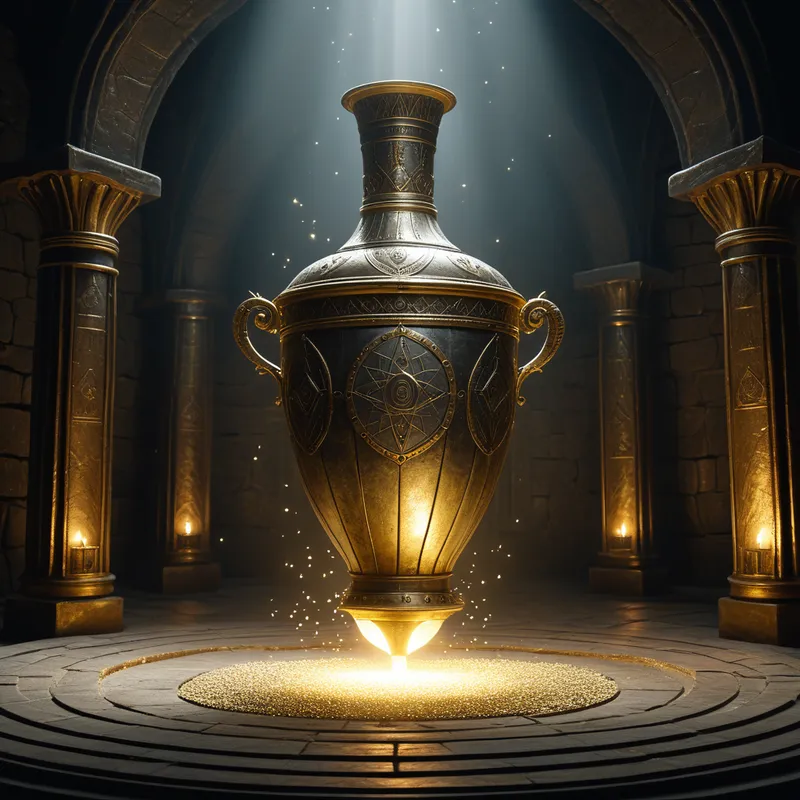
The Process of Abrasio Myth Meaning & Symbolism
A myth of the alchemical vessel, where the sacred substance is willingly ground down to nothing, dissolving all form to release its hidden, essential light.
The Tale of The Process of Abrasio
Listen, and hear the tale not of creation, but of unmaking. Not of building, but of wearing away. In the silent heart of the world, where the furnaces of the earth sigh and the waters of time run deep, there existed the Prima Materia. It was not gold, nor lead, but the substance of all potential, dark and glittering like crushed night sky. It held within it the promise of the Philosopher’s Stone, but it was bound, locked in a form that was also its prison.
The Keeper of the Vessel, a figure of neither youth nor age, whose eyes reflected the slow burn of centuries, understood. To ask the stone to reveal itself was to ask the mountain to become the valley. Force would only shatter it. Fire would only blacken it. The secret was not in addition, but in subtraction. Not in heat, but in friction.
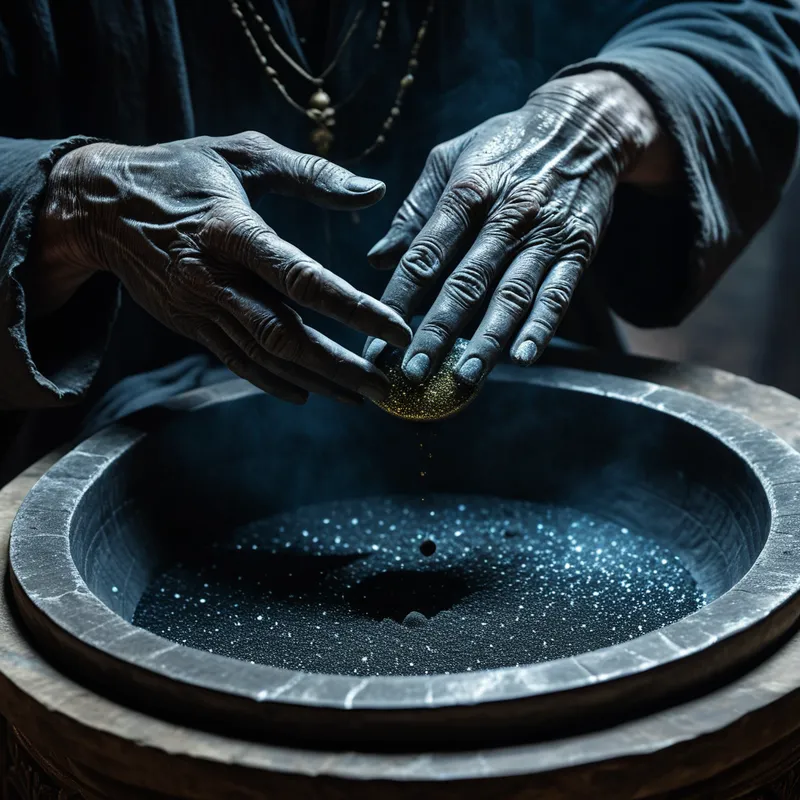
And so began the Abrasio. The Keeper took the precious Prima Materia—this fragment of condensed cosmos—and did not place it on a pedestal. They poured it into a shallow basin of unpolished basalt. With a stone smoother than a riverbed and heavier than regret, they began to grind. There was no glorious explosion, no chanting of spells. Only the relentless, whispering crush-crush-crush of stone upon substance, a sound so small it echoed the grinding of continental plates.
The substance resisted. It was prideful in its form. It glittered defiantly, each granule a tiny, hard star. The Keeper’s arms ached, their mind wearied by the monotony of destruction. Doubt, a cold serpent, coiled in their gut. “You are destroying the very thing you seek,” it hissed. “You are making dust of divinity.” Yet, the Keeper did not stop. The grinding was a prayer of patience, a liturgy of loss.
Days turned into cycles of the moon. The glitter lessened. The proud, granular form began to yield, not to become powder, but to become less. It lost its boundary. It mingled with the dust of the basin itself, becoming indistinguishable from the common stone that held it. To an outside eye, it was gone. A waste. A tragic reduction of something precious into nothing.
But in that moment of total dissolution, when not a single identifiable grain of the original substance remained, the miracle occurred. Not from above, but from within the very nothingness. A light began to glow. It was not a light that shone on the dust, but a light that emanated from it, as if the act of grinding had not destroyed, but had finally worn away the opaque shell that hid the inner sun. A soft, gold-white luminescence, warm and essential, filled the basin. It was the Spiritus Mundi, freed. The Keeper, covered in the dust of their labor, wept. They had not found the stone; they had allowed the stone’s hidden light to find the world.
Cultural Origins & Context
The myth of the Abrasio did not originate in a single text or from a lone master, but emerged from the collective practice of the alchemical artisanal guilds of late medieval Europe. It was an oral tradition, passed from master to apprentice not as a formal lesson, but as a story whispered during the long, repetitive tasks of the laboratory: while grinding herbs, polishing metals, or stirring solutions. Its tellers were not kings or priests, but practical workers in soot-stained workshops who witnessed daily the transformations of matter.
Societally, it functioned as a counter-narrative to the more famous tales of heroic conquest and glorious transmutation. In a culture obsessed with obtaining gold, the Abrasio myth served as a necessary corrective—a spiritual safety valve. It taught that the first and most sacred work was not gain, but loss; not inflation, but humble reduction. It legitimized the often-despised, tedious, and “destructive” early stages of the work, framing them not as failure, but as the essential, holy precondition for any true revelation. It was a myth for the disillusioned, for the one who had tried the grand experiments and found only dross, directing them back to the simplest, most humbling action of all.
Symbolic Architecture
Psychologically, the myth maps the terrifying yet necessary process of ego dissolution. The Prima Materia represents the complex, hardened structure of the conscious personality—our identities, achievements, defenses, and pride. It is substantial, it has form, and it glitters with the allure of who we think we are.
The Abrasio is the voluntary submission of the psyche’s prized forms to the mill of experience, where what was complex is made simple, and what was solid is returned to flux.
The Keeper is the nascent Self, the organizing principle of the psyche that intuits a greater wholeness lies beyond the current form. The grinding stone is the relentless friction of life: disappointments, failures, crises, and the slow, wearing passage of time that challenges our fixed notions. The common basalt basin is the humble, often painful, reality of embodied existence into which our grandiosity must be poured.
The critical turn is the moment when the substance becomes indistinguishable from common dust. This symbolizes the total disintegration of the ego’s project, the “dark night of the soul” where all previous identity is lost. The ensuing light, the Spiritus Mundi, is the emergent authentic Self, not built by the ego, but revealed only when the ego’s obstructive formations are worn away. It is the light of essence, which was always present but occluded by the very substance that sought to contain it.

The Dreamer’s Resonance
When this myth stirs in the modern unconscious, it manifests in dreams of profound reduction and yielding. One may dream of teeth crumbling to sand, of a cherished house slowly weathering away to its foundation, or of writing in a journal only to have the ink fade and the pages become blank. These are not nightmares of attack, but somber dreams of erosion. The somatic sensation is often one of deep fatigue, of “wearing thin,” or of a curious lightness following a period of great burden.
Psychologically, the dreamer is in the active phase of Abrasio. A long-held identity—the successful professional, the perfect caregiver, the invulnerable rebel—is being ground down by life’s circumstances. The dream confirms the process: the ego-structure is dissolving. The anxiety in the dream mirrors the Keeper’s doubt, the fear that this loss is annihilation. The work for the dreamer is to recognize the process not as a meaningless suffering, but as a sacred, if arduous, operation. The goal is to shift from resisting the friction to understanding its purpose, to become both the Keeper and the willing substance.

Alchemical Translation
For the modern individual seeking individuation, the Abrasio is the foundational, non-negotiable first step. Our culture prizes accretion—more knowledge, more possessions, more experiences, a more “curated” self. Alchemy, through this myth, prescribes the opposite starting point: a strategic, courageous subtraction.
To transmute lead to gold, one must first discover that the perceived gold of the ego is, in fact, the leaden weight that must be sacrificed.
This translates to the psychological work of surrendering the persona—the mask we wear for the world. It is the voluntary deconstruction of the “brand of me.” This may involve quitting a prestigious but soul-deadening job, ending a relationship that defines you but diminishes you, or confronting a core belief about your own capability or worthiness that you’ve used as armor. It is an active, often painful, participation in your own humbling.
The triumph of the myth is not in avoiding the grind, but in persisting through it until the moment of emptiness. The modern “light” that appears is not sudden enlightenment, but a quiet, durable sense of authenticity. It is the feeling of relief when you stop performing. It is the clarity that emerges after a period of breakdown. It is the simple, unadorned voice that speaks after the cacophony of internal critics and social expectations has finally been worn to silence. The Abrasio teaches that the true self is not constructed; it is excavated from beneath the rubble of who we were told to be. The process is the path.
Associated Symbols
Explore related symbols from the CaleaDream lexicon: