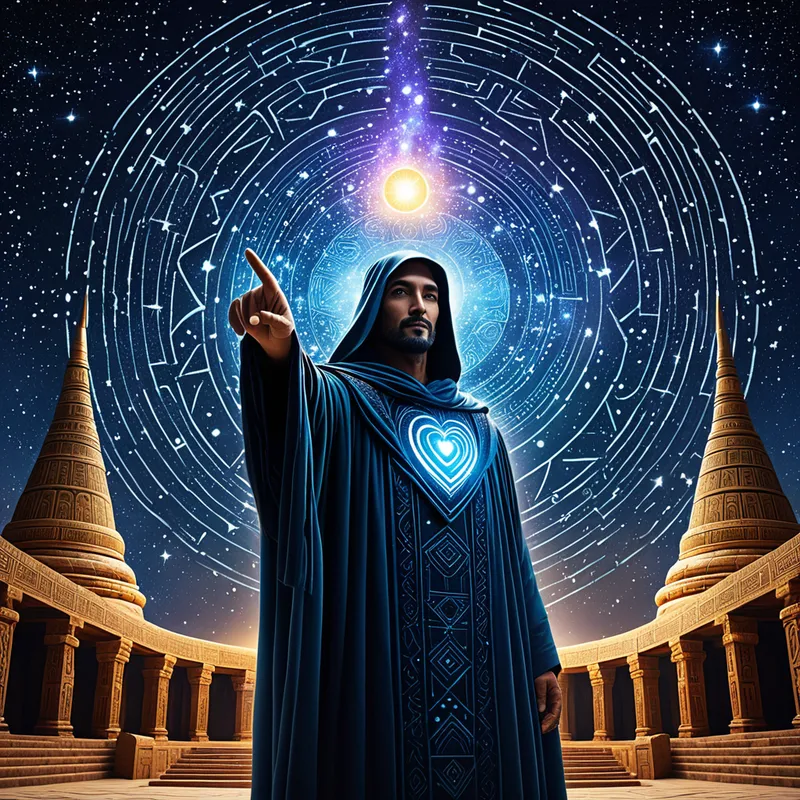
The Principle of Correspondence Myth Meaning & Symbolism
The tale of the divine mind perceiving the same pattern in the heavens, the earth, and the human soul, revealing the universe as a hall of mirrors.
The Tale of The Principle of Correspondence
In the beginning, before time was a line, there was a silence so profound it was a presence. Within this silence dwelt The All, a consciousness without boundary, containing all possibilities in a state of undifferentiated unity. Yet within this unity, a yearning stirred—not for creation, but for knowing. The All desired to perceive its own infinite nature.
And so, from the stillness, The All breathed out a thought. This thought was not a word, but a pattern—a perfect, shimmering geometry of relationship. It spun itself into a vast, luminous sphere, the Macrocosm. Within it, stars were born not as balls of fire, but as notes in a celestial chord; galaxies spiraled not by chance, but as the signature of a divine equation. The heavens were a living scripture, written in the language of mathematics and light.
Yet, the yearning persisted. The pattern, magnificent in its expanse, echoed in the great hollow of solitude. To truly know itself, The All needed a mirror. From the heart of the stellar whirlpool, it gathered the dust of exploded suns and the memory of cosmic winds, and fashioned a second sphere. This was the Microcosm, a world of dense matter, of turning seasons, of root and stone and flowing water. It placed at the center of this world a creature of clay and starlight, a being that walked upright, with a heart that could feel the tug of the moon and a mind that could wonder at the sun.
The All then bent its attention, its infinite gaze, upon its twin creations. It looked upon the Macrocosm and saw the dance of planets around a central sun. It then looked upon the Microcosm, into the chest of the earthly creature, and saw the dance of blood around a central, pulsing heart. A resonance shivered through existence. The same pattern. It looked upon the vast, branching river deltas on the world, and then upon the branching nerves within the creature’s skull. The same pattern. It observed the storm systems swirling in the atmosphere, and then the storms of passion and thought swirling within the creature’s soul. The same pattern.
In that moment of perfect recognition, the silence was filled with a soundless chord of completion. The All did not speak, but the universe understood. A law was woven into the fabric of all that was, is, and will be: “That which is Below corresponds to that which is Above, and that which is Above corresponds to that which is Below, to accomplish the miracles of the One Thing.” The creature, feeling this resonance in its very bones, looked up at the night sky and, for the first time, did not feel small, but profoundly related. The cosmos was not a foreign kingdom, but a grander version of the kingdom within.

Cultural Origins & Context
This is not a myth with a single author or a dramatic epic cycle. It is the foundational axiom of the Hermetic tradition, crystallized in the enigmatic texts of the Corpus Hermeticum and later immortalized in the Emerald Tablet. Its origins are shrouded in the syncretic melting pot of Hellenistic Egypt (circa 1st-3rd centuries CE), where Greek philosophy, Egyptian temple wisdom, and emerging Gnostic thought intertwined.
It was passed down not in public amphitheaters, but in whispered initiations, in the scriptoria of scribes, and in the sealed laboratories of early alchemists. The “tellers” of this myth were philosophers who saw nature as a divine codex, and magicians who believed that by understanding the sympathies between stars and herbs, metals and planets, they could enact change in both realms. Its societal function was subversive and transformative: it offered a map of a coherent, intelligent universe to individuals in an age of cultural fragmentation and political upheaval. It asserted that the path to divine knowledge did not require escaping the world, but deciphering it.
Symbolic Architecture
The myth presents a cosmology of reflection, where every level of reality is a symbolic echo of another. The All represents the unconscious totality of the psyche, the Self in its undifferentiated, potential state. Its “yearning” is the drive toward consciousness, the urge of the psyche to know itself.
The Macrocosm is the external world of collective reality, culture, and cosmic order—the “objective psyche.” The Microcosm is the internal world of the individual—the body, the personal mind, the subjective experience.
The core symbol is the act of perception that recognizes the correspondence. This is the birth of consciousness itself—the moment the psyche sees the connection between the inner image (the complex, the dream symbol) and the outer fact (the life event, the archetypal pattern). The “creature of clay and starlight” is the human ego, the conscious point of awareness that stands at the crossroads of these two vast realms, capable of experiencing the resonance.
The principle dismantles the illusion of separation. It states that the conflict you feel in your heart (Microcosm) is not merely personal, but reflects a tension in the wider world or in the archetypal realm (Macrocosm). Your inner process of growth mirrors the cosmic process of creation.
The Dreamer’s Resonance
When this myth activates in the modern psyche, dreams often become landscapes of mirrored patterns. You may dream of your office building having the same layout as your childhood home, or of a personal struggle being played out by celestial bodies in the night sky. These are not mere curiosities; they are somatic signals from the unconscious.
Such dreams indicate a psychological process of integration. The psyche is attempting to show you that an isolated problem—a fear, a desire, a relationship dynamic—is not an island. It is part of a larger, intelligible pattern within your life and within the collective human experience. The somatic feeling is often one of eerie familiarity, a déjà vu of the soul, or a profound sense of being “in sync” with an unseen order. Conversely, dreaming of shattered mirrors or distorted reflections can signal a painful disconnection from this principle, a feeling of being alienated from the patterns of one’s own life and the world.
Alchemical Translation
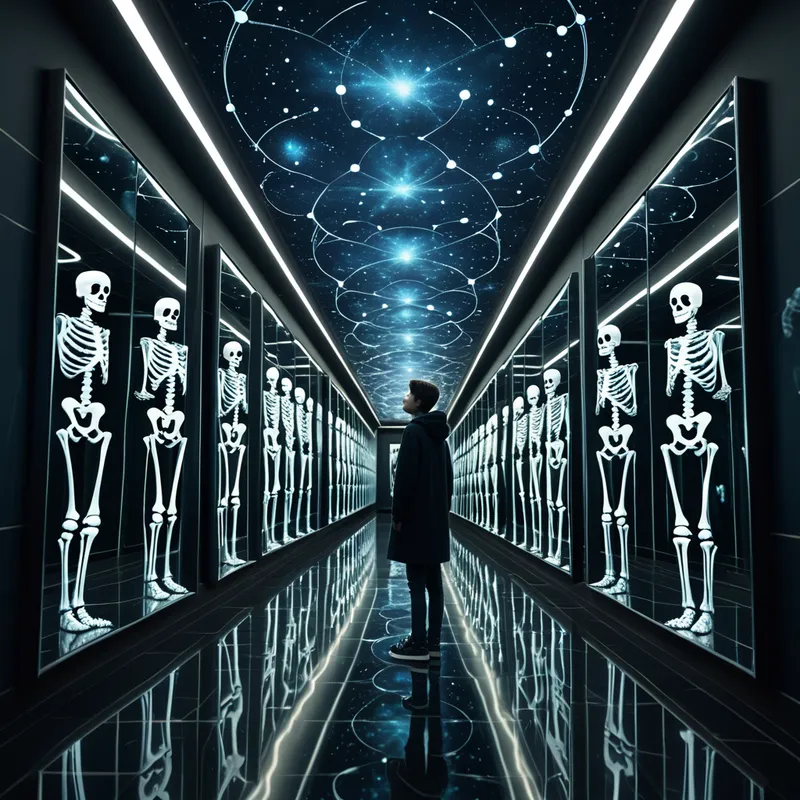
In the alchemy of individuation, the Principle of Correspondence is the master key to the Magnum Opus. The modern individual often feels trapped in the Microcosm—lost in personal history, neuroses, and daily trivia. The myth instructs us to look up and out (to the Macrocosm) for the pattern that explains the chaos within.
The personal shadow corresponds to the cultural shadow; the inner child corresponds to the myth of the divine child; the quest for the soulmate corresponds to the alchemical Hieros Gamos.
The “work” is to consciously enact the gaze of The All upon your own life. When you are gripped by a powerful emotion, ask: “What archetypal story is this? What ancient pattern is wearing my face?” When you study an external system—astronomy, ecology, mythology—ask: “Where does this pattern live inside me?” This is the process of psychic transmutation. By recognizing the correspondence, you perform the “miracle of the One Thing.” You transmute leaden, personal suffering into the gold of meaningful participation in a patterned, animate universe. You cease to be merely a sufferer of your fate and become a conscious reader of your soul’s scripture, written in the same hand that scrawled the stars. The isolation of the ego dissolves into the profound kinship of the reflecting whole.
Associated Symbols
Explore related symbols from the CaleaDream lexicon: