The Praying Posture Myth Meaning & Symbolism
A myth of the body becoming a bridge, where the soul's descent into humility meets the divine ascent in a gesture of ultimate dialogue.
The Tale of The Praying Posture
In the beginning of the gesture, there is only the weight of the world. It settles on the shoulders, a mantle of lead and longing. The air is thick with unspoken words—pleas that clot in the throat, praises that turn to ash on the tongue. The soul is a sealed chamber, echoing with its own solitude.
Then, the knees begin to bend.
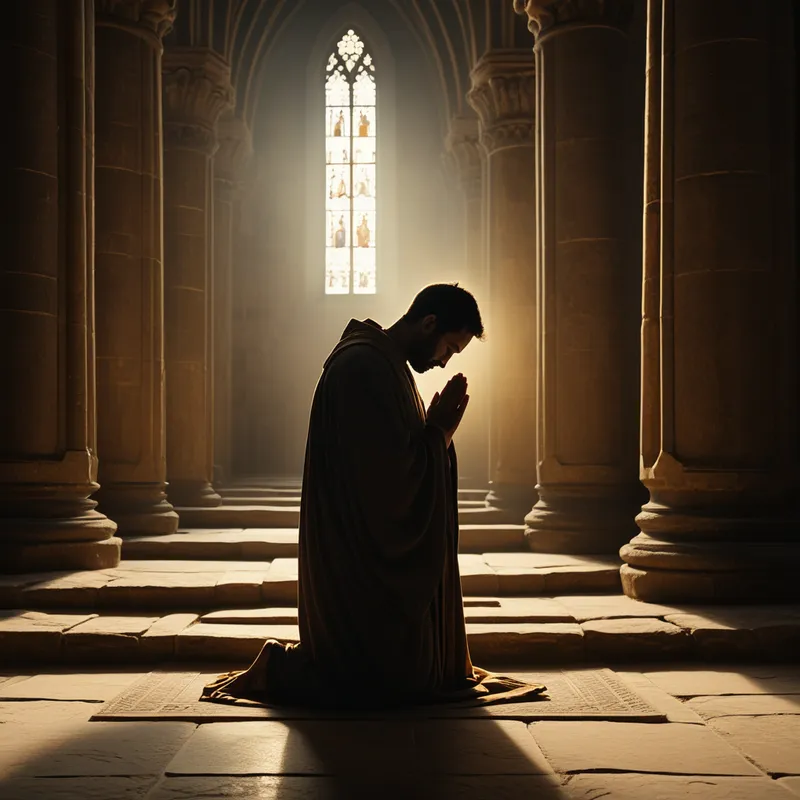
It is not a collapse, but a deliberate descent. The body, that stubborn temple of will, meets the unyielding earth—stone, wood, soil. The contact is a shock, a confession: I am not the axis on which the cosmos turns. The spine, that proud pillar, curves. The head, that seat of cunning and crown of ambition, bows. The eyes close, shutting out the kingdom of forms to gaze upon the kingdom within. The world recedes, its colors dimming, its noises fading to a distant hum.
Now, the hands. Fingers that have grasped, built, and fought now seek each other. They interlace, palm to palm, a lattice of flesh. This is the locking of the gate. All that one holds—fear, hope, memory, desire—is gathered into this cup of bone and skin. The clasp is an act of containment, of offering. The hands become a single, silent vessel.
And in that silence, a space is carved. It is a hollow in the noise of being, a listening post at the frontier of the self. Here, in the crucible of the bowed body, the soul stands upright. The psyche leans forward, an archer drawing a bowstring of attention. The breath slows, becoming the tide of this inner sea. The plea, once trapped, now finds a channel. It is not shouted, but breathed. It rises not as a demand, but as a scent of incense—a fragrance of need released into the vastness.
This is the posture of the bridge. The body is the arch, grounded in the earth of mortality, its apex pointing toward an unseen summit. In the curve of the back is the whole arc of existence: the fall into matter and the yearning to return. The one who kneels becomes both supplicant and sanctuary, the question and the quiet room where the answer might resonate.
The moment holds. There is no thunderous reply, no parting of the celestial veil. Only the persistent beat of the heart against the ribcage, a drum in the dark. The resolution is not in an external voice, but in the quality of the silence that follows the offering. It is a silence that feels… received. The weight, though not gone, is shared. The one who rises from the stone is the same, and yet not. They have deposited their burden at a threshold. They carry back with them only the imprint of the kneeler on the earth, and the memory of the hollow space where the self met something Other, and was not consumed, but heard.
Cultural Origins & Context
The myth of the praying posture is not bound to a single text, but is woven into the very fabric of Christian practice and art. Its origins are a confluence of ancient Mediterranean and Near Eastern postures of submission, supplication, and respect before both royalty and deity. In the early centuries of the Christian movement, prayer was often performed standing, with arms outstretched (orans), mirroring the crucifixion. The kneeling posture gained profound significance as a marker of metanoia—penitence, humility, and adoration.
It was passed down not merely through scripture, but through embodied ritual. A child learns it by watching a parent at a bedside. A congregation enacts it in unison, a field of bodies dipping like grass in a wind. Medieval monks codified it in the Liturgy of the Hours, their bodies bending at specific psalms. Renaissance painters like Bellini or Membling froze the posture in oil and light, making the humble kneeler the focal point of divine encounter. Its societal function was dual: it was a public declaration of faith and hierarchy within the community, and a private technology of the soul, a method for the individual to enact their relationship with the numen.
Symbolic Architecture
The posture is a complete symbolic system, a hieroglyph written with the body.
The body in prayer is a sentence written in the grammar of surrender. The knees spell humility, the bowed head spells reverence, and the clasped hands spell the offering of one’s entire story.
The knees on the ground symbolize the conscious descent from the ego’s throne. It is a voluntary relocation of the center of gravity from the head (intellect) to the earth (the grounded, the mortal, the receptive). The bowed head and closed eyes represent the turning away from the external, projected world—the “it”—and the turning inward toward the subjective “Thou.” It is the death of the spectator and the birth of the participant. The clasped hands are perhaps the most potent symbol. They gather the disparate, often warring, energies of the individual—the grasping left hand of desire, the giving right hand of action—and unite them into a single, contained vessel. They no longer reach to take or to push away, but to hold and to offer.
Psychologically, the figure in the praying posture represents the orphan archetype. This is not a weak orphan, but one who has consciously acknowledged their state of existential separation and, in that acknowledgment, actively seeks reconnection. The posture is the embodied expression of the orphan’s cry, not from a place of helplessness, but from a place of focused, disciplined longing.
The Dreamer’s Resonance
When this myth surfaces in modern dreams, the dreamer is often at a psychological impasse where conscious will has failed. To dream of kneeling, especially with a sense of necessity or awe, signals a somatic recognition that the ego must yield. The body in the dream knows what the waking mind resists: a need to surrender control.
The dream may feature the dreamer adopting the posture in an incongruent setting—kneeling in a boardroom, on a subway platform, or in a childhood bedroom. This juxtaposition highlights the conflict between the soul’s need for humble dialogue and the persona’s commitment to worldly power and competence. The feeling tone is crucial. Is it forced, filled with shame? This may point to a tyrannical inner critic or superego. Is it peaceful, a relief? This suggests the psyche is ready to deposit a burden it can no longer carry alone. The act in the dream is the psyche’s ritual, preparing the ground for a numinous encounter that the conscious ego is not yet equipped to have while awake.
Alchemical Translation
The journey of the praying posture is a perfect map for the alchemical process of individuation. It models the psychic transmutation from leaden ego-isolation to golden connection with the Self.
The first stage, nigredo (the blackening), is the felt weight, the confession of brokenness or limitation that initiates the kneel. The descent to the knees is the solutio (dissolution), where rigid ego structures are softened and dissolved in the waters of humility. The bowing of the head is the separatio, consciously separating from identification with the persona and its worldly concerns.
The clasped hands perform the coniunctio—the sacred marriage within. Here, opposites (conscious/unconscious, strength/vulnerability, self/other) are held together in tension, not to be resolved, but to create the vessel for something new.
The silent, listening wait in the posture is the albedo (whitening), a purification and clarification. From this still center, the rubedo (reddening) may emerge: not as a shouted answer, but as a subtle, enlivening warmth—a sense of meaning, direction, or peace that feels bestowed rather than manufactured. The one who rises has performed the inner work. They have not been given a solution, but have activated the internal receptor for grace. The transformed posture is no longer just a physical act, but an enduring inner attitude—a flexible spine of the soul that knows both how to stand in its truth and how to bend in reverence to the greater Mystery of which it is a part.
Associated Symbols
Explore related symbols from the CaleaDream lexicon: