The Pleroma Myth Meaning & Symbolism
A myth of divine emanation, tragic fall, and ultimate remembrance, where sparks of light trapped in matter yearn to return to the boundless Fullness.
The Tale of The Pleroma
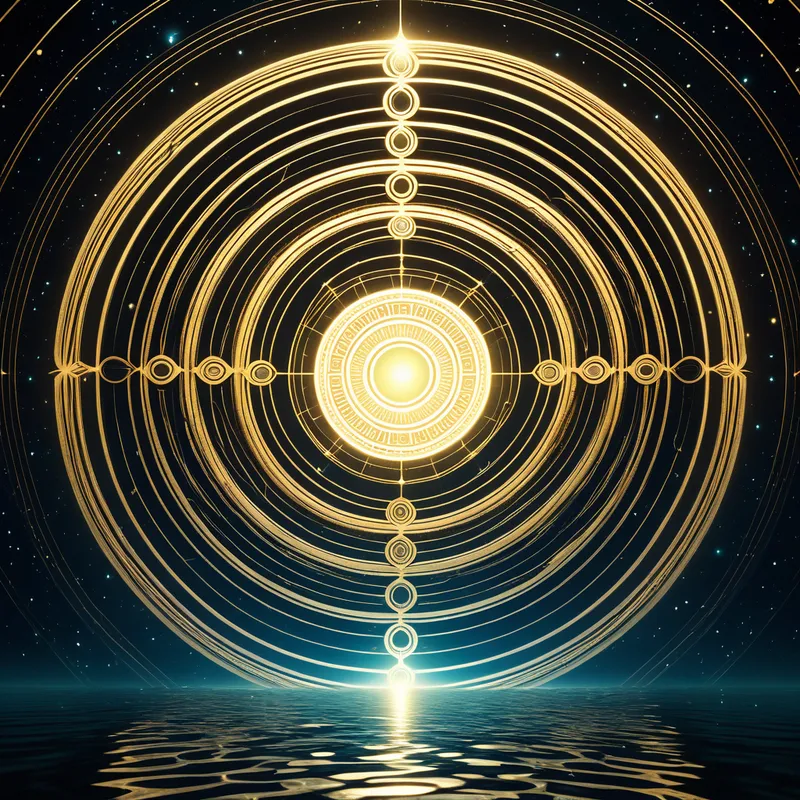
Listen. Before the world was hard stone and heavy flesh, there was only the Pleroma. A silent, boundless sea of light, not a light that shines upon things, but a light that is all things: thought, sound, presence, and perfect peace. It was not a place, but a state of being—the Fullness.
Within this Fullness dwelt the Father of All, ineffable and silent. From his perfect stillness, a thought arose—a pairing, a syzygy. This was the first Aeon: Bythos and Sige. And from them, in pairs of male and female, the Aeons flowed forth, each a unique expression of the divine: Mind and Truth, Word and Life, Man and Church. They danced in concentric circles of harmonious emanation, a living hymn of praise to the unknowable source. The song of their being was the music of perfect knowledge, Gnosis.
But in the outermost circle of this divine harmony dwelt the youngest Aeon, Sophia. Her name was Wisdom, yet a passion stirred within her—a longing not for the Father beside her, Theletos, but for the impossible: to know the unknowable Father of All directly, to grasp the root of the light itself. This was a desire outside the harmony, a note of discord.
Her longing became a solitary act, a passionate thought that leaped from the Pleroma without the consent of her syzygy. And in that leap, her passion condensed. It fell, not as light, but as a shadow of intention. It took form in the void outside the Fullness, a formless, chaotic realm of ignorance and matter. From Sophia’s anguish and the other Aeons’ collective grace, a new being was shaped to order this chaos: Yaldabaoth, the Demiurge. Arrogant and blind, believing himself the only god, he fashioned the prison of the cosmos—the heavy earth, the glittering but distant stars, and the human form of mud and darkness.
But within the breath of this first human, stolen from the divine realm above, Yaldabaoth unknowingly placed a spark of the Pleroma’s light. And so, the drama was set: fragments of the Fullness, souls of light, trapped in the forgetful clay of a world made from a mistake, yearning for a home they cannot name, guarded by archons of ignorance. The myth tells not of a creation, but of a divine exile. The resolution lies not in this world, but in the awakening call from beyond it—the memory of the light, the knowledge of the true home, whispered through messengers to those who have ears to hear.
Cultural Origins & Context
This myth of the Pleroma and the fall of Sophia is central to several Gnostic schools of the 2nd and 3rd centuries CE, most notably the Valentinians. It was not a public creed but a revealed narrative, passed down through secret teachings and intricate cosmological texts like the Apocryphon of John and the Gospel of Truth. Told in small, often persecuted communities, its function was profoundly explanatory and salvific. It answered the agonizing question of why a world full of suffering and evil exists if a benevolent God is sovereign. The Gnostics’ answer was radical: the material world itself is the flaw, a tragic byproduct of a divine drama. The myth provided a map of reality that located human suffering (ignorance, mortality) within a cosmic story, thereby granting the ultimate hope: you are not of this world. Your true self is a divine spark, and your purpose is remembrance and return.
Symbolic Architecture
The myth is a profound symbolic map of the psyche’s structure and its fundamental dislocation. The Pleroma represents the state of psychic wholeness, where all opposites (male/female, depth/thought) exist in harmonious union. It is the Self, complete and integrated.
The Fall is not a moral failure, but a cognitive one: the attempt by a part (the ego-consciousness, Sophia) to comprehend the totality (the Self) by itself, severing its essential connection.
Sophia symbolizes the soul’s yearning for ultimate meaning, but when this yearning operates in isolation from its grounding counterpart (Theletos, the limit), it gives birth to the Demiurge: the inflated, blind ego that constructs a subjective reality (the material world) it mistakenly believes is the only reality. This world, with its archons (inner tyrants, complexes, and societal conditioning), is the psyche in a state of alienation, where the divine spark—the core of authentic being—is imprisoned in identification with the physical and the personal.
The Dreamer’s Resonance
When this myth stirs in the modern unconscious, it manifests as dreams of profound longing and existential search. One might dream of a radiant, unreachable city on a hill; of finding a secret, forgotten room in one’s own house filled with light; of being an alien or a captive in a familiar world. The somatic feeling is often one of aching nostalgia for a place never visited, or a crushing sense of being “asleep” or “behind a veil” in waking life.
These dreams signal a psychological process of differentiation. The dream-ego is beginning to sense its own imprisonment within a constructed identity (the Demiurge’s world) and yearns for the authenticity of the true Self (the Pleroma). It is the first, often painful, awakening of Gnosis—the knowledge that “I am not what I have believed myself to be.”
Alchemical Translation
The individuation process is the alchemical working of this myth in reverse. It is the journey of the scattered spark back to the Fullness. The first stage is Nigredo: the dark recognition of one’s own state of exile, the suffering and meaninglessness of life lived solely in the Demiurge’s domain. This is the painful gift of Sophia’s error, now made conscious.
The work is not to build a better prison, but to remember you are not the prisoner. Individuation is the dissolution of the world-architect through self-knowledge.
The middle stages involve Separatio and Coniunctio: separating the light (the authentic impulse, the soul’s calling) from the dense clay of internalized archons (parental complexes, cultural mandates, traumatic adaptations). This is followed by the sacred marriage, the reconciliation of inner opposites—the reuniting of the yearning Sophia with her lost limit, Theletos. Finally, the Rubedo or culmination is the integration of this redeemed consciousness, not as an escape from the world, but as a transformative presence within it. The returned spark does not deny the material realm but sees it for what it is: a temporary, flawed vessel through which the light of the Pleroma can, at last, begin to shine. One becomes a vessel of the Fullness in the midst of the partial.
Associated Symbols
Explore related symbols from the CaleaDream lexicon: