The Pleiades Myth Meaning & Symbolism
Seven daughters of a Titan, pursued by a hunter, find eternal refuge in the heavens as a star cluster, a celestial story of loss, protection, and transformation.
The Tale of The Pleiades
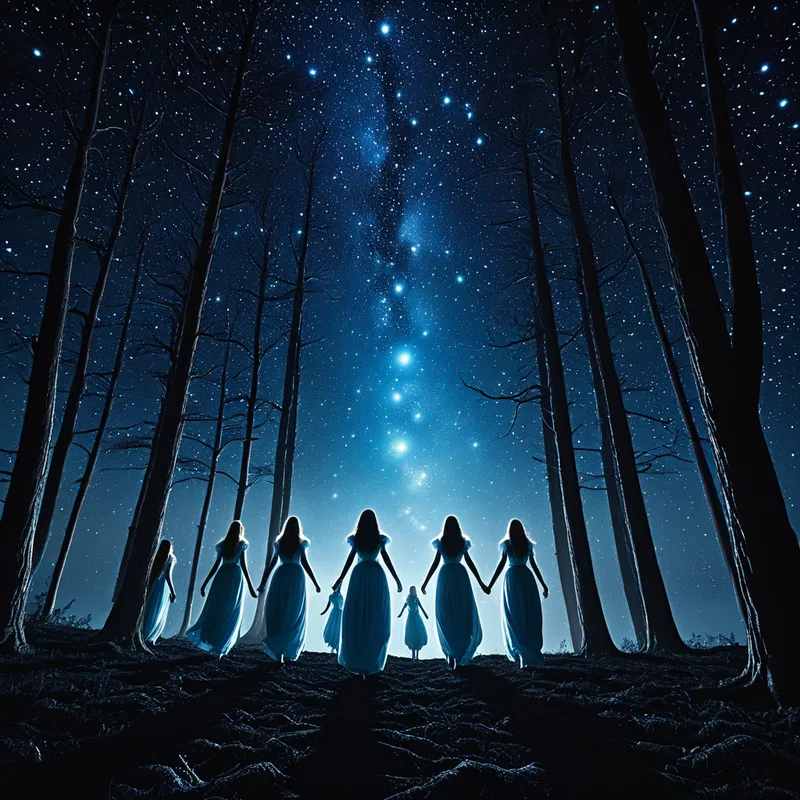
Hear now the tale written not on parchment, but across the vault of heaven itself. It begins not with a birth, but with a burden. Their father was Atlas, whose shoulders bore the crushing weight of [the sky](/myths/the-sky “Myth from Persian culture.”/). Their mother was Pleione, the sailing queen, whose name means “to increase.” From this union of endurance and abundance came seven daughters: Maia, the secluded; Electra, the amber-haired; Taygete; Alcyone; Celaeno; Sterope; and Merope, who alone among them wed a mortal.
They dwelt in the wild, beautiful places of [the earth](/myths/the-earth “Myth from Hindu culture.”/), in the valleys of Boeotia and the glades of Cyllene. Their laughter was like the ringing of silver bells, and their footsteps left dewy prints where flowers would later bloom. But their radiance drew a gaze that was not kind.
For five years, the mighty hunter [Orion](/myths/orion “Myth from Greek culture.”/), driven by a relentless and possessive passion, pursued them. Across meadow and mountain, through day and deepening dusk, his shadow fell upon their path. The sisters fled, a flutter of white robes and desperate breaths, their fear a cold scent on [the wind](/myths/the-wind “Myth from Various culture.”/). The earth offered no hiding place deep enough, no forest thick enough to conceal them from his unwavering desire.
Their cries, thin and sharp as broken crystal, rose to the ears of the gods. They called first to their titanic father, but Atlas could not move, the heavens trembling on his back. In their ultimate moment of despair, as Orion’s hand seemed to reach for [the veil](/myths/the-veil “Myth from Various culture.”/) of the youngest, they called upon Zeus himself. The father of gods heard the purity of their terror. Not with a thunderbolt, but with a profound, merciful metamorphosis, he answered.
He transformed them, not into stone or tree, but into a form of pure, untouchable light. Their mortal forms dissolved like morning mist, and in their place, seven luminous points of silver fire blossomed in the dark fabric of the night. He gathered them up and set them in the firmament, a tight cluster of stars—the [Pleiades](/myths/pleiades “Myth from Greek culture.”/)—forever beyond the grasp of the earthly hunter. And there Orion remains, immortalized in stars himself, forever chasing, never catching, his desire fossilized in an eternal celestial dance.
Cultural Origins & Context
The story of the Pleiades is a foundational star-lore, far older than the written Homeric epics. It belongs to the oral tradition of ancient Greek farmers, sailors, and poets—those whose lives were intimately tied to the rhythms of the cosmos. Hesiod, in his Works and Days, references them not as characters in a drama, but as practical timekeepers. Their heliacal rising (their first appearance before dawn) marked the beginning of the sailing season, and their setting signaled the start of winter and the time for ploughing.
This dual existence—as both a practical almanac and a profound myth—reveals its societal function. The myth provided an aition, a sacred story explaining a natural phenomenon. It answered the human question: “Why are those stars there, clustered so?” But more deeply, it embedded human emotions—fear, grief, longing, protection—into the impersonal night sky, making the cosmos a familiar, story-filled landscape. It was told by bards at feasts and by mothers at hearths, a shared narrative that connected the community to the turning of the year and the mysteries above.
Symbolic Architecture
At its core, the Pleiades myth is an archetypal [drama](/symbols/drama “Symbol: Drama signifies narratives, emotional expression, and the exploration of human experiences.”/) of persecution and [apotheosis](/symbols/apotheosis “Symbol: The transformation of a mortal into a divine or godlike state, representing ultimate spiritual elevation and transcendence of human limitations.”/)—of being hunted on [earth](/symbols/earth “Symbol: The symbol of Earth often represents grounding, stability, and the physical realm, embodying a connection to nature and the innate support it provides.”/) and finding sanctuary in the [cosmos](/symbols/cosmos “Symbol: The entire universe as an ordered, harmonious system, often representing the totality of existence, spiritual connection, and the unknown.”/). The seven sisters symbolize a vulnerable, beautiful [aspect](/symbols/aspect “Symbol: A distinct feature, quality, or perspective of something, often representing a partial view of a larger whole.”/) of the [psyche](/myths/psyche “Myth from Greek culture.”/) or [soul](/symbols/soul “Symbol: The soul represents the essence of a person, encompassing their spirit, identity, and connection to the universe.”/) that is threatened by a singular, overpowering force (Orion’s obsessive [pursuit](/symbols/pursuit “Symbol: A chase or being chased in dreams often reflects unresolved anxieties, unfulfilled desires, or internal conflicts demanding attention.”/)). This force can be interpreted as crushing [fate](/symbols/fate “Symbol: Fate represents the belief in predetermined outcomes, suggesting that some aspects of life are beyond human control.”/), overwhelming desire, [trauma](/symbols/trauma “Symbol: A deeply distressing or disturbing experience that overwhelms the psyche, often manifesting in dreams as unresolved emotional wounds or psychological injury.”/), or any annihilating pressure that seeks to consume individual [identity](/symbols/identity “Symbol: Identity represents the sense of self, encompassing personal beliefs, cultural background, and social roles.”/).
The transformation into stars is not an escape, but a sublime translation. It is the psyche’s ultimate defense: when earthly existence becomes unbearable, the essence retreats into an eternal, observational state.
The [cluster](/symbols/cluster “Symbol: A dense grouping of similar elements, representing complexity, patterns, or interconnectedness within a larger system.”/) itself is rich in [symbolism](/symbols/symbolism “Symbol: The use of symbols to represent ideas or qualities, often conveying deeper meanings beyond literal interpretation. In dreams, it’s the language of the unconscious.”/). The [number](/symbols/number “Symbol: Numbers in dreams often symbolize meaning, balance, and the quest for understanding in the dreamer’s life, reflecting their mental state or concerns.”/) seven is universally sacred, representing completeness (the seven classical planets, the seven days). Their “lost” or faint [sister](/symbols/sister “Symbol: The symbol of a sister in a dream often represents connection, support, and the complexities of familial relationships.”/) (often Merope, who hides in [shame](/symbols/shame “Symbol: A painful emotion arising from perceived failure or violation of social norms, often involving exposure of vulnerability or wrongdoing.”/) for her mortal [marriage](/symbols/marriage “Symbol: Marriage symbolizes commitment, partnership, and the merging of two identities, often reflecting one’s feelings about relationships and social obligations.”/), or Electra, who veils herself in [grief](/symbols/grief “Symbol: A profound emotional response to loss, often manifesting as deep sorrow, yearning, and a sense of emptiness.”/)) speaks to the [human](/symbols/human “Symbol: The symbol of a human represents individuality, complexity of emotions, and social relationships.”/) experience of incompleteness, of a part of [the self](/myths/the-self “Myth from Jungian culture.”/) that feels dimmed or separate from the whole. Orion, forever in pursuit, represents the unresolved complex, the perpetual [hunger](/symbols/hunger “Symbol: A primal bodily sensation symbolizing unmet needs, desires, or emotional voids. It represents craving for fulfillment beyond physical nourishment.”/) of the unconscious that can never be satisfied by the object of its desire once it has been spiritualized.
The Dreamer’s Resonance
When the pattern of the Pleiades myth arises in modern dreams, it often signals a profound experience of psychic persecution and the need for radical transcendence. The dreamer may feel relentlessly pursued by a responsibility, a memory, a person, or their own ambition. There is a somatic quality of breathlessness, of running through a landscape that offers no true cover.
To dream of becoming stars, or of seeing loved ones turn into points of light, indicates a process of dissociation in its most positive, alchemical sense. It is the psyche’s way of preserving a fragile core identity by removing it from a destructive field of engagement. The dream is not of death, but of celestial preservation. It suggests the dreamer is undergoing a necessary “cosmic distancing” from a situation that threatens to consume them, preparing for a reintegration at a higher, more symbolic level of being.
Alchemical Translation
The alchemical journey mirrored in the Pleiades is the sublimatio—the process of making the volatile fixed, of raising the base material (the persecuted sisters) to a higher, spiritual plane (the stars). For the modern individual, this models the path of transforming personal, crushing suffering into a transpersonal, guiding truth.
[The first stage](/myths/the-first-stage “Myth from Alchemical culture.”/) is bearing the “burden of Atlas”—feeling the full weight of one’s fate or trauma. The second is the relentless “pursuit by Orion,” where the pressure becomes active and personal. The crisis point is the realization that no earthly solution (no hiding place) exists.
The alchemical fire is the unbearable pressure itself. It does not destroy the essence but forces it to change its state of matter from corporeal to luminous.
The [triumph](/myths/triumph “Myth from Roman culture.”/) is the appeal to a higher authority—not an external god, but the Self, the inner Zeus. This authority performs the sublimatio: it reframes the narrative. The individual learns to see their pain not as a story of victimhood, but as the origin story of their own unique constellation of wisdom. They become a fixed point of conscious awareness in the inner cosmos, an observer of their own life’s patterns. The pursuer (the complex) is not destroyed but integrated into the celestial map—forever a part of the landscape, but now held in a vast, meaningful order. The soul finds its eternal refuge not in escape, but in becoming a guiding light for its own navigation.
Associated Symbols
Explore related symbols from the CaleaDream lexicon: