The Plague of Athens Myth Meaning & Symbolism
A devastating plague sent by Apollo ravages Athens after King Agamemnon dishonors his priest, revealing the fragility of human order before divine will.
The Tale of The Plague of Athens
Hear now, of a time when the air grew thick with the breath of gods, and the laughter of men turned to ash upon their tongues. It began not with a whimper, but with the silent scream of a father’s heart. The great host of the Achaeans, a thousand ships strong, lay beached before the towering walls of Troy, a bristling forest of spears and pride. Among them was Agamemnon, king of men, whose tent held a prize: Chryseis, daughter of Chryses, priest of the far-striking Apollo.
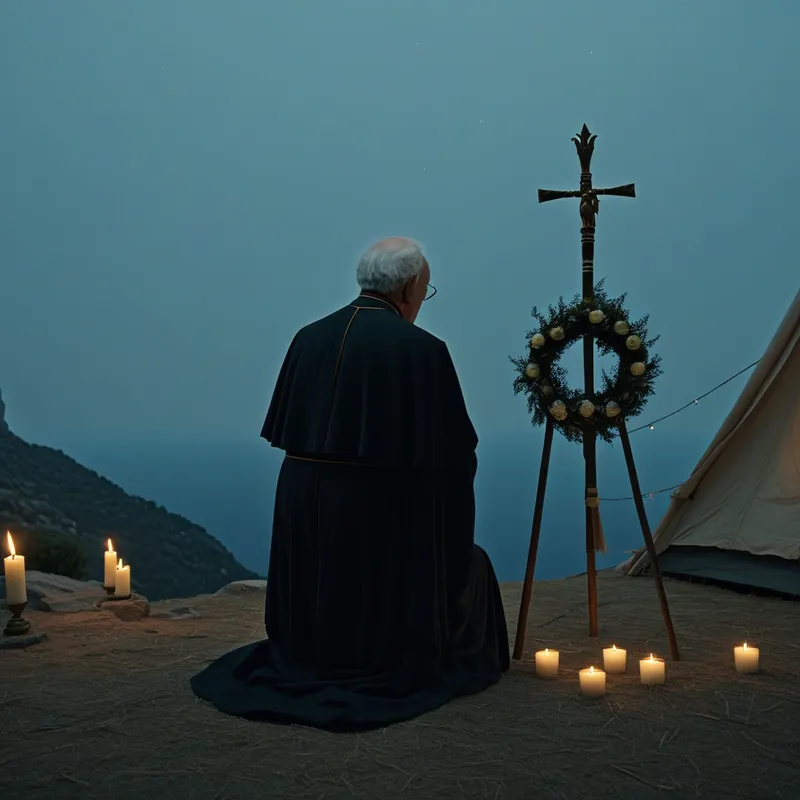
The old priest came. He did not come with threats, but with the holy symbols of his god—the staff wound with laurel, the wreaths of bright gold. His voice, thin as a reed yet carrying the weight of the sacred, filled the assembly. He offered ransom beyond counting for his child. The Achaeans roared their approval; it was right, it was pious. But Agamemnon’s heart was a stone fortress. His pride, fed by the weight of kingship, swelled. He drove the old man forth with words that cut deeper than any blade, threats that echoed in the salt air.
Chryses walked away, down the long beach to the whispering sea. There, he raised his arms to the vast, empty sky, and his prayer was not a plea, but a channeling of profound wrong. “Hear me, god of the silver bow! If ever I have built you a gracious temple or burned for you the fat thighs of bulls and goats, let your arrow repay the Danaans for my tears!”
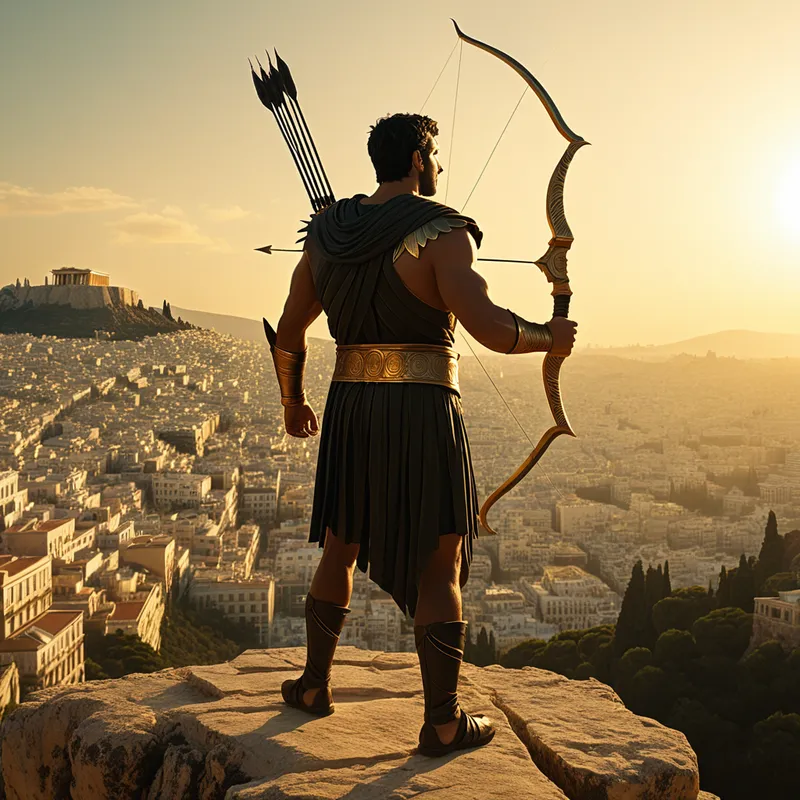
And Apollo heard. He heard from the pure heights of Olympus. Down he came, and the sound of his coming was the twang of a celestial bowstring, felt in the bone before it was heard in the ear. He came like the night, but a night born of noon—a darkness that carried its own terrible light. He settled on a vantage point, his face clouded, his quiver rattling with a sound like diseased teeth. He let fly a single shaft. Not at a hero, but at the milling dogs and mules first, then at the men themselves. The arrow did not pierce flesh; it poisoned the very air.
A new sound rose from the camp, drowning out the clash of practice arms and the boasting songs. It was the muffled thud of bodies falling. It was the dry, wracking cough that brought up black bile. It was the fevered babble of men burning from within, their skin erupting in foul sores. Pyres, built for enemy dead, now consumed Achaeans. Day and night, the flames danced, and the smoke carried the stench of sacred failure to the uncaring stars. For nine days, the god’s melody was the death rattle, and the once-mighty army was reduced to a shuddering, dying beast. Order crumbled. Ritual ceased. The bonds of fellowship frayed as each man retreated into the private hell of his own decaying body. This was the wrath of the Far-Darter, a lesson written not on tablets, but on scorched lungs and silent hearts.
Cultural Origins & Context
This foundational narrative is not a free-standing myth but the incendiary opening act of Homer’s Iliad, the bedrock of Greek literary and cultural consciousness. Passed down through generations of oral bards before being crystallized in writing, its function was multifaceted. It was a theodicy—an explanation for why suffering exists, placing its origin in a rupture of the sacred order (themis). The story served as a powerful social corrective, dramatizing the catastrophic consequences of a leader’s hubris and his violation of xenia (the sacred guest-host relationship) and proper respect for the gods’ servants. For a Greek listener, the plague was not a random biological event but a precise, divine grammar. It taught that collective suffering often springs from a single, prideful error, and that the health of the body politic is inextricably linked to its moral and ritual hygiene. The bard, in singing this tale, was performing a cultural immune function, reminding the community of the fragile, negotiated peace between human ambition and divine law.
Symbolic Architecture
At its core, the Plague of Athens (or the Achaean camp) is a masterful depiction of the psychic consequences of unintegrated arrogance. Agamemnon’s refusal is not merely personal stinginess; it is the ego, identified with the Ruler archetype, severing connection from the Sage (the priest) and the transcendent principle he represents (Apollo, here in his shadow aspect as bringer of disease).
The god of light and reason, when his order is defiled, becomes the god of fever and chaos. The brightest archetype casts the darkest shadow.
The plague itself is the symbolic embodiment of the repressed returning. The ignored plea, the dishonored father, the stolen vitality (Chryseis)—all these psychic injuries do not disappear. They fester and erupt somatically, not just in the individual (Agamemnon) but projected onto the entire community. The “camp” represents the shared psychic space, the collective ego-structure. The symptoms—fire, pustules, diarrhea—symbolize a violent, involuntary purification. The system is being forced to expel the toxic element of unrighteous possession. Apollo’s arrow is the piercing insight of truth, which, when resisted, becomes a psychic poison.

The Dreamer’s Resonance
When this mythic pattern stirs in the modern dreamer, it often manifests not as a literal plague, but as atmospheres of pervasive contamination, inexplicable group malaise, or environments where the very air feels toxic. One might dream of an office, a family home, or a social circle suddenly gripped by a mysterious, debilitating illness. The dreamer may feel a profound, somatic weight—a feverish anxiety, a sense of skin-crawling pollution, or a choking constriction.
Psychologically, this signals that a core value or a sacred inner truth (the “priest” within) has been dishonored by the ruling, pragmatic consciousness (the “Agamemnon” ego). Perhaps a creative calling has been ransomed for security, or a moral intuition has been silenced for the sake of social or professional standing. The resulting “plague” is the soul’s rebellion. It is the depression, anxiety, or psychosomatic illness that arises when life is lived in a state of profound disrespect to one’s own deeper spirit. The dream is the body-mind’s diagnosis: the system is poisoned by a foundational act of self-betrayal.

Alchemical Translation
The alchemical journey modeled here is the nigredo—the blackening, the putrefaction, the necessary descent into the shadow of one’s own choices. The triumph is not in avoiding the plague, but in surrendering to its meaning and initiating the process of atonement (at-one-ment). In the myth, the resolution begins only when the seer Calchas, backed by the hero Achilles, names the truth: Agamemnon is the cause. The king must reluctantly give up his prize.
The first step in healing a poisoned system is the agonizing confession of its source. The treasured possession, the symbol of ego-inflation, must be relinquished.
For the modern individual, this is the process of psychic transmutation. One must identify the “Chryseis” they have wrongly claimed—the status, the relationship, the self-image that is built on the disrespect of a deeper value. The “plague” of anxiety or meaninglessness will persist until that prize is given back, until the ego makes restitution to the soul. This act of surrender is not a defeat, but the beginning of reintegration. It allows Apollo, the archetype of light and order, to return in his healing aspect. The individuation process demands we honor our inner priest, lest we summon our inner plague. The myth teaches that collective and personal health is a sacred ecology, and its first law is reverence.
Associated Symbols
Explore related symbols from the CaleaDream lexicon: