
The Pine of Attis Myth Meaning & Symbolism
A youth beloved by a goddess, driven mad by her wrath, castrates himself beneath a pine tree, which becomes his eternal, resurrected form.
The Tale of The Pine of Attis
Hear now the tale of the beautiful one, the beloved, whose fate is bound to the evergreen and the sorrow of [the Great Mother](/myths/the-great-mother “Myth from Jungian culture.”/). In the wild, highlands of Phrygia, where [the earth](/myths/the-earth “Myth from Hindu culture.”/) herself feels older and the gods walk closer, there lived a youth of surpassing beauty. His name was Attis. His form was like the slender sapling, his eyes held the darkness of the fertile soil, and his spirit was untamed as the mountain wind.
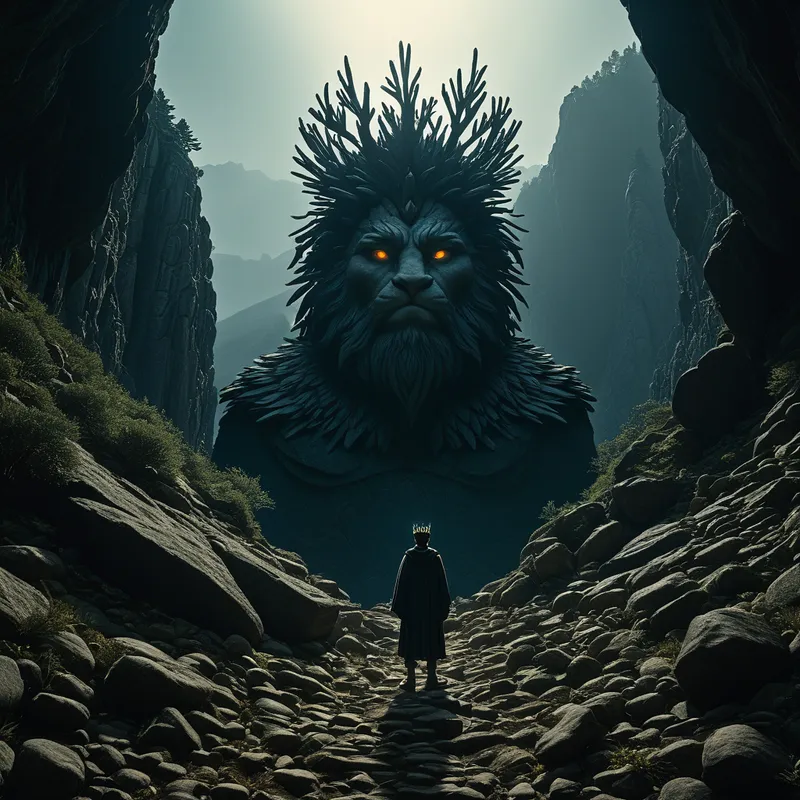
His beauty did not go unseen. It pierced the heart of the Magna Mater, Cybele herself. The goddess of the wild earth, she who rides in a lion-drawn chariot, whose crown is a mural of cities, she loved him with a possessive, consuming fire. She made him her priest, her companion, her sacred consort, swearing him to eternal chastity in her service. For a time, there was harmony. Attis presided over the ecstatic rites in her honor, the air thick with the smell of crushed pine needles and the wild rhythm of the tympanum.
But the heart of youth is a flickering flame, easily swayed. Whether by fate or folly, Attis’s gaze fell upon a nymph of the Sangarius, or in other whispers, a mortal princess. A spark of mortal love, human and fleeting, ignited within him, breaking the divine vow. The wedding was prepared.
Then came the wrath. Cybele’s jealousy was not a quiet storm but a cataclysm. She appeared at the wedding feast, not in human guise, but in the full, terrifying power of her divinity. The air cracked with her presence. She cast a madness upon Attis, a frenzy so profound it severed him from his own mind. The music of the feast became the roaring in his ears; the faces of the guests became monstrous visions.
Driven by this divine insanity, Attis fled. He ran like a wounded animal, up through the rocky passes, through the dense groves of pine. His thoughts were gone, replaced by a single, searing imperative of atonement. At the foot of a great, towering pine on the mountainside, his flight ended. In a final, terrible act of devotion and despair, seeking to offer the source of his transgression back to the goddess who claimed all, he took a sharp stone and castrated himself beneath the sacred tree. His lifeblood soaked into the roots, his cry echoing through the silent forest.
His spirit fled. But Cybele’s love, though terrible, was eternal. Filled with immediate remorse and infinite grief, she refused the finality of [Hades](/myths/hades “Myth from Greek culture.”/). She pleaded with the father god Zeus. No full return to mortal life was granted, but a compromise was struck. Attis’s body would not decay. Instead, it was transmuted. His spirit passed into the evergreen pine beneath which he fell. From that day, the pine tree of Attis stood forever green, a monument to the beautiful youth, a symbol of life persisting beyond violent change. Each spring, he is remembered, his spirit reborn with the new shoots.
Cultural Origins & Context
This is not a purely Hellenic tale. It is an import, a profound and unsettling mystery that washed onto Greek shores from the heartland of Anatolia. The myth of Attis and Cybele is fundamentally Phrygian. By the 5th century BCE, the worship of Cybele had been officially welcomed into Athens, and with the goddess came her tragic consort. The myth was not primarily conveyed through the epic poetry of a [Homer](/myths/homer “Myth from Greek culture.”/), but through the ecstatic, embodied practices of her cult.
It was a story performed, not just recited. The Galli, Cybele’s devoted priesthood who often emulated Attis’s final act, were living enactments of the myth. During the annual festival of the Hilaria and later the Roman Megalensia, the tale was relived: a pine tree, symbolizing Attis, was cut down, wrapped in woolen bands like a corpse, and adorned with violets (said to have sprung from his blood). Days of mourning were followed by wild celebration of resurrection. The myth served as the sacred narrative justifying extreme ritual practice, binding the community to the cycles of nature through a story of tragic love, violent sacrifice, and vegetative rebirth.
Symbolic Architecture
The myth is a dense [forest](/symbols/forest “Symbol: The forest symbolizes a complex domain of the unconscious mind, representing both mystery and potential for personal growth.”/) of symbols, each a key to a psychic process. At its core, it is not a simple morality tale but a map of a brutal, necessary transformation.
The castration is not merely a punishment, but the ultimate sacrifice of creative potential back to its source, a forced return to a state of undifferentiated unity with the Mother.
Attis represents the nascent, individual [consciousness](/symbols/consciousness “Symbol: Consciousness represents the state of awareness and perception, encompassing thoughts, feelings, and experiences.”/)—beautiful, creative, and full of potential. Cybele is the archetypal Great [Mother](/symbols/mother “Symbol: The symbol of ‘Mother’ represents nurturing, protection, and the foundational aspect of one’s emotional being, often associated with comfort and unconditional love.”/) in her totality: she is the [source](/symbols/source “Symbol: The origin point of something, often representing beginnings, nourishment, or the fundamental cause behind phenomena.”/) of [life](/symbols/life “Symbol: The symbol of ‘Life’ represents a journey of growth, interconnectedness, and existential meaning, encompassing both the joys and challenges that define human experience.”/), the nourishing [earth](/symbols/earth “Symbol: The symbol of Earth often represents grounding, stability, and the physical realm, embodying a connection to nature and the innate support it provides.”/), but also the possessive, devouring force that demands complete allegiance and threatens to swallow [the ego](/myths/the-ego “Myth from Jungian culture.”/) back into her unconscious [realm](/symbols/realm “Symbol: The symbol of ‘Realm’ often signifies the boundaries of one’s consciousness, experiences, or emotional states, suggesting aspects of reality that are either explored or ignored.”/). Attis’s turn toward a mortal [nymph](/symbols/nymph “Symbol: Nymphs are nature spirits embodying specific aspects of the natural world, often associated with beauty and allure.”/) symbolizes [the ego](/myths/the-ego “Myth from Jungian culture.”/)’s natural desire for [human](/symbols/human “Symbol: The symbol of a human represents individuality, complexity of emotions, and social relationships.”/) [relationship](/symbols/relationship “Symbol: A representation of connections we have with others in our lives, often reflecting our emotional state.”/), [differentiation](/symbols/differentiation “Symbol: The process of distinguishing or separating parts of the self, emotions, or identity from a whole, often marking a developmental or psychological milestone.”/), and worldly creation—a necessary but treacherous step away from the primal [matrix](/symbols/matrix “Symbol: A dream symbol representing the fundamental structure of reality, consciousness, or the self. It often signifies feelings of being trapped, controlled, or questioning the nature of existence.”/).
The madness Cybele sends is the archetypal possession, the utter [dissolution](/symbols/dissolution “Symbol: The process of breaking down, dispersing, or losing form, often representing transformation, release, or the end of a state of being.”/) of the conscious [personality](/symbols/personality “Symbol: Personality in dreams often symbolizes the traits and characteristics of the dreamer, reflecting how they perceive themselves and how they believe they are perceived by others.”/) by the unconscious. [The self](/myths/the-self “Myth from Jungian culture.”/)-inflicted wound is the critical, paradoxical act. Psychologically, it signifies the severing of a dominant, perhaps inflated, psychic function (often symbolized by masculine creative drive) that has become problematic. It is a radical act of surrender, a sacrifice of one’s own generative power to a force greater than the individual self, to avoid being completely annihilated by it.
The Pine [Tree](/symbols/tree “Symbol: In dreams, the tree often symbolizes growth, stability, and the interconnectedness of life.”/) is the alchemical [vessel](/symbols/vessel “Symbol: A container or structure that holds, transports, or protects something essential, representing the self, emotions, or life journey.”/) and the final form. Evergreen, it symbolizes life that does not die but transforms. It is the new, stabilized [identity](/symbols/identity “Symbol: Identity represents the sense of self, encompassing personal beliefs, cultural background, and social roles.”/) born from sacrifice—no longer a mortal, wandering [youth](/symbols/youth “Symbol: Youth symbolizes vitality, potential, and the phase of life associated with growth and exploration.”/), but a fixed, sacred, and perennial entity. The ego dies, but the Self finds a new, symbolic form of existence.
The Dreamer’s Resonance
When this myth stirs in the modern [psyche](/myths/psyche “Myth from Greek culture.”/), it manifests in dreams of profound crisis and radical change. One does not dream of Attis lightly.
To dream of being pursued by an overwhelming, terrifying feminine force (a storm, a tidal wave, a vast, dark forest) speaks to the ego feeling threatened by unconscious contents—perhaps a long-ignored emotional need, a creative block, or a dependency—rising up with devouring intensity. Dreams of sudden, shocking self-injury, particularly of losing a part of oneself or one’s power, mirror the Attis moment. This is not a call to literal harm, but a somatic metaphor from the deep unconscious. It indicates a psychic structure that must be deliberately deconstructed, a commitment or an identity that must be surrendered for survival and renewal.
The pine tree in a dream is a profoundly hopeful sign following such turmoil. Dreaming of embracing a pine, becoming one with it, or seeing new growth sprout from a wounded tree signals the beginning of the alchemical fixatio—the process of the shattered psyche finding a new, enduring form. The dreamer is in the process of moving from chaotic, personal suffering toward a more symbolic, impersonal, and resilient state of being.
Alchemical Translation
The myth of Attis is a stark recipe for individuation through the [nigredo](/myths/nigredo “Myth from Alchemical culture.”/), the blackening, the darkest night of the soul. It models the terrifying but necessary step where conscious ambition and personal desire (Attis’s love for the nymph) must be sacrificed to the transpersonal, archetypal reality (Cybele).
The goal is not to avoid the goddess’s wrath, but to undergo its full consequence, to allow the old self to be dismembered so that it may be reborn in a more authentic alignment with the Self.
For the modern individual, the “castration” is symbolic. It is the voluntary surrender of an outmoded identity, a cherished ambition, or a toxic attachment that, while generative in one phase of life, now blocks further growth. It is quitting the soulless career, ending the codependent relationship, or abandoning the rigid [persona](/myths/persona “Myth from Greek culture.”/). The “madness” is the period of dissolution that follows—the depression, the confusion, the feeling of being possessed by forces beyond one’s control.
The alchemical work is to endure this [solutio](/myths/solutio “Myth from Alchemical culture.”/) (dissolution) without fleeing into distraction or false rebirths. One must, like Attis, offer one’s wounding back to the source. This means consciously accepting the pain of limitation, failure, or loss, and understanding it as a sacred offering to a larger process of life.
The “Pine” is the state of consciousness achieved after this ordeal. It is the albedo (whitening) and [rubedo](/myths/rubedo “Myth from Alchemical culture.”/) (reddening). The individual is no longer identified with the fragile, mortal ego (the youth) but has discovered an inner, evergreen core—a connection to something perennial and symbolic. Creativity returns, not as personal passion, but as a service to this deeper life principle. One finds stability not in worldly status, but in being rooted in the transpersonal, able to weather the seasons of the soul. The myth teaches that true renewal often requires a sacrifice so total it looks like annihilation, and that from the very root of our wounds, the evergreen Self can rise.
Associated Symbols
Explore related symbols from the CaleaDream lexicon: