The Pilgrim's Progress Myth Meaning & Symbolism
An allegorical dream-vision of a soul's perilous journey from the City of Destruction to the Celestial City, mapping the inner landscape of faith and doubt.
The Tale of The Pilgrim’s Progress
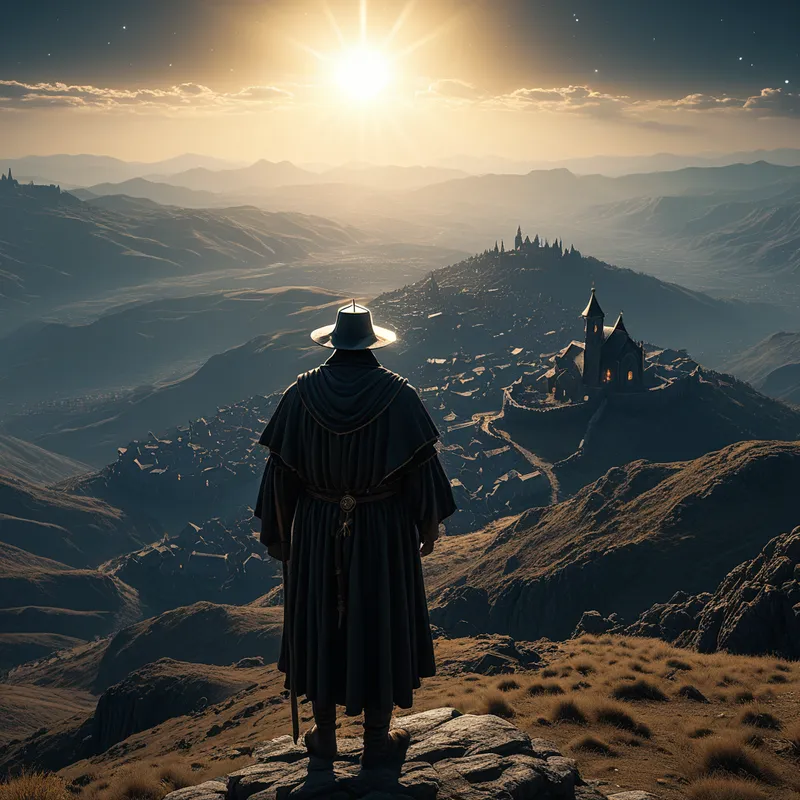
Hear now the dream of a man in a cage, a vision born in the darkness of a prison cell. In this dream, a man named Christian awakens in the City of Destruction, a book of warning clutched in his hands, a burden of terrible weight upon his back. A voice cries out, “Flee from the wrath to come!” And so he flees, leaving his weeping family behind, his eyes fixed on a distant, shining light.
He runs, but the path is not straight. He falls into the Slough of Despond, the mire of his own doubts, and only the hand of a helper named Help pulls him free. He passes through the Wicket-Gate, where his burden grows somehow heavier with the clarity of his new direction. On the hill called Calvary, before a simple cross and an open tomb, the straps of his burden snap, and the great weight rolls away into the sepulchre forever. A feeling of lightness, of impossible relief, floods his being.
But the journey has only begun. He must descend into the Valley of Humiliation, where the foul fiend Apollyon, a monster of scales and shadow, blocks his path. “You are my subject!” the fiend roars. A brutal battle ensues, sword against fiery darts, until Christian, wounded but resolute, cries, “In all these things we are more than conquerors!” and drives the demon back.
Next comes the Valley of the Shadow of Death, a canyon of utter darkness filled with howls and whispers. He clings to a promise, a word spoken in the light, and gropes his way along a narrow path between a deep ditch and a quagmire, until dawn breaks pale and cold.
He finds companionship in Faithful, and together they enter the garish, deafening spectacle of Vanity Fair. Here, everything is for sale: honors, pleasures, kingdoms, souls. They are mocked, then arrested, tried, and Faithful is martyred, ascending in a chariot of fire. Christian escapes, now joined by Hopeful.
Their resolve is tested in the dungeon of Doubting Castle, seized by the giant Despair and his wife Diffidence. For days they are beaten and urged to take their own lives. In the deepest pit, Christian remembers: a key called Promise has been in his pocket all along. It unlocks every door, and they flee the crumbling castle.
At last, they reach the River of Death. The waters are deep and frightening. Christian begins to sink, gripped by a final, terrifying doubt. Hopeful holds him fast, crying, “Be of good cheer! I feel the bottom, and it is sound!” And as the waters close over Christian’s head, he finds footing and crosses. On the far shore, shining ones greet them, strip them of their mortal rags, and clothe them in garments that shimmer like the sun. The gates of the Celestial City swing open, and a chorus of voices welcomes them home. The dreamer awakens, the echo of trumpets in his heart.

Cultural Origins & Context
This is not a myth of antiquity, but a theological allegory forged in the 17th century, a product of the Puritan mind and its intense, interior focus. Its author, John Bunyan, spun the tale from the raw material of his own imprisonment, his biblical knowledge, and the popular tradition of spiritual biography. Written in plain English, it was passed not from bard to bard, but from preacher to congregation, and from parent to child in devout households. Its societal function was didactic: a map for the soul, a guide for the nonconformist Christian navigating a world seen as inherently corrupt and perilous. It gave tangible form to abstract spiritual states—doubt, faith, despair, grace—making the inner journey of salvation vividly, unforgettably external. It became, for centuries, a foundational text second only to the Bible in many Protestant homes, a shared cultural dream of the ultimate quest.
Symbolic Architecture
The myth’s power lies in its complete translation of internal process into external landscape. The journey is not across a physical kingdom, but through the topography of the psyche in its religious dimension.
The burden is not a sin, but the consciousness of sin; it cannot be shed by effort, only at the place of surrender.
Christian is the nascent individuating ego, the part of the psyche that hears a call to wholeness and must leave the unconscious, collective mass (the City of Destruction). Every character he meets is an archetype: Help is the timely aid of the Self; Apollyon is the Shadow in its most militant, oppositional form; Despair is the paralysis of the psyche when hope is lost.
The locations are psychic states. The Slough of Despond is the swamp of depression that follows initial awakening. Vanity Fair is the alluring projection of the persona, where identity is a commodity. Doubting Castle is the prison constructed by the tyrannical, negative aspect of the anima/animus (Diffidence/Despair), which locks away the spirit.

The Dreamer’s Resonance
When this myth stirs in modern dreams, the dreamer is navigating a profound process of psychological or spiritual transition. The somatic feeling is often one of a literal weight—pressure on the chest, leaden limbs—signifying a carried guilt, obligation, or unresolved trauma (the Burden). Dreaming of a treacherous, narrow path through darkness suggests moving through a life crisis, a depression, or a major decision with high stakes (the Valley of the Shadow of Death).
A dream of a garish, overwhelming marketplace where one is lost or accused mirrors the anxiety of identity in a consumerist, social-media-saturated world—the fear of being judged or losing one’s authentic self (Vanity Fair). To be trapped in a dark, inescapable room or castle in a dream points directly to clinical or situational despair, a feeling that no action matters (Doubting Castle). The emergence of a key in such a dream is a pivotal moment of insight from the unconscious, the “promise” of the deeper Self that a way out exists.
Alchemical Translation
The pilgrim’s journey is a perfect model for the alchemical individuation process. It begins with the nigredo, the blackening: the crushing awareness in the City of Destruction and the Slough of Despond—the confrontation with one’s own shadow and misery.
The Celestial City is not a place the ego reaches, but a state of being the ego recognizes when it is finally aligned with the totality of the Self.
The battle with Apollyon and the trials of the valleys represent the albedo, the whitening: the painful purification and confrontation with opposites. Vanity Fair is the temptation of the false, glittering persona, which must be seen through and resisted. Imprisonment in Doubting Castle is the ultimate test, the mortificatio, where the old ego-structure faces annihilation by despair.
The key of Promise is the liberating insight from the Self, leading to the rubedo, the reddening or enlivening: the escape and the final journey. Crossing the River of Death is the last surrender, the dissolution of the ego’s final attachment to its own separate existence. The reception at the Celestial City symbolizes the coniunctio, the sacred marriage—the integration of the conscious personality with the unconscious, resulting in a new, radiant wholeness. For the modern individual, the myth maps the non-linear, often harrowing path from a life of unconscious suffering to one of conscious, hard-won meaning.
Associated Symbols
Explore related symbols from the CaleaDream lexicon: