The Pilgrim Myth Meaning & Symbolism
A soul's arduous journey from the City of Destruction to the Celestial City, facing trials of despair, temptation, and faith to find salvation.
The Tale of The Pilgrim
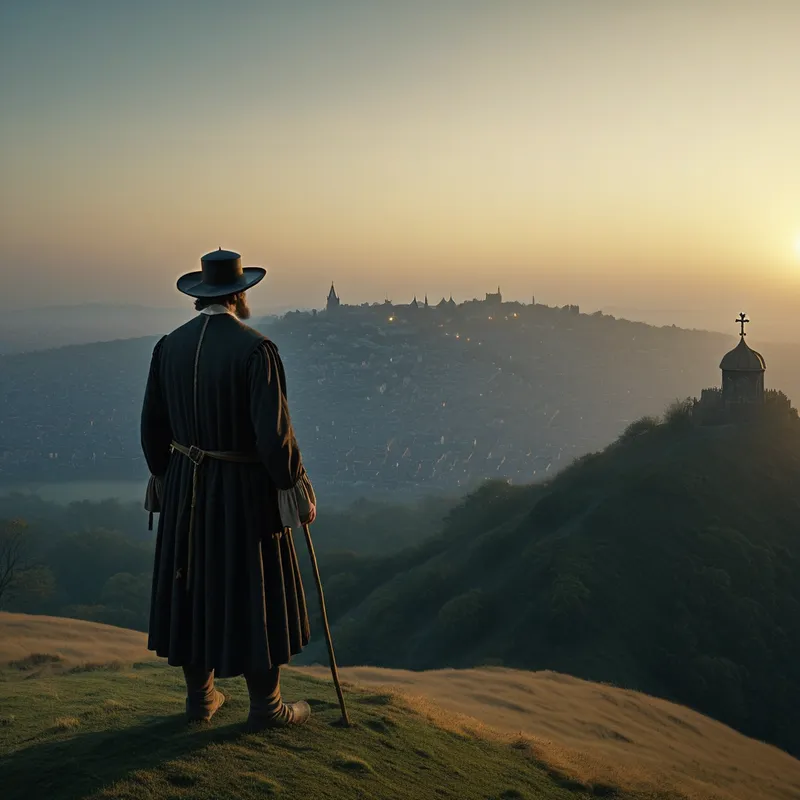
Hark, and listen to a tale not of flesh, but of spirit. In a place called the City of Destruction, a man named Christian lived under a terrible shadow. A book had come into his hands, and its words had kindled a fire of dread in his bones. He saw the city for what it was: a crumbling edifice built upon a pit of eternal fire. A burden, heavy as a mountain of lead, was fastened upon his back, and its weight pressed the very breath from his lungs.
Driven by a terror of the coming wrath and a whispered promise of deliverance, he fled. Leaving his weeping family in the street, he put his fingers in his ears and ran toward the light of a distant wicket-gate, crying, “Life! Life! Eternal life!” His neighbors thought him mad, but the madness was a divine sanity.
His path was no king’s highway. It was a narrow track through wilderness and bog. He fell first into the Slough of Despond, where the mire of his own fears and sins threatened to swallow him whole. A man named Help pulled him from the clinging darkness. At the House of the Interpreter, he was shown visions: a dusty parlour swept by a figure representing the Gospel, a man in an iron cage of despair, a valiant warrior fighting his way into a palace of glory. Each was a riddle for his soul.
He came to a hill, and upon it, a cross. As he looked upon it, the burden on his back loosened, tumbled down the hill, and vanished into a sepulchre. He stood, light and weeping with joy, clothed in raiments that shone. But the journey was not done. Now he must walk from the cross, not merely to it.
He descended into the Valley of Humiliation, where the foul fiend Apollyon blocked his path—a monster clothed in scales, with wings like a dragon and feet like a bear. “You are one of my subjects!” the fiend roared. They fought a long and terrible battle in that lonely valley. Christian’s sword flashed, and he was wounded, but he cried out, “I will walk in the strength of the Lord!” and thrust his blade with a final prayer. Apollyon spread his dragon wings and fled, and Christian healed his wounds with leaves from [the Tree of Life](/myths/the-tree-of-life “Myth from Kabbalistic culture.”/).
Then came the [Valley of the Shadow of Death](/myths/valley-of-the-shadow-of-death “Myth from Biblical culture.”/). It was a place of utter darkness, filled with the howls of creatures and the sighs of the damned. A narrow path ran between a deep ditch on one side and a quagmire on the other, and in the blackness, he heard blasphemies whispered as if just behind his ear. He clung to the promise, “I will fear no evil,” and as the dawn broke, he escaped that dreadful place.
He found companions: Faithful, who would later be martyred in the fair but corrupt city of Vanity Fair; and later, Hopeful, who joined him after [the fall](/myths/the-fall “Myth from Biblical culture.”/) of the wavering Talkative. They were captured by the giant Despair in Doubting Castle and beaten near to death. In the deepest dungeon, Christian remembered a key called Promise in his bosom. It fitted every lock in that grim castle, and they escaped.
At last, weary and worn but undeterred, they came to the final river. There was no bridge. The waters were deep and cold. As Christian began to cross, [the river](/myths/the-river “Myth from Buddhist culture.”/) rose, and he felt the terror of drowning. Hopeful cried out, “Be of good cheer, brother; I feel the bottom, and it is good!” And with a final struggle, they emerged on the far bank.
Two shining ones met them. They stripped them of their mortal garments and clothed them in raiment that shone like gold. With the sounds of trumpets, they approached the gates of the Celestial City, which were made of [pearl](/myths/pearl “Myth from Chinese culture.”/). As they entered, all the bells in the city rang for joy. And they saw within, a kingdom of light, and heard a voice say, “Enter ye into the joy of your Lord.” The pilgrimage was ended. The seeker was found.
Cultural Origins & Context
This tale is, of course, [The Pilgrim’s Progress](/myths/the-pilgrims-progress “Myth from Christian culture.”/) from This World to That Which Is to Come, penned by the Puritan tinker John Bunyan while imprisoned for preaching without a state license. Published in 1678, it emerged from the fertile, turbulent soil of post-Reformation England—a world fractured by religious war, doctrinal fervor, and the intense personalization of faith. Bunyan wrote not as a scholar for the elite, but as a pastor for the common people, drawing on the vernacular, the landscape of Bedfordshire, and the stark imagery of the King James Bible.
The myth was passed down not in temples, but in homes. It became, after the Bible, the most widely read text in the English language for centuries. Its societal function was multifaceted: it was a primer on Protestant theology, a map for the spiritual life, a comfort to the persecuted, and a stern warning against worldliness. It gave a tangible, narrative shape to the abstract Calvinist journey of conviction, conversion, and perseverance. It externalized the internal drama of conscience, making the soul’s struggle against sin, doubt, and despair an epic adventure anyone could understand.
Symbolic Architecture
The myth’s power lies in its masterful [translation](/symbols/translation “Symbol: The process of converting meaning from one form or language to another, representing communication, adaptation, and the bridging of differences.”/) of theological concepts into universal psychological landscapes. The pilgrim is not a historical figure but the [soul](/symbols/soul “Symbol: The soul represents the essence of a person, encompassing their spirit, identity, and connection to the universe.”/)-in-process. His [journey](/symbols/journey “Symbol: A journey in dreams typically signifies adventure, growth, or a significant life transition.”/) is the individuation [quest](/symbols/quest “Symbol: A quest symbolizes a journey or search for purpose, fulfillment, or knowledge, often representing life’s challenges and adventures.”/), the [movement](/symbols/movement “Symbol: Movement symbolizes change, progress, and the dynamics of personal growth, reflecting an individual’s desire or need to transform their circumstances.”/) from a state of identification with the collective (the [City](/symbols/city “Symbol: A city often symbolizes community, social connection, and the complexities of modern life, reflecting the dreamer’s relationships and societal integration.”/) of Destruction) toward the realization of [the Self](/myths/the-self “Myth from Jungian culture.”/) (the Celestial City).
The burden is the conscious weight of the unlived life, the guilt of ignored summons, and the anxiety of a meaning yet unfulfilled. It is not removed by effort, but by revelation.
Each [location](/symbols/location “Symbol: The symbol of ‘Location’ signifies a sense of place, context, and the environment in which experiences unfold.”/) is a state of [consciousness](/symbols/consciousness “Symbol: Consciousness represents the state of awareness and perception, encompassing thoughts, feelings, and experiences.”/). [The Slough of Despond](/myths/the-slough-of-despond “Myth from Biblical culture.”/) is the [swamp](/symbols/swamp “Symbol: Represents the subconscious mind, emotions, and the complexities of personal issues.”/) of clinical depression and existential [guilt](/symbols/guilt “Symbol: A painful emotional state arising from a perceived violation of moral or social standards, often tied to actions or inactions.”/) that can greet initial awakening. The Interpreter’s House represents the necessary stage of introspection and learning, where the [psyche](/myths/psyche “Myth from Greek culture.”/)‘s own dynamics are shown in [symbol](/symbols/symbol “Symbol: A symbol can represent an idea, concept, or belief, serving as a powerful tool for communication and understanding.”/). The battle with Apollyon is the crucial confrontation with the [shadow](/symbols/shadow “Symbol: The ‘shadow’ embodies the unconscious, repressed aspects of the self and often represents fears or hidden emotions.”/)—the internalized critic and accuser who claims ownership of our [identity](/symbols/identity “Symbol: Identity represents the sense of self, encompassing personal beliefs, cultural background, and social roles.”/). Vanity Fair is the collective [psyche](/myths/psyche “Myth from Greek culture.”/)‘s marketplace, where authentic values are mocked and spiritual integrity is commodified or persecuted. Doubting Castle is the [prison](/symbols/prison “Symbol: Prison in dreams typically represents feelings of restriction, confinement, or a lack of freedom in one’s life or mind.”/) of neurosis, built by the giant of a dominant complex ([Despair](/symbols/despair “Symbol: A profound emotional state of hopelessness and loss, often signaling a need for transformation or surrender to deeper truths.”/)), from which only the key of a remembered promise—a [connection](/symbols/connection “Symbol: Connection symbolizes relationships, communication, and bonds among individuals.”/) to a transpersonal [truth](/symbols/truth “Symbol: Truth represents authenticity, honesty, and the quest for knowledge beyond mere appearances.”/)—can free us.
The final [river](/symbols/river “Symbol: A river often symbolizes the flow of emotions, the passage of time, and life’s journey, reflecting transitions and movement in one’s life.”/) is the ultimate threshold, representing the [dissolution](/symbols/dissolution “Symbol: The process of breaking down, dispersing, or losing form, often representing transformation, release, or the end of a state of being.”/) of [the ego](/myths/the-ego “Myth from Jungian culture.”/). It is not a physical [death](/symbols/death “Symbol: Symbolizes transformation, endings, and new beginnings; often associated with fear of the unknown.”/), but the psychic death required for [rebirth](/symbols/rebirth “Symbol: A profound transformation where old aspects of self or life die, making way for new beginnings, growth, and renewal.”/) into a new order of being. The fear of drowning is the [terror](/symbols/terror “Symbol: An overwhelming, primal fear that paralyzes and signals extreme threat, often linked to survival instincts or deep psychological trauma.”/) of ego-[loss](/symbols/loss “Symbol: Loss often symbolizes change, grief, and transformation in dreams, representing the emotional or psychological detachment from something or someone significant.”/), of surrendering the final vestiges of control.

The Dreamer’s Resonance
When this myth stirs in the modern dreamer, it signals a profound shift in the psyche’s orientation. To dream of a heavy, inexplicable burden is to feel the somatic weight of a calling unlived, a truth unacknowledged. The dream-ego is being summoned out of its comfortable, yet destructive, identification.
Dreams of being lost on a narrow path, of fighting a shadowy foe in a valley, or of being trapped in a castle or [labyrinth](/myths/labyrinth “Myth from Various culture.”/) point directly to the Pilgrim’s journey. These are not mere anxieties; they are mythic diagnostics. The somatic feeling—the tight chest of the burden, the cold sweat of the shadowy valley, the claustrophobia of Doubting Castle—is the body participating in the soul’s drama. The dreamer is in the liminal space, the betwixt-and-between where the old self is dying and the new self is not yet born. Such dreams often cluster during life transitions: the end of a career, a crisis of faith or meaning, or in the wake of trauma that shatters a previous worldview. The psyche is narrating its own transformation using this ancient, pre-loaded script.
Alchemical Translation
The Pilgrim’s myth is a precise manual for psychic alchemy—the opus of turning the lead of suffering and confusion into the gold of integrated consciousness. It models the stages of individuation.
The journey begins with calcinatio—the burning anguish that forces the ego out of its complacency. The confrontation with [the shadow](/myths/the-shadow “Myth from Jungian culture.”/) (Apollyon) is [separatio](/myths/separatio “Myth from Alchemical culture.”/), where the individual consciously differentiates from internalized negativity and collective pressures (Vanity Fair). The imprisonment in Doubting Castle is mortificatio and [nigredo](/myths/nigredo “Myth from Alchemical culture.”/), the darkest point where the old structures of the psyche rot away.
The key of Promise is the transcendent function—the symbol that emerges from the unconscious to bridge the irreconcilable opposites of hope and despair.
The escape and journey onward represent ablutio and albedo, a cleansing and dawning clarity. The final river is the coniunctio, achieved only through total surrender ([solutio](/myths/solutio “Myth from Alchemical culture.”/)). The arrival at the City in garments of gold is the [rubedo](/myths/rubedo “Myth from Alchemical culture.”/)—the culmination of the work.
For the modern individual, this is not about reaching a physical heaven. It is about the inward arrival at a state of psychic wholeness. The Celestial City is the Self realized. The pilgrimage is the lifelong, often tortuous, process of becoming who one truly is, shedding the burdens of others’ expectations, integrating one’s shadows, and persevering through the valleys of doubt until one stands, authentic and complete, at the center of one’s own being. The myth tells us: the journey is harrowing, you will be wounded, you will want to turn back—but the path is real, and the destination is your own redeemed consciousness.
Associated Symbols
Explore related symbols from the CaleaDream lexicon: