The Pied Piper Myth Meaning & Symbolism
A town plagued by rats refuses to pay a piper for his service. He enchants their children away, a haunting lesson on debt and the uncanny.
The Tale of The Pied Piper
Listen, and hear the tale of a town that forgot the weight of a promise.
In the year of our Lord 1284, the town of Hamelin was a jewel of commerce, yet it festered from within. Not from plague or war, but from a creeping, chittering shadow. Rats. They swarmed from the Weser River, a grey-brown tide that flowed through every cellar, every granary, every nursery. They gnawed the town’s wealth to splinters and its peace to tatters. The burghers’ proclamations were as useless as paper against teeth. The people’s prayers seemed to stick in the thick, fetid air.
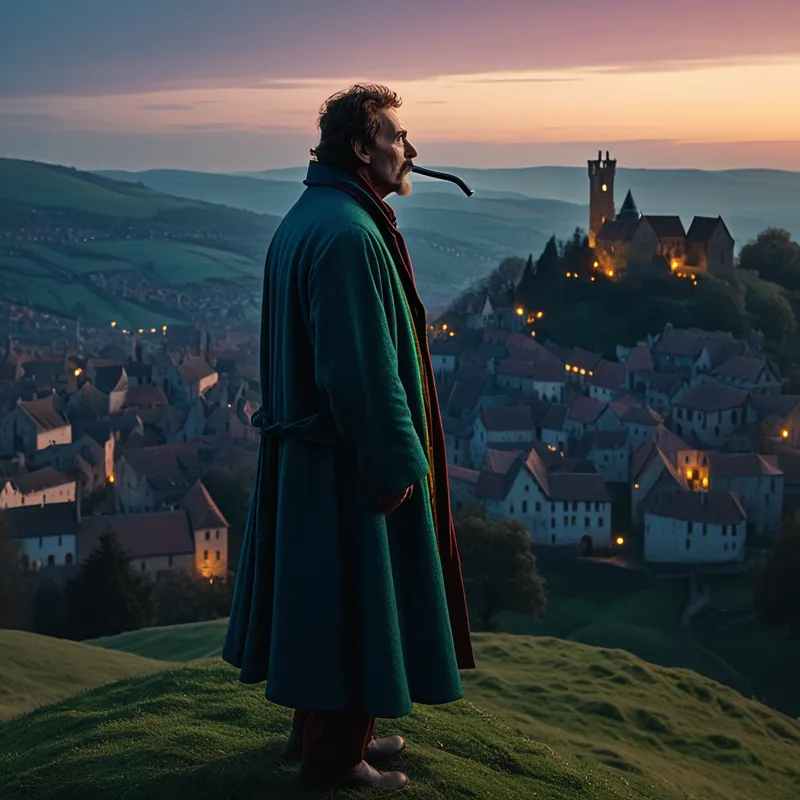
Despair had laid its heavy hand upon them all when a stranger appeared at the gates. He was a man of impossible color in a world of wool and stone, clad in a coat of a thousand bright patches, red and yellow and green. His eyes held the cool distance of deep woods and still waters. In his hands, he held a pipe of pale, polished wood.
“I can free your town of this vermin,” he said, his voice like [the wind](/myths/the-wind “Myth from Various culture.”/) through reeds. “For a price.”
The desperate council, smelling not [the stranger](/myths/the-stranger “Myth from Biblical culture.”/)’s magic but the sweet scent of a solution, agreed without thought. “Name your sum, Piper! Rid us of this scourge and you shall have a king’s ransom!”
The Piper did not smile. He simply raised the pipe to his lips and began to play.
The melody that flowed forth was not of this earth. It was a tune that slipped into the ear and coiled around the mind, a sound of rustling grain and skittering paws. From every hole and shadow, the rats came. They tumbled from beams, poured from sewers, a hypnotized, squirming river drawn by the unearthly song. The Piper, still playing, turned and walked calmly toward the Weser River. [The river](/myths/the-river “Myth from Buddhist culture.”/) of rats followed. Into the swift, cold current they plunged, every last one, and were swept away to drown.
The town erupted in joy. Bells rang, casks were broached. But when the Piper returned, silent now, and held out his hand for the promised payment, the mood soured. The burghers, seeing the threat gone, felt their purses grow heavy. They scoffed. “What? Such a simple trick for so grand a price? Here is a pittance for your trouble.” They tossed a meager bag of coins at his brightly colored feet.
The Piper looked at the coins, then at the faces of the men, now hard and smug. He said nothing. A terrible stillness settled around him. He turned his back on the council and walked into the sun-drenched streets of the town. Again, he raised his pipe.
This time, the melody was different. It was sweeter, sharper, a call that spoke of secret glades and mountains of candy, of endless games and adventures untold. It did not speak to the blood and hunger of beasts, but to the wild, untamed hearts of children. From every door, the children of Hamelin came. They left their games, their chores, their meals half-eaten. With eyes wide and bright, laughing with a joy their parents had forgotten, they followed the Pied Piper. He led them, dancing to his impossible tune, through the East Gate and toward the Koppenberg hill.
The townsfolk, frozen by a dread they could not name, watched helplessly. The Piper and the children reached the foot of the hill. Then, as the melody soared to a final, piercing note, the side of the mountain opened like a great door. The last they saw was the Piper’s bright coat vanishing into the darkness, followed by every child, save one lame boy who could not keep pace, and one deaf girl who had heard only silence. The mountain sealed itself shut, forever.
And Hamelin was left with its gold, its empty houses, and the eternal, echoing weight of a promise broken.

Cultural Origins & Context
The tale, while crystallized in the Brothers Grimm’s collection, is rooted in tangible history. A stained-glass window placed in Hamelin’s Market Church around 1300, now lost but documented, depicted the colorful piper and the lost children. Town records from 1384 state, “It is 100 years since our children left.” This is not mere folklore, but a etiological myth grappling with a real, communal trauma.
Scholars propose various seeds for this trauma: the Ostsiedlung, where young settlers were led away to new lands by a recruiter in colorful dress; a deadly plague that selectively took the young; or a tragic children’s crusade. The Piper is the enigmatic, ambivalent figurehead for this historical catastrophe—not a devil, not a saint, but an agent of a cosmic bargain. The story served as a societal warning about communal contracts and the dire consequences of bad faith, told and retold to remind the powerful that the currency of promises is the future itself.
Symbolic Architecture
The myth is a perfect, terrifying diagram of a psychic law: what is summoned must be paid for, and what is repressed will return, not in kind, but in essence.
The Rats are the [shadow](/symbols/shadow “Symbol: The ‘shadow’ embodies the unconscious, repressed aspects of the self and often represents fears or hidden emotions.”/) of the prosperous town. They are the unaddressed greed, the festering corruption, the instinctual [life](/symbols/life “Symbol: The symbol of ‘Life’ represents a journey of growth, interconnectedness, and existential meaning, encompassing both the joys and challenges that define human experience.”/) denied by rigid order. The town does not seek to understand or integrate this [plague](/symbols/plague “Symbol: A symbol of widespread affliction, collective suffering, and uncontrollable forces that threaten social order and personal survival.”/); it only wishes for it to be gone. They seek a magical extermination, not a transformation.
The Piper is the archetypal Daimon of the unconscious. He is the catalyst who makes the hidden visible and collects the owed price. His motley coat signifies his non-belonging to the conscious world’s systems; he operates by the older, deeper laws of nature and psyche.
The promised [payment](/symbols/payment “Symbol: Symbolizes exchange, obligation, and value. Represents what one gives to receive something in return, often tied to fairness, debt, or spiritual balance.”/) is the critical pivot. The town attempts to pay the unconscious, the magical, the numinous, with the conscious [currency](/symbols/currency “Symbol: Currency represents value exchange, personal worth, and societal power dynamics. It symbolizes resources, control, and the abstract systems governing human interaction.”/) of commerce. It is a fatal category [error](/symbols/error “Symbol: A dream symbol representing internal conflict, perceived failure, or a mismatch between expectations and reality.”/). The [psyche](/myths/psyche “Myth from Greek culture.”/) does not deal in coins, but in value, [attention](/symbols/attention “Symbol: Attention in dreams signifies focus, awareness, and the priorities in one’s life, often indicating where the dreamer’s energy is invested.”/), and integrity. By withholding the promised “[king](/symbols/king “Symbol: A symbol of ultimate authority, leadership, and societal order, often representing the dreamer’s inner power or external control figures.”/)’s ransom,” the town withholds respect, honor, and [truth](/symbols/truth “Symbol: Truth represents authenticity, honesty, and the quest for knowledge beyond mere appearances.”/). The [debt](/symbols/debt “Symbol: A symbolic representation of obligations, burdens, or imbalances that extend beyond financial matters into psychological and moral realms.”/) remains.
Thus, the Piper collects in symbolic equivalence. If the rats were the neglected life of the town (instincts, shadow), the children are its promised life (potential, future, vitality). The unconscious, cheated of its due in one form, claims it in another, more devastating form. The children led into the [mountain](/symbols/mountain “Symbol: Mountains often symbolize challenges, aspirations, and the journey toward self-discovery and enlightenment.”/) are not murdered; they are translated. They become the town’s lost potential, its stolen future, its [soul](/symbols/soul “Symbol: The soul represents the essence of a person, encompassing their spirit, identity, and connection to the universe.”/) now residing forever in the [underworld](/symbols/underworld “Symbol: A symbolic journey into the unconscious, representing exploration of hidden aspects of self, transformation, or confronting repressed material.”/) of the forgotten.

The Dreamer’s Resonance
When this myth stirs in modern dreams, it signals a profound reckoning with a psychic debt. To dream of being the town council is to feel the anxiety of a looming cost for past shortcuts, ignored intuitions, or broken inner vows. A somatic sense of being “gnawed at” by guilt or anxiety (the rats) may be present.
To dream of being the Piper is to confront one’s own powerful, amoral transformative energy—the part of [the self](/myths/the-self “Myth from Jungian culture.”/) that can ruthlessly end stagnant situations or enchant new possibilities, often feeling alien and separate from one’s daily identity.
Most poignantly, to dream of being or losing the children is to experience a crisis of vitality. It is the feeling that one’s creativity, joy, innocence, or future has been “led away” by an irresistible force due to some prior betrayal of the self. The dreamer is processing a deep grief for lost potential, often following a period where they “sold out” their true passions for security, or ignored their inner calling for external validation. The haunting, unheard melody is the call of the authentic self, now felt as a distant, painful echo.
Alchemical Translation
The alchemical journey modeled here is the brutal but necessary process of Individuation through the settlement of shadow debts.
The initial state ([Nigredo](/myths/nigredo “Myth from Alchemical culture.”/)) is the festering, rat-infested town: a conscious life plagued by unconscious contents. The Piper’s arrival is the emergence of the Self as a transformative agent. The first melody is the Coniunctio, the joining with and transformation of [the shadow](/myths/the-shadow “Myth from Jungian culture.”/) (the rats are led to dissolution in the [water](/myths/water “Myth from Chinese culture.”/), a symbol of the unconscious).
The critical stage is the Mortificatio, the death of the old attitude. The council’s refusal to pay is the ego’s last-ditch attempt to retain control, to profit from the work of the unconscious without true sacrifice. This failure necessitates a deeper, more painful death.
The leading away of the children is the ultimate Mortificatio. [The ego](/myths/the-ego “Myth from Jungian culture.”/)’s cherished potential and future-oriented identity must “die” or be surrendered to the unconscious. The mountain that opens is the Lapis, the [vessel of transformation](/myths/vessel-of-transformation “Myth from Alchemical culture.”/). The children are not destroyed; they are taken into the mountain, into the heart of the Self, where they are transmuted.
For the modern individual, this myth instructs that we cannot selectively integrate the psyche. We cannot ask for the removal of our “rats” (depression, anger, fear) without being willing to pay the full price: a fundamental change in attitude, a sacrifice of our childish dependencies and inflated self-image (the “children”). The lame and deaf children left behind represent those fragments of consciousness too rigid or disconnected to join the transformation—the lingering neuroses or blind spots that remain. The process ends not with a happy return, but with a solemn, wiser emptiness. The town is cleansed of both plague and promise, forced to live in the sober truth of its choices, a necessary ground from which, perhaps, a more authentic life can slowly, painfully, be rebuilt.
Associated Symbols
Explore related symbols from the CaleaDream lexicon: