The Pharmakon Myth Meaning & Symbolism
The myth of the sacred substance that is both poison and cure, revealing the paradoxical nature of healing and the shadow within transformation.
The Tale of The Pharmakon
Listen, and I will tell you of a truth that is not a truth, of a gift that is a curse, and a curse that is a gift. In the time before time was measured, when the gods walked the borderlands between Olympus and [the world](/myths/the-world “Myth from Tarot culture.”/) of mortals, there existed a knowledge so potent it was kept from human hands. It was not a weapon of bronze, nor a secret of the stars, but the mystery of the pharmakon itself.
The keeper of this mystery was a deity whose nature was as dual as the substance they guarded. Some whispered it was Asclepius, healer and bringer of pestilence. Others spoke of [Hecate](/myths/hecate “Myth from Greek culture.”/), mistress of herbs and phantoms. But in the oldest tales, it is a presence without a single name, a divine principle dwelling in a grove where the trees wept sap that could either seal a wound or stop a heart.
A mortal, driven by a hunger that was both noble and profane, sought this grove. Perhaps it was a king desperate to save his plague-stricken city. Perhaps it was a parent whose child lay breathless. The journey was a descent—through valleys of whispering doubts, across rivers that reflected not [the sky](/myths/the-sky “Myth from Persian culture.”/) but one’s own hidden fears. The air in the grove was thick with the scent of a thousand blossoms, a perfume so sweet it made the teeth ache.
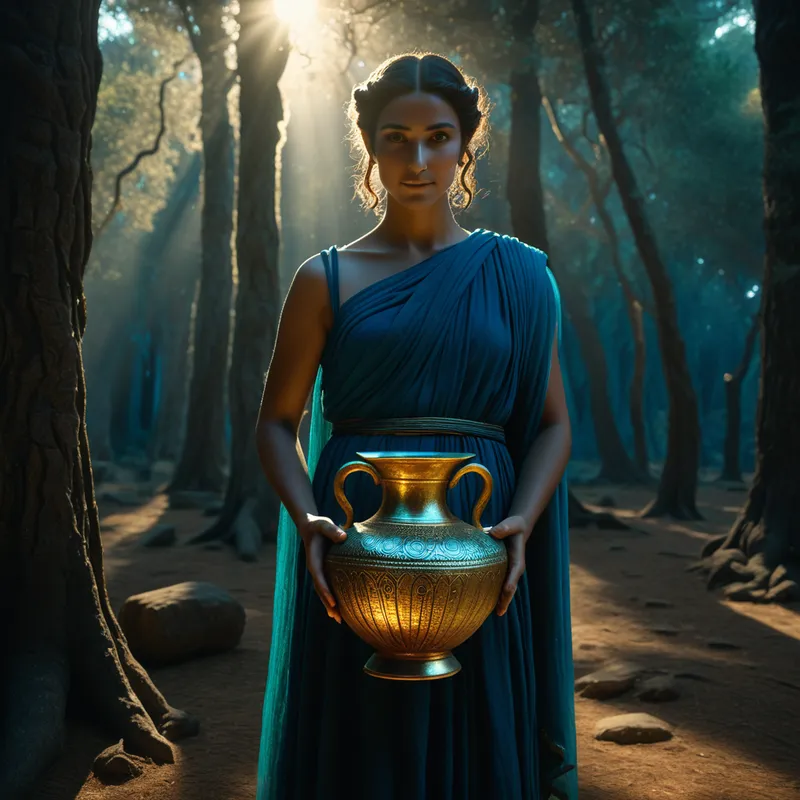
The deity appeared not in thunder, but in a silence so deep it had a sound. In their hands was a simple, unadorned amphora. “You seek the remedy,” the voice was the rustle of leaves and the crackle of drought. “Here it lies. But know this: the hand that pours the healing draught is the same hand that measures the lethal dose. The vine that gives the saving grape also bears the deadly nightshade. They are not two, but one. This is the pharmakon.”
The mortal was given not a recipe, but a single seed, glowing with an [inner light](/myths/inner-light “Myth from Buddhist culture.”/) that pulsed like a heartbeat. “Plant this with intention pure as sunlight, and it will bear fruit that mends broken flesh and broken spirit. Plant it with [the shadow](/myths/the-shadow “Myth from Jungian culture.”/) of greed, of power, of vengeance in your heart, and from the same soil will spring a vine whose fruit brings delirium and death.” There was no spell, no incantation—only this terrible, awesome responsibility. The myth ends not with a battle, but with a choice. The mortal turns from the grove, the seed burning a hole in their palm, carrying not an answer, but the weight of the question itself back into the world of humanity.
Cultural Origins & Context
The concept of the pharmakon is woven into the very fabric of ancient Greek thought, less a single myth with a plot than a pervasive philosophical and medical principle. It finds its roots in the practices of the Asclepiads and the lore of root-cutters and herbalists, figures like [Medea](/myths/medea “Myth from Greek culture.”/). It was passed down not solely as a story, but as a practical, terrifying truth in the healer’s art.
In a world without synthetic pharmaceuticals, healing was direct, empirical, and perilous. The same plant—like the opium poppy or the hellebore—could relieve agony or induce a fatal coma depending on the dose, the preparation, and the patient’s constitution. This duality was not seen as a flaw, but as an intrinsic property of nature and, by extension, of the divine. The societal function was one of profound caution and respect. It established the healer as a liminal figure, a mediator between life and death, requiring not just skill but impeccable ethical character. To handle the pharmakon was to hold a fragment of divine ambiguity in your hands.
Symbolic Architecture
At its core, the pharmakon is the ultimate [symbol](/symbols/symbol “Symbol: A symbol can represent an idea, concept, or belief, serving as a powerful tool for communication and understanding.”/) of [paradox](/symbols/paradox “Symbol: A contradictory yet true concept that challenges logic and perception, often representing unresolved tensions or profound truths.”/). It dismantles the comfortable [human](/symbols/human “Symbol: The symbol of a human represents individuality, complexity of emotions, and social relationships.”/) categories of “good” and “evil,” “helpful” and “harmful,” revealing them to be two sides of a single coin. The myth presents a [universe](/symbols/universe “Symbol: The universe symbolizes vastness, interconnectedness, and the mysteries of existence beyond the individual self.”/) where salvation is intrinsically linked to [danger](/symbols/danger “Symbol: The symbol of ‘Danger’ often indicates a sense of threat or instability, calling for caution and awareness.”/), where the cure is born from the same [source](/symbols/source “Symbol: The origin point of something, often representing beginnings, nourishment, or the fundamental cause behind phenomena.”/) as the poison.
The wound and the medicine are made of the same stuff. To seek healing is to willingly re-approach the source of your suffering.
Psychologically, the pharmakon represents the contents of the [shadow](/symbols/shadow “Symbol: The ‘shadow’ embodies the unconscious, repressed aspects of the self and often represents fears or hidden emotions.”/). These are the traits, impulses, and capacities we disown, deem unacceptable, and try to suppress—our rage, our cunning, our primal desires. Like the un-administered poison, they sit within us, inert but potent. The myth suggests that these very qualities, when approached not with fear but with conscious, ethical [intention](/symbols/intention “Symbol: Intention represents the clarity of purpose and direction in one’s life and can symbolize motivation and commitment within a dream context.”/), hold the key to our greatest strengths and our healing. The arrogance we shun can become confident leadership. The raw anger, when integrated, transforms into the fierce [energy](/symbols/energy “Symbol: Energy symbolizes vitality, motivation, and the drive that fuels actions and ambitions.”/) needed to set boundaries. The deity in the [grove](/symbols/grove “Symbol: A grove symbolizes a sacred space of nature, tranquility, and introspection, often associated with spiritual growth and connection.”/) does not offer a purified “cure”; it offers the whole, paradoxical substance, because wholeness, not purity, is the goal.
The Dreamer’s Resonance
When this myth stirs in the modern unconscious, it often manifests in dreams of ambiguous substances or transformative moments fraught with risk. You may dream of being given a glowing pill by a mysterious figure, feeling both hope and dread. You might dream of drinking from a cup that simultaneously refreshes and burns. Or you may find yourself in a garden where beautiful flowers emit a toxic scent.
These dreams signal a somatic and psychological process at [the threshold](/myths/the-threshold “Myth from Folklore culture.”/) of integration. The body-mind is grappling with a powerful, emerging content from the shadow. The “poison” in the dream is often a repressed emotion, a denied talent, or a forgotten trauma rising to the surface. The simultaneous feeling of it being a “cure” indicates the [psyche](/myths/psyche “Myth from Greek culture.”/)‘s innate wisdom that engaging with this difficult material is the path to greater wholeness. The anxiety in the dream is [the ego](/myths/the-ego “Myth from Jungian culture.”/)‘s rightful terror at facing what it has long kept at bay. It is the dream equivalent of holding the glowing seed, feeling its immense potential for both destruction and creation.

Alchemical Translation
The journey of the pharmakon is a perfect map for the alchemical process of individuation—the psychic transmutation of the base self into the integrated, authentic self. The initial “descent” into the grove is the withdrawal of projections and the courageous turn inward, into the personal and collective unconscious ([nigredo](/myths/nigredo “Myth from Alchemical culture.”/)).
The encounter with the dual-natured deity is the confrontation with [the Self](/myths/the-self “Myth from Jungian culture.”/), the archetype of wholeness that transcends ego-based judgments. The deity presents the unvarnished truth: your greatest power is entangled with your deepest wound. The acceptance of the seed is the critical moment of albedo, where one consciously takes responsibility for this paradoxical inner content.
The alchemist does not discard the poisonous ore; they learn the sacred art of transmutation. So too, we do not excise our shadow, we learn to work with its potent material.
The return to the world with the seed represents the beginning of [rubedo](/myths/rubedo “Myth from Alchemical culture.”/), the reddening or embodiment. The “planting” is the daily, intentional work of integrating shadow material into conscious life. Will you use your newfound assertiveness to dominate or to protect? Will your sharp perception be used for criticism or for insight? The myth tells us that the fruit of our life—our relationships, our work, our very being—is determined not by eliminating the poison, but by the consciousness with which we cultivate the entire, paradoxical plant. The ultimate pharmakon is the integrated Self, a living embodiment of the cure that contains, and transforms, its own poison.
Associated Symbols
Explore related symbols from the CaleaDream lexicon: