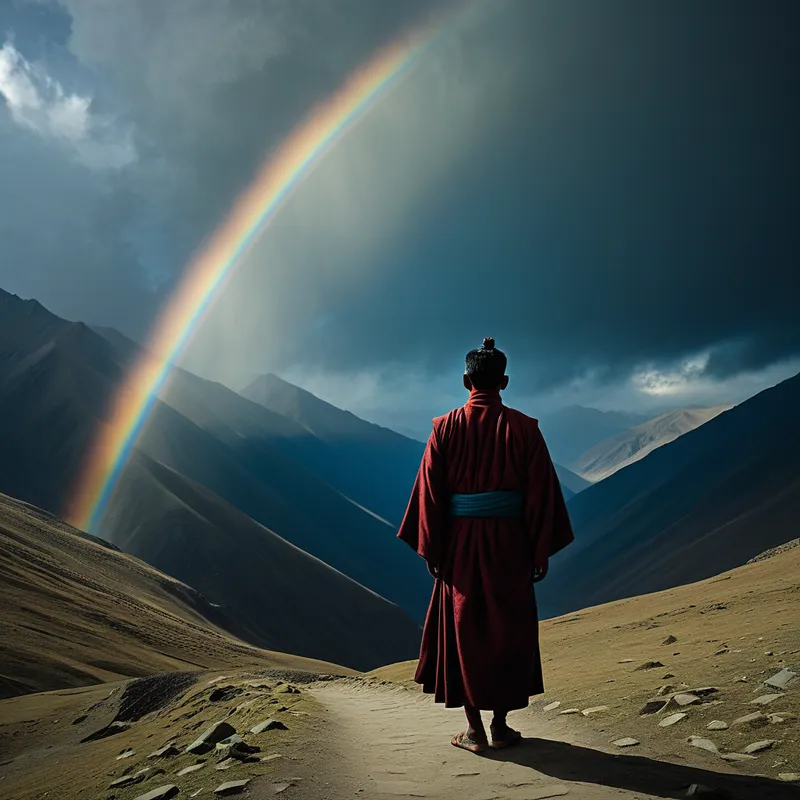
The Path to Enlightenment Myth Meaning & Symbolism
A profound journey through illusion, confronting inner demons to shatter the ego and awaken to the luminous, boundless nature of reality.
The Tale of The Path to Enlightenment
Listen. The story does not begin with a hero, but with a profound and aching sense of being lost. It begins in a valley of perpetual twilight, where the air is thick with the perfume of forgotten desires and the ground is soft with the dust of crumbled certainties. Here, the seeker awakens—not to a call, but to a deep, unsettling question that vibrates in the marrow of their bones. They look at the shimmering mirage of their life, the palace of self built from pride and fear, and for the first time, they see the cracks in its foundation.
Driven by a restlessness that is both terror and the first flicker of courage, they turn their back on the valley. They begin to climb. The path is not a road, but a whisper, a thread of intuition leading up the side of a mountain so vast its peak is hidden in clouds of unknowing. The climb is agony. The air thins. Every cherished belief becomes a heavy stone in their pack. The voices of the world below—praise, blame, gain, loss—echo as mocking winds.
Then, the guardians appear. These are not monsters from without, but from within. On a narrow ledge, the demon of Atman blocks the way, a colossal figure with the seeker’s own face, roaring of separation and specialness. The seeker must face it, not with a sword, but with the silent, piercing question: “Who are you?” The demon shrieks and dissolves into mist. Further on, in a cave of echoing memories, the seductive goddess of Trishna offers comfort, an eternity of beautiful, distracting dreams. The seeker must feel the pull, acknowledge the longing, and let it pass by like a cold mountain stream, without drinking.
The path grows steeper, more treacherous. It becomes a razor’s edge over an abyss of pure void. Here, the final and most intimate demon awaits: Avidya. It has no form, only a profound, convincing certainty that this—the pain, the seeker, the path—is all solidly, permanently real. In this moment of ultimate confrontation, the seeker has nothing left. No philosophy, no hope, no self to defend. From that utter emptiness, a tool is remembered—not a weapon, but a symbol: the Vajra. It does not strike outward. The seeker turns its diamond-pointed clarity inward, upon the very heart of the clinging “I.”
There is a sound like a universe of glass shattering. The mountain, the path, the seeker—all dissolve in a burst of silent, luminous clarity. What remains is not a person who has arrived, but a boundless, awake space. A Pure Land was not a place to reach, but the true nature of the valley from the start, now seen without the filter of fear. The journey ends where it began, but everything, and nothing, is the same.

Cultural Origins & Context
This is not a single myth with one author, but the living, breathing architecture of the Tibetan Buddhist path itself, woven from the threads of the Buddha Shakyamuni’s teachings, the profound insights of Indian Mahasiddhas, and the unique spirit of the Tibetan plateau. It was passed down not merely in texts, but in the oral instructions whispered from master (Lama) to disciple in the cold, high caves of retreat. It was enacted in ritual, visualized in intricate mandalas, and embodied in the lives of yogis like Milarepa, who literally transformed the poisons of his past into the nectar of realization through arduous practice.
Its societal function was dual. For the monastic and yogic communities, it was a precise, psychological map of the stages of meditation and insight. For the wider culture, it was a grand narrative that gave meaning to suffering, framed life as a sacred journey with a attainable, glorious conclusion, and validated the role of the guide who has traversed the path before. It turned the harsh, beautiful Tibetan landscape itself into a metaphor for the inner pilgrimage.
Symbolic Architecture
The myth is a masterclass in symbolic psychology. The valley is the conditioned mind, the consensus reality we take as solid. The mountain is the arduous path of introspection and discipline. The demons (maras) are not external evils but the archetypal, personified forces of our own psyche: the demon of Pride (the solidified ego), the demon of Desire (the longing that binds), and the demon of Ignorance (the primal mis-knowing).
The path is not a line between two points, but a spiral deepening into the center of the one who walks it. The enemy is the shadow cast by the seeker’s own longed-for light.
The Vajra symbolizes the indestructible, non-conceptual wisdom that cuts through illusion. Its partner, the Bell, represents the compassionate, spacious awareness within which that cutting takes place. Their union is the ultimate goal: the integration of penetrating insight (method) and all-embracing emptiness (wisdom). The final dissolution is not annihilation, but the realization of Shunyata—the understanding that the seeker, the path, and the goal were never separate, substantial entities.
The Dreamer’s Resonance
When this myth stirs in the modern dreamer, it often manifests not as a Himalayan climb, but as a profound psychological process. You may dream of being trapped in a labyrinthine bureaucracy (the valley of samsara), desperately seeking an exit permit that doesn’t exist. You may dream of a relentless chase, where the pursuer has your face (the demon of ego). You may find a simple, powerful tool in your dream—a key, a crystal, a word—that suddenly makes the oppressive labyrinth transparent.
These dreams signal a somatic and psychic confrontation with what psychology calls the Self-regulatory principle of the psyche. The ego’s dominion is being challenged. The dream images are the psyche’s way of orchestrating a necessary nervous breakdown—a literal breaking down of the old, rigid neural and psychological structures to make way for a more complex, authentic configuration. The anxiety, the feeling of being lost or pursued, is the death throes of an outmoded identity. The dream is the inner Lama, guiding you through your own interior mandala of transformation.

Alchemical Translation
The alchemy here is the transmutation of the lead of ego-fixation into the gold of conscious awareness. The modern individual’s “path” is their process of individuation—becoming who they truly are, beyond social masks and parental complexes.
The first alchemical stage (Nigredo, the blackening) is the awakening in the twilight valley: the depression, the midlife crisis, the feeling that “this is not it.” It is the necessary dissolution.
The second stage (Albedo, the whitening) is the arduous climb and confrontation with demons: therapy, shadow work, facing addiction, grief, or trauma. Here, one meets their personal maras—the inner critic, the needy child, the manipulative persona—and must, like the seeker, “face them down” with awareness, not combat.
Enlightenment is not a distant sunrise to be reached, but the willingness to let the candle of the self burn down completely, discovering the sun was always shining in the empty space where the wax and wick used to be.
The final stage (Rubedo, the reddening) is the diamond-like realization. It is not becoming a perfect, conflict-free person. It is the integration. The neurosis, once a demon blocking the path, is now seen as a twisted form of energy that, when understood, adds depth and compassion. The individual realizes they are both the journey and the destination. Their life, with all its pain and joy, is not an obstacle to the path—it is the path. They hold the Vajra of their hard-won insight and the Bell of their empathetic connection, and in that union, they find not a mythical paradise, but a truly human, fully conscious way of being in the world.
Associated Symbols
Explore related symbols from the CaleaDream lexicon: