The Path to Avalon Myth Meaning & Symbolism
The wounded king's voyage to the mist-shrouded Isle of Avalon, a journey of surrender, healing, and transformation beyond the known world.
The Tale of The Path to Avalon
Listen. [The world](/myths/the-world “Myth from Tarot culture.”/) is ending. Not with a roar, but with a sigh—the last, ragged breath of a king on a field of mud and blood. Arthur Pendragon lies broken at Camlan, the life seeping from him into the cold earth. The dream of Camelot is shattered, its light extinguished by betrayal. The air is thick with the iron scent of rain and loss.
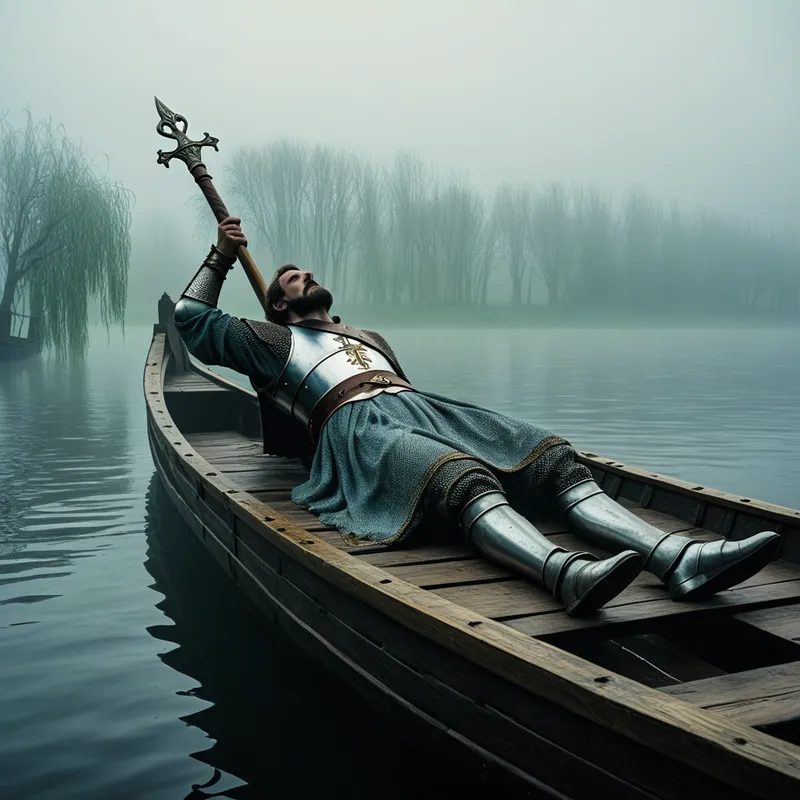
He sees a shape forming in [the mist](/myths/the-mist “Myth from Celtic culture.”/) that coils from the nearby mere. Not a ship of war, but a barge of sorrow, black as a [raven](/myths/raven “Myth from Haida culture.”/)’s wing and silent as a tomb. From it step three women, their faces veiled by the gloom. Some say they are queens; others whisper they are the Ladies of the Lake, keepers of the old ways. Their eyes hold no pity, only a deep, knowing sorrow. Without a word, they lift the king—so light, now, in his broken armor—and lay him upon the barge. His famed sword, Excalibur, rests useless at his side.
The barge begins to move, not by oar or sail, but by a will older than kingdoms. It slides into the waters of the Summerland, and the mists close behind it like a curtain. The world of men, of battles and crowns, fades into a grey silence. For three days and three nights, the barge drifts through a liminal realm where [water](/myths/water “Myth from Chinese culture.”/) and sky become one, where time unravels like old thread.
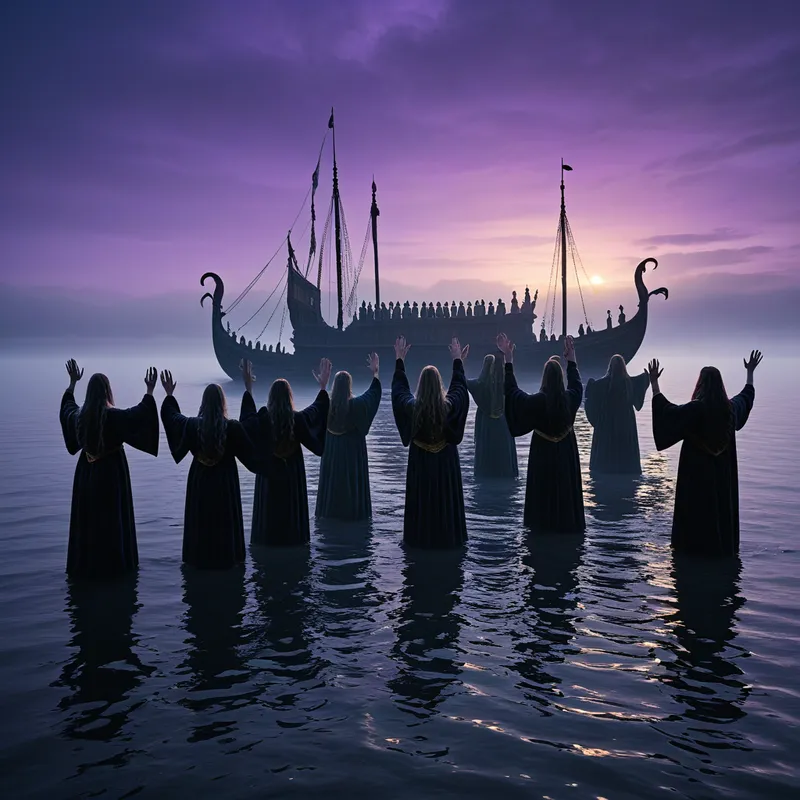
Then, a scent cuts through the damp air: the sweet, intoxicating fragrance of apple blossom, out of season. The mists part like a veil, revealing a shore of dark, glassy sand. An island rises, green and eternal, crowned with orchards of trees that bear both silver blossom and golden fruit simultaneously. This is Avalon, the Isle of Apples, the Fortunate Isle. On the shore stand nine more figures, robed in deep blue and grey, their hands raised in welcome or benediction.
The barge grounds itself softly on the black sand. The women gather around their fallen king. They do not speak of victory or defeat, of legacy or legend. They speak only of healing, of a sleep that is not death, of a time outside of time. They carry him inland, towards the heart of the island, where the springs run clear and the air hums with a quiet power. The path to Avalon ends not with a coronation, but with a relinquishment. The king surrenders his sword, his pain, his broken kingdom, and passes into the care of the island. He is taken to a place of quiet green, where he will sleep, and be made whole, until the world has need of him again. The mists close. The path vanishes. The tale, for now, is complete.
Cultural Origins & Context
The Path to Avalon is not a single, codified myth but a potent narrative strand woven through the later tapestry of the Arthurian cycle, particularly as developed by Geoffrey of Monmouth and later, Sir [Thomas](/myths/thomas “Myth from Christian culture.”/) Malory. Its roots, however, sink deep into pre-Christian Celtic soil. Avalon itself—Ynys Afallon, the Isle of Apples—echoes the Celtic [Otherworld](/myths/otherworld “Myth from Celtic culture.”/), a realm of eternal youth, abundance, and healing, often accessed across or beneath water, like [Tír na nÓg](/myths/tr-na-ng “Myth from Celtic culture.”/) or Annwn.
This myth functioned as a powerful cultural narrative of transition and preservation. In a historical context of invasion and cultural shift (from Celtic to Anglo-Saxon to Norman rule), the story of Arthur—the dux bellorum or “leader of battles”—being taken to a hidden, timeless isle served a crucial purpose. It transformed military defeat into mystical deferral. The king is not dead; he is in repose. The cultural ideal he represented is not lost, but safeguarded in a place beyond the reach of history’s ravages, awaiting the hour of Britain’s greatest need. It was a story told to sustain hope and identity, a mythic “deep storage” for the soul of a people.
Symbolic Architecture
At its core, the [Path](/symbols/path “Symbol: The ‘path’ symbolizes a journey, choices, and the direction one’s life is taking, often representing individual growth and exploration.”/) to [Avalon](/symbols/avalon “Symbol: A mythical island from Arthurian legend, often representing a spiritual paradise, eternal rest, or a place of healing and transformation.”/) is a master [symbol](/symbols/symbol “Symbol: A symbol can represent an idea, concept, or belief, serving as a powerful tool for communication and understanding.”/) of the [psyche](/myths/psyche “Myth from Greek culture.”/)‘s [journey](/symbols/journey “Symbol: A journey in dreams typically signifies adventure, growth, or a significant life transition.”/) from a state of catastrophic [fragmentation](/symbols/fragmentation “Symbol: The experience of breaking apart, losing cohesion, or being separated into pieces. Often represents disintegration of self, relationships, or reality.”/) to potential wholeness, but only through a radical act of surrender.
Arthur, the heroic ego, the conscious ruler who built a [kingdom](/symbols/kingdom “Symbol: A kingdom symbolizes authority, belonging, and a sense of identity within a larger context or community.”/) of order (Camelot), is laid low by the [shadow](/symbols/shadow “Symbol: The ‘shadow’ embodies the unconscious, repressed aspects of the self and often represents fears or hidden emotions.”/)—the unrecognized, destructive aspects of [the self](/myths/the-self “Myth from Jungian culture.”/) embodied by [Mordred](/myths/mordred “Myth from Arthurian culture.”/). The conscious project has failed. The Path, then, is not one of further heroic striving, but of allowing oneself to be taken. The barge is the [vessel](/symbols/vessel “Symbol: A container or structure that holds, transports, or protects something essential, representing the self, emotions, or life journey.”/) of the unconscious itself, which must now carry the crippled ego. The journey through the mist is the necessary [dissolution](/symbols/dissolution “Symbol: The process of breaking down, dispersing, or losing form, often representing transformation, release, or the end of a state of being.”/) of old identities and maps; it is the [nigredo](/myths/nigredo “Myth from Alchemical culture.”/), the dark [night](/symbols/night “Symbol: Night often symbolizes the unconscious, mystery, and the unknown, representing the realm of dreams and intuition.”/) of the [soul](/symbols/soul “Symbol: The soul represents the essence of a person, encompassing their spirit, identity, and connection to the universe.”/).
The true healing begins only when the sword is set down and the shore of the known world recedes from view.
Avalon represents the Self, the archetypal center of the psyche where opposites are held in [harmony](/symbols/harmony “Symbol: A state of balance, agreement, and pleasing combination of elements, often associated with musical consonance and visual or social unity.”/) ([blossom](/symbols/blossom “Symbol: A symbol of new beginnings, growth, and the unfolding of potential, often marking a transition or the start of a journey.”/) and [fruit](/symbols/fruit “Symbol: Fruit symbolizes abundance, nourishment, and the fruits of one’s labor in dreams.”/) simultaneously). The nine priestesses (a triple-triple, a [number](/symbols/number “Symbol: Numbers in dreams often symbolize meaning, balance, and the quest for understanding in the dreamer’s life, reflecting their mental state or concerns.”/) of completion) symbolize the integrative, nourishing, and transformative feminine principle—not as an [anima](/symbols/anima “Symbol: The feminine archetype within the male unconscious, representing soul, creativity, and connection to the inner world.”/) figure for romance, but as the [Sophia](/myths/sophia “Myth from Gnostic culture.”/)-like wisdom that heals through containment, not conquest. Theirs is the [medicine](/symbols/medicine “Symbol: Medicine symbolizes healing, transformation, and the pursuit of knowledge, addressing both physical and spiritual health.”/) of the deep unconscious, which works in its own time, according to its own laws.
The Dreamer’s Resonance
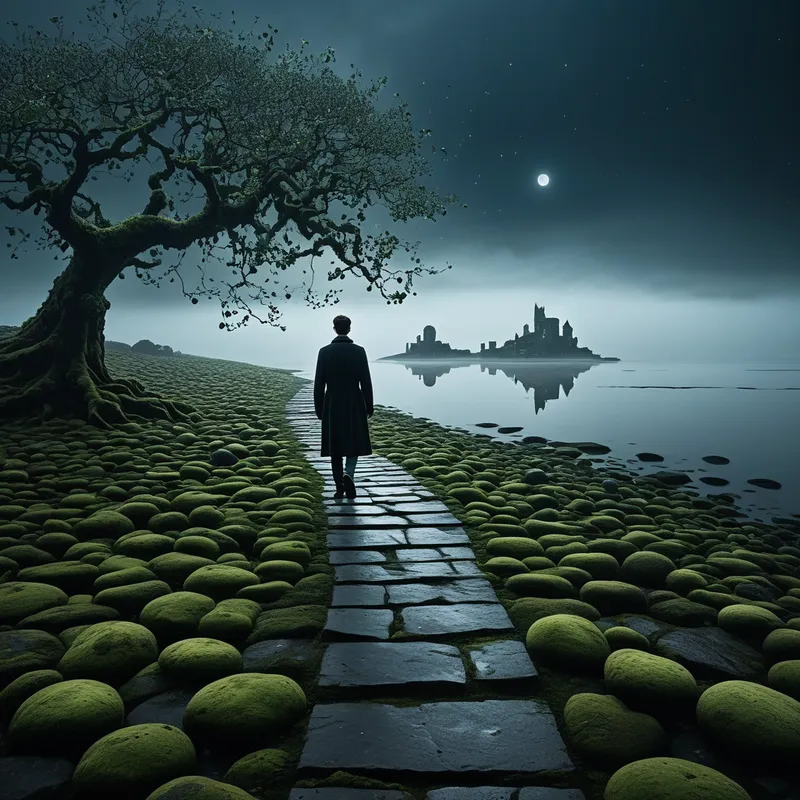
When this myth stirs in the modern dreamer, it often signals a profound psychological transition that cannot be managed by the will alone. To dream of a grievous wound, followed by a passive journey across water into a misty, unknown landscape, is to experience the psyche initiating its own “Avalon process.”
Somatically, this may correlate with periods of burnout, illness, or deep depression—states where the conscious mind is forced to relinquish control. Psychologically, it is the recognition that one’s former “kingdom”—a career, a relationship, a long-held identity—is irreparably damaged. The dream barge is the somatic intelligence and the deep unconscious saying, “You can no longer walk this path. You must be carried.” The resistance to this passive journey often manifests as anxiety or terror in the dream. The healing promised by the distant isle feels less like a reward and more like an annihilation of the self that once was. The dreamer is navigating the liminal space between identities, where the old has died but the new has not yet been born.
Alchemical Translation
The alchemical opus mirrored in the Path to Avalon is the stage of [solutio](/myths/solutio “Myth from Alchemical culture.”/)—dissolution—followed by coagulatio—coagulation into a new form. Arthur’s conscious, solar kingdom (Camelot) must be dissolved in the lunar waters of the unconscious (the mists of the Summerland) so that a more integrated being can eventually coalesce.
For the modern individual, this models the indispensable, and often dreaded, phase of individuation where one must surrender the heroic posture. We are culturally addicted to the archetype of the Hero who slays [the dragon](/myths/the-dragon “Myth from Chinese culture.”/). Avalon asks us to consider the Sage who is carried to the dragon’s lair to be remade. It is the transformation from “doing” to “being done unto,” from forging one’s destiny to being shaped by a destiny greater than one’s personal will.
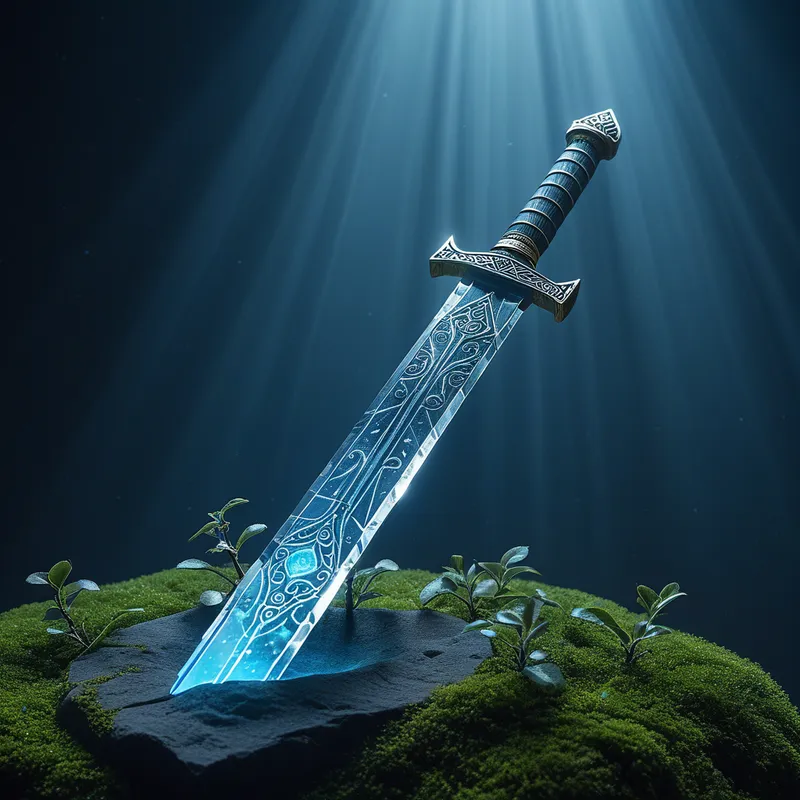
The ultimate treasure of Avalon is not a crown, but a scabbard—a vessel that contains and prevents wounding. It symbolizes the psychic container forged in the healing sleep, the resilience born of surrender.
The promise of Avalon is that wholeness lies not in the perfection of [the ego](/myths/the-ego “Myth from Jungian culture.”/), but in its graceful retirement to a subordinate role within the larger ecology of the Self. The king does not rule the island; the island heals the king. In our own lives, this translates to listening for the call to lay down our exhausting projects of self-construction, to be carried by the deeper currents of the psyche into a necessary fallow period, a healing sleep, from which we may emerge not as rulers of our domain, but as wise stewards of a mystery we finally consent to serve.
Associated Symbols
Explore related symbols from the CaleaDream lexicon: