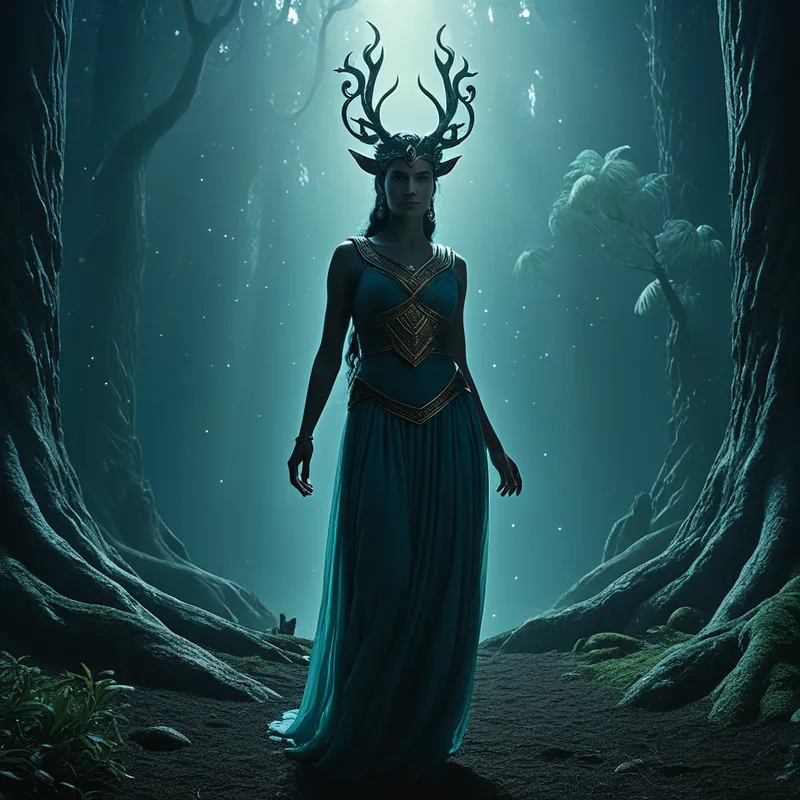
The Partzufim Divine Faces
The Partzufim are divine faces or personas in Kabbalistic thought, representing aspects of God's interaction with creation through mystical symbolism.
The Tale of The Partzufim Divine Faces
In the beginning, before the beginning known to creation, there was the Infinite, the [Ein Sof](/myths/ein-sof “Myth from Kabbalistic culture.”/). It was a light so absolute, so undifferentiated, that no vessel could hold it, no form could conceive it. It was the pure potential of Being, but not a being. In its boundless compassion to be known, to give, it performed the primordial act of [Tzimtzum](/myths/tzimtzum “Myth from Kabbalistic culture.”/)—a contraction, a withdrawal, creating a metaphysical void within itself. Into this void, it emanated ten vessels of light, the Sefirot. But the light was too potent, too fierce in its love, and the vessels shattered. This was the Shevirat HaKelim, [the Breaking of the Vessels](/myths/the-breaking-of-the-vessels “Myth from Jewish culture.”/). Holy sparks fell into [the abyss](/myths/the-abyss “Myth from Kabbalistic culture.”/), scattered and clothed in the husks of materiality.
From this cosmic catastrophe, a new order was destined to arise. The scattered light did not vanish; it yearned to return, to be reconstituted in a form that could endure relationship. Thus, from the fractured Sefirot, the Divine Faces—the Partzufim—were born. They are not new gods, but profound configurations of the original emanations, arranged into divine personas or countenances that can engage with one another and with the lower worlds.
First arose Arikh Anpin, the Vast or Long Face, also called Atika Kadisha, the Holy Ancient One. This is the face of boundless mercy, the supernal father, whose patience is as deep as eternity. From his brow shines forth Abba, the Father, and Imma, the Mother—the divine parents, Chokhmah (Wisdom) and Binah (Understanding) in intimate union. Their communion is a silent, endless stream of potentiality, the begetting of all that might be.
From their union, [the child](/myths/the-child “Myth from Alchemy culture.”/) is born: Zeir Anpin, the Short or Impatient Face. This is the face of the six Sefirot of emotion—Chesed, Gevurah, Tiferet, Netzach, Hod, Yesod—now unified as a single divine [persona](/myths/persona “Myth from Greek culture.”/), often correlated with the Holy One, Blessed be He. Zeir Anpin is the passionate, engaged God, the king who rules the cosmos with a blend of loving-kindness and judgment. He is the bridegroom, eternally yearning for his counterpart.
And she is Nukvah d’Zeir Anpin, the Female of Zeir Anpin, also called the [Shekhinah](/myths/shekhinah “Myth from Jewish Mysticism culture.”/), the Divine Presence. She is the daughter of Imma and the bride of Zeir Anpin, the manifestation of the final Sefirah, Malkhut (Kingdom). She is the indwelling presence of God in creation, the receptive vessel, the community of Israel, the earthly sanctuary. Her exile is the separation from her beloved, the source of all cosmic fragmentation and human sorrow. The great drama of existence is the story of their courtship, their occasional union in [the Sabbath](/myths/the-sabbath “Myth from Abrahamic culture.”/) bride, and their longed-for permanent reunion, which will signal the mending of all worlds.
These faces gaze upon one another in a perpetual dance of influence. Arikh Anpin showers the downflow of unearned grace upon Zeir Anpin, tempering his stern judgments. Abba and Imma pour the seeds of intellect and form into their son. And the love between Zeir Anpin and Nukvah is the very engine of cosmic sustenance and redemption. They are the hidden countenances behind [the veil](/myths/the-veil “Myth from Various culture.”/) of reality, the personal dimensions of an otherwise impersonal divine structure.
Cultural Origins & Context
The doctrine of the Partzufim represents the flowering of medieval Jewish mysticism, primarily within the Zoharic tradition. While [the Sefirot](/myths/the-sefirot “Myth from Kabbalistic culture.”/) are central to earlier Kabbalistic works like the [Sefer Yetzirah](/myths/sefer-yetzirah “Myth from Jewish culture.”/), [the Zohar](/myths/the-zohar “Myth from Kabbalistic culture.”/) (the “Book of Splendor”) and its interpreters, particularly the 16th-[century](/myths/century “Myth from Biblical culture.”/) masters of Safed like Rabbi [Isaac](/myths/isaac “Myth from Biblical culture.”/) Luria (the Ari), developed these into dynamic, anthropomorphic configurations. This was not a move toward polytheism, but a profound psychological and theosophical deepening. It addressed a core tension: how can a transcendent, unknowable God have a relationship with a finite, suffering world?
The Partzufim provided an answer rooted in relationality itself. They emerged from the need to explain the process of creation and the nature of divine providence. In a post-exilic context, where the Jewish people experienced profound dislocation, the myth of the exiled Shekhinah offered a powerful theodicy. God was not absent; the Divine Presence itself was in exile with them. The intimate, familial drama of the Partzufim—father, mother, son, daughter-bride—mapped the cosmic onto the personal, making the abstract process of [emanation](/myths/emanation “Myth from Neoplatonic/Gnostic culture.”/) something that could be felt, yearned for, and influenced through prayer, commandment, and mystical intention (kavanah).
Symbolic Architecture
The Partzufim constitute a living symbolic [architecture](/symbols/architecture “Symbol: Architecture in dreams often signifies structure, stability, and the framing of personal identity or life’s journey.”/) where theology becomes [psychology](/symbols/psychology “Symbol: Psychology in dreams often represents the exploration of the self, the subconscious mind, and emotional conflicts.”/), and cosmology becomes a map of the [soul](/symbols/soul “Symbol: The soul represents the essence of a person, encompassing their spirit, identity, and connection to the universe.”/). Each Partzuf is a complete configuration, a holographic fragment containing the whole.
Arikh Anpin symbolizes the super-ego or the transcendent self, the source of unconditional acceptance that exists prior to the conflicts of the psyche. Its “vastness” is the boundless space of pure consciousness before identification.
Abba and Imma represent the archetypal parental dyad within the psyche: the generative, impulsive principle of insight (Abba/Father/Wisdom) and the receptive, structuring principle of understanding that gives birth to form (Imma/Mother/Binah). Their union is the primal creative act of the mind.
Zeir Anpin is the ego in its totality—the configured self that experiences emotion, conflict, time, and relationship. Its six attributes are the full spectrum of human emotional and moral life, now integrated into a single, struggling, and passionate identity.
Nukvah/Shekhinah is the soul, the anima, or the embodied self in the world. She is the experience of immanence, the feeling of being here, now, often feeling separate from the source of meaning and love (Zeir Anpin). Her redemption is the integration of the divine into the fabric of daily, earthly life.
This architecture is not [static](/symbols/static “Symbol: Static represents interference, disruption, and the breakdown of clear communication or signal, often evoking feelings of frustration and disconnection.”/). The “influences” (shefa) flowing between the Partzufim are the internal dynamics of a healthy [psyche](/myths/psyche “Myth from Greek culture.”/): mercy tempering judgment, wisdom informing understanding, and the conscious self (Zeir Anpin) striving to unite with its own soulful [presence](/symbols/presence “Symbol: Presence in dreams often signifies awareness or acknowledgment of something significant in one’s life.”/) (Shekhinah) in [the world](/myths/the-world “Myth from Tarot culture.”/).
The Dreamer’s Resonance
To encounter the Partzufim in the inner landscape is to meet the fundamental personas of one’s own being. The dreamer may encounter the Vast Face (Arikh Anpin) in moments of profound peace or in dreams of infinite, peaceful spaces—a sense of being held by something older and wiser than one’s personal history. It is the internalized, benevolent ancestor.
The tension and love between Father and Mother (Abba & Imma) play out in the psyche as the dance between spontaneous inspiration and the capacity to give it form. A creative block may be a disruption in this inner union. The Impatient Face (Zeir Anpin) is the dreamer’s passionate, striving self—the hero of one’s personal myth, wrestling with ethical dilemmas, desires, and ambitions. Dreams of kings, bridegrooms, or central, complex male figures often touch this archetype.
But it is the Shekhinah who is most intimately known. She is the feeling of sacred presence in a beloved place, the poignant beauty of a moment that cannot last, the collective spirit of a community, and the profound loneliness of exile. She is the part of [the self](/myths/the-self “Myth from Jungian culture.”/) that feels vulnerable, waiting, and in need of reunion with its own core purpose and vitality. Her exile is felt as alienation, depression, or a sense of meaninglessness. Her redemption is experienced as integration, wholeness, and the sanctification of the ordinary.

Alchemical Translation
The Lurianic myth of the Partzufim is a grand alchemical opus. The initial Tzimtzum is the negrido, the blackening, the contraction into [the void](/myths/the-void “Myth from Buddhist culture.”/) of potential. The shattering of the vessels is the mortificatio, the necessary dissolution of rigid, incomplete forms. The formation of the Partzufim is the [albedo](/myths/albedo “Myth from Alchemical culture.”/), the whitening—the reconstitution of the scattered elements into more complex, resilient, and relational vessels.
The entire process is an alchemy of relationship. The divine substance (the light of Ein Sof) must undergo successive transformations—from unity to differentiation (Sefirot), from differentiation to fragmentation (Shattering), and from fragmentation to complex relationship (Partzufim)—to achieve a higher, more conscious unity.
The work of Tikkun Olam, mending the world, is the human participation in this divine alchemy. By performing acts of kindness (chesed) and establishing boundaries with [justice](/myths/justice “Myth from Tarot culture.”/) (gevurah), the individual aligns the microcosm of their soul with the macrocosm of the Partzufim. Each ethical act gathers a spark of the fallen light and elevates it, contributing to the ultimate union of Zeir Anpin and [the Shekhinah](/myths/the-shekhinah “Myth from Hebrew culture.”/). In this view, human consciousness is [the crucible](/myths/the-crucible “Myth from Alchemical culture.”/) where divine fragmentation is healed. We are not merely repairing the world; we are completing the anatomy of God.
Associated Symbols
Explore related symbols from the CaleaDream lexicon:
- Face — The manifest persona of the infinite, the point of contact where the unknowable becomes relational and knowable.
- Light — The divine essence and emanation, which is both creative and destructive, requiring vessels and faces to be received.
- Father — The archetypal principle of active wisdom, seed-like potential, and the initiating force of emanation.
- Mother — The archetypal principle of receptive understanding, [the womb](/myths/the-womb “Myth from Various culture.”/) that gives form to potential and births the structures of existence.
- Child — The emergent product of the divine union, symbolizing the configured world of emotion and action (Zeir Anpin) born from wisdom and understanding.
- Bride — The soul of creation (Shekhinah), the receptive counterpart yearning for union, representing fulfillment, completion, and the sanctification of the material.
- Exile — The state of separation between the divine masculine and feminine, the foundational wound in creation that drives the narrative of longing and return.
- Union — [The sacred marriage](/myths/the-sacred-marriage “Myth from Various culture.”/) (hieros gamos) of Zeir Anpin and Shekhinah, representing cosmic harmony, psychological integration, and the redemption of scattered sparks.
- Vessel — That which is designed to receive and contain [divine light](/myths/divine-light “Myth from Christian culture.”/), prone to shattering from overwhelming force but essential for the process of manifestation.
- Tree — The symbolic architecture of the Sefirot, the organic structure from which the anthropomorphic faces (Partzufim) blossom and grow.
- Shadow — The fragmented husks (kelipot) that capture the fallen sparks, representing the latent divine light trapped within the shells of negativity and obstruction.
- Circle — The endless, dynamic flow of influence (shefa) between the Partzufim, a symbol of the complete, inter-relational system of divine life.