The Palladium Myth Meaning & Symbolism
A sacred wooden statue fell from heaven, protecting the city that housed it. Its theft by cunning heroes sealed Troy's fate, revealing the power of the intangible.
The Tale of The Palladium
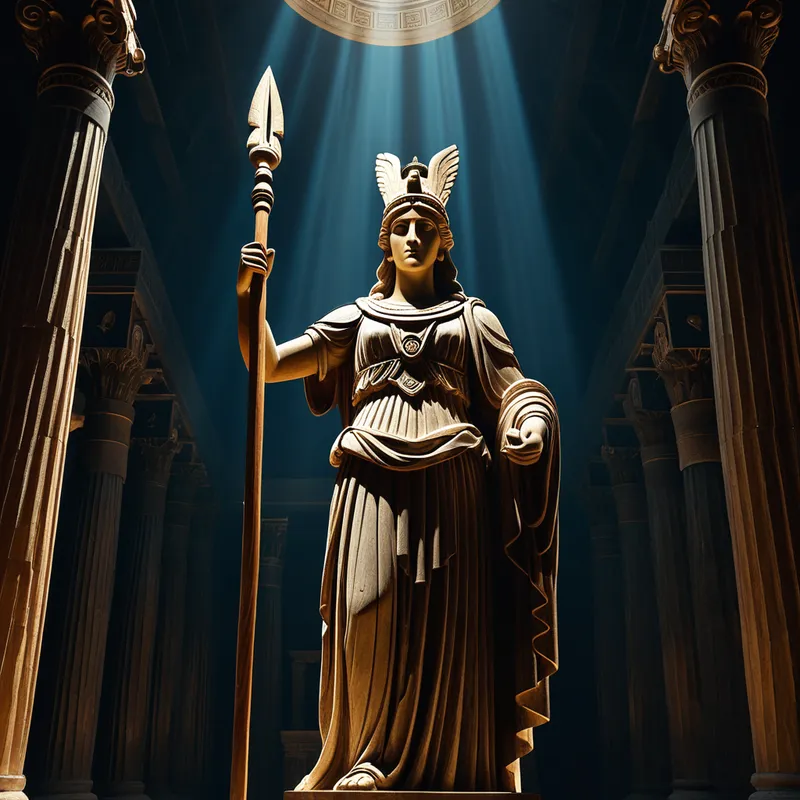
Hear now the tale of the city’s soul, the divine anchor that held fate at bay. It began not with mortal hands, but in the fiery heart of heaven. In the first, primal age, the goddess Athena, daughter of mighty Zeus, wished to honor her lost companion, the nymph Pallas. From the trunk of a sacred oak, she carved an image, a [xoanon](/myths/xoanon “Myth from Greek culture.”/), a vessel for divine presence. She poured her craft and her grief into the wood, shaping a figure three cubits tall, standing with feet joined, a spear raised in the right hand, a distaff and spindle in the left.
But [the Fates](/myths/the-fates “Myth from Greek culture.”/) are cruel in their weaving. As the goddess practiced the arts of war with her friend, a misstep, a divine deflection—and Pallas fell, slain by Athena’s own hand. In her boundless sorrow, Athena set the likeness of her friend in the high court of Zeus, and named it the [Palladium](/myths/palladium “Myth from Greek culture.”/), an eternal memorial. There it sat, thrumming with the power of two goddesses, until the day Ilus, building his new city of Ilium upon the plains, prayed for a sign of favor.
Zeus heard. From the clear, star-flecked vault of night, the Palladium fell, a comet of wood and destiny, crashing to earth within the king’s tent. It did not shatter. It stood, whole and terrible in its silence. An oracle’s voice, thin as wind through reeds, spoke: So long as this image remains within your walls, your city shall never fall. Ilus built for it a temple, a naos within the citadel, and there the people worshipped. The statue became the city’s sinew, its spiritual keystone. For generations, the high walls of Troy stood, and the Palladium watched from its dark cella, the guarantor of their permanence.
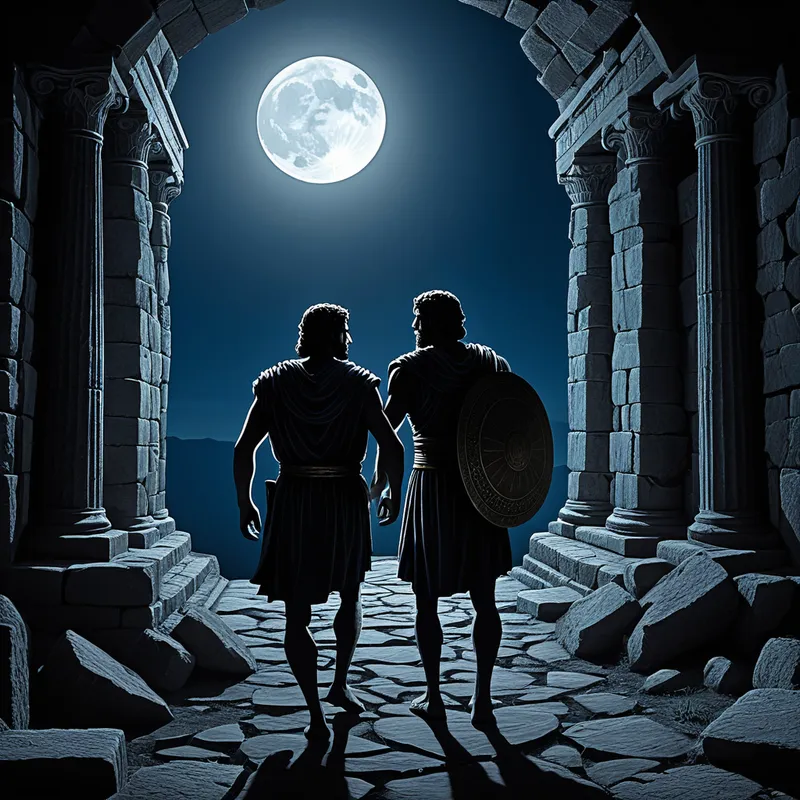
Then came the thousand ships, the decade-long siege, the blood-soaked plain. The Achaeans could not breach the walls while the Palladium kept its vigil. Desperation is the mother of cunning. The wily [Odysseus](/myths/odysseus “Myth from Greek culture.”/) and the fierce Diomedes took upon themselves a sacred crime. Under the cloak of a storm-wracked night, they slipped into the besieged city. Diomedes, mightier in arm, scaled [the temple](/myths/the-temple “Myth from Jewish culture.”/) walls. [Odysseus](/myths/odysseus “Myth from Greek culture.”/), mightier in guile, kept watch below. The air in the sanctuary was thick with the smell of old incense and dread. Diomedes’ hands closed around the ancient wood. Did it burn with cold fire? Did the eyes of the goddess seem to follow him? History does not say. He passed it down to his accomplice, and together they fled back through the sleeping streets, bearing the soul of Troy away in their profane hands.
With the dawn, a chill entered the stones of the city. The people felt it in their bones before they knew it in their minds. The protection was gone. The divine compact was broken. Not long after, the gift of the Trojan Horse was welcomed within those same walls, and the final, fiery fall began. The Palladium, meanwhile, traveled west—some say to Athens, others to Rome with the hero Aeneas—a stolen god, a transplanted destiny, its power now bound to new foundations.
Cultural Origins & Context
The myth of the Palladium is not a single, codified tale but a resonant motif woven through the epic cycles and later historiographies. Its primary sources are fragmentary, found in the lost epics of the Little Iliad and the Iliupersis (The Sack of Troy), and referenced by later writers like Vergil and Pausanias. This was a myth told not just for entertainment, but to explain a profound cultural and political reality: the transfer of kharis (favor) and auctoritas (authority) from one great civilization (Troy) to its successors (Greece, and ultimately Rome).
For the Greeks, it served as a divine justification for [the Trojan War](/myths/the-trojan-war “Myth from Greek culture.”/)’s outcome. [The fall](/myths/the-fall “Myth from Biblical culture.”/) was not merely due to superior force, but because a sacred, magical-technical prerequisite had been met. It transformed the war from a simple conflict into a ritual of transference. Later, for the Romans who claimed descent from Aeneas, the myth was foundational propaganda. It physically connected the might of Rome to the divine lineage of Troy and the favor of Athena, legitimizing their empire as the rightful heir to ancient, god-given power. The Palladium was thus a narrative vessel for discussing destiny, the fragility of divine protection, and the morally ambiguous acts often required to secure a future.
Symbolic Architecture
At its core, the Palladium is the [symbol](/symbols/symbol “Symbol: A symbol can represent an idea, concept, or belief, serving as a powerful tool for communication and understanding.”/) of the numen loci—the indwelling [spirit](/symbols/spirit “Symbol: Spirit symbolizes the essence of life, vitality, and the spiritual journey of the individual.”/) of a place, a people, or a [psyche](/myths/psyche “Myth from Greek culture.”/). It is not the walls themselves, but the intangible principle that makes the walls unassailable. It represents the sacred contract between the mortal and the divine, the internalized ideal that provides [identity](/symbols/identity “Symbol: Identity represents the sense of self, encompassing personal beliefs, cultural background, and social roles.”/), [cohesion](/symbols/cohesion “Symbol: The quality of sticking together or forming a unified whole, often representing unity, strength, and integrity in dreams.”/), and protection.
The true fortress is not stone, but belief; the most vulnerable point in any defense is the sanctum of its meaning.
The [statue](/symbols/statue “Symbol: A statue typically represents permanence, ideals, or entities that are revered.”/)’s theft is the critical symbolic act. It is not destruction, but appropriation. Odysseus and Diomedes do not smash the Palladium; they steal its context. This represents the profound psychological [truth](/symbols/truth “Symbol: Truth represents authenticity, honesty, and the quest for knowledge beyond mere appearances.”/) that our deepest protections—our core beliefs, our sense of self, our traumas—can be “stolen” or re-contextualized. What once guaranteed [security](/symbols/security “Symbol: Security denotes safety, stability, and protection in one’s personal and emotional life.”/) can, through [insight](/symbols/insight “Symbol: A sudden, deep understanding of a complex situation or truth, often arriving unexpectedly and illuminating hidden connections.”/), cunning, or [crisis](/symbols/crisis “Symbol: A crisis symbolizes turmoil, urgent challenges, and the need for immediate resolution or change.”/), be seen from a new [angle](/symbols/angle “Symbol: An angle represents change, perspective, and the multifaceted nature of situations.”/), dismantling the old [paradigm](/symbols/paradigm “Symbol: A fundamental model or framework in arts and music that shapes creative expression, perception, and cultural understanding.”/). [The fall of Troy](/myths/the-fall-of-troy “Myth from Greek culture.”/) is then the inevitable collapse of an identity that has lost its central, organizing principle. The power was never in the wooden idol, but in the collective [faith](/symbols/faith “Symbol: A profound trust or belief in something beyond empirical proof, often tied to spiritual conviction or deep-seated confidence in people, ideas, or outcomes.”/) in the idol. Once that faith is disrupted, the [structure](/symbols/structure “Symbol: Structure in dreams often symbolizes stability, organization, and the framework of one’s life, reflecting how one perceives their environment and personal life.”/) it supported cannot stand.
The Dreamer’s Resonance
When this myth stirs in the modern unconscious, it often manifests in dreams of violated sanctums. To dream of a cherished, small object—a locket, a key, a figurine—being stolen from a secure place (a childhood home, a vault, one’s own chest) points directly to the Palladium complex. The somatic sensation is one of hollow dread, a chilling vacancy in a space that should feel full and safe.
Psychologically, this indicates a process where a long-held, foundational self-concept is being challenged or “stolen” by emerging awareness. Perhaps the dreamer’s sense of being a “caretaker” (their Palladium) is being taken by the recognition of their own need. Or their identity as a “victim” (a negative Palladium that still “protects” by defining limits) is being pilfered by burgeoning strength. The dream is the psyche’s dramatic rendering of this inner coup. The ensuing disorientation and anxiety mirror Troy’s final days—a known world is ending because its spiritual core has been displaced. The task for the dreamer is not to recover the stolen object as it was, but to discover where it has been taken and what new city it is now meant to protect.
Alchemical Translation
The alchemical journey modeled by the Palladium myth is the transmutation of the [talisman](/myths/talisman “Myth from Global culture.”/). The process begins with the identificatio—the total fusion of [the self](/myths/the-self “Myth from Jungian culture.”/) with a protective ideal (the city is the statue). This provides stability but also stagnation; Troy under the Palladium is in a ten-year siege, a static, unbearable tension.
The theft is the crucial [separatio](/myths/separatio “Myth from Alchemical culture.”/) and mortificatio. It is a violent, shadow-driven act (undertaken by the “cunning” and “fierce” parts of the self, Odysseus and Diomedes) that severs [the ego](/myths/the-ego “Myth from Jungian culture.”/) from its identification with the primal object. This is experienced as a death, a profound loss. The old city-self must burn.
The treasure is never where you first guarded it; it is always in the hands of the thief who dared to take it, for he has taken it into a new story.
Finally, the translatio—the carrying of the statue to a new land. This is the albedo and [rubedo](/myths/rubedo “Myth from Alchemical culture.”/), the whitening and reddening. The core power, the numen, is not lost. It is purified by the journey and re-contextualized. The wooden idol becomes a founding principle for a new, more conscious identity (Rome, or the integrated Self). The individual learns that their deepest power was not the rigid form of their old belief, but the animating spirit within it. That spirit, once stolen from the prison of unconscious identification, can be used to consciously build rather than unconsciously defend. The myth thus charts the path from being a guarded citadel to becoming a purposeful founder, carrying [the sacred fire](/myths/the-sacred-fire “Myth from Native American culture.”/) of one’s essence into an unknown, self-created future.
Associated Symbols
Explore related symbols from the CaleaDream lexicon: