The Paduka Myth Meaning & Symbolism
The myth of Bharata placing Rama's sandals on the throne, a profound symbol of sacred duty, surrendered sovereignty, and the soul's true path.
The Tale of The Paduka
Listen. The story begins not with a birth, but with an absence. The great city of Ayodhya was a city of silence. Its towers, which once sang with the conch-shells of celebration, now stood mute. Its streets, which once flowed like rivers of joyous citizens, were dry and still. The king was dead, felled by a broken heart. The heir, the beloved Rama, was gone, exiled to the deep, whispering forests for fourteen long years. And the throne, the magnificent Simhasana, sat empty, a gaping maw of power in the heart of the palace.
Into this hollow grandeur returned Prince Bharata. He had been away, summoned by a fateful message. He returned to find his world inverted. His mother, Kaikeyi, whose lap was his comfort, had become the architect of this calamity. His father’s pyre was cold ash. His brother, his north star, was banished. And the crown, heavy with guilt and manipulation, had been thrust upon his head. The weight of it was not of gold, but of a terrible, profane error.
Bharata’s heart did not swell with ambition; it shattered with grief. He raged at his mother, his tears a torrent of betrayal. He refused the kingdom born of deceit. Donning the bark garments of an ascetic, he turned his back on the glittering palace and led a mournful procession of ministers, soldiers, and citizens southward, towards the dark line of the Dandaka forest. They crossed rivers and plains, their purpose a single, desperate plea.
They found Rama on a mountainside at Chitrakuta. He was clad in simple deerskin, yet he shone with a sovereignty that needed no throne. Bharata fell at his feet, weeping. “The kingdom is yours,” he implored. “Return. Rule. Let me take your place in this exile.” The air was thick with the scent of pine and unspoken love.
But Rama, bound by the sacred word given to his father, could not return. His duty, his dharma, was as unyielding as the mountain beneath them. The kingdom wept. Hope seemed to drain into the forest soil.
Then, Bharata’s devotion forged a solution of breathtaking humility. “If you cannot grace the throne with your presence,” he said, his voice steady with resolve, “then let your presence grace it in another form. Give me your paduka. Your sandals. I will place them upon the Simhasana. I will rule not as a king, but as their humble regent, their servant. Every decree will be issued in their name. Every judgment will be rendered under their gaze. The kingdom will wait for you, and these, your footprints, will hold your place.”
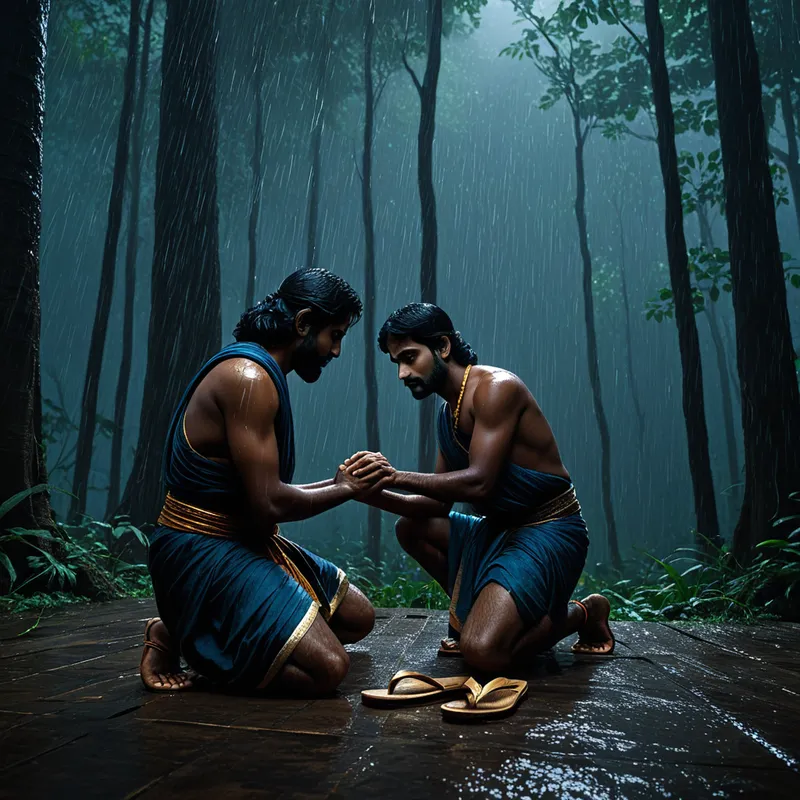
And so, on the banks of the Mandakini river, Rama removed his simple wooden sandals. They were worn from forest paths, etched with the dust of his righteous journey. He placed them into Bharata’s waiting, reverent hands. In that transfer, a new kind of kingship was born—one of proxy, of devotion, of surrendered sovereignty.
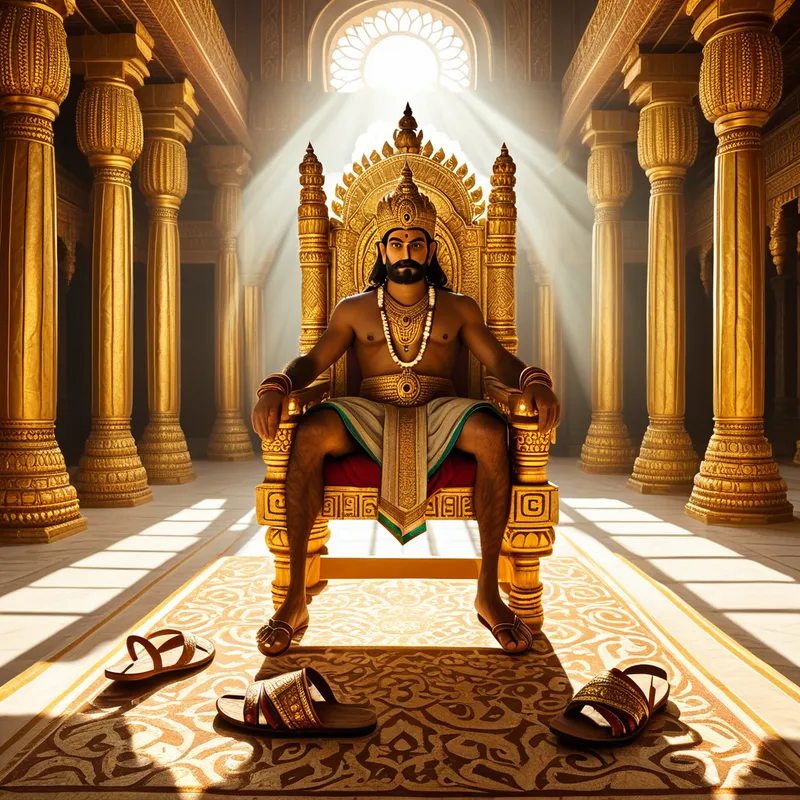
Bharata returned to Ayodhya. He entered the silent palace, passed the empty throne room, and ascended the dais. But he did not sit upon the Lion Throne. Instead, with the care of a priest performing the highest ritual, he placed Rama’s paduka upon the seat of power. For fourteen years, he ruled from a village outside the city, Nandigrama, coming to the palace only to conduct state affairs before the sandals. He lived as an ascetic, his crown a burden he bore only for his brother. The throne was never empty. It was occupied by the sacred imprint of the one who walked the true path.
Cultural Origins & Context
This poignant episode is the emotional core of the Ayodhya Kanda, the second book of the ancient Indian epic, the Ramayana. Attributed to the sage Valmiki, the epic was not merely literature but itihasa—“thus indeed it happened”—a narrative framework for encoding cultural, spiritual, and political ideals. The story of the Paduka was transmitted for millennia through oral recitation by bards and kathakars (storytellers), in temple performances, and later through countless regional written and artistic adaptations.
Its societal function was multifaceted. Politically, it presented a radical model of governance: authority derived not from personal ambition but from duty and moral proxy. The king is the servant of dharma, symbolized by the sandals. Psychologically, it reconciled the tension between the worldly duty of kingship (rajadharma) and the spiritual duty of truth and filial piety. For the common person, it modeled the essence of devotion (bhakti)—Bharata’s self-effacing service became the ultimate ideal of loyalty and love, teaching that true power lies in surrender to a principle higher than the self.
Symbolic Architecture
The Paduka is far more than footwear. It is a dense, multi-layered symbol of presence-in-absence, of the path as the destination.
The throne is not where the king sits, but where his sacred footprint rests. Sovereignty is not a station one occupies, but a path one walks.
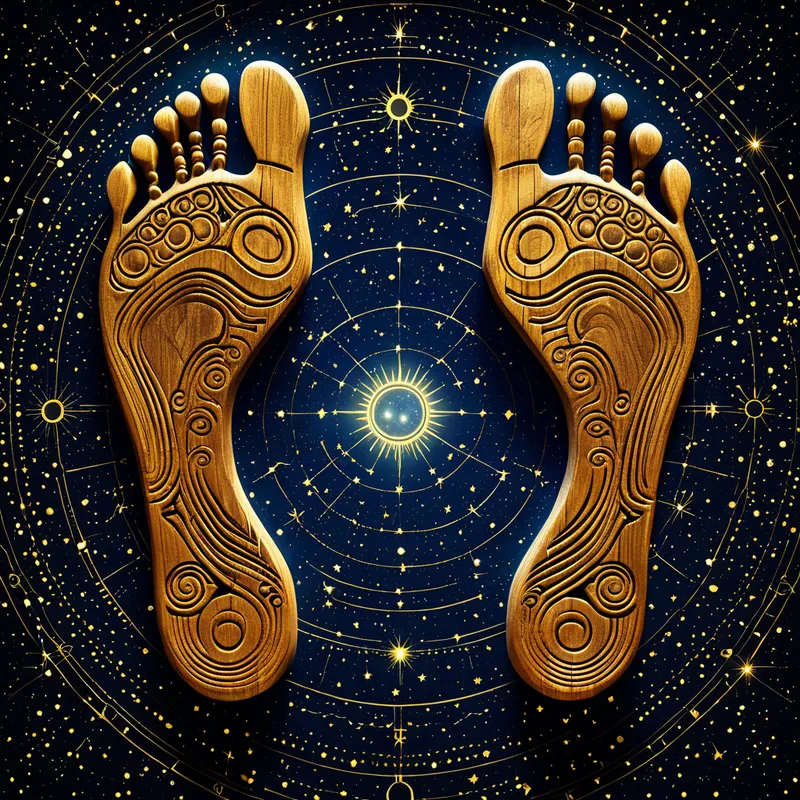
The Sandals themselves symbolize the interface between the soul and its journey. They touch the earth (the manifest world) while protecting and carrying the foot (the individual spirit or atman). Rama’s worn, simple paduka signify that true authority is seasoned by sacrifice and contact with the raw truth of the world, not insulated by palace walls.
The Empty Throne occupied by the sandals represents the concept of divine or dharmic kingship. The physical ruler is merely a temporary placeholder for an eternal principle. It speaks to the Jungian concept of the ego serving the Self—the personal identity administering the will of the deeper, transpersonal core of the psyche.
Bharata’s Role is the archetype of the righteous regent, the ego that recognizes it is not the true monarch of the psyche. His anguish, his refusal of wrongly gained power, and his ingenious solution model the crucial psychological process of subordinating personal desire to a transpersonal value. His rule from Nandigrama, away from the seat of power, illustrates the attitude of stewardship: managing the affairs of the psyche (the kingdom) without identifying with its central authority.
The Dreamer’s Resonance
When this myth stirs in the modern unconscious, it rarely appears as a literal scene of sandals and thrones. Instead, it manifests as dreams of surrogate authority and sacred proxy.
One might dream of being asked to lead a team or a family, but insisting that an empty chair at the head of the table be reserved for an absent, respected mentor whose photo or personal item is placed there. The dreamer feels they are acting “in the name of” something greater than themselves. Another may dream of wearing a uniform or a badge that feels too large, accompanied by the somatic sensation of walking carefully in another’s oversized shoes, trying to fill an imprint rather than create a new one.
Psychologically, this signals a process where the ego is grappling with a new level of responsibility or identity. It is not a power fantasy, but a dream of humble stewardship. The conflict is between the desire to own one’s authority and the intuitive knowledge that the role one is stepping into belongs, in its essence, to a principle, a legacy, or a duty that precedes and transcends the individual. The dream is guiding the dreamer toward an attitude of service to this greater principle, easing the anxiety of “imposter syndrome” by reframing the role as one of regency, not ownership.

Alchemical Translation
The alchemy of the Paduka myth is the transmutation of egoic ambition into devotional service, a cornerstone of the individuation process. The “gold” produced is not personal glorification, but a personality structured around a central, guiding truth.
The initial nigredo, the blackening, is Bharata’s despair—the realization that the crown one is offered is tainted, that the identity presented (the kingship) is built on a foundation of shadow (his mother’s manipulation). The conscious ego must “go into exile,” like Bharata traveling to the forest, to confront its true source of authority (Rama).
The albedo, the whitening, is the clarity of the solution: the sandals. This is the moment of insight where the ego realizes, “I am not the Self, but I can serve the Self. I cannot be the ultimate authority, but I can represent it.” The sandals are the symbol that mediates between the personal and transpersonal. In psychological terms, this is the creation of a living symbol—like a personal ethic, a creative calling, or a spiritual practice—that one places at the center of one’s life.
Individuation is not about becoming king. It is about discovering what you are willing to place upon the throne of your life, and having the humility to rule as its regent.
Finally, the rubedo, the reddening or culmination, is Bharata’s long reign in Nandigrama. This is the sustained, daily practice of living from this symbolic center. It is the integration phase, where one administers the complexities of life (the kingdom) not from a place of identifying with the central power, but from a place of service to the symbolic paduka—the chosen, sacred principle. The ego finds its rightful, fulfilling, and potent role not as the solitary monarch, but as the devoted custodian of the path. The footprint becomes the throne, and the journey itself becomes the seat of sovereignty.
Associated Symbols
Explore related symbols from the CaleaDream lexicon: