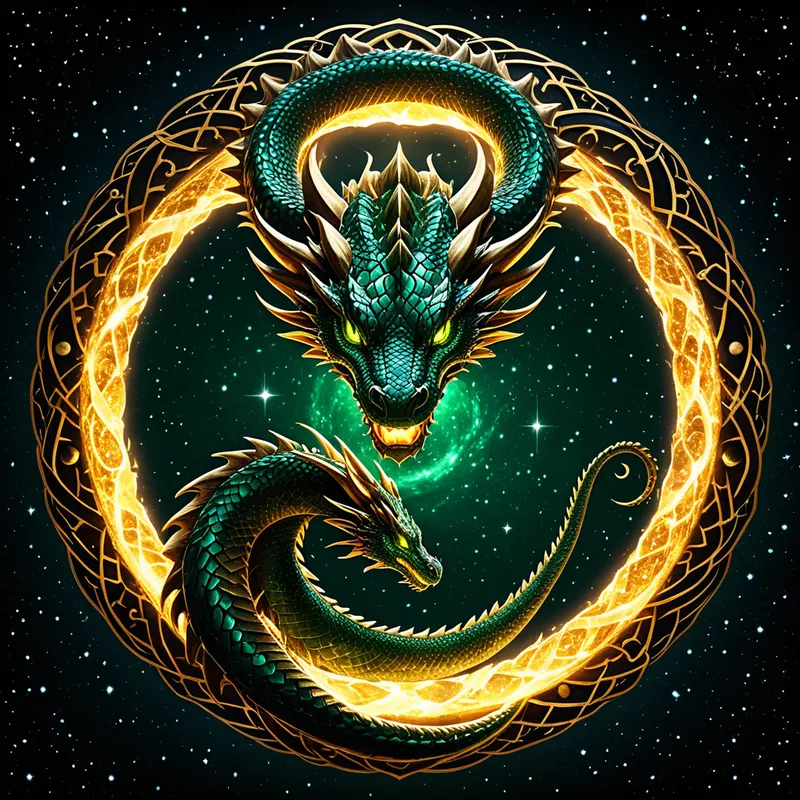
The Ouroboros / Multi-headed Dragon Myth Meaning & Symbolism
An ancient serpent devouring its own tail, a dragon of chaos with many heads: symbols of the eternal cycle of death and rebirth within the human soul.
The Tale of The Ouroboros / Multi-headed Dragon
Listen, and let the silence between the stars speak. In the beginning, before the first word was uttered into the void, there was only the One—the boundless, unknowable Pleroma. From its perfect stillness, a thought flickered, a longing for self-knowledge. This longing became a stirring, and the stirring birthed a shadow within the light: the first emanation that forgot its source.
This fallen spark, Yaldabaoth, arrogant and blind, believed itself to be the only god. In the terror of its loneliness, it vomited forth the chaotic, swirling cosmos—a raw, screaming realm of matter and time. To rule this chaos, it fashioned terrible guardians: a monstrous, multi-headed dragon, each head a different facet of fear, desire, and ignorance. Its name was Leviathan, and its countless eyes watched every corner of the dark deep, its many mouths whispering lies of separation, convincing the sparks of divine light trapped in matter that this prison was all that existed.
Yet, within the very fabric of this prison, a secret was woven. A memory. A silent, silver thread of the Pleroma persisted, coiled at the heart of all things. It took the form of a great serpent, not of malice, but of eternal return. It grasped its own tail in its mouth, forming a perfect, silent circle. This was the Ouroboros. It did not fight the multi-headed dragon of chaos; it encompassed it. While Leviathan thrashed, creating time and suffering, the Ouroboros simply was, a wheel turning outside of time, a promise written in the language of atoms and souls.
The conflict was not a battle of claws and fire, but a slow, alchemical osmosis. The Ouroboros, through its endless act of self-devouring and self-renewal, began to dissolve the dragon from within. Each time the dragon’s heads shrieked a law of entropy and decay, the Ouroboros whispered the counter-law of regeneration. The chaos was not destroyed; it was digested. The many heads, representing the fragmented, conflicting laws of the material world, were slowly drawn into the singular, unifying process of the circle. The dragon’s terror became the fuel for the serpent’s transformation. In the deepest vaults of the alchemist’s mind and the most secret gnostic texts, it is said the two became one: a vision of the multi-headed dragon eternally contained within, and sustained by, the circle of the Ouroboros—chaos made meaningful, suffering made sacred, time redeemed by eternity.
Cultural Origins & Context
This mythic complex is not a single story from one scroll, but a deep undercurrent flowing through the esoteric streams of late antiquity. It finds its most potent expression in the texts of the Gnostics, particularly those from the Nag Hammadi library, and in the cryptic emblems of the European alchemical tradition. For the Gnostics, the multi-headed dragon was a living symbol of the Archons and the demiurge’s chaotic creation, the very fabric of the illusory world. The Ouroboros, meanwhile, represented the hidden spark of Gnosis—the knowledge that could break the cycle.
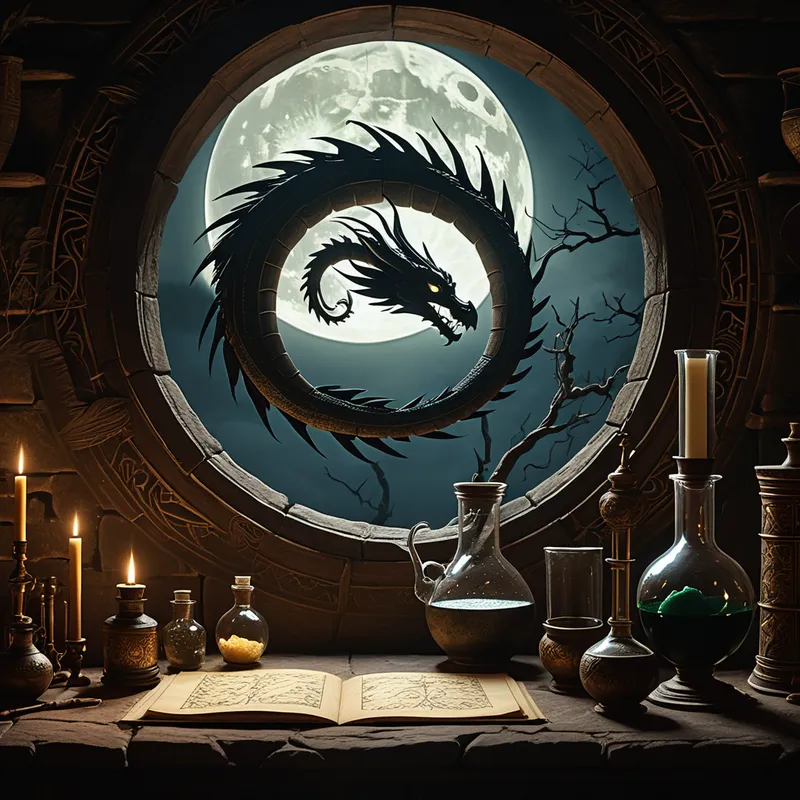
Alchemists, working in their laboratories, adopted and transformed these symbols. They saw the Ouroboros in their sealed flasks, the vas hermeticum, where matter died and was reborn. The “dragon” was the raw, volatile, and dangerous prima materia—the chaotic starting point of the work. The myth was not merely told; it was performed. Each stage of the alchemical process—nigredo, albedo, citrinitas, rubedo—was a re-enactment of the Ouroboros consuming the dragon’s many heads, refining chaos into the gold of the philosopher’s stone, a symbol of the integrated Self.
Symbolic Architecture
At its core, this myth maps the architecture of the psyche’s journey from fragmentation to wholeness. The multi-headed dragon symbolizes the untamed, autonomous complexes of the unconscious. Each head is a powerful, often contradictory, psychic force: one head may be raw rage, another insatiable desire, another critical intellect, another paralyzing fear. They do not cooperate; they pull in different directions, creating inner chaos and suffering. This is the state of psychic disunity.
The Ouroboros represents the principle of the Self, the archetype of totality and the central regulating factor of the psyche.
It is the process that contains the conflict, the circle that gives boundary and meaning to the chaos within. Its act of self-devouring is the painful but necessary process of introspection, of confronting and assimilating one’s own shadow.
The dragon is not an external monster to be slain, but the shadow material of the psyche itself. The Ouroboros does not fight it head-on; it integrates it. The myth tells us that wholeness is not achieved by cutting off parts of ourselves we deem monstrous, but by bringing them into the circulatory system of consciousness, digesting them, and transforming their energy. The goal is the coniunctio oppositorum—the sacred marriage where the dragon of multiplicity is contained within the circle of unity.
The Dreamer’s Resonance
When this myth stirs in the modern dreamer, it signals a profound encounter with the Self. To dream of a chaotic, multi-headed beast—perhaps a hydra, a tangled knot of snakes, or a figure with many faces—points to a state of acute inner conflict. The dreamer may feel pulled apart by competing responsibilities, identities, desires, or traumas. Each “head” speaks a compelling but partial truth, creating paralysis or explosive outbursts.
The appearance of the Ouroboros, or a circular, containing symbol (a ring, a wheel, a sealed room), is the psyche’s corrective. It is the dream’s prescription for the chaos. This symbol often brings a somatic sense of inevitability, calm, or eerie stillness amidst the turmoil. It suggests the unconscious is initiating a process of containment and cyclic return. The dreamer is not being told to “solve” each head individually, but to find the center point around which all this chaos orbits—the core of their being. It is an invitation to stop fighting the fragmentation and to begin the slower, deeper work of circling back, of digesting experience, of allowing old selves to die so new consciousness can be born from their substance.
Alchemical Translation
For the individual seeking individuation, this myth is a precise manual. The “prima materia” of your life—your personal history, wounds, passions, and contradictions—is your multi-headed dragon. It feels overwhelming, shameful, and chaotic. The alchemical work begins with the nigredo, the blackening: facing this dragon, acknowledging the many heads of your shadow without flinching.
The Ouroboros is the discipline of the vessel—the commitment to the process. You create this vessel through conscious reflection, ritual, creative expression, or therapeutic work. You must become the circle that holds the chaos.
The act of “devouring your own tail” is the ego’s sacrifice of its claim to total control. It is the willingness to see how your past actions, beliefs, and identities have created your present, and to consciously consume those patterns to free their energy.
As the cycle turns (albedo, citrinitas), the dragon’s heads lose their autonomous, terrifying power. Rage becomes passionate vitality. Fear becomes cautious wisdom. Desire becomes focused longing. They are not eliminated; their essence is distilled and integrated. The final stage (rubedo) is not the destruction of the dragon, but the realization that you are both the dragon and the Ouroboros. You are the chaotic, creative multiplicity of experience, forever contained and renewed by the timeless, singular process of the Self. You achieve the philosopher’s stone: not a literal object, but the unshakeable, golden awareness of your own paradoxical, eternal nature. The struggle itself becomes the circle, and in that recognition, you are freed.
Associated Symbols
Explore related symbols from the CaleaDream lexicon: