
The Origin of Throat Singing Siberian Myth Meaning & Symbolism
A myth where a hunter's sacrifice to the mountain spirit births a new voice, allowing humanity to sing the world's soul.
The Tale of The Origin of Throat Singing Siberian
Listen. Listen to the wind that scours the high steppe, to the ice that groans in the river’s heart, to the whisper in the larch tree’s roots. Before there was a song for these things, there was only silence in the human chere. People lived, hunted, loved, and died with a single voice, a lonely note in the vast choir of the world.
In the time when the world was younger and the spirits walked closer, there was a hunter named Erkhe. He was the best tracker of his clan, but a great hunger had fallen upon the land. The caribou had vanished into the white mists of the north, the hares were scarce, and the fish slept deep under thickening ice. The people grew thin, and their single voices became whispers of despair. Erkhe, driven by the cries of the children, journeyed further than any had before, into the sacred, forbidden peaks where the Ezhin of the mountain dwelled.
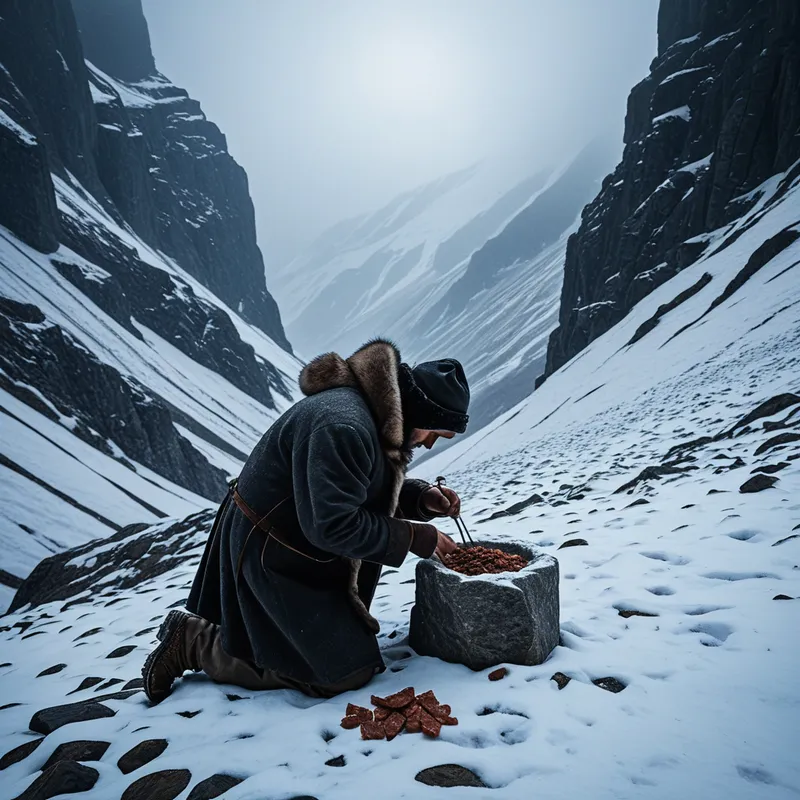
For seven days and seven nights, he climbed, his breath a ragged plume in the thin, knife-cold air. He found no game, only the immense, watching silence of the stone. On the eighth morning, at the roof of the world where the sky bleeds into the earth, he collapsed. His strength was spent, his food pouch empty. In a final act of surrender, not of conquest, he took his last piece of dried meat and his last sip of fermented mare’s milk, and placed them as an offering in a deep crack in the mountain’s face.
“Great Ezhin,” he rasped, his one voice breaking. “I have nothing left to give my people but my life. If you must take it, take it. But if you have any mercy, let it be a bridge. Let our loneliness meet your fullness.”
A deep rumble answered, not through the air, but through the stone beneath him. The mountain seemed to shift, and from the crack where he made his offering, a warmth flowed out. It was not fire, but a vibration, a profound and ancient hum that resonated in his very bones. The voice of the mountain was not a single sound, but many—the grinding of glaciers, the sigh of the wind through canyons, the chatter of a stream over pebbles, the deep pulse of the earth’s heart.
The sound entered Erkhe, not through his ears, but through the soles of his feet, rising up his spine. It filled him, and he felt it pressing against the walls of his chest, his throat, desperate for release. He opened his mouth, but his old, single voice was gone. Instead, when he breathed, the world’s breath breathed through him.
From his throat emerged a low, droning fundament, steady as the permafrost. And upon that drone, other voices blossomed: a high, whistling melody like the berkut riding the wind, a middle tone that mimicked the wild horse’s whinny, a rhythmic pulse like a stag’s hooves on tundra. He was no longer singing about the world; he was singing the world itself. The mountain’s spirit had accepted his sacrifice and given in return the gift of multiplicity—the ability to hold and express the polyphonic soul of all things.
When Erkhe returned to his people, he was gaunt, his eyes holding the storm. He did not speak. He sat by the fire, opened his mouth, and sang. And from him flowed the river, the forest, the herd, and the spirit of the mountain. The people wept, for in that song, they were no longer orphans in a silent universe. They were children hearing their mother’s true voice for the first time. The hunger remained in their bellies for a time, but the famine in their souls was over. Throat singing, khoomei, was born.
Cultural Origins & Context
This foundational myth originates from the Turkic-speaking pastoralist peoples of the Altai-Sayan region in Southern Siberia, particularly the Tuvans and Altaians. It is not a single, codified text, but a living oral tradition passed down by storytellers and, most importantly, by the throat singers (khoomeizhi) themselves. The myth served as an etiological narrative, explaining the sacred origin of a defining cultural practice. More than mere entertainment, khoomei was and is a spiritual technology—a way to commune with the animistic landscape, to honor the master spirits (Ezhin) of mountains, rivers, and forests, and to mimic and invoke the animals essential for survival. The myth legitimized the singer’s role as a mediator between the human community and the more-than-human world. By learning to sing, one was not just learning a technique; one was walking the path of Erkhe, engaging in a sacred reciprocity with the cosmos.
Symbolic Architecture
At its core, the myth is a profound map of psychic transformation through encounter with the Other. Erkhe begins as the [orphan](/symbols/orphan “Symbol: Represents spiritual abandonment, primal vulnerability, and the quest for belonging beyond biological ties. Often signifies a soul’s journey toward self-reliance.”/), separated from his nourishing [source](/symbols/source “Symbol: The origin point of something, often representing beginnings, nourishment, or the fundamental cause behind phenomena.”/) (the game, the [favor](/symbols/favor “Symbol: ‘Favor’ represents the themes of acceptance, goodwill, and the desire for approval from others.”/) of the spirits). His [journey](/symbols/journey “Symbol: A journey in dreams typically signifies adventure, growth, or a significant life transition.”/) is one of desperate necessity, not heroic ambition.
The true gift is never given to the full hand, but to the empty one. It is in the utter expenditure of the ego’s resources that the Self can finally speak.
The [mountain](/symbols/mountain “Symbol: Mountains often symbolize challenges, aspirations, and the journey toward self-discovery and enlightenment.”/) represents the ultimate [Stone](/symbols/stone “Symbol: In dreams, a stone often symbolizes strength, stability, and permanence, but it may also represent emotional burdens or obstacles that need to be acknowledged and processed.”/)—the immutable, daunting face of the unconscious or the objective psyche. Erkhe’s offering is the critical pivot. He moves from taking (hunting) to giving, even in his [poverty](/symbols/poverty “Symbol: A state of lacking material resources or essential needs, often symbolizing feelings of inadequacy, vulnerability, or spiritual emptiness in dreams.”/). This ritualizes a psychological shift from an [attitude](/symbols/attitude “Symbol: Attitude symbolizes one’s mental state, perception, and posture towards life, influencing emotions and actions significantly.”/) of appropriation to one of sacrifice, creating a vacuum that the psyche must fill. The [mountain](/symbols/mountain “Symbol: Mountains often symbolize challenges, aspirations, and the journey toward self-discovery and enlightenment.”/)’s [response](/symbols/response “Symbol: Response in dreams symbolizes how one reacts to situations, often reflecting the subconscious mind’s processing of events.”/)—the [multi](/symbols/multi “Symbol: Multi signifies multiplicity and diversity, often representing various aspects of life or identity in dreams.”/)-voiced hum—symbolizes the latent complexity and [harmony](/symbols/harmony “Symbol: A state of balance, agreement, and pleasing combination of elements, often associated with musical consonance and visual or social unity.”/) of the unconscious itself, which contains the voices of all our instincts, ancestors, and archetypes (the animal spirits). Erkhe’s [Throat](/symbols/throat “Symbol: Represents communication, expression, and the transmission of thoughts.”/) becomes the alchemical [vessel](/symbols/vessel “Symbol: A container or structure that holds, transports, or protects something essential, representing the self, emotions, or life journey.”/) where this inner multiplicity is transmuted into conscious [expression](/symbols/expression “Symbol: Expression represents the act of conveying thoughts, emotions, and individuality, emphasizing personal communication and creativity.”/). He does not become the [mountain](/symbols/mountain “Symbol: Mountains often symbolize challenges, aspirations, and the journey toward self-discovery and enlightenment.”/); he becomes its [instrument](/symbols/instrument “Symbol: An instrument symbolizes creativity, communication, and the means by which one expresses oneself or influences the world.”/).

The Dreamer’s Resonance
When this mythic pattern stirs in the modern dreamer, it often signals a profound somatic and psychological process of integration. One may dream of being in a barren, frozen landscape (emotional aridity, creative famine), feeling a pressure in the chest or throat (repressed emotions, unlived life struggling for expression), or hearing impossible, layered sounds from within or from the environment.
These dreams point to an encounter with what Jung called the “psychoid” unconscious—aspects of the psyche so deep they are indistinguishable from bodily states and instinctual patterns. The pressure in the Throat is the somatic imprint of unlived potentials, ancestral wounds, or silenced instincts demanding to be “sung,” to be given a voice in the individual’s life. The dream is an invitation to make Erkhe’s sacrifice: to offer up the ego’s insistence on a single, controlled identity (the “one voice”) and to courageously allow the more complex, often discordant-seeming, chorus of the inner world to emerge.

Alchemical Translation
The myth models the individuation process with stunning clarity. The starting point is the orphan state—a sense of psychic famine, of being a monophonic self in a polyphonic universe. The Journey into the mountains is the conscious descent into the unconscious, the nekyia.
The critical alchemical operation is the Sacrifice. The ego must offer its “last piece of meat”—its certainty, its pride, its old ways of being—into the crack of the unknown. This is the solutio (dissolution) and mortificatio (death) of the old, impoverished attitude.
Individuation is not about becoming a louder single note, but about learning to harmonize the many notes you already contain. The Self is a chord, not a melody.
The infusion of the mountain’s voice is the coniunctio—the sacred marriage of conscious and unconscious. The new skill, throat singing, represents the resultant lapis or philosopher’s stone: the capacity for conscious, embodied expression of the whole psyche. The individual gains the ability to “sing their world into being,” to articulate their inner landscape with all its textures, conflicts, and harmonies, thus transforming personal famine into a feast of meaning. They return to the community of the self, no longer an orphan, but a mediator of wholeness.
Associated Symbols
Explore related symbols from the CaleaDream lexicon:
- Mountain — The immutable, daunting face of the Great Other, representing the objective psyche, the unconscious, and the ultimate challenge that demands surrender, not conquest.
- Sacrifice — The critical act of giving up the ego’s last resources, creating the sacred vacuum that allows a greater power to enter and transform the individual.
- Throat — The alchemical vessel and channel of transmutation, where the silent, inner multiplicity of the psyche is forged into audible, harmonious expression.
- Journey — The necessary, arduous passage from the known world of the ego into the unknown wilderness of the spirit, driven by a deep, often desperate, need.
- Spirit — The animating, intelligent presence within the landscape (the Ezhin), symbolizing the objective, autonomous reality of the archetypal forces within the unconscious.
- Voice — The expression of soul; in the myth, the transformation from a single, lonely human voice to a polyphonic instrument of the cosmos.
- Hunger — The psychic famine, the feeling of emptiness and disconnection that initiates the transformative quest for deeper nourishment.
- Stone — The enduring, eternal ground of being; the mountain as the ultimate stone that holds and then imparts the foundational vibration of life.
- Animal — The instinctual forces and archetypal energies (eagle, horse, stag) that reside within the unconscious and become the harmonic overtones of the new self.
- Gift — The boon that comes not from seeking, but from surrendering; the unexpected capacity that arises from a state of true poverty and openness.
- Origin — The mythic moment of inception, where a fundamental human capacity is born from an encounter with the sacred, defining a culture’s and an individual’s relationship to the world.
- Harmony — The ultimate goal and evidence of the transformation: the state where multiple, distinct voices coexist in a resonant, beautiful whole, both in song and in psyche.