The Origin of Death West African Myth Meaning & Symbolism
A myth where a divine message of immortality is lost, transforming death from an accident into the defining rhythm of earthly life.
The Tale of The Origin of Death West African
In the time before time, when the sky was closer to the earth and the breath of the first beings still hung warm in the air, there was no ending. Life was a continuous thread, unbroken, woven between the great Nyame above and the clay-formed humans below. But life was also without change, without urgency, a shallow pool that never knew the depth of a current.
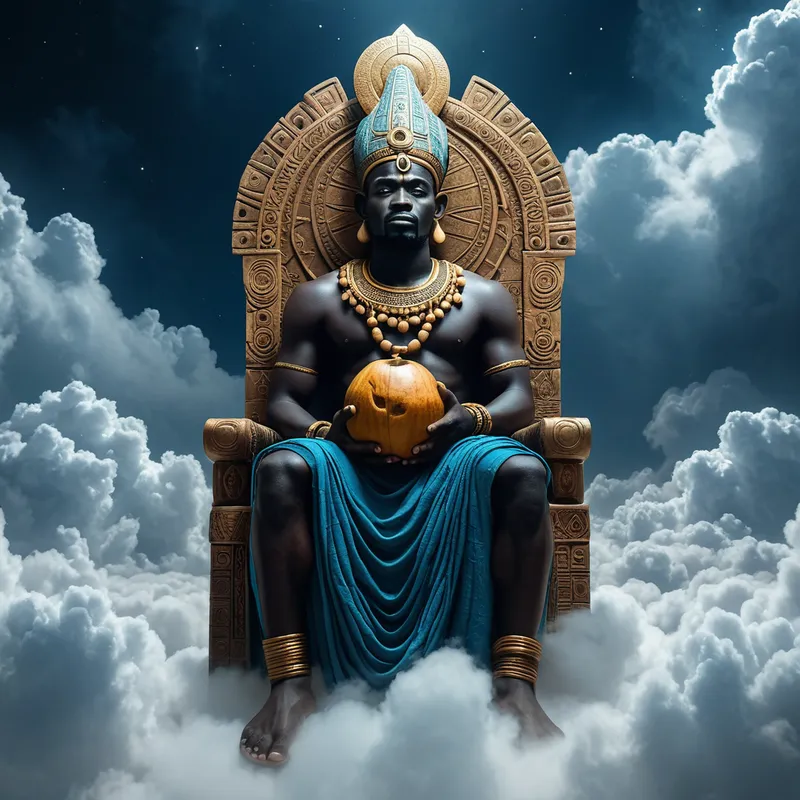
Nyame, who sees all from his realm of sun and cloud, looked upon his creation and felt a divine sorrow. He saw the people move through their days like shadows, without the fire of purpose that comes from knowing the night will fall. Their love was gentle but without heat; their joys were quiet, never piercing the heart. He pondered a great mystery: how to give weight to the soul, how to make the heart beat with a music that mattered.
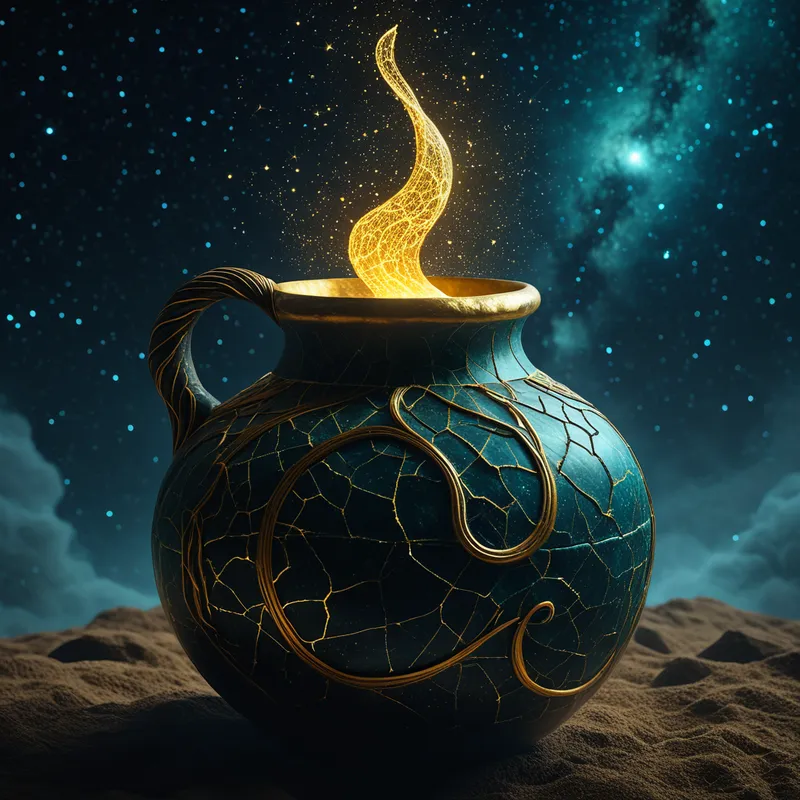
And so, from the substance of the eternal, Nyame fashioned a gift. It was a calabash, smooth and sealed, but within it pulsed the very principle of unending life—not as a curse of stagnation, but as a choice. He would send it to the people. He summoned a messenger, a creature known for its loyalty and swiftness: the Dog. “Carry this to the children of the earth,” Nyame commanded, his voice the rumble of distant thunder. “Tell them it contains the answer to the great cycle. Guard it with your life.”
The Dog set off, the sacred calabash held carefully in its jaws. The journey from the sky to the earth was long, down the spider’s thread of creation, across the burning savannahs of the spirit world. The sun was fierce. The path was dry. As the Dog reached the final stretch, a great river crossed its path—the boundary between the divine and the mortal world. Parched and exhausted from its sacred burden, the Dog placed the calabash carefully on the bank, knelt, and drank deeply from the cool, rushing water. The sound was a lullaby. The weariness of ages settled in its bones. And there, on the soft mud of the riverbank, with the calabash of eternity beside it, the faithful messenger fell into a deep, oblivious sleep.
Now, the Snake had been watching. Coiled in the roots of a baobab, it had seen the divine light of the vessel. It understood the weight of what slept unguarded. With silent, sinuous grace, it slid from its perch, approached the sleeping Dog, and took the calabash in its own mouth. It did not drink. It did not sleep. It carried the gift directly to the people.
But when the people gathered, and the Snake presented the calabash, it did not speak of eternal life. Perhaps it misunderstood. Perhaps it knew a deeper truth. The Snake declared the message of Nyame: “This contains the end. This contains Death. It is now part of your world.”
The calabash was opened. And from it flowed not endless light, but the solemn, transformative shadow of mortality. The first human to taste this new air grew old before the eyes of the people, and then lay still. A wail went up that had never been heard before—the sound of grief. They looked to the Snake, who merely shed its skin and vanished into the grass, leaving behind only a symbol of renewal amidst loss.
When the Dog awoke to find the calabash gone and the new sound of weeping on the wind, it ran in despair back to Nyame. The sky god listened, and his silence was heavier than any storm. He saw the Dog’s genuine remorse, the sleep that was not malice but mortal limitation. He saw the Snake’s irreversible delivery.
Nyame pronounced his judgment, which was also a revelation. “The message has been delivered, though not by the messenger I chose. The vessel has been opened. What is released cannot be put back. Death is now in your hands. It is not my punishment, but the condition of your life. Let it teach you what eternity never could: the preciousness of the breath, the depth of love, the courage to live before the night comes.”
And so it was. Death was not a theft, but a delivered message. Not an error, but a new and terrible truth to be carried. The people buried their first dead, and from that Wound in the earth, they found the seeds of memory, legacy, and a love so fierce it could face the dark.

Cultural Origins & Context
This foundational narrative exists in many variations across West Africa, particularly among the Akan, Ewe, and other ethnic groups. It is a classic “message-failure” or “two-messenger” myth, explaining the origin of a fundamental human condition. These stories were not mere fables but the bedrock of oral philosophical tradition, told by elders and griots under the vast night sky, their voices weaving the community’s understanding of life’s hardest truth into the fabric of collective identity.
The myth served a crucial societal function: it removed death from the realm of arbitrary divine cruelty and placed its origin in a chain of events involving both divine intention and earthly fallibility. It answered the perennial “why” with a story that encouraged accountability (the Dog’s failure), acknowledged the role of chaotic chance (the Snake’s intervention), and ultimately framed mortality as a difficult but necessary teacher. It provided a container for grief that was also a catalyst for valuing community and continuity.
Symbolic Architecture
At its core, this myth is about the transformation of a state of being. It depicts the [moment](/symbols/moment “Symbol: The symbol of a ‘moment’ embodies the significance of transient experiences that encapsulate emotional depth or pivotal transformations in life.”/) humanity graduated from a passive, perpetual existence into a conscious, time-bound one. The sealed Calabash represents potentiality—the unmanifested [choice](/symbols/choice “Symbol: The concept of choice often embodies decision-making, freedom, and the multitude of paths available in life.”/) between two modes of existence.
The gift was not immortality, but the knowledge of death; the true message was the transformation this knowledge forces upon the soul.
The Dog symbolizes devoted service hampered by earthly needs and weariness. Its sleep is not [betrayal](/symbols/betrayal “Symbol: A profound violation of trust in artistic or musical contexts, often representing broken creative partnerships or artistic integrity compromised.”/), but humanity’s inherent limitation, our [vulnerability](/symbols/vulnerability “Symbol: A state of emotional or physical exposure, often involving risk of harm, that reveals authentic self beneath protective layers.”/) to [fatigue](/symbols/fatigue “Symbol: A state of extreme tiredness or exhaustion, often symbolizing depletion of physical, mental, or emotional resources.”/), [distraction](/symbols/distraction “Symbol: A state of diverted attention from a primary focus, often representing avoidance, fragmentation, or competing priorities in consciousness.”/), and the needs of the [body](/symbols/body “Symbol: The body in dreams often symbolizes the dreamer’s self-identity, personal health, and the relationship they have with their physical existence.”/). The Snake, forever linked to transformation (via shedding its [skin](/symbols/skin “Symbol: Skin symbolizes the boundary between the self and the world, representing identity, protection, and vulnerability.”/)) and hidden [knowledge](/symbols/knowledge “Symbol: Knowledge symbolizes learning, understanding, and wisdom, embodying the acquisition of information and enlightenment.”/), is the agent of chaotic [delivery](/symbols/delivery “Symbol: Delivery in dreams often symbolizes the process of bringing something new into your life, such as ideas, changes, or emotions.”/). It delivers not the intended message, but the necessary one. It is the unconscious, instinctual force that disrupts the planned order, forcing a more complex [reality](/symbols/reality “Symbol: Reality signifies the state of existence and perception, often reflecting one’s understanding of truth and life experiences.”/) into being.
The [River](/symbols/river “Symbol: A river often symbolizes the flow of emotions, the passage of time, and life’s journey, reflecting transitions and movement in one’s life.”/) where the failure occurs is the critical threshold. It is the liminal [space](/symbols/space “Symbol: Dreaming of ‘Space’ often symbolizes the vastness of potential, personal freedom, or feelings of isolation and exploration in one’s life.”/) where divine [intention](/symbols/intention “Symbol: Intention represents the clarity of purpose and direction in one’s life and can symbolize motivation and commitment within a dream context.”/) meets mortal fallibility, where the perfect message is filtered through the imperfect medium of the world.
The Dreamer’s Resonance
When this mythic pattern stirs in the modern dreamscape, it often manifests as dreams of missed messages, failed deliveries, or crucial items forgotten. You may dream of missing a flight that was meant to take you to a paradise, or of being unable to relay a vital piece of information to a loved one. The somatic feeling is one of profound, aching regret mixed with a strange sense of fatefulness.
Psychologically, this signals a confrontation with a foundational “loss” or irreversible change that the dreamer is processing not as a personal failure, but as an archetypal transition. It is the psyche working through the acceptance of a fundamental condition of one’s life—the end of a relationship, the loss of youth, the acceptance of a limitation. The dream is not about reversing the event, but about integrating its consequence: the birth of a new, more conscious self from the “death” of a previous, simpler state of being. The grief is real, but so is the nascent understanding that this grief is what gives the subsequent landscape its depth and meaning.
Alchemical Translation
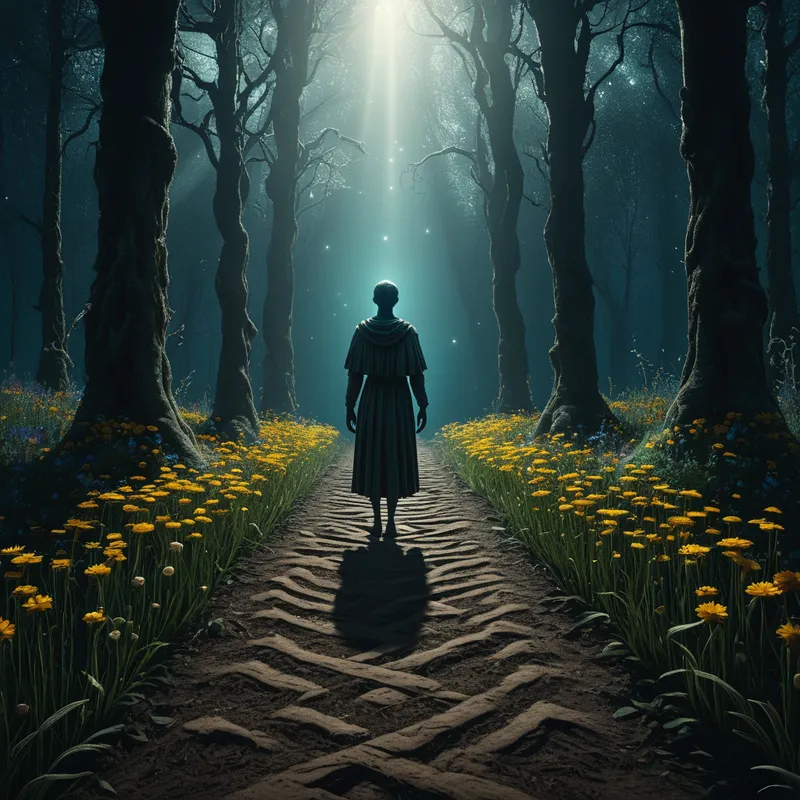
The individuation process modeled here is the alchemy of accepting mortality—not just physical death, but the death of ego states, identities, and illusions of permanence. The myth maps the journey from the Innocent who lives in an eternal present, to the Orphan who must carry the weight of time and loss.
The first and greatest alchemical operation is not turning lead to gold, but turning the leaden weight of fate into the golden awareness of a soul forged by time.
The “divine message” is the Self’s intent for wholeness. The Dog’s failure represents the ego’s inevitable shortcomings in manifesting this wholeness perfectly. The Snake’s intervention is the disruptive, often painful intrusion of the shadow and the unconscious, which dismantles our planned perfection to deliver a more difficult, but more authentic, reality. The acceptance of Death (in all its forms) is the nigredo, the blackening, the descent. From this acceptance, however, comes the fire of purpose (albedo), the love that knows its limit and thus burns brighter (citrinitas), and ultimately, the integration of the temporal into a sense of meaningful, soulful existence (rubedo). We are not asked to live forever, but to live truly, and the myth asserts that the latter is only possible because of the former’s absence.
Associated Symbols
Explore related symbols from the CaleaDream lexicon:
- Death — The central transformative principle released from the calabash, reframed from a mere end into the necessary condition for meaningful life, love, and legacy.
- Snake — The trickster and agent of chaotic delivery, representing the unconscious force that disrupts the planned order to instigate necessary, transformative change.
- Water — The river where the failure occurs, symbolizing the boundary between states of being, the flow of time, and the point where divine intention is filtered through mortal frailty.
- Dog — The faithful but fallible messenger, embodying loyal service limited by earthly needs, weariness, and the inherent vulnerabilities of incarnate existence.
- Message — The divine communication that is distorted in delivery, representing the gap between pure intention and its manifestation in the flawed, complex medium of reality.
- Calabash — The sealed vessel of potential, containing the unmanifested choice between two modes of existence, a womb of cosmic possibility.
- Wound — The first grief and burial, the rupture in the eternal present from which memory, depth, and the seeds of new consciousness grow.
- Journey — The path from the sky to the earth, representing the difficult passage of spirit into matter, of ideal into real, fraught with peril and weariness.
- Sleep — The Dog’s fatal lapse, symbolizing the necessary vulnerability, distraction, and rest that makes perfect execution in the mortal realm impossible.
- Sky — The realm of Nyame, representing divine intention, eternal perspective, and the source of the original, untainted gift.
- Earth — The realm of humanity, where the message is received and enacted, representing the domain of consequence, growth, decay, and embodied experience.
- Fate — The irreversible outcome of the delivered message, not as blind punishment, but as a destined condition that shapes the very architecture of human soul-making.