The Oracle of Delphi Myth Meaning & Symbolism
At the center of the world, a priestess breathes the breath of the earth and speaks for a god, her riddles a bridge between the human and the divine.
The Tale of The Oracle of Delphi
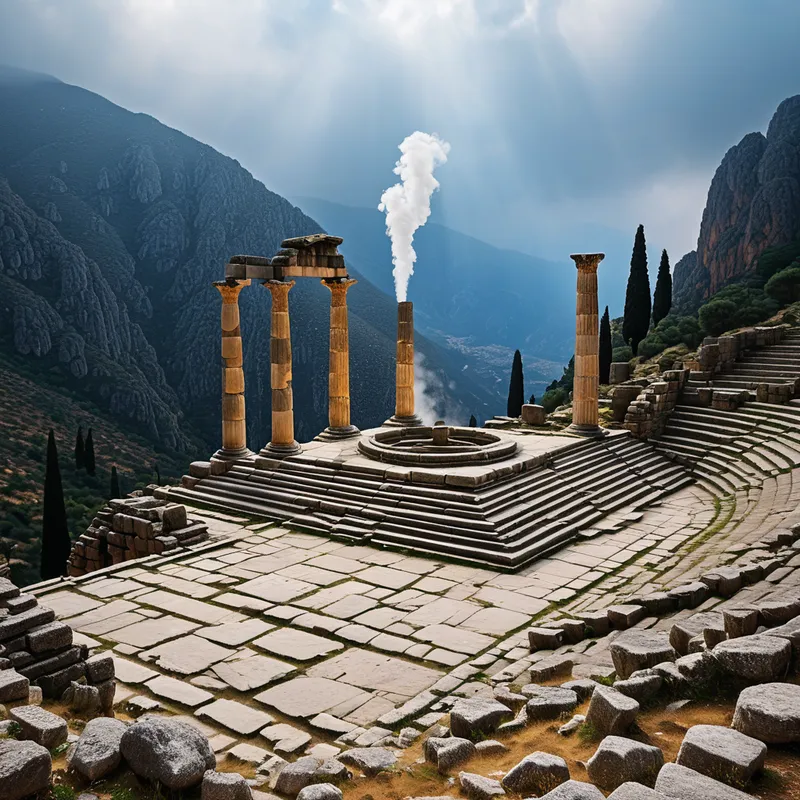
Beneath the twin peaks of Parnassus, where eagles circled [the throne of Zeus](/myths/the-throne-of-zeus “Myth from Greek culture.”/), [the earth](/myths/the-earth “Myth from Hindu culture.”/) herself once dreamed. Her breath was not air, but a potent, sweet-smelling vapor, [pneuma](/myths/pneuma “Myth from Greek culture.”/), that seeped from a deep crack in the living rock. This was no ordinary place. This was the [Omphalos](/myths/omphalos “Myth from Greek culture.”/), the navel of [the world](/myths/the-world “Myth from Tarot culture.”/), marked by a stone dropped by Zeus when he sought the center of his domain.
Long before the first temple was built, the spirit of the place was a serpent, a great dragon named [Python](/myths/python “Myth from Greek culture.”/). It coiled in the chthonic dark, its hiss the sound of the earth’s secrets. Then came the god Apollo, the Far-Shooter, radiant and young. He descended from the northern hyperborean lands, a bow of gold in his hand. His conflict with [Python](/myths/python “Myth from Greek culture.”/) was the clash of sun and deep earth, of clear light and primal murk. Apollo’s arrow found its mark, and Python fell, its blood soaking into the very stone from which the vapors rose. But the god did not destroy the power of the place; he consecrated it. He took the serpent’s wisdom for his own, becoming Pythian Apollo, and the oracle was born.
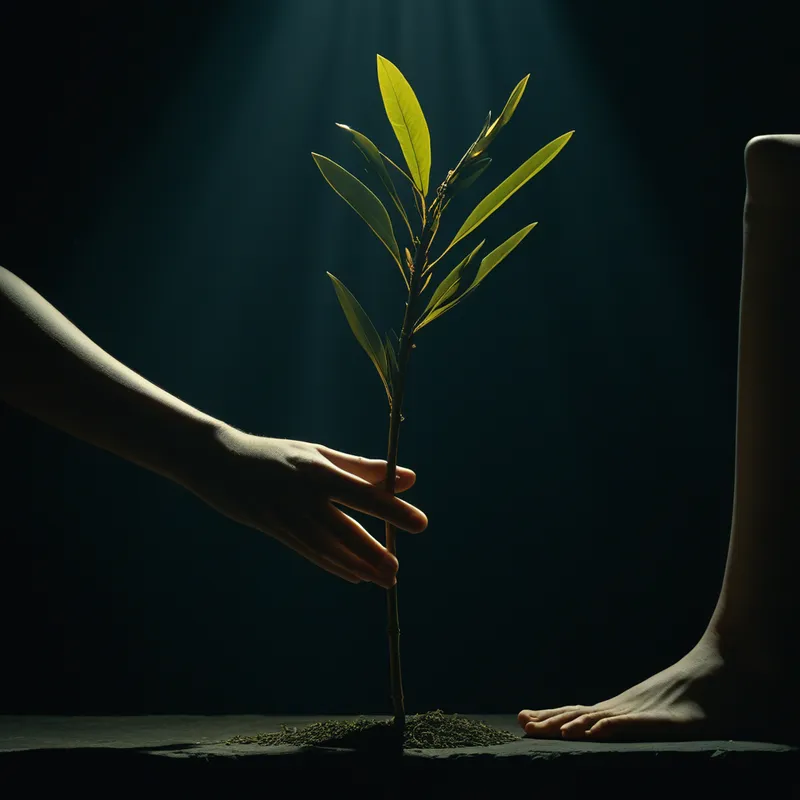
Centuries flowed. A magnificent temple was built over the sacred chasm. Within its deepest, most forbidden chamber, the adyton, sat a simple tripod cauldron over the fissure. Here, at appointed times, a woman chosen from the villagers of Delphi would come. She was the [Pythia](/myths/pythia “Myth from Greek culture.”/). Before the ritual, she would bathe in the Castalian Spring, drink from the sacred Kassotis stream, and chew leaves of the intoxicating laurel, the tree of Apollo. Then, seated on the tripod, she would breathe the rising pneuma.
The transformation was terrifying to behold. The god entered her. Her body would shudder, her limbs convulse. Her eyes, once human, would glaze over, seeing not the dark room but the vast, tangled [threads of fate](/myths/threads-of-fate “Myth from Greek culture.”/). Her voice changed—it became deep, guttural, a channel for a power that shattered her ordinary self. Kings and commoners alike would stand before her, their questions laden with fear and hope. They asked of war, of voyages, of love, of guilt. The words that tumbled from her lips were not clear commands. They were riddles, poetic fragments, often ambiguous, always profound. “Know thyself,” [the temple](/myths/the-temple “Myth from Jewish culture.”/) walls whispered, and the Pythia’s utterances forced that very confrontation. Croesus, King of Lydia, was told if he attacked the Persians, he would destroy a great empire. He did—his own. [Oedipus](/myths/oedipus “Myth from Greek culture.”/) was told he would kill his father and marry his mother, a prophecy that set in motion his tragic attempt to flee destiny, only to run headlong into its arms.
For nearly a thousand years, the voice from the cleft in the earth was the supreme counsel of the Hellenic world. It guided the founding of colonies, sanctioned laws, and cast a shadow of fate over every great endeavor. It was the place where humanity, in all its anxiety and aspiration, knelt at the crack between worlds and begged for a glimpse of the pattern.
Cultural Origins & Context
The [Oracle of Delphi](/myths/oracle-of-delphi “Myth from Greek culture.”/) was not merely a religious institution; it was the geopolitical and psychological nerve center of the ancient Greek world. Its historical roots are shrouded in prehistory, likely originating as a site of worship for an earth goddess, perhaps Gaia or [Themis](/myths/themis “Myth from Global/Universal culture.”/), before being assimilated into the Olympian [pantheon](/myths/pantheon “Myth from Roman culture.”/) under Apollo. This transition from chthonic female divinity to Olympian male god, preserved in the myth of Apollo slaying Python, reflects a broader cultural shift in ancient Greece.
The oracle’s function was multifaceted. For the city-state (polis), it provided divine sanction for laws, treaties, and colonial expeditions, lending celestial authority to human politics. For the individual, it was a place of purification and consultation, especially for matters of moral pollution like homicide. The rituals surrounding consultation—the payment of a sacred tax (pelanos), the ordering of questions by lot, the sacrifice of a goat to test the god’s favor—created a powerful container for the numinous experience. The prophecies were delivered in hexameter verse, likely shaped into coherent form by male priests (Hosioi) who interpreted the Pythia’s ravings. This collaboration between the ecstatic female vessel and the rational male interpreter is a crucial dynamic, symbolizing the marriage of unconscious inspiration and conscious ordering that the oracle itself represented.
Symbolic Architecture
At its core, the [Oracle](/symbols/oracle “Symbol: An oracle represents wisdom, foresight, and divine communication, often serving as a mediator between the spiritual and physical worlds.”/) symbolizes the [human](/symbols/human “Symbol: The symbol of a human represents individuality, complexity of emotions, and social relationships.”/) encounter with the unknowable ground of being—the Self. The geographical and mythological elements are a perfect symbolic map of the [psyche](/myths/psyche “Myth from Greek culture.”/).
The Omphalos is the central [axis](/symbols/axis “Symbol: A central line or principle around which things revolve, representing stability, orientation, and the fundamental structure of reality or consciousness.”/), the point where the personal psyche connects to the transpersonal, the archetypal [realm](/symbols/realm “Symbol: The symbol of ‘Realm’ often signifies the boundaries of one’s consciousness, experiences, or emotional states, suggesting aspects of reality that are either explored or ignored.”/). The [Python](/symbols/python “Symbol: The python represents both fear and fascination, as well as transformation through confronting one’s deeper issues.”/) represents the chthonic, instinctual, and potentially overwhelming power of the unconscious that must be confronted and integrated (slain) for conscious order (Apollo) to establish a sacred [space](/symbols/space “Symbol: Dreaming of ‘Space’ often symbolizes the vastness of potential, personal freedom, or feelings of isolation and exploration in one’s life.”/) for communication.
The tripod over the fissure is the liminal vessel where opposites meet: above and below, consciousness and unconsciousness, human and divine.
The Pythia herself is the ultimate [symbol](/symbols/symbol “Symbol: A symbol can represent an idea, concept, or belief, serving as a powerful tool for communication and understanding.”/) of the [anima](/symbols/anima “Symbol: The feminine archetype within the male unconscious, representing soul, creativity, and connection to the inner world.”/), the inner feminine mediating function of the psyche. She is not the [source](/symbols/source “Symbol: The origin point of something, often representing beginnings, nourishment, or the fundamental cause behind phenomena.”/) of the [knowledge](/symbols/knowledge “Symbol: Knowledge symbolizes learning, understanding, and wisdom, embodying the acquisition of information and enlightenment.”/) but its [vessel](/symbols/vessel “Symbol: A container or structure that holds, transports, or protects something essential, representing the self, emotions, or life journey.”/). Her possession, her mania (divine madness), represents a voluntary ego-[death](/symbols/death “Symbol: Symbolizes transformation, endings, and new beginnings; often associated with fear of the unknown.”/), a sacrifice of personal [identity](/symbols/identity “Symbol: Identity represents the sense of self, encompassing personal beliefs, cultural background, and social roles.”/) to become a [conduit](/symbols/conduit “Symbol: A passage or channel that transfers energy, information, or substance from one place to another, often hidden or structural.”/) for a larger [truth](/symbols/truth “Symbol: Truth represents authenticity, honesty, and the quest for knowledge beyond mere appearances.”/). The resulting [prophecy](/symbols/prophecy “Symbol: A foretelling of future events, often through divine or supernatural means, representing destiny, fate, and hidden knowledge.”/) is never a flat fact; it is a poetic [riddle](/symbols/riddle “Symbol: A puzzle or enigmatic statement requiring cleverness to solve, symbolizing hidden truths, intellectual challenge, and the search for meaning.”/) that demands interpretation. This is the symbolic key: [truth](/symbols/truth “Symbol: Truth represents authenticity, honesty, and the quest for knowledge beyond mere appearances.”/) from the [depths](/symbols/depths “Symbol: Represents the subconscious, hidden emotions, or foundational aspects of the self, often linked to primal fears or profound truths.”/) is not given, it is co-created. It requires the active engagement of the conscious mind (the supplicant and the interpreting priests) to wrest meaning from the chaotic, archetypal [material](/symbols/material “Symbol: Material signifies the tangible aspects of life, often representing physical resources, desires, and the physical world’s influence on our existence.”/) that erupts.

The Dreamer’s Resonance
When the pattern of the Delphic Oracle appears in modern dreams, it signals a powerful activation of the process of receiving guidance from the deep Self. The dreamer may not see a literal temple; the symbolism is often displaced.
Dreaming of a hidden room or basement with a strange source of light or sound echoes the adyton and the sacred chasm. A wise but cryptic or intimidating female figure who speaks in puzzles or whose words are distorted is a direct manifestation of the Pythia archetype. Seeking answers from a source that is both all-knowing and frustratingly ambiguous—a computer that outputs poetry, a book with shifting text—captures the essence of the oracular experience.
Somatically, this dream process often accompanies a feeling of tension, anticipation, and a slight dread—the “trembling before the god” described by ancient visitors. Psychologically, it marks a crossroads where [the ego](/myths/the-ego “Myth from Jungian culture.”/)’s logical planning has reached its limit. The dream is staging a consultation with the inner oracle. The confusion or anxiety upon waking mirrors the ancient supplicant’s struggle to interpret the riddle. The process underway is one of receptivity: the ego is being compelled to listen to a voice and a logic that is not its own, initiating a necessary dialogue with the unconscious.

Alchemical Translation
The journey to Delphi is a master metaphor for the alchemical process of individuation. [The pilgrim](/myths/the-pilgrim “Myth from Christian culture.”/)’s voyage represents the conscious decision to seek wholeness, to move toward the center (the Omphalos). The required purification in the Castalian Spring is the [nigredo](/myths/nigredo “Myth from Alchemical culture.”/), the initial washing away of [persona](/myths/persona “Myth from Greek culture.”/) and conscious attitudes to prepare [the vessel](/myths/the-vessel “Myth from Alchemical culture.”/).
The consultation itself is the central, terrifying, and transformative operation. The ego (the supplicant) presents its question—its life problem—and then must endure the dissolution of the mediating function (the Pythia’s possession). This is a symbolic death. The clear, rational light of Apollo is temporarily swallowed by the chaotic, serpentine wisdom of the Python-dragon, producing a third [thing](/myths/thing “Myth from Norse culture.”/): the ambiguous prophecy.
The oracle does not solve the problem; it transmutes it. It reframes the ego’s question in the symbolic language of the Self.
The final and most crucial stage is the return journey, the interpretation. The raw, often frightening, revelation must be integrated. This is the [rubedo](/myths/rubedo “Myth from Alchemical culture.”/), the reddening, where the insight is brought into the light of consciousness and applied to life. The prophecy that doomed Oedipus was a literal truth to be avoided; its alchemical meaning was the command “Know thyself”—a command he failed to heed by trying to outrun his shadow. For the modern individual, the “riddle” from the inner oracle might be a recurring dream image, a sudden irrational impulse, or a symptom that defies logic. Its meaning is not in a single translation but in the ongoing, lived dialogue it initiates between the conscious mind and the mysterious, life-giving, and sometimes terrifying voice from the deep. To heed the oracle is not to obey a command, but to commit to the lifelong art of listening to the crack in the world.
Associated Symbols
Explore related symbols from the CaleaDream lexicon:
- Couch
- Sound
- Stomach
- Impression
- Answer
- State
- Didn
- Television
- Subject
- Inner
- Decision
- Vague
- Crystal
- Oldest
- Opinion
- Says
- Internal
- Basic
- Rustling Leaves
- Tea Leaves
- Glimpsing the Future
- Mystical Temple
- Veil of Mist
- Veiled Prophecy
- Translucent Dream
- Veiled Figure
- Mystical Crystal
- Clear White Prism
- Petalite Crystals
- Sodalite Stone
- Moonstone Mirror
- Aquamarine Drop
- Chalcedony Orb
- Diamond Shimmer
- Zircon Gemstone
- Cadmium Shadow
- Technetium Dream
- Severe Weather Warning
- Secretive Juniper
- Gemstone of Truth
- Talking Crystal
- Journalist’s Notepad
- Magic Eight Ball
- Fortune Teller
- Socrates’ Cup
- Mystery in Monochrome
- Glass Dining Table
- Smart TV
- Touchscreen Monitor
- Calculator Whirl
- Magic 8 Ball
- Tuning Fork of Truth
- Zen Meditation Room
- Moonlit Ruins
- Veiled Guardian
- Eerie Whispers
- Wisdom Pearls
- Veiled Enlightenment
- Veil of Perception
- Frosted Glass
- Cliffside Dwelling
- Ancestral Spirits
- Incense Burner
- Omikuji Fortune
- Metallic Tang
- Creaking Sound
- Cave Wisdom
- Digital Noise
- Acoustic Lens
- The Decree
- The Directive
- Metanalysis
- Presupposition
- Ambiguity
- Meta
- Mystery
- Divination
- Vomit
- Gauge
- Intestinal
- Intuition
- Clarity
- Somniloquy
- Pungent
- Astringent
- Onion