The Oracle Chamber Myth Meaning & Symbolism
A seeker enters a living, breathing chamber of stone and shadow to ask one question, learning that the deepest truth is not spoken, but felt.
The Tale of The Oracle Chamber
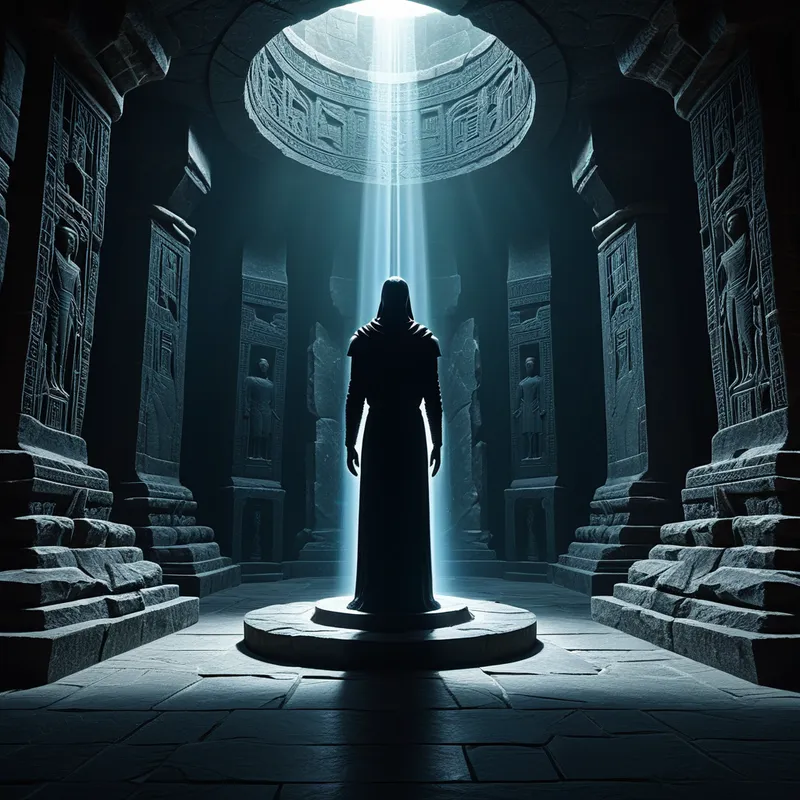
Listen. In the time before maps, when the world was a question whispered into the dark, there existed a place known only in sighs and half-remembered dreams. It was not a temple built by hands, but a chamber grown by the earth’s own slow, patient thought. They called it the Oracle Chamber.
To find it was the first ordeal. It called not to the ambitious, but to the haunted. You would feel it in the hollow of your chest first—a pull like a lodestone drawing you not north or south, but inward, down forgotten paths, through briar-thick forests that clutched at your clothes like pleading hands, and finally, into the mouth of a cave that breathed out air colder than winter and older than stone.
Inside, the dark was not empty. It was a substance. It pressed against your skin, heavy and knowing. The only light came from the chamber itself: veins of faintly pulsing crystal in the walls, the color of a fading bruise or a distant star. The air tasted of ozone and damp clay. And in the center, rising from the floor as if it had been waiting since the world’s first dawn, stood the Oracle. It was not a statue, not an idol. It was a pillar of seamless, black stone, taller than three men, wider than an ancient tree. It had no face, no mouth, no eyes. Yet you felt its attention settle upon you, a weight that stilled the very breath in your lungs.
The seeker, trembling not from cold but from the sheer presence of the place, would step forward. The rules were known in the blood: you may ask one question. Just one. The price was the question itself—the act of giving your deepest uncertainty to the silence.
A merchant might ask of fortunes, a warrior of victory, a lover of fidelity. They would speak their query, their voice swallowed by the immense quiet. And then… nothing. No booming voice, no spectral vision. Only the slow, rhythmic pulse of the light in the walls, and the feeling of the stone underfoot, which had grown subtly warm.
Frustration would rise, then despair. Had they come all this way for silence? But as they stood, stranded in that unbearable listening, a shift would begin. Not in the chamber, but in them. The darkness around them would start to feel less like a void and more like a mirror. The quiet became a canvas. Their own fears, their hidden motives, the unspoken parts of their question, would rise up from within, projected onto the blank screen of the stone. The answer was never given. It was revealed, excavated from the seeker’s own depths by the Chamber’s perfect, reflecting silence. To receive it was not to hear a prophecy, but to understand a truth you had always carried, buried beneath layers of hope and noise. You left not with a command, but with a recognition. And the Chamber would return to its waiting, having spoken by saying nothing at all.
Cultural Origins & Context
The myth of the Oracle Chamber is a rare breed of folklore, found in fragments across disparate cultures—in the highland tales of shepherds, the sea stories of isolated islanders, and the oral histories of desert nomads. It belongs to no single pantheon or priesthood. This is not a state-sanctioned myth of power, but a folkloric whisper of inner authority. It was likely told at crossroads, not in courts; shared by travelers, elders, and those who worked closely with the unyielding elements of the earth.
Its societal function was subversive and therapeutic. In cultures where divination was often controlled by a clerical class interpreting omens or entrails, this story democratized access to truth. It proposed that the ultimate source of wisdom was not an external god requiring mediation, but the individual’s own encounter with the depths of their being, facilitated by a numinous, natural space. It served as a narrative container for the experience of profound introspection and the often unsettling clarity that comes from confronting one’s own shadow. The story validated the journey of the lone seeker and framed deep self-knowledge as the highest, and most terrifying, form of prophecy.
Symbolic Architecture
The Chamber is the ultimate symbol of the objective psyche. It is not a personal memory but a transpersonal, structural reality of the human mind—the place where the archetypes reside. Its location underground signifies its nature as part of the unconscious. It is “grown, not built,” indicating it is an innate, organic structure of the psyche, not a construct of the conscious ego.
The Oracle that does not speak teaches the hardest lesson: that the answer must be born from the seeker, not bestowed upon them. The void is a womb.
The seeker represents the conscious ego, venturing beyond its familiar territory into the unknown Self. The single, costly question symbolizes the focused energy and sincere intent required to engage the unconscious; it is the sacrifice of egoic certainty. The initial silence and subsequent inner revelation model the psychological truth that insight does not come as a foreign download, but as an integration of previously split-off or unconscious contents. The Chamber’s “reflection” is the process of projection and reintegration—we see our own inner dynamics mirrored in the outer world (or, in this case, the numinous environment), and in recognizing them as our own, we reclaim our wholeness.

The Dreamer’s Resonance
When this myth pattern activates in the modern dreamer, it often manifests as dreams of finding hidden rooms in one’s own house, discovering vast basements, or entering caves, vaults, or sealed archives. The somatic experience is key: the dreamer feels a palpable atmosphere of anticipation, a “charged” silence, and a deep, bodily knowing that something significant is about to be revealed.
Psychologically, this dream marks a critical phase in shadow work. The dream-ego is ready to confront a core, unanswered question about its identity, purpose, or a frozen conflict. The Chamber’s appearance signals that the unconscious is prepared to facilitate this confrontation. The frustration felt in the dream—the oracle’s silence—mirrors the dreamer’s waking-life frustration with external sources failing to provide answers. The dream is initiating a process of turning the individual’s attention inward. The eventual revelation, if it comes, is often non-verbal: a feeling, a sudden understanding, or a symbolic image that resonates with profound personal truth upon waking. This is the psyche’s alchemical vessel in action, containing the tension of the question until it transforms into self-knowledge.
Alchemical Translation
The journey to and within the Oracle Chamber is a perfect allegory for the individuation process, specifically the stage of shadow integration. The conscious mind (the seeker) must deliberately descend (the journey inward) into the unfamiliar terrain of the unconscious (the cave). The offering of the one question is the sacrificium intellectus—the sacrifice of the intellect’s demand for a clear, logical, external answer.
The alchemical vessel is not the flask of glass, but the sustained tension of holding a question in the dark until it ripens into a new form of consciousness.
The Chamber itself performs the alchemical function of the vas hermeticum—the sealed vessel where transformation occurs. In its silent, containing darkness, the lead of the ego’s confused question is subjected to the heat of psychic tension. The “pulse” in the walls represents the latent, living energy of the Self, the archetype of wholeness, which catalyzes the reaction. The answer that arises is the aurum non vulgi—the “gold not of the vulgar”—a piece of genuine self-knowledge unique to the individual, of no monetary value but of immense psychological worth. The seeker does not conquer the Chamber; they are transformed by it. They return to the surface world not with a trophy, but with an integrated piece of their own soul, having learned that the truest oracle was never in the stone, but in the courage to stand before it and listen to the echo of their own depths.
Associated Symbols
Explore related symbols from the CaleaDream lexicon: