The Oracle Bones Myth Meaning & Symbolism
A forgotten seer's bones become the ultimate oracle, revealing that true prophecy is born from the dissolution of the self into the world's pattern.
The Tale of The Oracle Bones
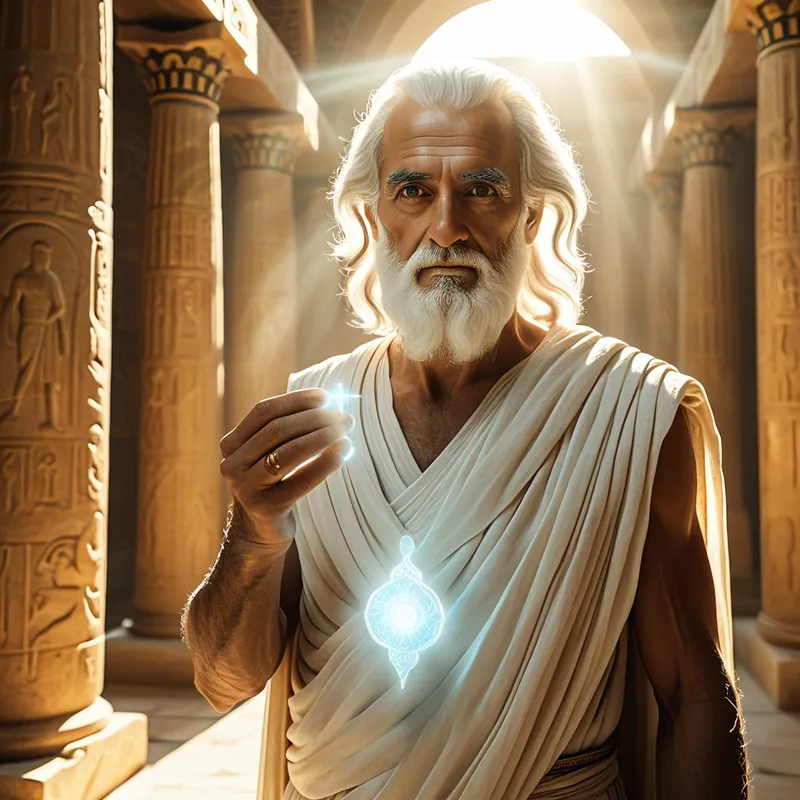
Hear now a tale not sung in the grand halls of Athens, but whispered in the dry throats of mountain hermits and the rustling leaves of [sacred groves](/myths/sacred-groves “Myth from Celtic culture.”/). It is the story of Alcander, whose name means “Strength of Man,” yet whose fate was to become something far less, and infinitely more.
In the high, lonely peaks where eagles nest and the air is thin with the presence of the gods, Alcander dwelled. He was a mantis of rare purity, who sought not the favor of kings, but the unvarnished voice of the cosmos. He listened to [the wind](/myths/the-wind “Myth from Various culture.”/) in the crags, the chatter of streams over stone, and the silent turning of the stars. But the truth he sought—the clear, unambiguous pattern of fate—remained fractured, glimpsed in riddling flashes. The god Apollo favored him, yet the gift was a torment, a puzzle of light and shadow.
Driven by a sacred madness, Alcander descended from his peak to the most ancient of places: the [Omphalos](/myths/omphalos “Myth from Greek culture.”/) at Delphi. Yet he bypassed [the temple](/myths/the-temple “Myth from Jewish culture.”/), drawn instead to the dark, sulphurous cleft in the mountain from which the [Pythia](/myths/pythia “Myth from Greek culture.”/) drew her vapors. There, at [the world](/myths/the-world “Myth from Tarot culture.”/)’s navel, he made a terrible petition. He did not ask for clearer sight. He offered himself as [the vessel](/myths/the-vessel “Myth from Alchemical culture.”/).
“Let the pattern be written not in smoke, not in the ravings of a priestess, but in the very architecture of being!” he cried to the chasm. “Let my bones become the alphabet of destiny! Let my flesh be the parchment, my marrow the ink!”
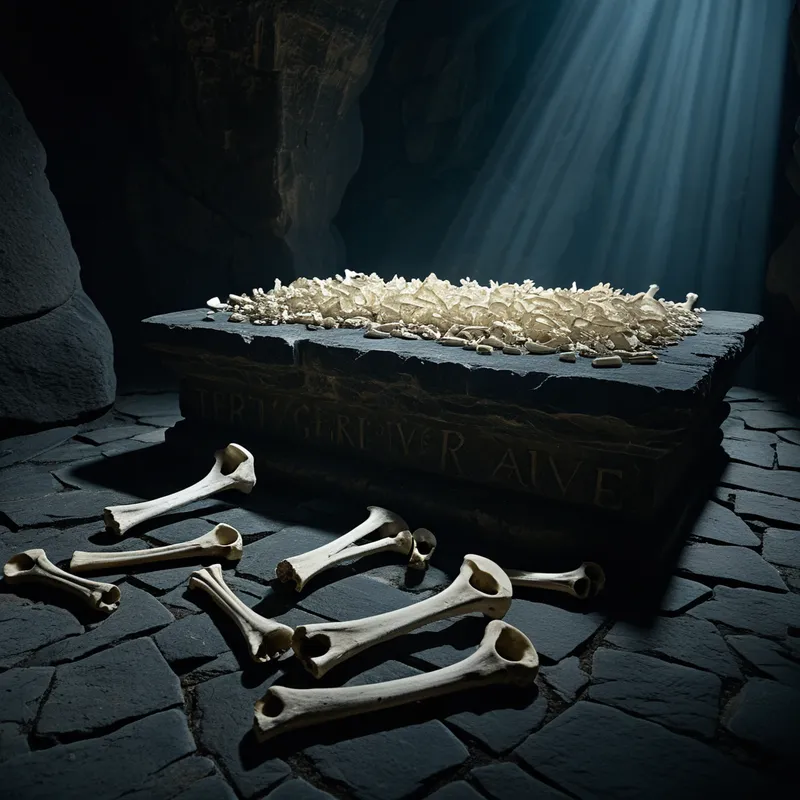
[The earth](/myths/the-earth “Myth from Hindu culture.”/) shuddered. The fumes from the cleft, usually reserved for the chosen Pythia, enveloped him not in a trance, but in a consuming fire. It was a fire that did not burn, but dissolved. For three days and nights, a silent, radiant transformation occurred within the sacred smoke. When [the mist](/myths/the-mist “Myth from Celtic culture.”/) cleared, only a skeleton remained, seated in a posture of meditation. But this was no ordinary death. The bones, bleached to a divine ivory, were covered in a fine, intricate script—not carved, but grown, as if the letters were veins of prophecy. Every scapula, every femur, every sliver of rib bore the cryptic language of the gods, a permanent record of the world’s weaving.
The priests, in awe and terror, collected the bones. They discovered that when cast upon a cloth of pure black wool under the full moon, the bones would arrange themselves. Their positions, the angles they formed, the specific glyphs that faced upward—all spoke. This was the Oracle of Bones. It gave no easy answers. It showed relationships, tensions, hidden connections. To consult it was to stare into the skeleton of fate itself, to see the bare structure upon which the flesh of events hung. It spoke the truth, always. But to understand it, one had to be willing to see the world as a pattern of stark, beautiful, and often terrifying bones.
Cultural Origins & Context
This myth exists in the shadowed periphery of the Greek mythological canon, preserved not in the works of [Homer](/myths/homer “Myth from Greek culture.”/) or Hesiod, but in fragmentary scholia and the records of localized mystery cults, particularly those associated with Apollo Smintheus and chthonic oracles in Arcadia and Thessaly. Its transmission was oral, secretive, and likely practiced by ascetic seers outside the formal priestly hierarchies of major sanctuaries.
Its societal function was dual. For the culture at large, it served as a foundational etiological myth for lesser, bone-based divination practices (astragalomancy – divination with knucklebones), granting them a profound, if terrifying, divine origin. More importantly, for initiates and philosophers, it presented the ultimate model of the seer: one who moves beyond being a temporary channel for divine voice (enthousiasmos) and becomes a permanent artifact of divine knowledge. It addressed a deep cultural anxiety about the ambiguity of traditional oracles (like the famously cryptic Delphic pronouncements) by presenting a form of prophecy that was objective and structural, but required supreme interpretation.
Symbolic Architecture
The myth’s power lies in its brutal, alchemical [symbolism](/symbols/symbolism “Symbol: The use of symbols to represent ideas or qualities, often conveying deeper meanings beyond literal interpretation. In dreams, it’s the language of the unconscious.”/). Alcander begins as the [hero](/symbols/hero “Symbol: A hero embodies strength, courage, and the ability to overcome significant challenges.”/), seeking [knowledge](/symbols/knowledge “Symbol: Knowledge symbolizes learning, understanding, and wisdom, embodying the acquisition of information and enlightenment.”/). His [journey](/symbols/journey “Symbol: A journey in dreams typically signifies adventure, growth, or a significant life transition.”/), however, is not one of conquest, but of utter deconstruction. The [oracle](/symbols/oracle “Symbol: An oracle represents wisdom, foresight, and divine communication, often serving as a mediator between the spiritual and physical worlds.”/) he seeks is not outside him; it is him, but only after the annihilation of his individual, flesh-bound [identity](/symbols/identity “Symbol: Identity represents the sense of self, encompassing personal beliefs, cultural background, and social roles.”/).
The ultimate prophecy is not spoken; it is the state of being perfectly inscribed by reality.
The bones symbolize the fundamental, indestructible [structure](/symbols/structure “Symbol: Structure in dreams often symbolizes stability, organization, and the framework of one’s life, reflecting how one perceives their environment and personal life.”/) of the [psyche](/myths/psyche “Myth from Greek culture.”/)—the archetypal core that persists after all personal trappings are stripped away. The divine [script](/symbols/script “Symbol: The symbol of ‘script’ indicates a narrative or roadmap for one’s life, representing the conscious and unconscious stories we tell ourselves.”/) represents the [collective unconscious](/symbols/collective-unconscious “Symbol: The Collective Unconscious refers to the part of the unconscious mind shared among beings of the same species, embodying universal experiences and archetypes.”/) itself, the eternal patterns of [life](/symbols/life “Symbol: The symbol of ‘Life’ represents a journey of growth, interconnectedness, and existential meaning, encompassing both the joys and challenges that define human experience.”/), [death](/symbols/death “Symbol: Symbolizes transformation, endings, and new beginnings; often associated with fear of the unknown.”/), and [destiny](/symbols/destiny “Symbol: A predetermined course of events or ultimate purpose, often linked to spiritual forces or cosmic order, representing life’s inherent direction.”/), writing itself directly onto this core. Alcander’s sacrifice is the ultimate act of kenosis—an emptying of [the self](/myths/the-self “Myth from Jungian culture.”/). He does not gain knowledge; he becomes the medium for Knowledge. The act of casting the bones is then a symbolic [reflection](/symbols/reflection “Symbol: Reflection signifies self-examination, awareness, and the search for truth within oneself.”/) of the [human](/symbols/human “Symbol: The symbol of a human represents individuality, complexity of emotions, and social relationships.”/) mind attempting to read the immutable, objective [patterns of existence](/symbols/patterns-of-existence “Symbol: Patterns of existence signify the interconnected and cyclical nature of life, symbolizing how experiences and events are recurrent and interrelated.”/) through the random, [chance](/symbols/chance “Symbol: A representation of opportunities and unpredictability in life, illustrating how fate can influence one’s journey.”/)-driven events of [life](/symbols/life “Symbol: The symbol of ‘Life’ represents a journey of growth, interconnectedness, and existential meaning, encompassing both the joys and challenges that define human experience.”/).
The Dreamer’s Resonance
When this myth stirs in the modern unconscious, it manifests in dreams of profound structural revelation. One does not dream of Alcander, but of becoming the bones.
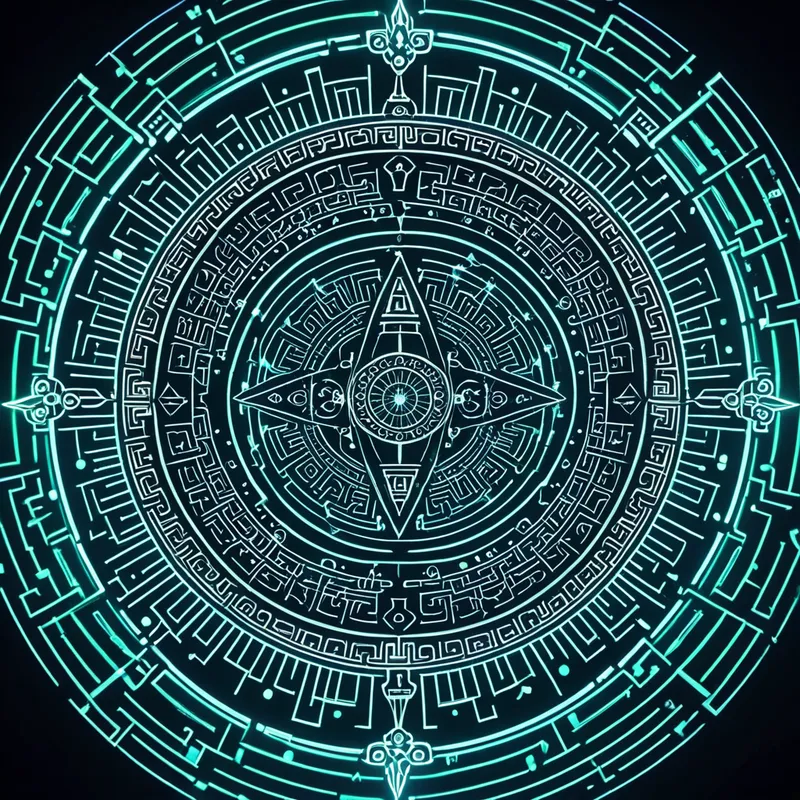
A dreamer may find their body turning to crystal or polished stone, with maps, circuitry, or unknown languages etched into their limbs. They may dream of their skeleton stepping out of their body, standing separate and speaking in a language of geometry and light. The somatic experience is often one of chilling clarity, a cold, hard truth replacing the warm confusion of emotion. There is no comfort here, only awe.
Psychologically, this signals a critical phase in confronting the Self. [The ego](/myths/the-ego “Myth from Jungian culture.”/) is undergoing a necessary dissolution. The dreamer is being shown that their personal identity, with all its wounds and desires, is a temporary garment over an eternal, impersonal structure. It is the psyche’s way of forcing a confrontation with objective truth, often preceding a major life decision or a spiritual crisis. The process is one of depersonalization in service of a greater integration—feeling the terror of becoming an object in order to perceive the pattern one is part of.
Alchemical Translation
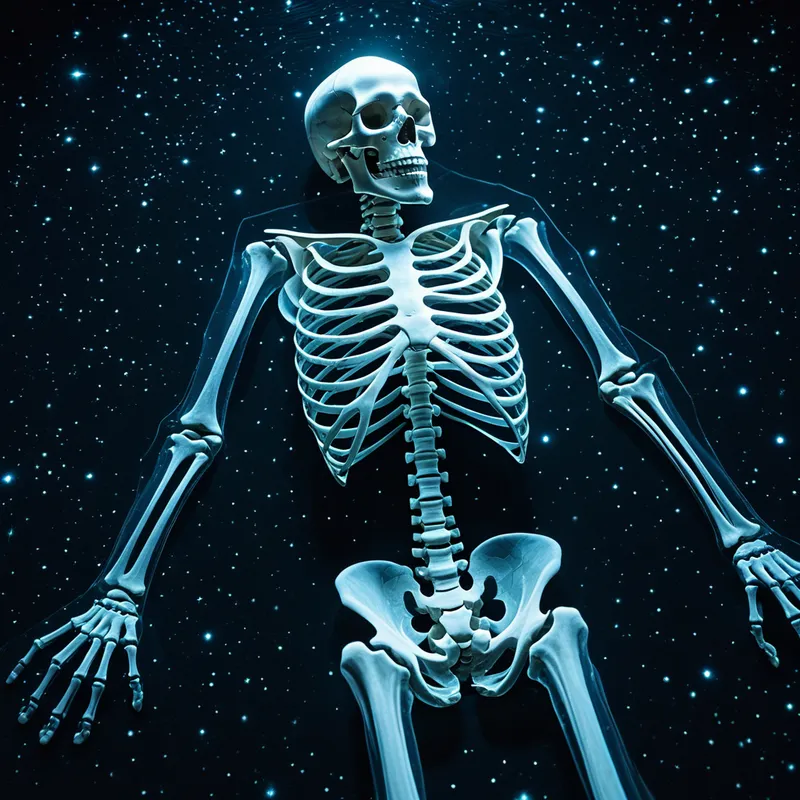
The alchemical journey mirrored here is the [nigredo](/myths/nigredo “Myth from Alchemical culture.”/) leading to the albedo. Alcander’s ordeal in the fumes is the [nigredo](/myths/nigredo “Myth from Alchemical culture.”/): the total dissolution of the known personality, the reduction of the complex psyche to its bare, white bones (materia prima). This is the stage of despair, of feeling utterly annihilated.
Individuation is not about building a better self, but about discovering the self that was always written in the bones of the soul.
The resulting [Oracle Bones](/myths/oracle-bones “Myth from Chinese culture.”/) represent the albedo: the purified, immutable essence now visible and capable of reflecting divine light (knowledge). For the modern individual, this models the process of individuation. We must be willing to let our cherished self-concepts, our emotional histories, and even our spiritual aspirations be “burned away” by the truth of our own deepest nature—often experienced as a crisis, depression, or “dark night of the soul.”
The [triumph](/myths/triumph “Myth from Roman culture.”/) is not a return to a comfortable life. Alcander does not come back. The triumph is the creation of an inner oracle. The individual who undergoes this finds that their core, their values, and their perceptions are no longer swayed by personal whim or collective opinion. They have access to an inner, structural truth. They become a reader of their own bones, interpreting the immutable patterns of their own destiny and the world’s flow with a clarity that feels cold, sacred, and utterly real. They become, not a prophet of others, but a living testament to the pattern within.
Associated Symbols
Explore related symbols from the CaleaDream lexicon: