The Oracle at Delphi - Pythia Myth Meaning & Symbolism
A priestess, breathing sacred vapors, becomes the voice of the god Apollo, delivering cryptic prophecies from the world's navel to kings and commoners alike.
The Tale of The Oracle at Delphi - Pythia
Beneath the twin peaks of [Mount Parnassus](/myths/mount-parnassus “Myth from Greek culture.”/), where eagles circle [the throne of Zeus](/myths/the-throne-of-zeus “Myth from Greek culture.”/), [the earth](/myths/the-earth “Myth from Hindu culture.”/) herself breathes. A strange, sweet scent rises from a cleft in the rock, a breath older than memory. Here, at the center of [the world](/myths/the-world “Myth from Tarot culture.”/), marked by the [omphalos](/myths/omphalos “Myth from Greek culture.”/), the god Apollo slew the great serpent [Python](/myths/python “Myth from Greek culture.”/), and claimed the chthonic power of prophecy for the bright realm of Olympus.
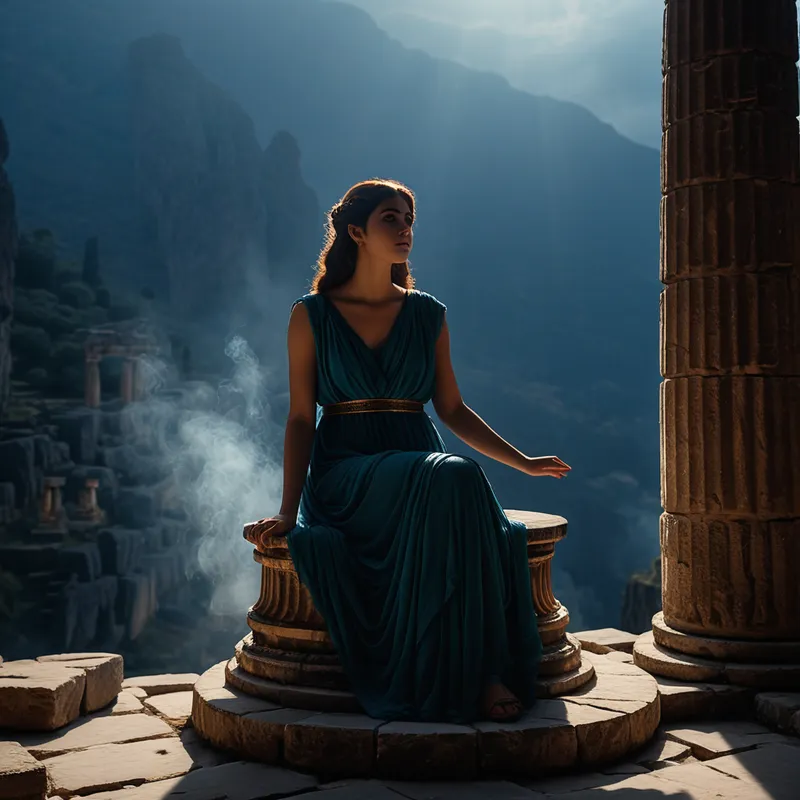
On the seventh day of each month, when the god was present, a sacred drama unfolded. A goat was drenched with icy [water](/myths/water “Myth from Chinese culture.”/) from the sacred spring; if it shuddered, the god gave his consent. Then, she would descend. The [Pythia](/myths/pythia “Myth from Greek culture.”/). An ordinary woman of Delphi, chosen for her simple life, would bathe in the Castalian Spring, donning the robes of a virgin. She would chew laurel leaves, the plant sacred to Apollo, and descend into [the temple](/myths/the-temple “Myth from Jewish culture.”/)‘s innermost sanctum, the adyton.
There, seated on a three-legged stool perched over the chasm, she inhaled the [pneuma](/myths/pneuma “Myth from Greek culture.”/)—the sacred, intoxicating vapor rising from the earth. The spirit of the place, the ghost of the Python, entered her. Her body would tremble, her eyes glaze over, her voice drop to a guttural rasp or rise to an unearthly shriek. She was no longer herself. She was [the vessel](/myths/the-vessel “Myth from Alchemical culture.”/), the medium, the bridged gap between the human and the divine.
Into this charged darkness stepped the supplicant—a king fearing war, a colonist seeking direction, a citizen accused of murder. Having paid his fee and offered his sacrifice, he presented his question to the male priests. They, in turn, would pose it to the writhing, possessed woman. From her lips came sounds, words, fragmented verses. The priests, the Hosioi, would then “translate” these raw, divine utterances into the elegant, often ambiguous hexameter verses that would be delivered. “Know thyself,” the temple facade warned, and “Nothing in excess.” The answers obeyed these principles: they were mirrors, not maps. Croesus asked if he should wage war on Persia. The Oracle said a great empire would fall. He did not ask which empire. He marched to his ruin, and the Oracle’s truth was fulfilled.

Cultural Origins & Context
[The Oracle at Delphi](/myths/the-oracle-at-delphi “Myth from Greek culture.”/) was not merely a religious institution; it was the geopolitical and psychological nerve center of the ancient Greek world for nearly a millennium. Its origins are shrouded in pre-Olympian, earth-goddess worship, likely linked to Gaia or [Themis](/myths/themis “Myth from Global/Universal culture.”/), before Apollo’s mythic conquest established a new, patriarchal order that nonetheless retained the primal, chthonic power of the site.
The myth and the ritual were passed down through a living, continuous practice. The “tale” was performed monthly, witnessed by priests, state delegates (theōroi), and pilgrims. Its function was profoundly societal: it provided a sanctioned, divine mechanism for decision-making in a world fraught with uncertainty. It mediated conflicts between city-states, legitimized new laws and colonies, and offered a direct line to cosmic order. The Pythia was the ultimate liminal figure—a mortal woman acting as the temporary mouthpiece of a god, her personal identity dissolved for the sake of a collective, transcendent truth. The process, from the lottery for question order to the priestly interpretation, was a sophisticated system for managing the terrifying and awesome experience of direct revelation, packaging the chaos of the unconscious divine into a usable, if cryptic, cultural product.
Symbolic Architecture
The [Oracle](/symbols/oracle “Symbol: An oracle represents wisdom, foresight, and divine communication, often serving as a mediator between the spiritual and physical worlds.”/) represents the [human](/symbols/human “Symbol: The symbol of a human represents individuality, complexity of emotions, and social relationships.”/) encounter with the unknowable Self, the point where conscious [intention](/symbols/intention “Symbol: Intention represents the clarity of purpose and direction in one’s life and can symbolize motivation and commitment within a dream context.”/) meets the mysterious, autonomous responses of the deeper [psyche](/myths/psyche “Myth from Greek culture.”/).
The tripod is the unstable, trinitarian seat of consciousness (past, present, future) poised above the abyss of the unconscious. To receive an answer, one must first surrender one’s footing.
The [Python](/symbols/python “Symbol: The python represents both fear and fascination, as well as transformation through confronting one’s deeper issues.”/) symbolizes the primal, instinctual wisdom of the [earth](/symbols/earth “Symbol: The symbol of Earth often represents grounding, stability, and the physical realm, embodying a connection to nature and the innate support it provides.”/) and the [body](/symbols/body “Symbol: The body in dreams often symbolizes the dreamer’s self-identity, personal health, and the relationship they have with their physical existence.”/)—the untamed psychic [material](/symbols/material “Symbol: Material signifies the tangible aspects of life, often representing physical resources, desires, and the physical world’s influence on our existence.”/) that must be confronted and integrated (slain by Apollo) for conscious understanding ([prophecy](/symbols/prophecy “Symbol: A foretelling of future events, often through divine or supernatural means, representing destiny, fate, and hidden knowledge.”/)) to emerge. Apollo represents the light of [consciousness](/symbols/consciousness “Symbol: Consciousness represents the state of awareness and perception, encompassing thoughts, feelings, and experiences.”/), [logos](/myths/logos “Myth from Christian culture.”/), and order, but he does not speak directly; he requires the dark, embodied, ecstatic medium of the Pythia. This is the essential psychic dialectic: the rational mind is incapable of accessing its own [depths](/symbols/depths “Symbol: Represents the subconscious, hidden emotions, or foundational aspects of the self, often linked to primal fears or profound truths.”/) without the mediating, and often destabilizing, power of the non-rational.
The cryptic, ambiguous [nature](/symbols/nature “Symbol: Nature symbolizes growth, connectivity, and the primal forces of existence.”/) of the prophecies is not a flaw but the core symbolic [truth](/symbols/truth “Symbol: Truth represents authenticity, honesty, and the quest for knowledge beyond mere appearances.”/). The unconscious does not speak the [language](/symbols/language “Symbol: Language symbolizes communication, understanding, and the complexities of expressing thoughts and emotions.”/) of direct instruction. It speaks in symbols, metaphors, and possibilities. The answer is always a [reflection](/symbols/reflection “Symbol: Reflection signifies self-examination, awareness, and the search for truth within oneself.”/) that requires the questioner’s own consciousness to complete its meaning. “Know thyself” is the only true command, for the oracle is ultimately a mirror of the [soul](/symbols/soul “Symbol: The soul represents the essence of a person, encompassing their spirit, identity, and connection to the universe.”/) that consults it.
The Dreamer’s Resonance
When this mythic pattern stirs in the modern dreamer, it signals a profound interior crossroads. Dreaming of seeking an oracle, or of being the oracle, points to a somatic and psychological process of consultation with the inner, authoritative Self.
To dream of anxiously climbing a sacred mountain to ask a question reflects a conscious ego at a loss, seeking guidance from a higher, inner authority. The anxiety in the dream is the somatic recognition of [the ego](/myths/the-ego “Myth from Jungian culture.”/)‘s impending dissolution or reconfiguration. To dream of being the Pythia—of feeling a foreign power speak through you, of choking on smoke or vapor, of your voice becoming not your own—is an experience of powerful psychic inflation or mediumship. It signifies the eruption of unconscious content into the conscious personality. The body in the dream may tremble or feel hot, mirroring the Pythia’s possession, a somatic metaphor for the autonomic nervous system responding to a psychic upheaval too large for the conscious mind to process. Such dreams often precede or accompany periods of major life decision, creative breakthrough, or psychological crisis, where the old, familiar ego-stance is no longer sufficient.

Alchemical Translation
The journey to Delphi models the complete alchemical process of individuation—the Opus Magnum of the psyche. [The pilgrim](/myths/the-pilgrim “Myth from Christian culture.”/)‘s external voyage mirrors the internal descent.
The nigredo, the blackening, is the initial confusion and sacrifice: the pilgrim leaves his city (ego-identity), purifies himself in the cold spring (a painful honesty), and offers a sacrifice (surrenders a cherished attachment or certainty).
The consultation in the adyton is the albedo, the whitening, the lunar phase. Here, in the sacred darkness, the conscious question (the ego’s desire) is exposed to the chaotic, transformative vapors of the unconscious (the Pythia’s possession). The ego must hold its question while enduring the disorienting, often frightening, spectacle of its own depths being articulated in a foreign tongue. This is the crucial dissolution.
The interpretation by the priests represents the citrinitas, the yellowing, the dawning of understanding. The raw, psychic material is brought into the realm of symbolic language and structure. Finally, the delivered verse is the [rubedo](/myths/rubedo “Myth from Alchemical culture.”/), the reddening, the return to the world with the newfound “gold” of insight. The prophecy, even if tragic, provides a paradoxical liberation. It frames the chaos of life within a narrative of meaning, however ambiguous. For the modern individual, this alchemy occurs not in a stone temple, but in the interior space where one dares to pose a heartfelt question to the depths of one’s own being—through therapy, meditation, art, or deep reflection—and has the courage to sit with the unsettling, non-linear, and transformative answer that rises, in its own time and its own symbolic form, from [the omphalos](/myths/the-omphalos “Myth from Greek culture.”/) of the soul.
Associated Symbols
Explore related symbols from the CaleaDream lexicon: