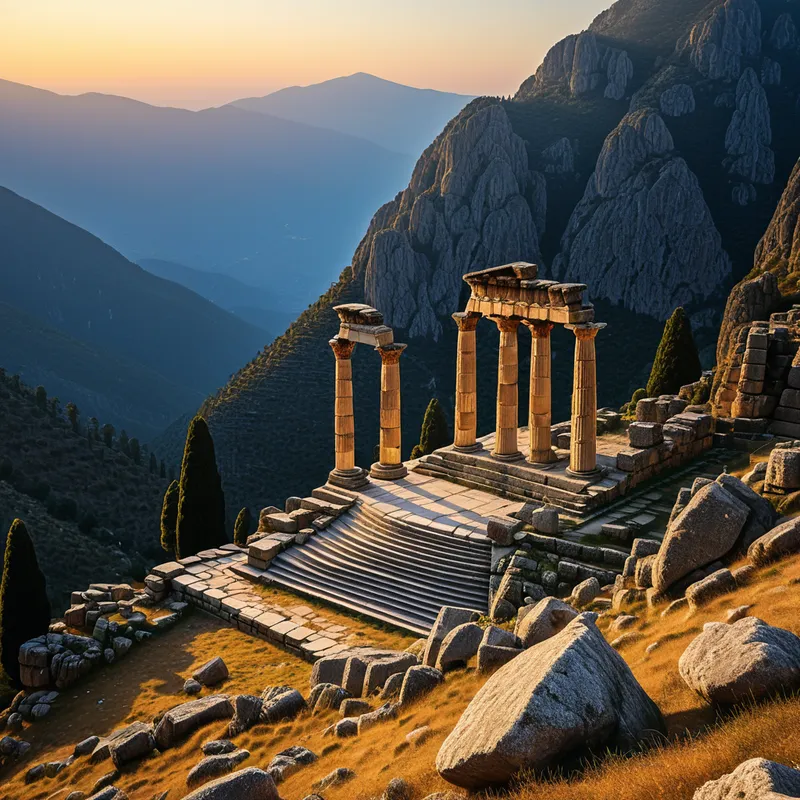
The Oracle at Delphi Myth Meaning & Symbolism
The story of Apollo claiming Delphi, where a priestess, breathing sacred vapors, became a conduit for divine prophecy, guiding heroes and kings.
The Tale of The Oracle at Delphi
Before the world knew reason, it knew whispers. Before the age of maps, there was a center. High on the shuddering shoulders of Mount Parnassus, where eagles carved circles in the thin, cold air, the earth itself dreamed aloud. Here, in a place of terrible beauty, the ground was not silent. A deep chasm breathed—a sigh of ancient stone, a vapor that smelled of wet laurel and something older than memory. This was the navel of the world, the omphalos.
It was a place claimed first by the primordial Python, a great serpent-dragon born of the earth’s first mud, who coiled around the chasm and spoke its dreams in hisses. But then came the one who carries the sun in his quiver: Phoebus Apollo. He descended from the bright, logical heavens, a golden youth with a silver bow. His music was order, his light was clarity, and the chthonic murmurs of the place called to him as a challenge. With arrows that flew like rays of dawn, he slew the Python, letting its dark blood soak back into the sacred soil from which it came.
Yet Apollo, god of truth, was wise. He did not silence the earth’s voice; he sought to translate it. He took the form of a dolphin, leaping from the blue sea to guide a ship of Cretan sailors to this spot, making them his first priests. And he chose a vessel for the voice—not a king, not a warrior, but a woman. A simple peasant from the nearby village, she would be the Pythia.
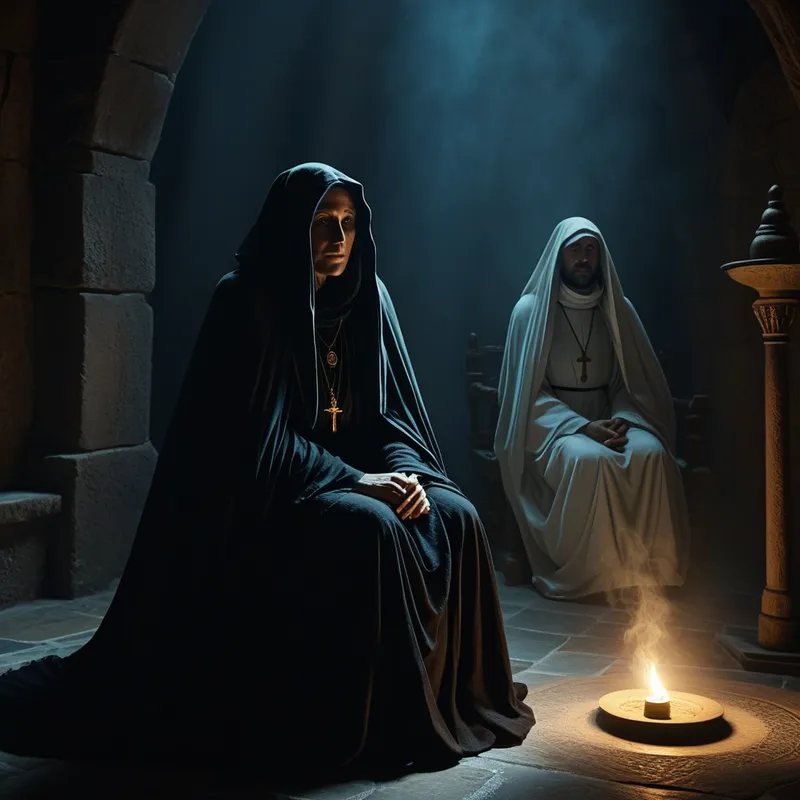
On the seventh day of each month, save the winter months when Dionysus ruled, she would undergo rites of purification. She would bathe in the Castalian Spring, drink from the sacred stream, and chew leaves from the holy laurel tree. Then, led into the temple’s innermost sanctum, the adyton, she would seat herself upon a three-legged stool placed over the chasm. The breath of the earth—the pneuma—would rise.
It began with a trembling in the hands, a widening of the eyes. The sweet, cloying scent of the vapor filled her lungs. Her body would shake, her head loll. The rational mind of the woman receded, and a presence, vast and roaring, rushed in. Her mouth moved, but the voice was not her own. It was guttural, fragmented, a torrent of sound—the raw, untranslated language of the god. Around her, the Hosioi stood ready, their styluses poised over wax tablets. They would take her cries, her groans, her riddling phrases, and shape them into the ambiguous, perfect hexameters that would then be delivered to the supplicant trembling outside.
Kings and beggars alike made the arduous pilgrimage. They brought lavish gifts, sacrificed animals, and asked their fateful questions: “Shall I go to war?” “Who is the wisest man in Athens?” “How do I cleanse myself of a terrible crime?” The answers they received were never lies, but they were mirrors, reflecting back the unspoken depths of the question itself. Croesus was told if he attacked the Persians, he would destroy a great empire. He did—his own. Oedipus was told he would kill his father and marry his mother, a truth so horrific he fled directly into its arms.
The Oracle did not command. It revealed. It cast the seeker’s own hidden truth, their deepest fate, into a riddle they themselves had to unravel. The tripod was not a throne of power, but a crucible where the human and the divine, chaos and order, met in a single, trembling form.
Cultural Origins & Context
The Oracle at Delphi was not merely a story; it was the beating heart of the Hellenic world for nearly a millennium. Its origins are layered, pointing to a prehistoric earth-goddess cult centered on Gaia that was later assimilated by the incoming Olympian pantheon under Apollo. This synthesis is the myth in microcosm: the chthonic (earthly) wisdom preserved within a new, Apollonian (heavenly) framework of order and institution.
Historically, the site gained Panhellenic prominence by the 8th century BCE. Its authority was unparalleled. City-states consulted it before founding colonies, enacting laws, or going to war. Its pronouncements on religious law were considered final. This function transformed the myth into a living, socio-political nerve center. The Oracle’s ambiguity was its genius; it offered divine sanction while leaving room for human agency and interpretation, thus binding the community to a shared, yet personally internalized, fate.
The myth was passed down through a triad of channels: the epic poetry of Homer and Hesiod, which reference its sanctity; the historical accounts of Herodotus and Plutarch (who himself served as a priest at Delphi); and the countless dedications—statues, treasuries, inscriptions—that physically crowded the Sacred Way, each a testament to a prophecy received. It was a collective narrative, reinforced by every pilgrim’s journey and every city’s tribute.
Symbolic Architecture
At its core, the Delphic myth is a profound symbol of the psyche’s own structure and the terrifying process of accessing self-knowledge. The Oracle represents the interface between the conscious ego and the unconscious Self.
The Parnassus setting symbolizes the arduous ascent required to approach truth—it is a psychological high place, removed from the mundane plains of daily life. The slain Python represents the conquest of sheer, undifferentiated instinct, the chaotic “dragon” of the unconscious that must be confronted and integrated, not ignored. Apollo’s establishment of his temple atop this very site signifies that true order (logos) is not imposed upon chaos from the outside, but is built directly over its source.
The tripod is the unstable seat of consciousness, positioned directly over the abyss of the unknown. To seek an answer is to consent to be unmade.
The Pythia herself is the ultimate symbol of the anima—the inner feminine mediating function—or of the ego temporarily surrendering to a greater power. Her ritual intoxication (from the vapors, laurel, and possibly underground gases) is a controlled ekstasis, a “standing outside” of oneself. This is not madness as pathology, but sacred madness, the necessary dissolution of the ego’s boundaries to allow a transpersonal truth to speak. The priests who interpret her fragmented speech represent the necessary return to structure; the raw content of the unconscious must be translated by the conscious mind into usable, if ambiguous, form. The famous maxims inscribed at the temple, “Know Thyself” and “Nothing in Excess,” are the Apollonian framework that contains the Dionysian revelation.

The Dreamer’s Resonance
When the pattern of the Delphic Oracle manifests in modern dreams, it signals a critical moment of intrapsychic consultation. The dreamer is at a crossroads, facing a life decision or an inner conflict where rational analysis has failed. The somatic feeling is often one of vertigo, awe, and deep anxiety—the feeling of standing at the edge of a great depth.
Dream imagery may include: finding a hidden room or cave in one’s house (the adyton of the personal psyche); encountering a wise but cryptic figure who speaks in riddles (the Pythia as dream guide); hearing one’s own voice giving advice in a strange tone; or being given a written message that is blurry, in a foreign language, or changes when looked at again (the ambiguous prophecy). The dreamer may feel “possessed” or overwhelmed by an emotion or insight during the dream.
Psychologically, this is the process of the ego appealing to the deeper wisdom of the Self. The anxiety arises from the ego’s fear of dissolution—of being “taken over” by the unconscious, just as the Pythia was. The dream is the sacred space where this controlled possession can safely occur. The cryptic answer received is not the unconscious withholding information, but presenting it in its native, symbolic language, which the waking ego must then labor to interpret. It is an invitation to engage in a dialogue with one’s own depths.

Alchemical Translation
The myth models the complete alchemical opus of individuation—the journey toward psychic wholeness. The seeker’s pilgrimage to Delphi is the initial nigredo, the recognition of a problem that leads into the dark night of the soul, the arduous climb up the mountain.
The consultation itself is the central coniunctio oppositorum (conjunction of opposites). Here, the opposites meet in violent, creative union: male/female (Apollo/Pythia), heaven/earth (Olympian/chthonic), consciousness/unconsciousness, order/chaos, clarity/ambiguity. The Pythia on the tripod is the living symbol of the filus philosophorum, the child of the union, who holds the paradoxical answer.
The prophecy is the prima materia of the soul—the raw, unrefined truth of one’s own nature, delivered in a form that demands the seeker’s own labor to refine it.
The return journey with the riddle is the long work of albedo and rubedo—the whitening and reddening. The ambiguous hexameter must be lived with, wrestled with, and integrated into conscious life. Like Oedipus or Croesus, the individual must confront how the prophecy reflects their own blind spots, hubris, or hidden desires. The destruction of a “great empire” is often the necessary deconstruction of an outworn ego-identity.
Finally, the offering left at Delphi symbolizes the sacrifice required: the old, narrow self must be given up to gain access to the wider Self. The ultimate “know thyself” is not an intellectual exercise but an ordeal of encounter, surrender, and reinterpretation. The modern individual walking this path learns that the truest oracle does not reside on a remote mountain, but at the fissure where one’s own conscious life meets the breathing, whispering depths of the unconscious. The quest is internalized; we each must become both pilgrim and Pythia, seeker and the sacred, trembling voice that answers.
Associated Symbols
Explore related symbols from the CaleaDream lexicon:
- Ear
- Somewhat
- Option
- Flickering Computer Screen
- Searching for Clarity
- Veiled Truth
- Sulfur Fog
- Translucent Quartz
- Aspen Leaves
- Spiraling Seashell
- Distant Snipe
- Yeti’s Footprint
- Greek Philosopher’s Scroll
- Inkblot
- Inkblot Art
- Funnel
- Tea Infuser
- Tea Strainer
- Tablet Device
- Cliffside Retreat
- Rocky Cliff House
- Echoing Cathedral
- Park Bench
- Observer’s Perch
- Beneath Old Stones
- Looming Storm
- Visionary Portal
- Cave Springs
- Riverside Shrine
- Forked Branch Signaling
- Acoustic Filter
- Statistical Noise
- Parse
- Input
- Daath
- Thermometer
- Promontory