The Omphalosat Myth Meaning & Symbolism
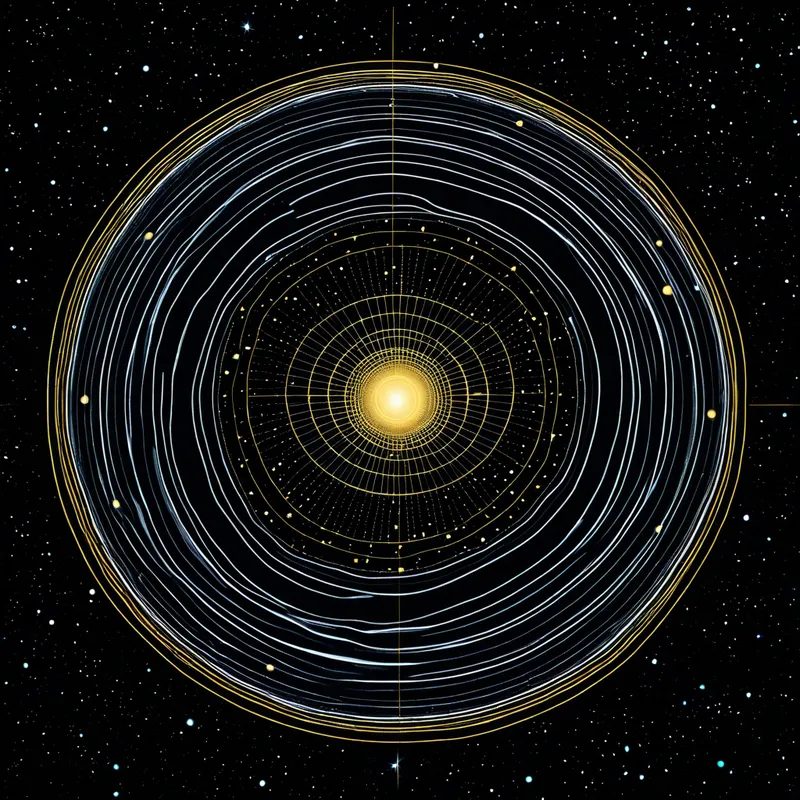
A myth of a primordial stone, the world's navel, holding the tension between chaos and order, anchoring all existence through a sacred, silent hum.
The Tale of The Omphalosat
Listen. Before the names of things were spoken, there was only the Tehom, the deep and swirling dark. And in that dark, a silence so profound it was a kind of sound—a pressure on the soul of what was to come. From this pressure, not through violence but through a gathering, a condensation of intent, the First Stone was born. It was not carved. It was uttered.
They called it the Omphalosat. It appeared where the currents of potential crossed, a point that was no point, a place that was every place. It was a stone of perfect, unreflective black, smoother than [water](/myths/water “Myth from Chinese culture.”/) yet holding the weight of mountains. It did nothing but be. And in its being, it began to hum.
This was not a sound for ears. It was a vibration for the bones of [the world](/myths/the-world “Myth from Tarot culture.”/). The hum was a question and an answer in one tone. It asked, “Where is the center?” and answered, “Here.” The chaotic swirls of the Tehom, hearing this anchor-tone, began to slow. They began to spiral, to find rhythm. Land coagulated around its resonance. Seas pooled in its gravitational sigh. [The sky](/myths/the-sky “Myth from Persian culture.”/) vaulted upward from its steadfast plane.
The first beings to emerge from the now-stabilized world were the Resonants. They were not gods of thunder or love, but of attention. Their sole purpose was to listen to the Omphalosat’s hum and, by listening, sustain it. They built no temples, for the stone was [the temple](/myths/the-temple “Myth from Jewish culture.”/). They sang no hymns, for the hum was the hymn. They simply sat in concentric circles around it, their silent focus a vessel for its foundational song. The world flourished in the harmony of this arrangement.
But a fracture came. A Resonant, named Kael, grew weary of the single tone. “To only listen is to be deaf to all else,” he whispered. “What of the song of [the wind](/myths/the-wind “Myth from Various culture.”/)? The cry of the newborn cataclysm? The melody of a falling star?” His attention, the most focused of all, wavered. He leaned in, and instead of listening, he pressed his ear against the stone.
The contact was a catastrophe of silence. The Omphalosat’s hum did not cease, but it changed. Kael’s own longing, his dissonant curiosity, flowed into the stone. The perfect tone gained a shadow, a faint harmonic of yearning and doubt. The world shuddered. Mountains developed slight tremors. Tides developed a hesitant lag.
The other Resonants recoiled in horror, but the deed was done. The Omphalosat was no longer a pure, external anchor. It now contained the echo of a question from within the world it anchored. Kael, his being unraveled by the feedback, became the first Wandering Echo, forever circling the world, his form a shimmer of the lost pure tone.
And the Omphalosat? It remained. Its hum was now a dual tone: the deep, steady foundation, and within it, the quiet, restless question. The world was not broken, but it was awake. It was grounded, yet dreaming. The center held, but it now knew the periphery.
Cultural Origins & Context
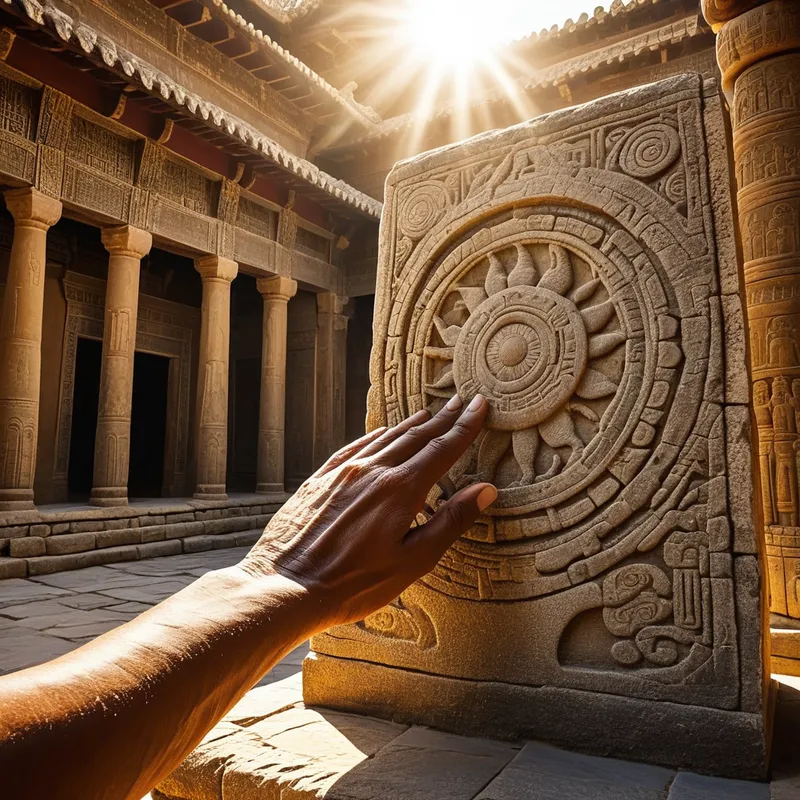
The myth of the Omphalosat finds its roots not in one land, but in the universal human experience of seeking a center in a seemingly boundless existence. It is a “Global/Universal” myth because it articulates a psychological and cosmological intuition found in myriad forms: the [Omphalos](/myths/omphalos “Myth from Greek culture.”/) at Delphi, the Axis Mundi of shamanic cosmologies, the foundational cornerstone in Masonic lore, even the primordial singularity of theoretical physics.
It was never the property of a single priesthood. It appears in the oral traditions of nomadic storytellers who spoke of the “Heart-Stone of the Plains,” in the navigational chants of ocean voyagers who steered by the “Still Point Star,” and in the meditation manuals of mountain ascetics who sought the “Inner Mountain that does not move.” Its function was societal and personal: to provide an imaginal anchor. In times of chaos, plague, or social upheaval, the recitation of the Omphalosat myth did not promise intervention, but remembrance. It reminded the community that however turbulent the surface, a foundational order—however complex—existed.
Symbolic Architecture
The Omphalosat is the ultimate [symbol](/symbols/symbol “Symbol: A symbol can represent an idea, concept, or belief, serving as a powerful tool for communication and understanding.”/) of the Psychic Center. It is not [the ego](/myths/the-ego “Myth from Jungian culture.”/), which is often off-kilter and identified with passing thoughts. It is the deeper, often unconscious, point of orientation around which the [psyche](/myths/psyche “Myth from Greek culture.”/) organizes itself.
The center is not where you stand, but what allows you to stand at all.
The [stone](/symbols/stone “Symbol: In dreams, a stone often symbolizes strength, stability, and permanence, but it may also represent emotional burdens or obstacles that need to be acknowledged and processed.”/)’s perfect blackness symbolizes the Ungrund, the fertile void. Its hum is the first [differentiation](/symbols/differentiation “Symbol: The process of distinguishing or separating parts of the self, emotions, or identity from a whole, often marking a developmental or psychological milestone.”/), the primordial [vibration](/symbols/vibration “Symbol: A rhythmic oscillation or resonance, often representing energy, connection, or unseen forces. In dreams, it can signal awakening, disturbance, or spiritual communication.”/) (Aum) that structures [chaos](/symbols/chaos “Symbol: In Arts & Music, chaos represents raw creative potential, uncontrolled expression, and the breakdown of order to forge new artistic forms.”/) into potential forms. The Resonants represent the faculty of pure [attention](/symbols/attention “Symbol: Attention in dreams signifies focus, awareness, and the priorities in one’s life, often indicating where the dreamer’s energy is invested.”/), the ego’s [capacity](/symbols/capacity “Symbol: A measure of one’s potential, limits, or ability to contain, process, or achieve something, often reflecting self-assessment or external demands.”/) to align itself with this deeper center, to “listen” to [the Self](/myths/the-self “Myth from Jungian culture.”/) rather than its own chatter.
Kael’s transgression is the necessary, tragic, and creative act of [consciousness](/symbols/consciousness “Symbol: Consciousness represents the state of awareness and perception, encompassing thoughts, feelings, and experiences.”/). Pressing his ear against the stone is the ego’s attempt not just to align with the Self, but to understand it, to merge with it prematurely. This “fall” introduces complexity, time, and [psychology](/symbols/psychology “Symbol: Psychology in dreams often represents the exploration of the self, the subconscious mind, and emotional conflicts.”/) into a [static](/symbols/static “Symbol: Static represents interference, disruption, and the breakdown of clear communication or signal, often evoking feelings of frustration and disconnection.”/), perfect [system](/symbols/system “Symbol: A system represents structure, organization, and interrelated components functioning together, often reflecting personal or social order.”/). The dual tone that results is the [condition](/symbols/condition “Symbol: Condition reflects the state of being, often focusing on physical, emotional, or situational aspects of life.”/) of [human](/symbols/human “Symbol: The symbol of a human represents individuality, complexity of emotions, and social relationships.”/) [life](/symbols/life “Symbol: The symbol of ‘Life’ represents a journey of growth, interconnectedness, and existential meaning, encompassing both the joys and challenges that define human experience.”/): we are grounded in a fundamental order (the [body](/symbols/body “Symbol: The body in dreams often symbolizes the dreamer’s self-identity, personal health, and the relationship they have with their physical existence.”/), the laws of [nature](/symbols/nature “Symbol: Nature symbolizes growth, connectivity, and the primal forces of existence.”/), the archetypal patterns), yet permeated by a restless questioning (consciousness, desire, the search for meaning). The world is “awake” because of this flaw.
The Dreamer’s Resonance
When the Omphalosat appears in modern dreams, it is rarely as a literal stone. It manifests as the experience of a center. A dreamer may find themselves in a vast, chaotic city (the psyche’s complexity) and suddenly discover a small, locked garden that is perfectly quiet. They may be in a storm-tossed boat and feel a sudden, solid calm beneath their feet. They may hear a single, sustained note beneath the cacophony of a dream argument.
These dreams often occur during life transitions—career shifts, relational endings, spiritual crises—when the ego’s usual [reference](/myths/reference “Myth from Global/Universal culture.”/) points are dissolving. The somatic feeling is one of profound grounding amidst disorientation. It is the body sensing the Self’s stability before the mind can comprehend it. The psychological process is one of re-centering. The dream is not solving the problem; it is reminding the dreamer of the foundational platform from which all solutions must arise. If the dream includes a flaw or crack in the center (a chip in the stone, a hesitant hum), it signals the dreamer’s own Kael-like struggle: the conscious mind’s attempt to grasp or control this deep stability, which inevitably introduces a new layer of personal complexity to the journey.

Alchemical Translation
The myth models the entire alchemical process of individuation. The initial state is the massa confusa (the Tehom). The first goal is not to build a personality, but to find the [prima materia](/myths/prima-materia “Myth from Alchemical culture.”/), the irreducible core—the Omphalosat. This is the stage of introspection, meditation, and withdrawing projections, seeking the inner anchor.
The work of the Resonants is the stage of meditatio and observatio. One learns to attend to this inner center without demanding anything from it.
Individuation begins not with becoming special, but with becoming specific—finding the unique point where the universal hum resonates in you.
Kael’s act is the critical [separatio](/myths/separatio “Myth from Alchemical culture.”/). The conscious mind (Kael) must engage with the Self (the Stone), not just observe it. This is always a “fall” from innocent unity; it creates conflict, shadow, and the “wandering echo” of neurosis and doubt. Yet this is where life gains its texture and its story. The dual tone is the coniunctio oppositorum. The goal is not to return to the pure, single tone—that is regression. The goal is to hold the tension of the dual tone, to live from the center that has integrated the question.
For the modern individual, the alchemical translation is this: Your crisis, your doubt, your “flaw” is not a deviation from your purpose. Like Kael’s yearning, it is the ingredient that personalizes the universal foundation. You are not tasked with finding a perfect, static center. You are tasked with listening to the unique, complex hum of your own anchored-yet-questioning soul, and building your world from that resonant truth.
Associated Symbols
Explore related symbols from the CaleaDream lexicon: