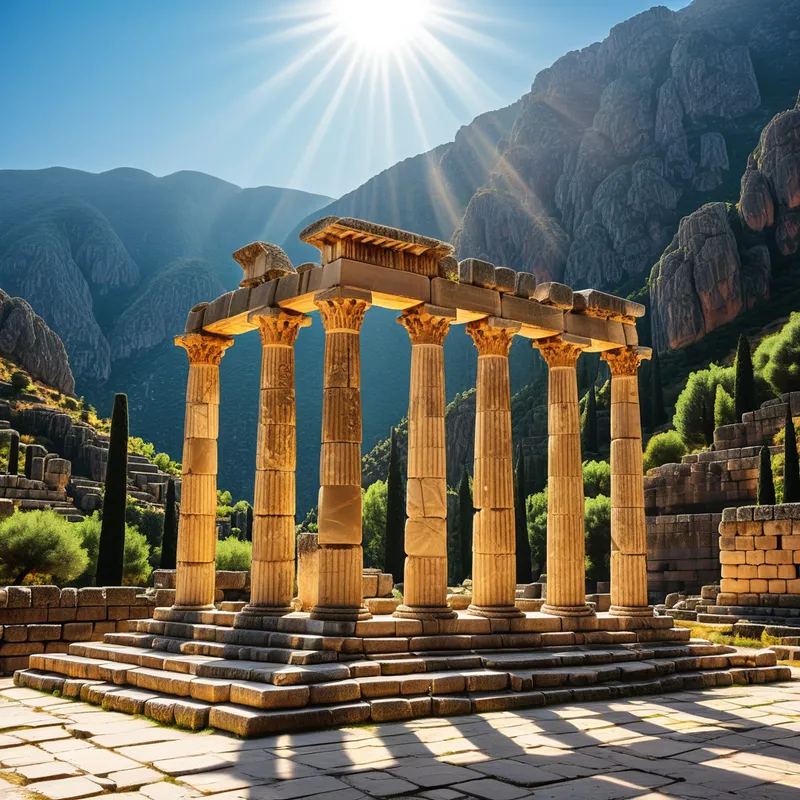
The Omphalos at Delphi Myth Meaning & Symbolism
The story of the sacred stone marking the world's center, where two eagles of Zeus met, establishing Delphi as the oracle of Apollo and the heart of the ancient world.
The Tale of The Omphalos at Delphi
Listen, and let the mists of time part. Before the first stone of the great temple was laid, before the name of Apollo echoed in the gorge, [the world](/myths/the-world “Myth from Tarot culture.”/) was a formless, arguing chaos. The gods, in their majesty, looked upon [the earth](/myths/the-earth “Myth from Hindu culture.”/)—a beautiful, sprawling disk—and saw it had no heart, no fixed point from which to measure its breadth. It spun in [the void](/myths/the-void “Myth from Buddhist culture.”/), beautiful but unmoored.
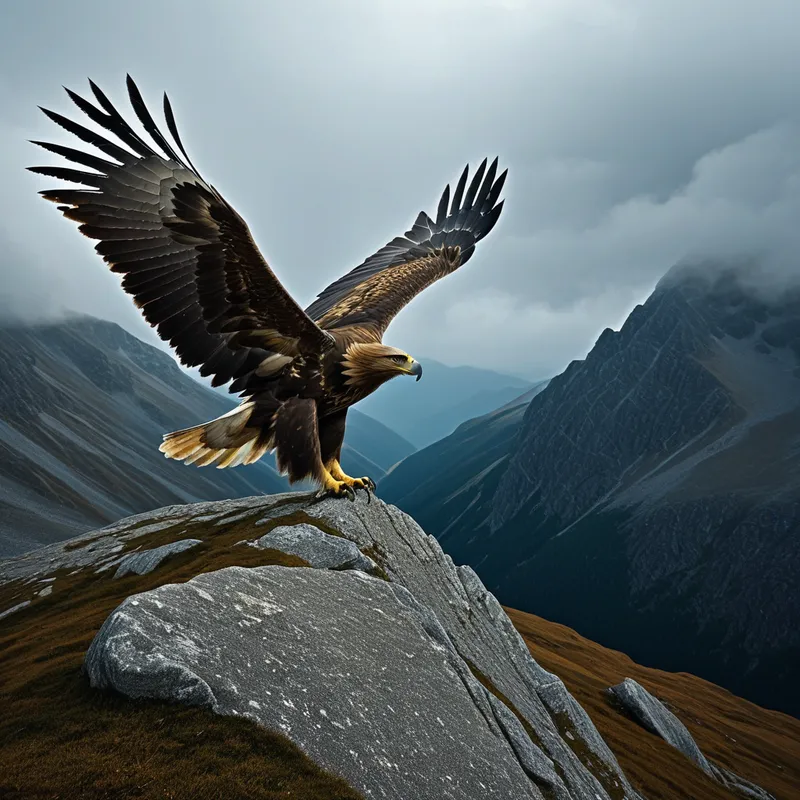
Zeus, the cloud-gatherer, father of gods and men, resolved to find its center. His will was [the law](/myths/the-law “Myth from Biblical culture.”/) that brought order from the primeval clash. From the pinnacle of [Mount Olympus](/myths/mount-olympus “Myth from Global/Universal culture.”/), he loosed two eagles. Not mere birds, but extensions of his sovereign mind. One he sent flying to the very edge of the rising sun, to the farthest east where the world begins anew. The other he hurled toward the dying light, to the ultimate west where the world sinks into the ocean of night. He commanded the winds to still, and [the sky](/myths/the-sky “Myth from Persian culture.”/) became a vast, empty bowl.
For days uncounted, the eagles flew, their tireless wings beating a rhythm against the curve of the world. They traversed mountains and seas, crossed the paths of titans and the haunts of monsters, until the great circle of the earth began to draw them back together. Their flight, begun in opposition, became a convergent arc.
And it was in a wild, rugged place, where the slopes of [Mount Parnassus](/myths/mount-parnassus “Myth from Greek culture.”/) fell away into a deep, mysterious cleft, that the miracle occurred. From the rosy-fingered dawn and the violet-hued dusk, the two eagles descended. The air crackled with a silent thunder. With a final, majestic sweep, their wingtips brushed the same point of empty air, and they met—not in conflict, but in perfect, mirrored recognition—directly above a simple, grey stone that jutted from the earth.
A flash of light, pure and soundless, sealed the moment. Zeus declared it: here was the [omphalos](/myths/omphalos “Myth from Greek culture.”/), the navel of the world. The stone was no longer mere rock; it was a covenant, a axis pin driven through the layers of creation, binding the heavens, the earth, and the dark realm below into a single, ordered whole.
But a center of such power cannot lie fallow. It draws its guardian. The great serpent [Python](/myths/python “Myth from Greek culture.”/), born of the earth’s primal mud, had long coiled in the chasm, its breath a foul mist that spoke of chaos old as time. To this sacred navel came Apollo, the far-shooter, golden and terrible. With arrows that were rays of the sun itself, he slew the serpent, cleansing the site. The chasm, once a fuming mouth of chaos, now breathed a different vapor—a sweet, intoxicating [pneuma](/myths/pneuma “Myth from Greek culture.”/) that rose from the very stone. Over it, Apollo placed his priestess, the [Pythia](/myths/pythia “Myth from Greek culture.”/), and the stone itself was enshrined. They wrapped the Omphalos in a sacred net, as if to hold the captured unity of the cosmos, and there it sat, in [the temple](/myths/the-temple “Myth from Jewish culture.”/)’s inner sanctum, the silent, beating heart from which the riddles of fate would flow for a thousand years.
Cultural Origins & Context
The myth of [the Omphalos](/myths/the-omphalos “Myth from Greek culture.”/) is not a single authored tale but a foundational belief woven into the very identity of Delphi. It served as the divine charter, the “why” for the oracle’s pre-eminent authority. Passed down through the hymns of priests (like the Homeric Hymn to Apollo), the poems of Pindar, and the histories of travelers like Herodotus, it was a story every Greek knew. Its societal function was profound: it established Delphi not just as a religious site, but as the geopolitical and spiritual center of the Hellenic world. City-states, often at odds, could agree on one [thing](/myths/thing “Myth from Norse culture.”/)—this was the common navel. It legitimized the oracle’s pronouncements on matters of state, colonization, and personal destiny, grounding its authority in a cosmic, Zeus-ordained geography. The stone was a physical anchor for a collective worldview, a point of stability around which the turbulent world of poleis and fortunes could orient itself.
Symbolic Architecture
The Omphalos is the ultimate [symbol](/symbols/symbol “Symbol: A symbol can represent an idea, concept, or belief, serving as a powerful tool for communication and understanding.”/) of the [axis](/symbols/axis “Symbol: A central line or principle around which things revolve, representing stability, orientation, and the fundamental structure of reality or consciousness.”/) mundi—the world axis. It represents the point where the vertical [dimension](/symbols/dimension “Symbol: Represents the fundamental structure of reality, consciousness, or existence beyond ordinary perception.”/) (the realms of gods, humans, and chthonic powers) intersects with the horizontal [plane](/symbols/plane “Symbol: Dreaming of a plane often symbolizes a desire for freedom, adventure, and new possibilities, as well as transitions in life.”/) of earthly existence. It is the still point in the turning world.
The center is not a place you find on a map; it is the place where opposites reconcile, where separation ends and meaning begins.
The two eagles of Zeus symbolize the polarized forces of existence: east and west, [dawn](/symbols/dawn “Symbol: The first light of day, symbolizing new beginnings, hope, and the transition from darkness to illumination.”/) and [dusk](/symbols/dusk “Symbol: A transitional period between day and night, symbolizing liminality, reflection, and the merging of opposites in artistic and musical contexts.”/), beginning and end. Their meeting marks the [resolution](/symbols/resolution “Symbol: In arts and music, resolution refers to the movement from dissonance to consonance, creating a sense of completion, release, or finality in a composition.”/) of duality into unity. The [stone](/symbols/stone “Symbol: In dreams, a stone often symbolizes strength, stability, and permanence, but it may also represent emotional burdens or obstacles that need to be acknowledged and processed.”/) itself, often depicted as draped in a agrenon (a woolen net), represents the captured and ordered [cosmos](/symbols/cosmos “Symbol: The entire universe as an ordered, harmonious system, often representing the totality of existence, spiritual connection, and the unknown.”/)—[chaos](/symbols/chaos “Symbol: In Arts & Music, chaos represents raw creative potential, uncontrolled expression, and the breakdown of order to forge new artistic forms.”/) bound into a knowable, structured form. The slaying of [Python](/symbols/python “Symbol: The python represents both fear and fascination, as well as transformation through confronting one’s deeper issues.”/) by Apollo is not merely a victory of order over [chaos](/symbols/chaos “Symbol: In Arts & Music, chaos represents raw creative potential, uncontrolled expression, and the breakdown of order to forge new artistic forms.”/), but the necessary consecration of the center. The primal, unconscious, [earth](/symbols/earth “Symbol: The symbol of Earth often represents grounding, stability, and the physical realm, embodying a connection to nature and the innate support it provides.”/)-bound power (Python) must be integrated and transformed, not simply ignored, for the center to become a [source](/symbols/source “Symbol: The origin point of something, often representing beginnings, nourishment, or the fundamental cause behind phenomena.”/) of luminous [prophecy](/symbols/prophecy “Symbol: A foretelling of future events, often through divine or supernatural means, representing destiny, fate, and hidden knowledge.”/) rather than murky [dread](/symbols/dread “Symbol: A profound, anticipatory fear of impending doom or catastrophe, often without a clear external threat. It manifests as a heavy, paralyzing emotional state.”/). The Omphalos, therefore, is a symbol of achieved cosmic and psychic order.
The Dreamer’s Resonance
When the motif of the Omphalos appears in modern dreams, it rarely manifests as an ancient Greek stone. Instead, the dreamer may encounter a singular, potent object in a vast, empty space—a glowing crystal in a dark forest clearing, a unique machine at the heart of a labyrinthine building, or a still, deep pool in the center of a chaotic landscape. The somatic feeling is one of profound magnetic pull, a mixture of awe and deep calm. Psychologically, this signals a process of centering. The [psyche](/myths/psyche “Myth from Greek culture.”/) is in the act of locating its own core amidst internal or external turmoil. The conflicting “eagles”—perhaps career versus family, logic versus intuition, a past self versus a future self—are being summoned to their point of reconciliation. The dream is an announcement from the unconscious: a central, organizing principle is emerging. There may be anxiety ([the remnant](/myths/the-remnant “Myth from Biblical culture.”/) of the “Python”) guarding this nascent center, but the overarching message is one of integration and the birth of a personal, inner authority.

Alchemical Translation
For the modern individual navigating the fragmentation of contemporary life, the myth of the Omphalos models the alchemical process of finding the [lapis philosophorum](/myths/lapis-philosophorum “Myth from Alchemical culture.”/)—[the philosopher’s stone](/myths/the-philosophers-stone “Myth from Alchemical culture.”/)—within oneself. The journey of individuation is the search for one’s own psychic center.
[The first stage](/myths/the-first-stage “Myth from Alchemical culture.”/) is the release of the “eagles”: the conscious, often oppositional, striving of [the ego](/myths/the-ego “Myth from Jungian culture.”/). We send out parts of ourselves to conquer extremes—success, pleasure, knowledge, spirituality. This flight is necessary but ultimately circular, leading to exhaustion and contradiction. The crisis comes when these polarized pursuits converge, revealing their common origin. The “stone” they meet over is the nascent Self, the potential wholeness that was always there, buried under the ambitions and conflicts of the [persona](/myths/persona “Myth from Greek culture.”/).
Individuation is the slaying of the Python not by annihilation, but by inhalation; we take the chaotic, chthonic energy of the unconscious and breathe it into the service of consciousness, creating the sacred pneuma of self-knowledge.
The “Apollonic” task that follows is the difficult, sun-lit work of clearing the site. It is the discipline of introspection, the “slaying” of old, compulsive patterns (the Python) that guard our core with fear. Finally, the establishment of the inner oracle: the wrapped stone represents the integrated Self, now a stable, generative center. From this place of hard-won unity, one does not receive prophecies of external fate, but gains the capacity for true discernment—the ability to consult one’s own depths and speak, with authority, from the center of one’s being. The Omphalos thus translates from a myth of cosmic geography to a map for psychic wholeness, reminding us that every soul contains, and must seek, its own navel of the world.
Associated Symbols
Explore related symbols from the CaleaDream lexicon: