The Olympic Flame Myth Meaning & Symbolism
The story of a titan who stole fire from the gods to give to humanity, sparking civilization and an eternal, sacred contest of spirit and body.
The Tale of The Olympic Flame
In the age before memory, when the earth was young and humanity shivered in the endless twilight of its own infancy, the world was a place of cold stone and raw fear. The Titans had fallen, and the new gods, the Olympians, ruled from their cloud-veiled citadel. They feasted on ambrosia and nectar, their laughter like distant thunder. Below, in the mud and the dark, humankind crouched. They ate their meat raw, their bones aching with the damp. They had no craft, no art, no hope to lift their eyes above the next desperate hunt. They were ephemeral, pitiable things, destined to live and die in the same breath of ignorance.
But one being watched them with a heart that was not made of divine indifference. Prometheus, whose name means “Forethought,” saw not beasts, but potential. He saw the spark of curiosity in their eyes, a spark that was smothered by the sheer, crushing weight of a world they did not understand. He had helped Zeus secure his throne, yet he felt a deeper kinship with the fragile creatures of clay.
The great divide was fire. Fire was the sole property of the gods, the celestial element that danced in the hearth of Hestia and flashed from the fist of Zeus. It was the secret of power, of transformation, of vision. Without it, humanity would remain in the muck, forever children in a cold nursery.
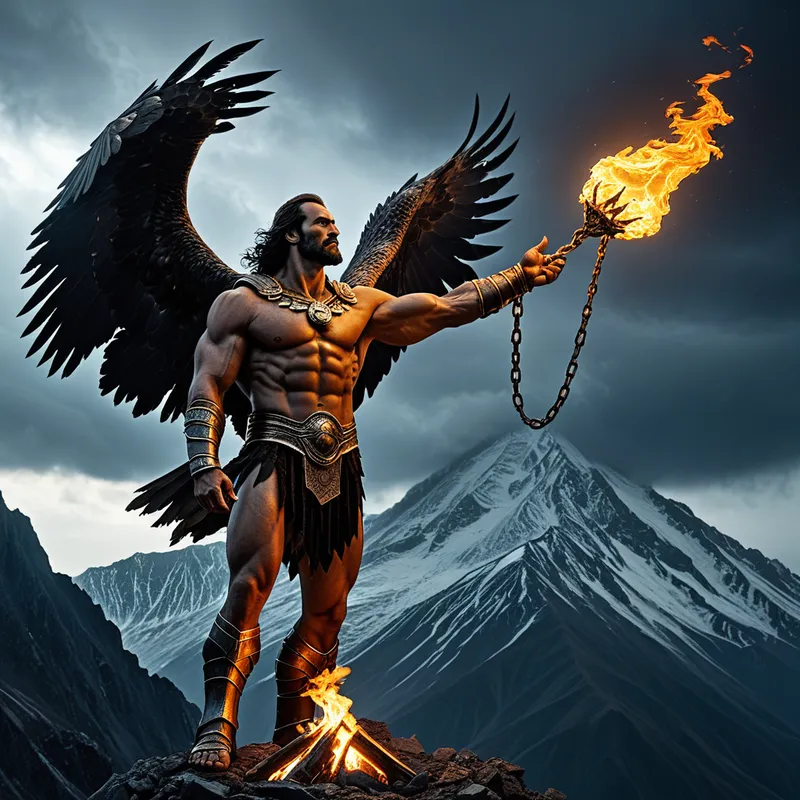
So Prometheus, the cunning Titan, made his choice. He journeyed to the sun-chariot of Helios as it blazed across the sky. With a stalk of giant fennel—narthex—hollow and dry, he stole a single, burning ember from the wheel’s fiery rim. He hid the glowing coal within the stalk and descended, a thief of light returning to the shadowed world.
He arrived at a desolate place where men huddled. Without a word, he knelt. He placed the fennel stalk on the ground and blew gently. A wisp of smoke, then a tongue of gold, then a roaring, dancing, living light erupted. The people fell back, crying out in terror at this wild, consuming spirit. But Prometheus showed them. He showed them how to feed it wood, how to contain it in a ring of stone, how its heat could turn tough flesh into nourishing feast, how its light could banish the terrors of the night, how its spark could harden the tip of a spear and shape stubborn metal.
Civilization was born in that circle of warmth. But on Olympus, Zeus felt the theft in his very bones. The order of the cosmos had been violated. The sacred boundary between divine and mortal had been breached by a trickster’s hand. His wrath was absolute, a tempest contained in a single, cold decree.
Prometheus was seized by the will of the king of gods. He was dragged to the most desolate crag in the Caucasus Mountains, a place of screaming winds and barren rock. There, with unbreakable chains forged by the smith-god Hephaestus—who wept as he worked—the Titan was bound, spread-eagled against the stone. His crime was compassion; his punishment was eternity.
Yet Zeus decreed the torment must be renewed. Each day, a monstrous eagle, born of the storm itself, would fly to the mountain. With talons like bronze sickles, it would tear open Prometheus’s side and feast upon his liver, the seat of passion and emotion. Each night, as the cold stars watched, the liver would regrow, whole and vulnerable, so that at dawn the agony could begin anew. And through it all, Prometheus held a secret—a prophecy of a future threat to Zeus’s rule—which he refused to barter for his freedom. His defiance was as eternal as his pain, a silent scream echoing across the ages, the price paid for a single, stolen flame.
Cultural Origins & Context
The myth of Prometheus and the fire is not a single, standardized tale but a foundational stratum of Greek religious and cultural thought, with versions appearing in the poetry of Hesiod (8th-7th century BCE) and later, most famously, in the tragic play Prometheus Bound attributed to Aeschylus (5th century BCE). It was not merely a story of origins but a philosophical and theological framework used to explain the human condition: our technological prowess, our suffering, and our fraught relationship with the divine.
The myth was transmitted through the sacred channels of Greek theater, where it was performed during religious festivals like the City Dionysia. Here, the entire polis would gather to witness the Titan’s agony, making his sacrifice a communal meditation on the costs of progress and knowledge. It served a critical societal function, justifying the necessity of ritual sacrifice to the gods (a recompense for the stolen fire) while also celebrating the uniquely human virtues of metis (cunning intelligence) and resilience. The fire was the literal and symbolic starting point for all human techne (craft, art), and thus the myth was invoked by artisans, potters, and metalworkers who saw in Prometheus their divine, if tragic, patron.
Symbolic Architecture
At its core, the stolen flame represents the awakening of consciousness itself. It is the moment the human psyche steps out of the unconscious, instinctual darkness—the realm of pure biological drive—and into the light of self-awareness, foresight, and creative agency.
The fire is not just a tool; it is the divine spark of logos (reason) and eros (passionate striving) stolen from the realm of the unconscious gods and implanted in the mortal clay of the ego.
Prometheus embodies the archetypal Rebel or Savior who acts against a stagnant or oppressive order for the sake of a greater potential. His theft is the ultimate transgressive act of individuation—seizing one’s own source of light and power from the parental, omnipotent figures (the gods/Olympus). The subsequent punishment is equally symbolic: the daily devouring of the liver represents the perpetual cost of consciousness—the enduring pain of sensitivity, empathy, and the burden of foresight that comes with being awake in a world of suffering. The eagle is the punishing aspect of the super-ego or the tyrannical father complex, ceaselessly attacking the very seat of feeling.

The Dreamer’s Resonance
When this myth stirs in the modern unconscious, it often manifests in dreams of forbidden knowledge, illicit acquisition, or profound, self-sacrificial isolation. To dream of stealthily carrying a hidden light, of protecting a vulnerable flame in a vast darkness, or of being bound and exposed on a high place speaks to a critical psychological process.
The dreamer is likely grappling with the act of claiming their own authority and creative power, often in defiance of internalized or external authorities (family, tradition, societal expectations). The somatic feeling is one of simultaneous exhilaration and profound dread—the thrill of the theft mixed with the chilling certainty of consequence. This is the psyche’s initiation into the Promethean complex: the recognition that to become who you are meant to be, you must often “steal” the fire of your own destiny, accepting that this awakening will bring not only warmth and capability, but also periods of intense isolation, scrutiny, and the painful, recurring “eagle” of self-doubt or criticism.

Alchemical Translation
The myth models the alchemical process of psychic transmutation, or individuation, with stark, brutal clarity. The prima materia (base material) is humanity in its “clay” state—unconscious, undifferentiated, and powerless. The fire is the catalyzing agent, the ignis divinus (divine fire) of the Self that must be integrated.
The journey is not toward avoiding the rock, but toward enduring it with conscious defiance, transforming eternal punishment into chosen sacrifice.
The first stage is the theft—the conscious ego’s daring act to seek and claim the transformative energy from the deeper, transpersonal layers of the psyche (the gods). This is the start of analysis, creative work, or any deep self-examination. The second, inevitable stage is the binding—the feeling of being trapped by the consequences of this awakening, chained by new responsibilities, insights, and vulnerabilities you did not anticipate. The final, ongoing stage is the eagle’s feast—the recurring confrontation with shadow material, with painful emotions (the liver), which are continually torn open and, crucially, regrown. This is the alchemical solve et coagula (dissolve and coagulate), the repeated breaking down and reconstitution of the personality, each time with greater resilience and a firmer grasp on the stolen secret (the prophecy of one’s own authentic Self).
For the modern individual, the “Olympic Flame” is not just a relayed torch; it is the enduring, hard-won spark of one’s own consciousness, perpetually under threat yet eternally defiant, illuminating the long, sacred contest of becoming human. We are all, in our struggles to create, to know, and to feel deeply, bound to our own Caucasus, paying the price for the glorious, terrible fire within.
Associated Symbols
Explore related symbols from the CaleaDream lexicon: