The Norse god Odin sacrificing Myth Meaning & Symbolism
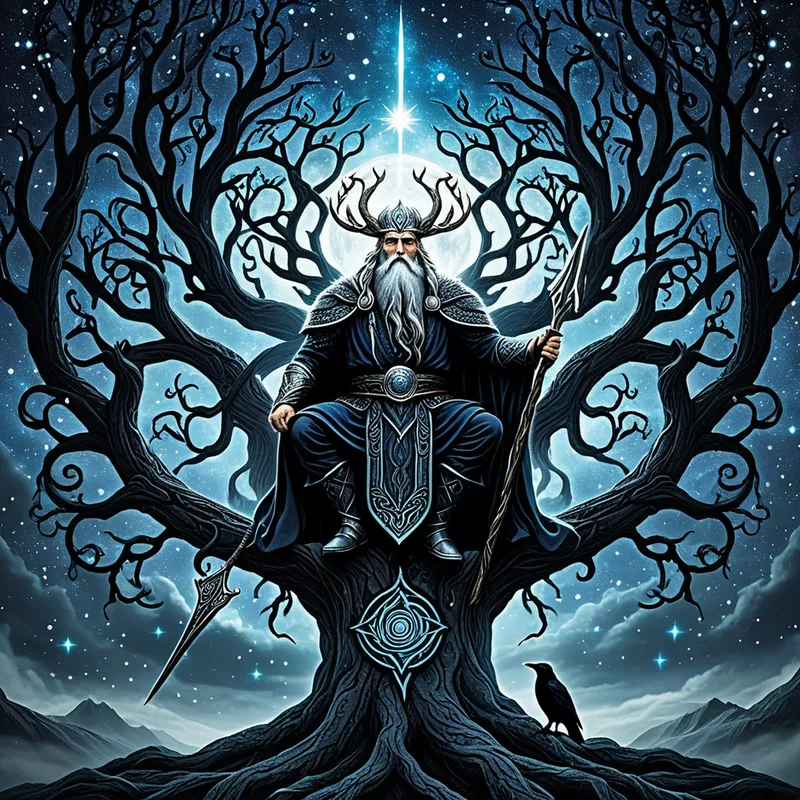
The Allfather hangs himself on the World Tree, pierced by his own spear, to gain the runes and the wisdom of the unseen.
The Tale of The Norse god Odin sacrificing
Listen, and hear the price of knowing.
In the time before time, when the great ash [Yggdrasil](/myths/yggdrasil “Myth from Global/Universal culture.”/) was young and its roots drank from wells of memory and fate, there walked a god who was not content. He was Odin, the Allfather, whose throne in Asgard gave him a view of all [the Nine Worlds](/myths/the-nine-worlds “Myth from Norse culture.”/). He saw the play of giants and elves, the toil of men, the silent depths of the dead in Hel. He heard the whispers of the future from the three [Norns](/myths/norns “Myth from Nordic culture.”/) at the tree’s root. Yet, for all his power, a deeper thirst gnawed at him—a hunger for the wisdom that lies beneath the surface of things, the hidden architecture of reality itself. This wisdom was held by the [runes](/myths/runes “Myth from Norse culture.”/), but they were not given. They had to be taken, and the cost was everything.
So Odin, [the Wanderer](/myths/the-wanderer “Myth from Taoist culture.”/), left his high seat. He journeyed to the very heart of the worlds, to the trunk of Yggdrasil itself. [The wind](/myths/the-wind “Myth from Various culture.”/) in its branches was the breath of creation, and its bark was etched with the scars of ages. He carried with him his own spear, [Gungnir](/myths/gungnir “Myth from Norse culture.”/), a shaft of certainty that never missed its mark. But this day, its mark would be his own flesh.
With a resolve that shook the roots of the tree, he took the spear and drove it deep into his own side. He did not fall. Instead, he offered himself to the great branches, hanging himself upon the tree as a sacrifice to himself. For nine nights and nine days, a sacred and terrible number, he hung there. No food passed his lips, no [water](/myths/water “Myth from Chinese culture.”/) cooled his thirst. The winds of the worlds lashed him. The cold of [the void](/myths/the-void “Myth from Buddhist culture.”/) seeped into his bones. The pain was a fire that burned away all that was not essential. He stared, with his one remaining eye, into [the abyss](/myths/the-abyss “Myth from Kabbalistic culture.”/) below—the dark, churning waters of the Well of Urd.
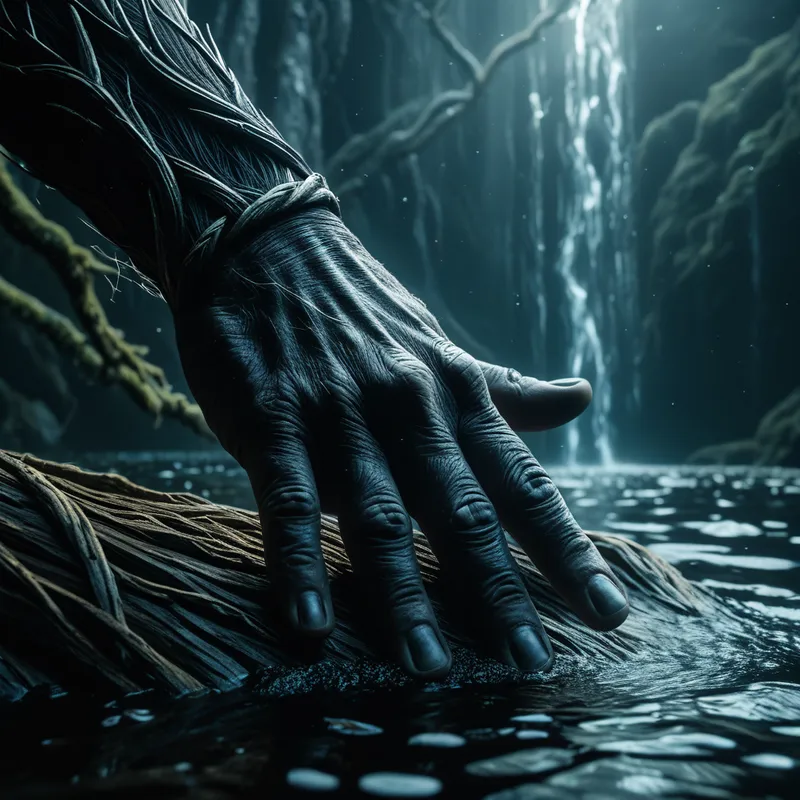
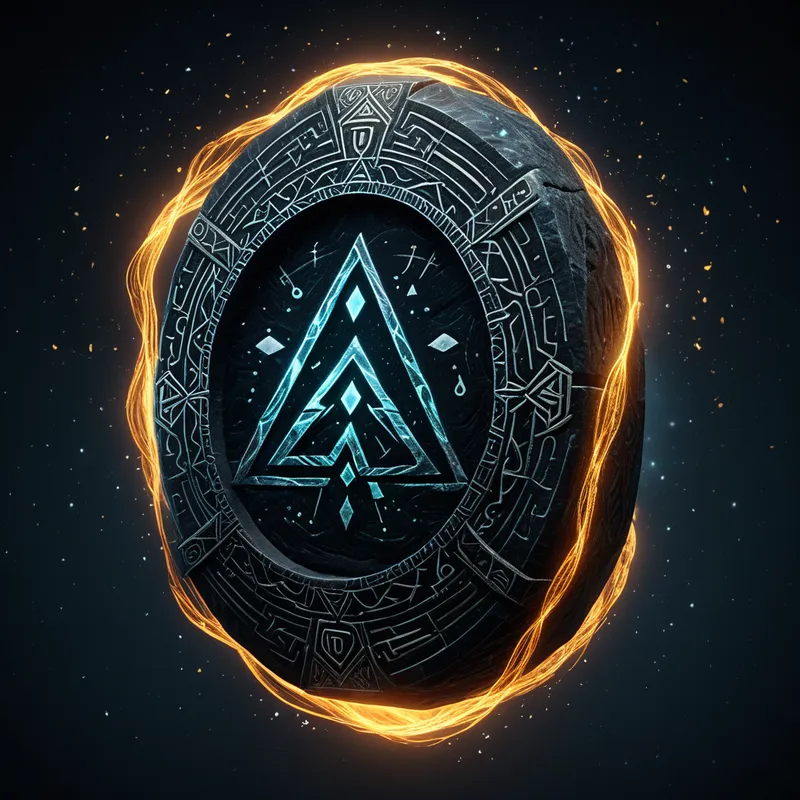
He was dangling between life and death, a bridge of agony spanning the known and the unknown. On the final, desperate night, as his consciousness frayed like an old rope, he saw them. From the depths of the well, from the whispers of the tree, from the very fabric of his suffering, shapes began to glow. They were angular, stark, and potent. [The runes](/myths/the-runes “Myth from Norse culture.”/). They revealed themselves not to his eye, but to his spirit. With a final, gasping effort, he reached down—not with his hands, which were bound by his own oath, but with his being—and seized them.
The spell was broken. He fell from the tree, wounded, hallowed, and forever changed. He now possessed the runes, and with them, a terrible and joyous understanding of the secrets of life, death, magic, and poetry. He had paid for sight with blindness, for wisdom with wounding, and from that day, he was truly the god of the hidden.
Cultural Origins & Context
This profound narrative is preserved primarily in the Old Norse poem Hávamál (“The Sayings of the High One”), a collection of wisdom verses attributed to Odin himself, found within the Poetic Edda. It was not a story for children or for casual entertainment. It was esoteric knowledge, passed down by skalds (poets) and perhaps within initiatory contexts, reflecting a worldview where knowledge was not free but was earned through ordeal.
In the Viking Age, Odin was not merely a “king of the gods” but a complex deity of poetry, ecstasy, fury, and death. He was the patron of outcasts, warriors, and seekers. This myth functioned as a foundational charter for the value of hard-won wisdom. It presented a model of seeking that was active, painful, and self-directed. In a culture that valued strength and decisive action, the myth legitimized the intellectual and spiritual struggle, framing the ultimate pursuit of knowledge as the highest form of heroism—a heroism turned inward.
Symbolic Architecture
At its core, Odin’s ordeal is the ultimate [archetype](/symbols/archetype “Symbol: A universal, primordial pattern or prototype in the collective unconscious that shapes human experience, behavior, and creative expression.”/) of the willing descent for the sake of [consciousness](/symbols/consciousness “Symbol: Consciousness represents the state of awareness and perception, encompassing thoughts, feelings, and experiences.”/). The [tree](/symbols/tree “Symbol: In dreams, the tree often symbolizes growth, stability, and the interconnectedness of life.”/), Yggdrasil, is the [axis](/symbols/axis “Symbol: A central line or principle around which things revolve, representing stability, orientation, and the fundamental structure of reality or consciousness.”/) of all worlds, the [structure](/symbols/structure “Symbol: Structure in dreams often symbolizes stability, organization, and the framework of one’s life, reflecting how one perceives their environment and personal life.”/) of [reality](/symbols/reality “Symbol: Reality signifies the state of existence and perception, often reflecting one’s understanding of truth and life experiences.”/) and [the self](/myths/the-self “Myth from Jungian culture.”/). To hang upon it is to suspend one’s ordinary [life](/symbols/life “Symbol: The symbol of ‘Life’ represents a journey of growth, interconnectedness, and existential meaning, encompassing both the joys and challenges that define human experience.”/) and [identity](/symbols/identity “Symbol: Identity represents the sense of self, encompassing personal beliefs, cultural background, and social roles.”/) at the very center of existence.
The sacrifice is not to an external god, but to the Self. One must become both the offering and the altar.
The [spear](/symbols/spear “Symbol: The spear often symbolizes power, aggression, and the drive to protect or conquer.”/), Gungnir, represents focused will and penetrating [insight](/symbols/insight “Symbol: A sudden, deep understanding of a complex situation or truth, often arriving unexpectedly and illuminating hidden connections.”/). That Odin turns this [instrument](/symbols/instrument “Symbol: An instrument symbolizes creativity, communication, and the means by which one expresses oneself or influences the world.”/) of [outward](/symbols/outward “Symbol: Movement or orientation away from the self or center; expansion, expression, or externalization of inner states into the world.”/) power upon himself signifies the crucial turning of consciousness [inward](/symbols/inward “Symbol: A journey toward self-awareness, introspection, and the exploration of one’s inner world, thoughts, and unconscious mind.”/). The wound is the necessary opening through which the hidden can enter. The nine nights symbolize a full [gestation](/symbols/gestation “Symbol: A period of development and preparation before a significant birth or emergence, symbolizing potential, transformation, and the journey toward manifestation.”/) [period](/symbols/period “Symbol: Periods in dreams can symbolize cyclical patterns, renewal, and the associated emotions of loss or change throughout life.”/) in the [womb](/symbols/womb “Symbol: A symbol of origin, potential, and profound transformation, representing the beginning of life’s journey and the unconscious source of creation.”/) of the unconscious, a complete cycle of [dissolution](/symbols/dissolution “Symbol: The process of breaking down, dispersing, or losing form, often representing transformation, release, or the end of a state of being.”/) before [rebirth](/symbols/rebirth “Symbol: A profound transformation where old aspects of self or life die, making way for new beginnings, growth, and renewal.”/).
The runes are more than an [alphabet](/symbols/alphabet “Symbol: A system of letters representing sounds, symbolizing communication, order, and the building blocks of knowledge and expression.”/); they are the fundamental patterns of [energy](/symbols/energy “Symbol: Energy symbolizes vitality, motivation, and the drive that fuels actions and ambitions.”/) and consciousness that underpin reality. To gain them is to move from being a subject of [fate](/symbols/fate “Symbol: Fate represents the belief in predetermined outcomes, suggesting that some aspects of life are beyond human control.”/) to becoming a conscious participant in its weaving. Odin exchanges an eye for this insight—a literal sacrifice of one mode of [perception](/symbols/perception “Symbol: The process of becoming aware of something through the senses. In dreams, it often represents how one interprets reality or internal states.”/) (external, surface-level [sight](/symbols/sight “Symbol: Sight symbolizes perception, awareness, and insight, representing both physical and inner vision.”/)) for another (internal, symbolic [vision](/symbols/vision “Symbol: Vision reflects perception, insight, and clarity — often signifying the ability to foresee or understand deeper truths.”/)).
The Dreamer’s Resonance
When this myth stirs in the modern [psyche](/myths/psyche “Myth from Greek culture.”/), it often manifests in dreams of suspension, ordeal, or painful seeking. You may dream of being stranded in a high place, of undergoing a voluntary medical procedure for a mysterious gain, or of searching desperately for a lost book or code in a [labyrinth](/myths/labyrinth “Myth from Various culture.”/).
Somatically, this can correlate with a feeling of being “in limbo” or “on the hook”—a life transition where the old identity has been surrendered but the new one has not yet crystallized. Psychologically, it signals a profound engagement with the anima or the deep unconscious. The dreamer is in the “nine nights” phase: enduring the tension, the loneliness, and the disorientation that necessarily precedes a breakthrough in self-knowledge. It is the psyche’s way of enacting its own initiation, demanding a payment of old comforts for new depth.
Alchemical Translation
For the individual, Odin’s myth maps the alchemical stage of mortificatio or [nigredo](/myths/nigredo “Myth from Alchemical culture.”/)—the blackening, the dissolution of [the ego](/myths/the-ego “Myth from Jungian culture.”/). This is not a pathological depression but a sacred depression, a deliberate deconstruction.
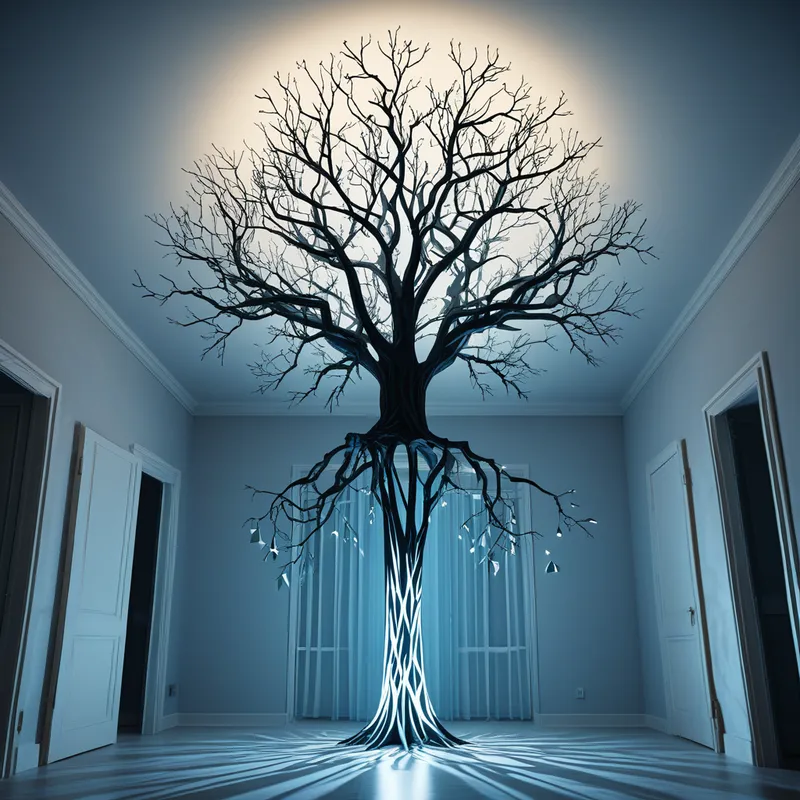
The modern seeker’s “Yggdrasil” is the structure of their own life—their career, relationships, and beliefs. The “sacrifice” is the voluntary letting go of a prized possession: a cherished identity (“the successful one,” “the knowledgeable one”), a long-held certainty, or a source of security. We hang ourselves on the tree of our own crisis.
The runes are not found in books, but in the well of our own unlived life, our pain, and our silence.
The process is one of psychic transmutation: the raw material of suffering and longing is subjected to the intense pressure of conscious endurance (“the spear”) and, through that very pressure, is reconstituted into a new, more resilient form of understanding. One gains the “runes”—personal symbols of meaning, inner authority, and creative potency. The outcome is individuation: no longer living by borrowed scripts, but from a core of hard-won, self-sacrificed wisdom. You become, in your own sphere, the Allfather and All-knower of your destiny, having paid the price to see the threads you are made of.
Associated Symbols
Explore related symbols from the CaleaDream lexicon: