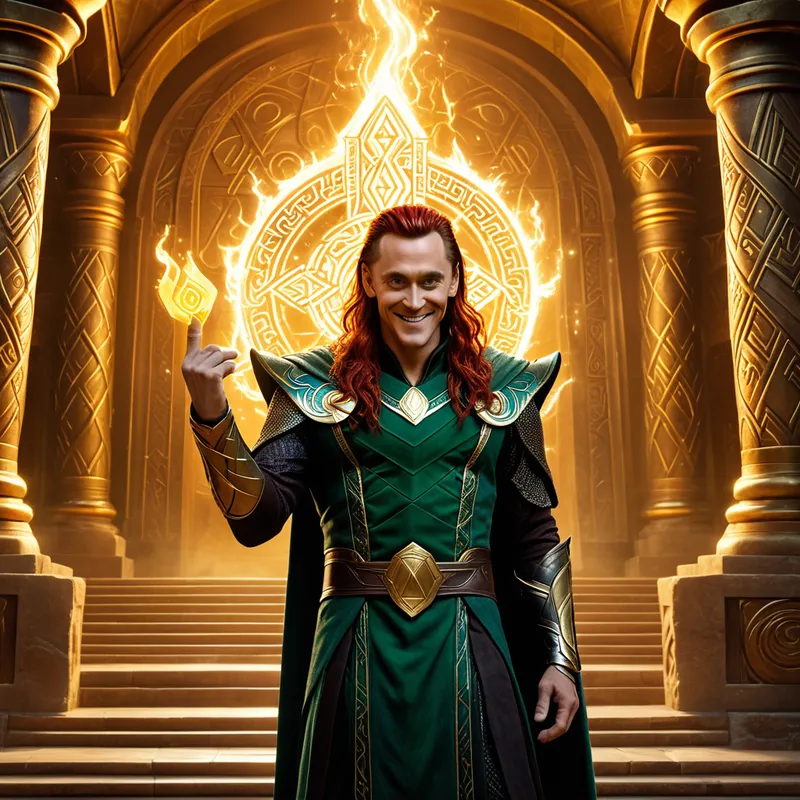
The Norse god Loki sliding bet Myth Meaning & Symbolism
A tale of Loki's cunning wager, where his slippery nature risks everything, revealing the shadow's role in cosmic balance and personal transformation.
The Tale of The Norse god Loki sliding bet
Hear now a tale from the dawn of the world, when the mead flowed like rivers in the halls of the gods and the very air crackled with the magic of promises yet unbroken. It was a time of boasting, a time of contests, where the pride of the Aesir was as vast as the vault of the sky itself.
In the golden realm of Asgard, the gods had gathered. The firelight from the great hearths danced on the faces of Odin All-Father, of mighty Thor, and of the cunning one, Loki. Laughter echoed against the rafters, fueled by drink and by the sheer joy of existence. But in the heart of Loki, that restless spark, a different fire burned—the need to prove, once and for all, that his wit was the sharpest blade in all the Nine Worlds.
The talk turned, as it often did, to deeds and capabilities. A builder, a master of stone and muscle, had come before them, offering a feat. “I will build for you,” he said, his voice like grinding rock, “a wall so high, so strong, that no jotun, no foe, shall ever breach Asgard. I will do it in a single winter.” His price? The sun, the moon, and the goddess Freyja as his bride.
The gods roared with laughter, deeming it impossible. But Loki, his eyes gleaming like chips of ice, saw a crack. “What loss is there?” he whispered, a serpent’s hiss in the council. “Let him try. Set him a condition: he must work alone, with no help but his stallion, Svadilfari. If the wall is not complete by the first day of summer, he forfeits all payment.”
The bet was struck. The gods nodded, confident in the limits of flesh and bone. But as the winter wore on, their confidence turned to ash. Svadilfari was no ordinary beast. By night, the stallion hauled monstrous blocks of stone with ease; by day, the builder fitted them with terrifying speed. The wall rose, seamless and impregnable, and with three days left of winter, it was nearly done.
A cold dread settled over Asgard. The sun, the moon, Freyja—these were not trifles to be lost. The gods turned their fury upon Loki. “This was your counsel, son of Laufey,” they thundered. “This evil you devised. Find a solution, or we will visit upon you a death most unpleasant.”
Loki felt the trap of his own making snap shut. The sliding bet—the wager that seemed so clever, so risk-free—was now a chasm threatening to swallow the cosmos. His cunning, which had always been his shield, had become a noose. Panic, cold and sharp, pierced him. He had to make the bet slide, to find a loophole where none seemed to exist.
And so, as the final evening of winter descended, Loki transformed. Shedding his godly shape, he became a sleek, alluring mare. He ventured out to the building site where the great stallion, Svadilfari, was toiling. With whinnies and a beguiling presence, the mare led the powerful horse away, far from its master, into the deep, dark woods.
The builder raged, his roars shaking the foundations of the unfinished wall. But without his stallion, his work was impossible. The first light of summer broke over an incomplete fortification. The bet was lost. The gods, their relief as violent as their fear had been, revealed the builder’s true nature—a jotun—and Thor’s hammer, Mjölnir, ended the contract with finality.
Loki, however, did not return for many months. And when he did, he brought with him a strange offspring: an eight-legged foal, grey and extraordinary, the child of his equine disguise and Svadilfari. This foarl, Sleipnir, would become the greatest steed in all the worlds. The bet had slid, the price was unpaid, but the consequences had birthed something entirely new and unforeseen.
Cultural Origins & Context
This myth, part of the larger tale of the building of Asgard’s wall, is preserved primarily in the Prose Edda by Snorri Sturluson. It is a story from the rich tapestry of Norse mythology, recorded in medieval Iceland but echoing beliefs and narrative traditions from earlier Germanic and Scandinavian cultures. These stories were not mere entertainment; they were the foundational texts of a worldview, passed down by skalds (poets) and storytellers around hearth-fires in the long, dark winters.
The societal function of such a tale was multifaceted. It explained the origin of Odin’s steed, Sleipnir, anchoring a divine attribute in a dramatic story. More profoundly, it served as a narrative exploration of social and cosmic boundaries. The myth operates in the tense space between order (the wall, the contract) and chaos (the trickster, the broken promise). It taught listeners about the dangers of ill-considered oaths, the unpredictable ripple effects of cunning, and the fact that even the gods are not immune to miscalculation. Loki, as the agent of chaos, is both the problem and the solution—a necessary, if dangerous, element within the divine hierarchy.
Symbolic Architecture
At its core, this myth is an archetypal drama of the Trickster. Loki’s “sliding bet” represents the psyche’s capacity for clever evasion, for reinterpreting reality to avoid a painful consequence. It is the intellect attempting to wriggle free from the iron grip of cause and effect.
The bet is the psyche’s contract with reality, and Loki is the part of us that believes it can negotiate the terms after the deal is struck.
The wall symbolizes the ego’s desperate desire for security, invulnerability, and definitive boundaries. The builder is the shadowy, relentless drive of the unconscious—often seen as alien or monstrous (the jotun)—that possesses the raw power to actually build these defenses, but at a terrifying price: our vitality (the sun and moon) and our capacity for love and connection (Freyja). Loki’s initial counsel is the ego’s naive arrogance, believing it can harness this unconscious power without cost. His panic and subsequent shape-shifting represent the inevitable moment when the ego realizes it is utterly outmatched and must resort to radical, transformative trickery to survive.
The resolution is profoundly alchemical. Loki does not defeat the builder with superior strength, but through seduction and diversion. He engages with the source of power (Svadilfari) on an instinctual, non-rational level (becoming a mare). The offspring of this chaotic union is Sleipnir, a symbol of transcendent function. The eight-legged horse, able to travel between all worlds, represents a new psychic capability born precisely from the crisis. The failed defense (the wall) is less important than the new means of traversal (the steed).
The Dreamer’s Resonance
When this myth pattern stirs in the modern dreamer, it often manifests as a somatic experience of slippery struggle. One might dream of desperately trying to complete a task with tools that keep changing shape, or of making a promise that immediately becomes a crushing, inescapable weight. The dream environment may feel slick, unstable, like trying to run on ice.
Psychologically, this signals a confrontation with a “deal with the devil” the dreamer has made unconsciously. Perhaps it is an over-identification with a clever persona that is now failing, a commitment (to a job, a relationship, a self-image) that is exacting too high a price. The dream is the moment of panic, the realization that the contract is about to be called in. The Loki-within is scrambling, seeking any shape, any deception, to avoid the impending consequence. This dream state is a critical juncture in shadow-work, where the conscious mind is forced to acknowledge that its clever strategies are insufficient and that a deeper, more instinctual, and potentially embarrassing or taboo transformation is required.
Alchemical Translation
The process modeled here is the transmutation of a catastrophic failure of cunning into a vehicle for transcendence. For the individual on the path of individuation, the myth maps a crucial transition.
First, we must recognize our own “sliding bets”—the times we have used intellect, charm, or loopholes to avoid authentic engagement with life’s demands, especially those from the depths of our own psyche. The rising wall is the unsustainable defense structure we are building, paid for with our own light and love.
The alchemical fire is ignited in the crisis, when those defenses are about to cement us into a prison of our own making. The old trickster identity must die. It cannot think its way out. This is the descent, the shape-shifting into a baser, more instinctual form (the mare). It is an act of profound humility and cunning of a different order: engaging the very power that threatened us (our raw, instinctual drives, our “Svadilfari”) not through opposition, but through allure, through recognition, through a kind of wild mating.
The birth of Sleipnir is the emergence of a new psychic faculty from the union of conscious trickery and unconscious power. It is the transcendent function—the ability to navigate previously impassable inner landscapes.
The unfinished wall remains. The ego’s perfect, impregnable citadel is never completed, and that is its salvation. In its place, we are given mobility, not stasis. The steed born of chaos becomes the means to travel across all realms of our being—conscious, unconscious, personal, collective. The myth teaches that our greatest failures of strategy, when met with the courage to transform at an instinctual level, do not merely avert disaster; they are the precise crucibles in which our most extraordinary capacities are foaled.
Associated Symbols
Explore related symbols from the CaleaDream lexicon: