The Noble Eightfold Path Myth Meaning & Symbolism
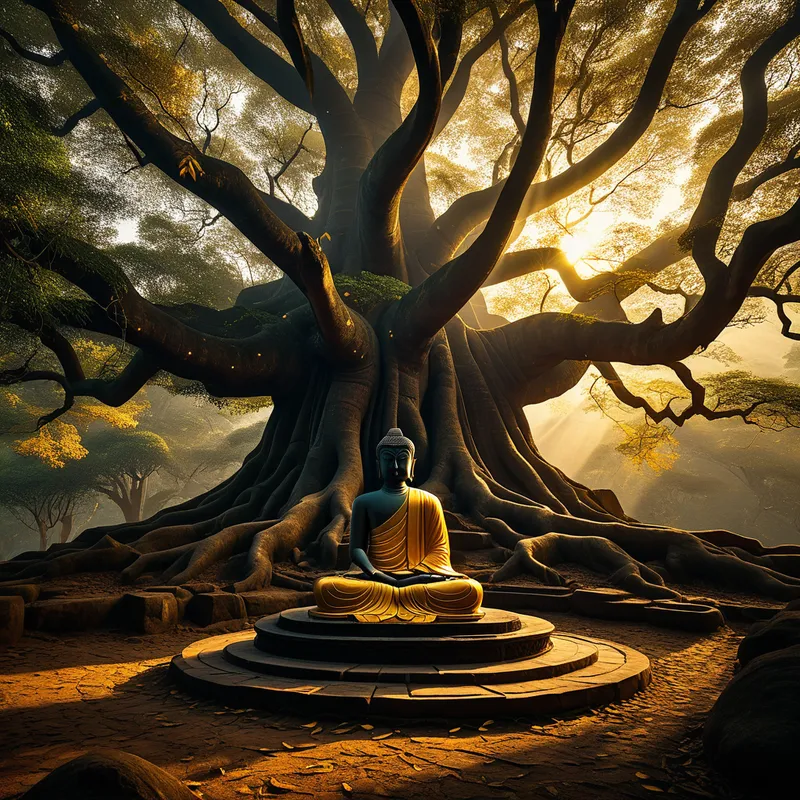
A luminous path of eight spokes, revealed beneath the Bodhi tree, guiding the seeker from the dark forest of suffering to the open sky of liberation.
The Tale of The Noble Eightfold Path
Before [the world](/myths/the-world “Myth from Tarot culture.”/) knew him as the Buddha, he was a prince named Siddhartha, who walked away from his palace into the heart of [the world](/myths/the-world “Myth from Tarot culture.”/)’s ache. For years, he wandered the dusty roads of the [Ganges](/myths/ganges “Myth from Hindu culture.”/) plain, his body growing thin, his mind a battlefield of philosophies. He sat with ascetics who believed freedom lived in the denial of the flesh. He sat with teachers who mapped the heavens with thought. Yet the great question—the one that had driven him from his gilded cage—remained: Why is there suffering, and how does it end?
Exhausted, he came to the banks of the Nairanjana River. He washed the dust of seeking from his limbs and accepted a simple offering of milk-rice from a village woman named Sujata. Strength, not as force, but as gentle nourishment, returned to him. He walked to a quiet grove and sat beneath a spreading pipal tree, vowing not to rise until he had seen truth to its very root.
As dusk fell, so did the assault of Mara, the great deceiver. Mara did not come as a monster, but as everything the world holds dear. He sent his beautiful daughters to seduce, his fierce armies to intimidate, and finally, he himself appeared, thundering, “By what right do you sit where past [saints](/myths/saints “Myth from Christian culture.”/) have sat? Who will bear witness for you?” The seeker beneath the tree did not fight. He simply reached down and touched [the earth](/myths/the-earth “Myth from Hindu culture.”/). The very ground roared its witness: “I bear him witness.” Mara’s illusions shattered like glass.
In the deep, diamond clarity of that night, the seeker’s mind turned inward, through layer upon layer of memory and existence. He saw the endless cycle of [samsara](/myths/samsara “Myth from Buddhist culture.”/)—the rising and passing of countless worlds and lives, all bound by craving and ignorance. And in the moment before dawn, he saw it with utter simplicity: the cause of the suffering and the path leading to its cessation. It was not a single truth, but a living process; not a destination, but a way of walking.
When [the morning star](/myths/the-morning-star “Myth from Astrological culture.”/) glittered in the violet sky, he was awake. And what he offered to the world was not a doctrine, but a map. He called it the Ariya Atthangika Magga—the Noble Eightfold Path. It was not a ladder to climb, but a wheel to set in motion. He spoke of Right View and Right Intention as the wisdom that sets the direction. He spoke of Right Speech, Right Action, and Right Livelihood as the ethical foundation that steadies the journey. He spoke of Right Effort, Right Mindfulness, and Right Concentration as the disciplined mind that carries one forward. One step did not come before the other; all eight turned together, like the spokes of a great wheel, rolling forward through [the wilderness](/myths/the-wilderness “Myth from Biblical culture.”/) of the world, carving a road to freedom where before there was only thicket and thorn.

Cultural Origins & Context
This “myth” is, in essence, the foundational narrative of a historical awakening. It emerged in the 5th century BCE in the northeastern region of the Indian subcontinent, a time of immense social change and philosophical [ferment](/myths/ferment “Myth from Alchemical culture.”/). The story was not sung by bards but was preserved and transmitted orally for centuries by the [Sangha](/myths/sangha “Myth from Buddhist culture.”/), the community of monks and nuns. Its primary function was pedagogical and transformative.
The tale of the path’s discovery under [the Bodhi tree](/myths/the-bodhi-tree “Myth from Buddhist culture.”/) served as the archetypal model for every subsequent seeker. It was not merely a biography of [the Buddha](/myths/the-buddha “Myth from Buddhist culture.”/), but a template for the human [psyche](/myths/psyche “Myth from Greek culture.”/). The societal function was radical: it democratized the goal of liberation. One did not need birthright or priestly intervention; the path was open to anyone willing to walk it. The myth was recounted in sutras like the Dhammacakkappavattana Sutta, and its preservation was an act of sacred responsibility, ensuring the map to the end of suffering would not be lost to time.
Symbolic Architecture
Psychologically, the myth presents not a [hero](/symbols/hero “Symbol: A hero embodies strength, courage, and the ability to overcome significant challenges.”/) slaying a [dragon](/symbols/dragon “Symbol: Dragons are potent symbols of power, wisdom, and transformation, often embodying the duality of creation and destruction.”/), but a [consciousness](/symbols/consciousness “Symbol: Consciousness represents the state of awareness and perception, encompassing thoughts, feelings, and experiences.”/) turning [inward](/symbols/inward “Symbol: A journey toward self-awareness, introspection, and the exploration of one’s inner world, thoughts, and unconscious mind.”/) to integrate its own [chaos](/symbols/chaos “Symbol: In Arts & Music, chaos represents raw creative potential, uncontrolled expression, and the breakdown of order to forge new artistic forms.”/). The [palace](/symbols/palace “Symbol: A palace symbolizes grandeur, authority, and the pursuit of one’s ambitions or dreams, often embodying a desire for stability and wealth.”/) Siddhartha leaves represents the conditioned self, the [persona](/symbols/persona “Symbol: The social mask or outward identity one presents to the world, often concealing the true self.”/) built of comfort and [convention](/symbols/convention “Symbol: A convention often signifies collective understanding, agreements, or shared knowledge, embodying the pursuit of goals and unity among individuals.”/). The austere forests and riverbanks symbolize the descent into the unconscious, where one confronts the [shadow](/symbols/shadow “Symbol: The ‘shadow’ embodies the unconscious, repressed aspects of the self and often represents fears or hidden emotions.”/)—here personified as Mara.
The path is not a line drawn on the ground, but a circle etched in the soul. Its eight spokes are the simultaneous turning of understanding, ethics, and mind into a single, coherent force of being.
Mara is not an external devil, but the totality of our inner [resistance](/symbols/resistance “Symbol: An object or tool representing opposition, struggle, or the act of pushing back against external forces or internal changes.”/): our doubts, our cravings, our deep-seated fear of [the void](/myths/the-void “Myth from Buddhist culture.”/) that precedes real change. His defeat via the “touching of the [earth](/symbols/earth “Symbol: The symbol of Earth often represents grounding, stability, and the physical realm, embodying a connection to nature and the innate support it provides.”/)” (Bhumisparsha [Mudra](/symbols/mudra “Symbol: A symbolic hand gesture used in Hindu and Buddhist traditions to channel spiritual energy, express teachings, and focus meditation.”/)) is the ultimate [symbol](/symbols/symbol “Symbol: A symbol can represent an idea, concept, or belief, serving as a powerful tool for communication and understanding.”/) of grounding, of rooting consciousness in [reality](/symbols/reality “Symbol: Reality signifies the state of existence and perception, often reflecting one’s understanding of truth and life experiences.”/), not in illusion. The Eightfold [Path](/symbols/path “Symbol: The ‘path’ symbolizes a journey, choices, and the direction one’s life is taking, often representing individual growth and exploration.”/) itself is the symbolic [architecture](/symbols/architecture “Symbol: Architecture in dreams often signifies structure, stability, and the framing of personal identity or life’s journey.”/) of a healed and functioning psyche. It represents the move from a fragmented, conflicted self (driven by conflicting desires and views) to an integrated, harmonious one where thought, [word](/symbols/word “Symbol: Words in dreams often represent communication, expression, and the power of language in shaping our realities.”/), and deed are aligned.

The Dreamer’s Resonance
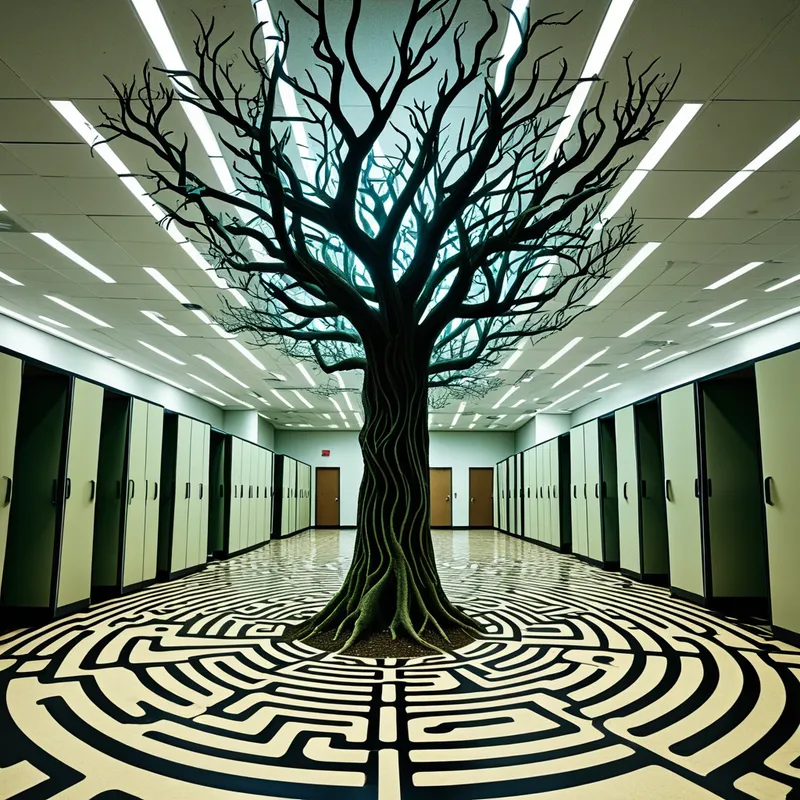
When this myth stirs in the modern dreamer, it rarely appears as ancient iconography. Instead, one might dream of being lost in a complex, endless building (the palace of samsara) and discovering a simple, overlooked door. Or of being assailed not by demons, but by the voices of family, society, or one’s own critical mind (Mara’s army), while trying to hold a quiet, central truth.
The somatic experience is often one of tension followed by profound release—the clenched effort of “Right Effort” giving way to the fluid awareness of “Right Mindfulness.” The dream may feature a wheel, a compass, or a [mandala](/myths/mandala “Myth from Buddhist culture.”/) with eight points, signaling a deep, unconscious reorganization. The psychological process is one of orientation. The dreamer is not being given answers, but is being shown the means by which answers can be found. It is the psyche’s innate intelligence laying down the groundwork for individuation, suggesting that [the way](/myths/the-way “Myth from Taoist culture.”/) out of a personal suffering or confusion is through a disciplined, holistic re-alignment of one’s entire approach to life.
Alchemical Translation
The alchemy here is one of synthesis, not of conquest. The modern individual, fragmented by a thousand demands and identities, undergoes a similar ordeal beneath their own “Bodhi tree”—a moment of crisis, burnout, or profound questioning that forces a halt. The first alchemical stage is [nigredo](/myths/nigredo “Myth from Alchemical culture.”/), the blackening: facing one’s personal Mara—the anxiety, addiction, despair, or meaninglessness that arises when old ways collapse.
[The Eightfold Path](/myths/the-eightfold-path “Myth from Buddhist culture.”/) provides [the vessel](/myths/the-vessel “Myth from Alchemical culture.”/) for the albedo, the whitening. Right View and Intention begin the purification of perception. Right Speech, Action, and Livelihood act as [the alembic](/myths/the-alembic “Myth from Alchemical culture.”/), containing and refining one’s energy in the world, preventing leaks of vital force through ethical carelessness. This is the foundation without which the deeper work cannot hold.
Individuation is the path walked, not the peak claimed. Each mindful step transmutes the leaden weight of habit into the gold of conscious presence.
Finally, Right Effort, Mindfulness, and Concentration are the fires of citrinitas and [rubedo](/myths/rubedo “Myth from Alchemical culture.”/), the yellowing and reddening. They are the sustained heat of attention that cooks the raw material of experience into wisdom. The goal is the philosopher’s stone of awakened presence—a self not perfected, but fully integrated and functional, capable of meeting the world with compassion because it is no longer at war with itself. The path’s end is not a static state of bliss, but the dynamic, moment-to-moment freedom of a mind that has mastered its own currents, having turned the wheel of the dharma within its own heart.
Associated Symbols
Explore related symbols from the CaleaDream lexicon: