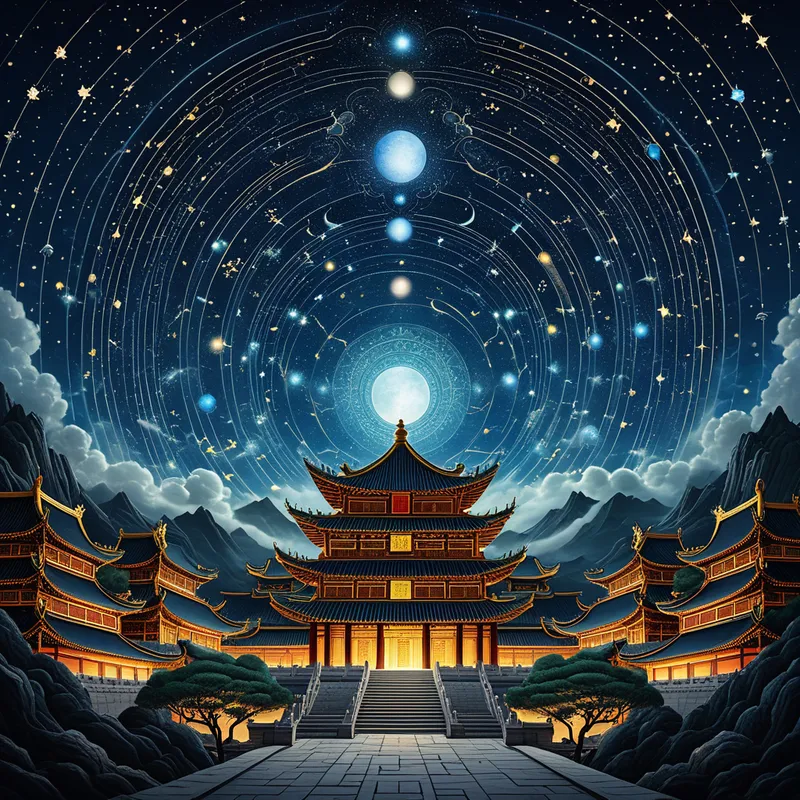
The Nine Heavens Myth Meaning & Symbolism
A Taoist cosmology of nine celestial realms, mapping the soul's arduous ascent from earthly chaos to primordial unity and divine realization.
The Tale of The Nine Heavens
In the time before time, when the [Hundun](/myths/hundun “Myth from Chinese culture.”/) was still and the Taiji had not yet stirred, the cosmos was a single, silent breath. Then came the division: the clear, light Yang rose, and the heavy, dark Yin descended. But the ascent was not a simple leap. It was a journey of ninefold refinement, a ladder of celestial realms known only to the most steadfast of souls.
The first heaven is a realm of winds, the Cang Tian. Here, the seeker, having left the solid earth, is buffeted by the gales of change and uncertainty. The air is thin and cold, the path invisible. Only by becoming as supple as [the willow](/myths/the-willow “Myth from Celtic culture.”/), bending but not breaking, can one pass through.
Beyond lies the Chi Tian, a sky stained crimson with the passions and vital energies of [the world](/myths/the-world “Myth from Tarot culture.”/) below. It is a furnace of emotion, where untamed desires rise like scarlet mist. The seeker must witness this inner fire without being consumed, learning to temper the heart’s blood into a steady flame.
The third gate opens to the Cang Tian (of a different character), a vast, azure expanse. Here, the chaos begins to order itself into patterns. The mind’s chatter softens, replaced by the first intimations of cosmic law. The journey becomes one of observation, of seeing the blueprint within the blue.
Ascending further, the seeker enters the Xuan Tian. This is the heaven of the profound and the hidden, a velvet darkness studded with the first true stars. It is the realm of the Mysterious Female, the deep womb of all potential. Here, one must navigate not by sight, but by intuition, trusting the pull of the unseen.
The midpoint of the journey is the Huang Tian, the Yellow Heaven. This is [the cosmic axis](/myths/the-cosmic-axis “Myth from Various culture.”/), the still center of the turning worlds. All colors blend here into the hue of the sacred earth, representing balance and sovereignty. To stand here is to hold the tension of all opposites within oneself, becoming the unmoving pivot.
From this center, the ascent turns outward and upward into the Hao Tian. A blinding, white light pervades everything, dissolving form into pure luminosity. This is the heaven of radiant clarity, where the shadows of the lower self are burned away. The seeker is refined in this crucible of light.
Next is the Yan Tian, a realm of vermilion brilliance. If the previous heaven was cleansing light, this is transformative fire. It is [the alchemical furnace](/myths/the-alchemical-furnace “Myth from Alchemical culture.”/) where the purified self is forged into something more enduring, its essence crystallizing under immense spiritual pressure.
The penultimate realm is the Zi Tian, the Purple Heaven. Purple, the color of the polar star and imperial majesty, signifies a state of near-complete realization. The seeker operates with the authority of aligned will, no longer struggling against the cosmos but acting as its conscious agent. Celestial palaces of jade and cloud become visible, the architecture of a higher order.
Finally, the ninth and supreme heaven: the Jun Tian. Here, all differentiation ceases. There is no seeker, no path, no heaven. Only the ineffable, silent hum of the Dao itself. It is not a place, but a state of absolute non-being from which all being springs. The journey ends in the perfect, wordless unity from which it began.
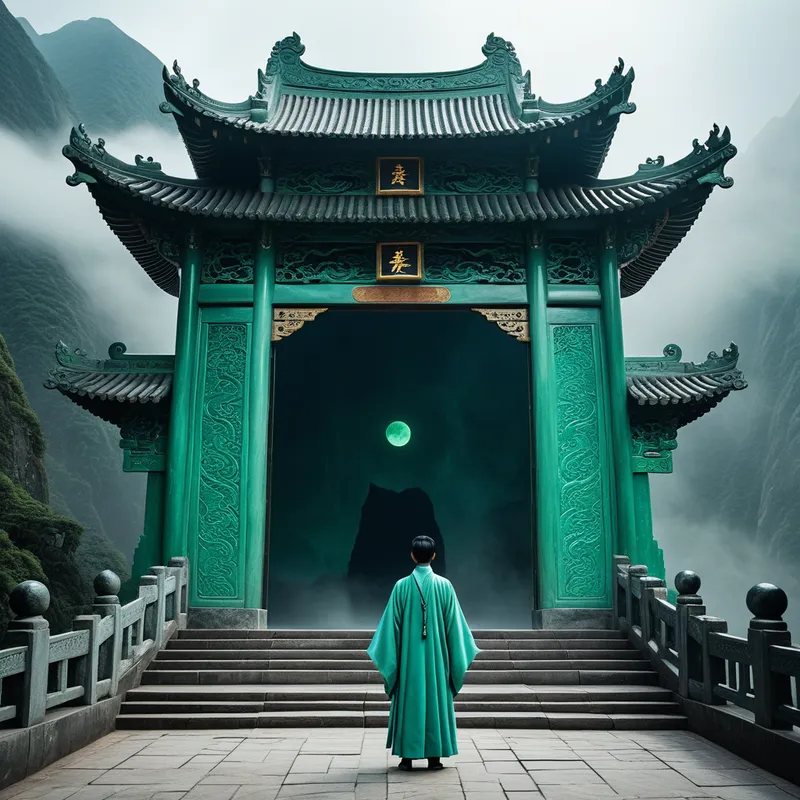
Cultural Origins & Context
The myth of the Jiu Tian is not the product of a single author, but a cosmological framework that coalesced over centuries within the Taoist religious and philosophical tradition. Its roots intertwine with ancient Chinese astrological observations, shamanic practices of spirit journeying, and the bureaucratic metaphor of the celestial court that mirrored the imperial government.
It was passed down through esoteric lineages of Daoshi, often orally alongside ritual practices like Neidan (internal alchemy). Texts such as the Daodejing and the [Zhuangzi](/myths/zhuangzi “Myth from Chinese culture.”/) provided the philosophical bedrock, while later Daozang compilations elaborated the celestial geography. Its societal function was multifaceted: it provided a map for spiritual ascent, a cosmology that explained humanity’s place within a living universe, and a symbolic language for inner transformation that was accessible to both the erudite scholar and the practicing mystic.
Symbolic Architecture
The [Nine Heavens](/symbols/nine-heavens “Symbol: A spiritual concept representing celestial realms, divine hierarchy, and ultimate transcendence across multiple traditions.”/) are not merely places out there, but states of [consciousness](/symbols/consciousness “Symbol: Consciousness represents the state of awareness and perception, encompassing thoughts, feelings, and experiences.”/) in here. They represent a complete cartography of the [psyche](/myths/psyche “Myth from Greek culture.”/)‘s evolution from fragmented ego to integrated Self.
The ascent is not an escape from the world, but a deepening descent into the architecture of the soul. Each heaven is a chamber of the heart that must be inhabited and understood before the next door will open.
The lower heavens (Cang Tian, Chi Tian) symbolize the confrontation with [the personal unconscious](/myths/the-personal-unconscious “Myth from Jungian Psychology culture.”/)—the chaotic winds of change and the bloody clouds of raw instinct and [emotion](/symbols/emotion “Symbol: Emotion symbolizes our inner feelings and responses to experiences, often guiding our actions and choices.”/). The middle heavens (Cang Tian, Xuan Tian, Huang Tian) represent the engagement with the cultural and archetypal unconscious, where one encounters the patterns (Li) of [reality](/symbols/reality “Symbol: Reality signifies the state of existence and perception, often reflecting one’s understanding of truth and life experiences.”/) and the mysterious, creative void. The upper heavens (Hao Tian onward) signify the transcendence into transpersonal realms, where the individual consciousness is purified, transformed, and ultimately dissolved back into the [source](/symbols/source “Symbol: The origin point of something, often representing beginnings, nourishment, or the fundamental cause behind phenomena.”/).
The [number](/symbols/number “Symbol: Numbers in dreams often symbolize meaning, balance, and the quest for understanding in the dreamer’s life, reflecting their mental state or concerns.”/) nine itself is profoundly significant in [Chinese](/symbols/chinese “Symbol: Chinese symbolism represents a rich tapestry of culture, traditions, and philosophical beliefs originating from China.”/) thought, being the ultimate yang [number](/symbols/number “Symbol: Numbers in dreams often symbolize meaning, balance, and the quest for understanding in the dreamer’s life, reflecting their mental state or concerns.”/) and representing completion and celestial perfection. The [journey](/symbols/journey “Symbol: A journey in dreams typically signifies adventure, growth, or a significant life transition.”/), therefore, is a process of becoming whole—a ninefold [initiation](/symbols/initiation “Symbol: A symbolic beginning or transition into a new phase, status, or awareness, often involving tests, rituals, or profound personal change.”/) into one’s own inherent divinity.
The Dreamer’s Resonance
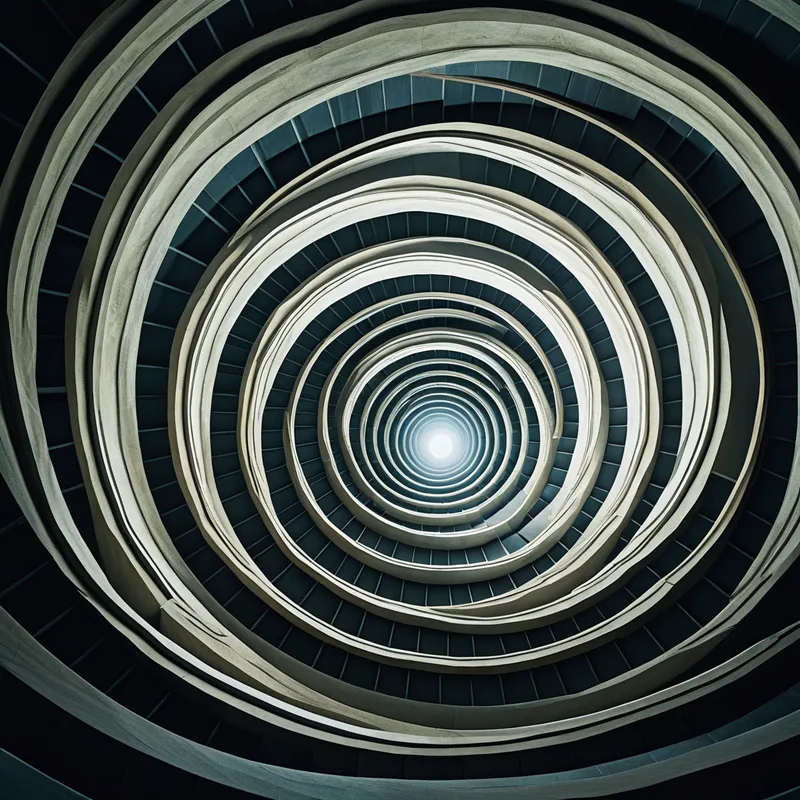
When this myth stirs in the modern dreamer, it often manifests not as a literal celestial ladder, but as a profound somatic and psychological process of ascent through integration. One may dream of climbing a vast, multi-leveled structure—a skyscraper, a mountain with distinct plateaus, or a spiraling staircase. Each level presents a unique challenge: a storm-wracked ledge (the winds of Cang Tian), a hall of mirrors reflecting distorted passions (the clouds of Chi Tian), or a dark, intuitive [labyrinth](/myths/labyrinth “Myth from Various culture.”/) (the mystery of Xuan Tian).
The body in the dream may feel the strain of the climb, the lightness of elevation, or the burning purification of light. Psychologically, this signals a period where the unconscious is actively reorganizing the psyche. Each “heaven” dreamed represents the integration of a previously split-off complex—a bundle of emotions, memories, and perceptions. The dream is the psyche’s innate ritual, guiding [the ego](/myths/the-ego “Myth from Jungian culture.”/) through its own alchemical ascent, forcing it to confront and harmonize the contents of each successive layer of [the self](/myths/the-self “Myth from Jungian culture.”/).
Alchemical Translation
For the modern individual, the myth of the Nine Heavens is a master blueprint for the Jungian process of individuation—the psychic transmutation of the lead of the ego-personality into the gold of the Self.
The initial stages are about confrontation with [the shadow](/myths/the-shadow “Myth from Jungian culture.”/). The chaotic winds and bloody clouds are the unruly, unintegrated parts of ourselves we have denied. To ascend, we must first gather these fragments, acknowledging our capacity for chaos and passion without being identified with them. The middle stages represent dialogue with the soul. Engaging the blueprints and the mysterious darkness is akin to listening to the guiding voice of the anima/animus and encountering the archetypal images of [the collective unconscious](/myths/the-collective-unconscious “Myth from Jungian culture.”/). Finding the Huang Tian within is the achievement of ego-Self axis, a stable center from which the psyche can operate.
The final purification in the upper heavens is the dissolution of the ego’s illusion of separateness. It is not the destruction of personality, but its liberation from identifying solely with its own boundaries.
The blinding light of Hao Tian is the conscious illumination that burns away neurotic attachments. The forging fire of Yan Tian is the enduring commitment to this new, more authentic way of being. The sovereign purple of Zi Tian is the Self, now the guiding principle of the personality. The culmination in the Jun Tian is the experience of unio mystica—not as a permanent residence, but as a touchstone of unity to which one can return. [The adept](/myths/the-adept “Myth from Alchemical culture.”/) returns to the world, but now grounded in the Dao, carrying the integrated awareness of all nine heavens within a single, humble step.
Associated Symbols
Explore related symbols from the CaleaDream lexicon: