The Nine Cauldrons of Yu Myth Meaning & Symbolism
Yu the Great tames the Great Flood, forges nine sacred cauldrons from tribute metal, and establishes the Mandate of Heaven as the foundation of Chinese civilization.
The Tale of The Nine Cauldrons of Yu
Hear now the tale from when the world was young and unformed, when the waters did not know their banks and the mountains trembled in chaos. The Gong Gong had raged, striking the pillar of the world, and the heavens wept without cease. The Nine Rivers burst their bounds, swallowing the fields, drowning the hearths, and leaving the people to wail upon the peaks, their world a churning, hungry Hundun.
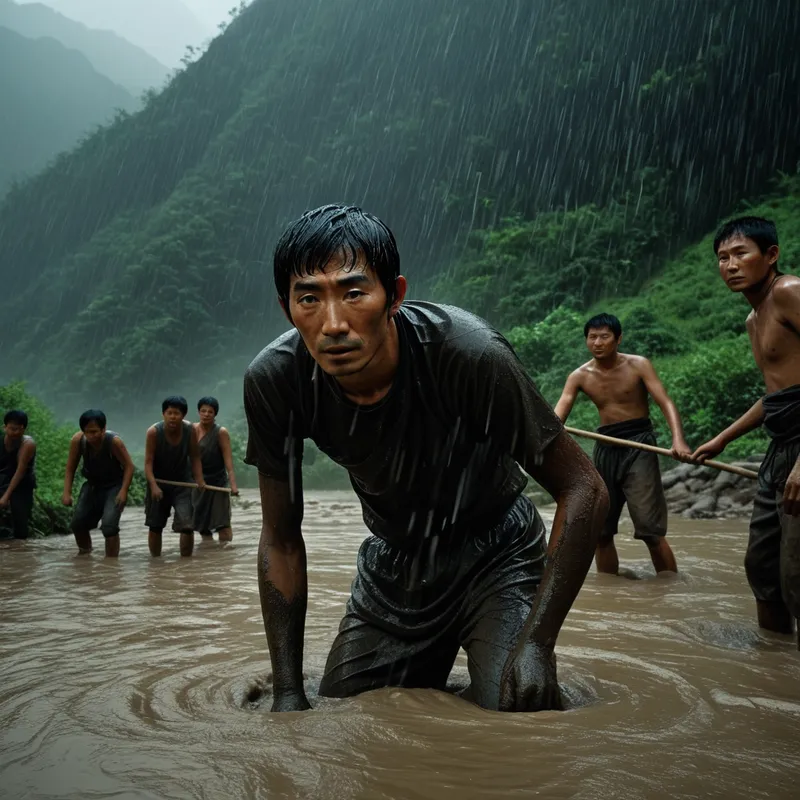
From this despair arose a man of stone-hearted resolve: Yu. He was not a god of thunder, but a son of the earth, chosen by the Shangdi. For thirteen years, he walked. He did not pass his own gate when he heard the cry of his newborn son. His hands became claws from digging; his shins lost all hair from wading through the icy torrents. He followed the dragon’s tail, the veins of the earth, and with boundless toil and a wisdom gifted by a sacred turtle from the Yellow River, he carved channels for the wild waters. He raised the nine great mountains as pillars and defined the nine provinces, giving shape to the formless.
When the waters finally receded, bowing to the order of his will, and the people returned to sow their seeds in the mud of renewal, a new task was born. The world was ordered, but sovereignty was fragile. How to anchor this hard-won harmony? How to make the mandate of heaven visible to all under the sky?
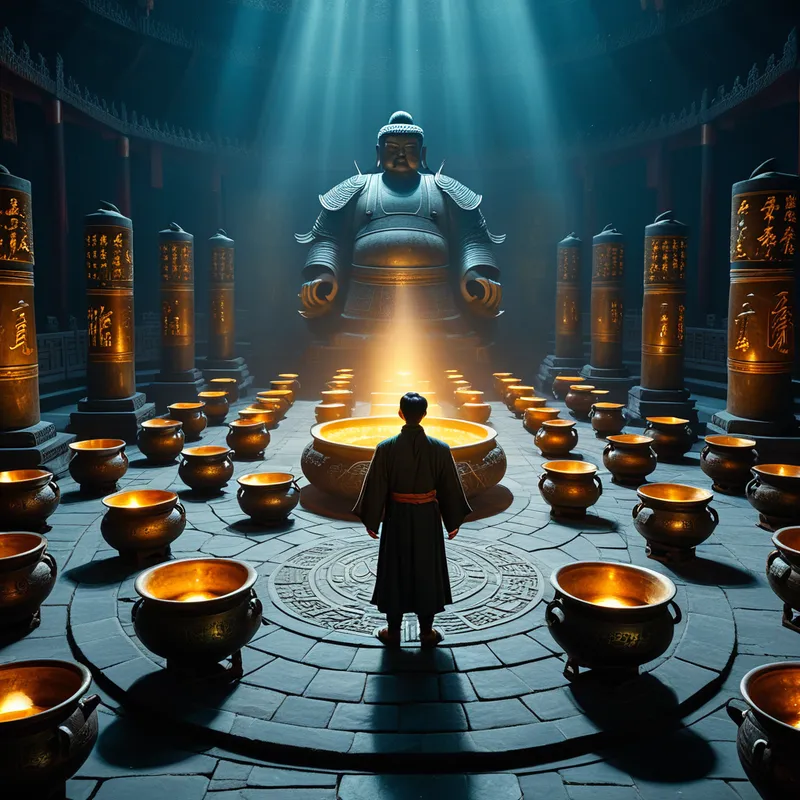
Yu commanded. From each of the nine provinces he had saved, the people brought tribute—not grain or silk, but the very essence of the earth: metal. Copper from Jing, tin from Yang, the ores of mountains now stable. These he gathered at the foot of Mount Kunlun, under a sky cleared of tempests. The forges were lit, fires that mirrored the first fire of creation. The breath of a thousand bellows was the breath of the world itself.
And from this union of earth’s bounty and human craft, they were born: The Nine Cauldrons. Each one vast, profound, a vessel of cosmic weight. Upon their bronze skins, the master artisans inscribed the very soul of the land they represented—the strange shapes of its demons, the benevolent forms of its spirits, the maps of its waterways and fertile valleys. They were not mere pots, but living testaments. They contained the jing, the essential spirit, of all under heaven. To possess them was to hold the mandate to rule, for they were heavy with the assent of the very earth Yu had healed. They were the sacred, unbreakable contract between the ordered world and the one who would guard its order.
Cultural Origins & Context
The myth of the Nine Cauldrons is foundational, woven into the historical and philosophical fabric of Chinese civilization long before being absorbed into Taoist cosmological thought. It originates in texts like the <abbr title=""Book of Documents”, one of the Five Classics of ancient Chinese literature”>Shangshu and <abbr title=""The Commentary of Zuo”, an ancient narrative history”>Zuo Zhuan, serving as a potent political and spiritual symbol for the Mandate of Heaven.
Functionally, the myth served multiple layers of societal purpose. It provided a divine origin story for political legitimacy—a dynasty possessed the Cauldrons because it possessed virtue and order, and their loss signaled the end of that mandate. It also acted as a cultural memory of unification, transforming Yu from a flood-controller into a civilizing culture-hero who defined the Chinese world (tianxia, “all under heaven”). Within Taoist culture, the story was alchemized. The Cauldrons transcended political regalia to become symbols of inner attainment—vessels for refining the primordial energies of Yin and Yang and achieving harmony with the Dao. They became templates for the Neidan practitioner’s own body as the crucible of transformation.
Symbolic Architecture
At its [heart](/symbols/heart “Symbol: The heart symbolizes love, emotion, and the core of one’s existence, representing deep connections with others and self.”/), the myth is a profound [drama](/symbols/drama “Symbol: Drama signifies narratives, emotional expression, and the exploration of human experiences.”/) of converting [chaos](/symbols/chaos “Symbol: In Arts & Music, chaos represents raw creative potential, uncontrolled expression, and the breakdown of order to forge new artistic forms.”/) into [cosmos](/symbols/cosmos “Symbol: The entire universe as an ordered, harmonious system, often representing the totality of existence, spiritual connection, and the unknown.”/), and raw power into legitimate sovereignty. Yu represents the archetypal principle of the Culture-Bringer, the one who imposes intelligible form onto the formless. His thirteen-[year](/symbols/year “Symbol: A unit of time measuring cycles, growth, and passage. Represents life stages, progress, and mortality.”/) [journey](/symbols/journey “Symbol: A journey in dreams typically signifies adventure, growth, or a significant life transition.”/) is the ultimate sacrifice of personal [life](/symbols/life “Symbol: The symbol of ‘Life’ represents a journey of growth, interconnectedness, and existential meaning, encompassing both the joys and challenges that define human experience.”/) for cosmic order.
The Cauldron is the vessel where the undifferentiated One becomes the manifest Many, and the chaotic Many are reconciled back into a sacred One.
The Flood is the primal, undifferentiated state—psychic chaos, unbounded [emotion](/symbols/emotion “Symbol: Emotion symbolizes our inner feelings and responses to experiences, often guiding our actions and choices.”/), [trauma](/symbols/trauma “Symbol: A deeply distressing or disturbing experience that overwhelms the psyche, often manifesting in dreams as unresolved emotional wounds or psychological injury.”/), or the unconscious itself. Yu’s labors are the conscious, disciplined [effort](/symbols/effort “Symbol: Effort signifies the physical, mental, and emotional energy invested toward achieving goals and personal growth.”/) (the Wei) required to channel this chaos into productive patterns. The Nine Provinces represent the differentiated psyche—the various complexes, talents, and territories of the self that must be mapped and integrated.
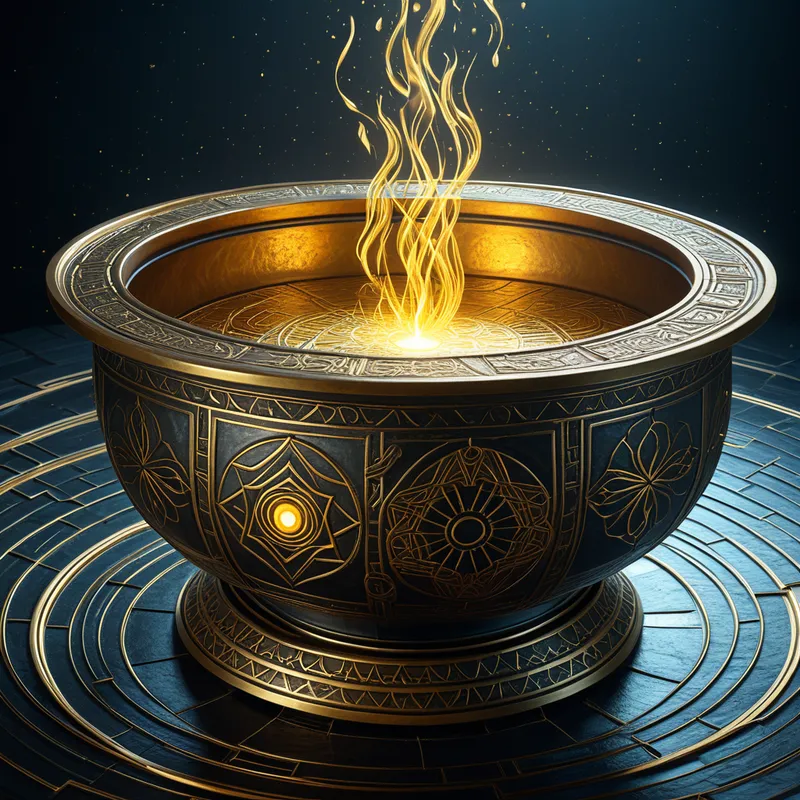
The Cauldrons themselves are the master [symbol](/symbols/symbol “Symbol: A symbol can represent an idea, concept, or belief, serving as a powerful tool for communication and understanding.”/). They are the containers. Psychologically, they represent the ego’s [capacity](/symbols/capacity “Symbol: A measure of one’s potential, limits, or ability to contain, process, or achieve something, often reflecting self-assessment or external demands.”/) to hold and transmute experience. They are forged from “tribute [metal](/symbols/metal “Symbol: Metal in dreams often signifies strength, transformation, and the qualities of resilience or coldness.”/)“—the raw [material](/symbols/material “Symbol: Material signifies the tangible aspects of life, often representing physical resources, desires, and the physical world’s influence on our existence.”/) of one’s personal [history](/symbols/history “Symbol: History in dreams often represents the dreamer’s past experiences, lessons learned, or unresolved issues that continue to influence their present.”/), sufferings, and gifts. The inscriptions are the conscious understanding and symbolic representation of one’s inner [landscape](/symbols/landscape “Symbol: Landscapes in dreams are powerful symbols representing the dreamer’s emotional state, personal journey, and the broader context of life situations.”/). Their “[heaviness](/symbols/heaviness “Symbol: A sensation of weight or pressure, often reflecting emotional burdens, responsibilities, or unresolved issues weighing on the psyche.”/)” is the [weight](/symbols/weight “Symbol: Weight symbolizes burdens, responsibilities, and emotional loads one carries in life.”/) of [responsibility](/symbols/responsibility “Symbol: Responsibility in dreams often signifies the weight of duties and the expectations placed upon the dreamer.”/) and integrity; they cannot be stolen, only earned or lost through one’s inner state.
The Dreamer’s Resonance
When the Nine Cauldrons appear in a modern dream, the psyche is engaged in a foundational process of psychic state-building. This is not a dream of fleeting emotion, but of structural change.
You may dream of a vast, empty vessel you must fill, or of a fragile container threatening to spill a precious, chaotic substance. You may be tasked with inscribing something upon a metal surface, or feel the immense weight of a responsibility you cannot put down. The somatic experience is often one of pressure, density, and gravitas—a feeling of being tested at your core. This dream pattern emerges when the dreamer is confronting a “Great Flood” in their life: a dissolution of old structures (a career, relationship, or identity) that requires a Yu-like response of disciplined, prolonged effort to re-establish order on a new, more authentic foundation. It is the psyche preparing the vessel of the self to hold a new level of consciousness and responsibility.
Alchemical Translation
The myth of Yu provides a complete map for the alchemical process of individuation—the forging of a sovereign, integrated self.
First, Confront the Flood (Hundun). One must acknowledge the inner chaos, the unmetabolized grief, rage, or desire that floods the conscious landscape. This is the nigredo, the blackening, the chaotic first matter.
Second, The Labor of Differentiation (Yu’s Journey). This is the arduous, often lonely work of analysis—channeling the floodwaters by digging conscious channels. It involves mapping the “nine provinces” of one’s psyche: recognizing patterns, naming complexes, and accepting the shadow. This is the albedo, the whitening, the separation of elements.
Third, Gathering the Tribute (Collecting the Metal). This is the stage of synthesis. The raw ores of lived experience—successes, failures, shames, and triumphs—are gathered as essential material. Nothing is wasted. Every experience contains the metal needed for the vessel.
Individuation is the process by which one becomes the legitimate ruler of one’s own inner kingdom, forging a cauldron of self that is heavy with the weight of lived truth.
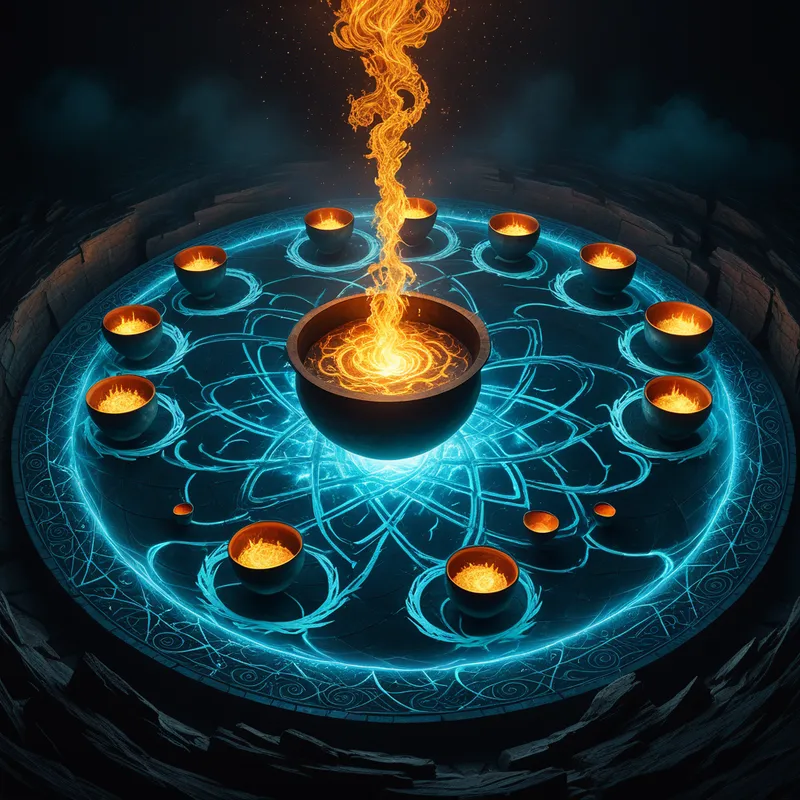
Finally, The Forging and Inscription (Creating the Cauldron). In the furnace of intense introspection or transformative crisis, the gathered elements are fused. The ego becomes a vessel strong enough to contain the Self. The “inscriptions” are the personal myths, values, and ethical codes—the unique symbolic language—that give meaning to one’s territory. This is the rubedo, the reddening, the creation of the sacred vessel. The resulting “cauldron” is the individuated personality: a centered, durable self capable of holding complexity without fracturing, granting the inner mandate to rule one’s own life with authenticity and grace.
Associated Symbols
Explore related symbols from the CaleaDream lexicon:
- Water — The primordial chaos of the Great Flood that Yu must channel and order, representing the unconscious, emotion, and the formless potential that precedes creation.
- Mountain — The stable, enduring pillars Yu raises to define the world, symbolizing the ego’s strength and the conscious structures needed to contain psychic chaos.
- Journey — Yu’s thirteen-year odyssey of relentless labor, mapping the archetypal path of prolonged sacrifice and disciplined effort required for profound transformation.
- Sacrifice — Yu’s total devotion to his task, forsaking home and family, representing the necessary surrender of personal comfort for a higher, ordering principle.
- Cauldron — The central artifact forged from tribute, the sacred vessel that contains and transmutes the essence of a territory, symbolizing the integrated self that can hold complexity.
- Earth — The nine provinces given shape and identity, representing the differentiated world of manifest reality and the mapped territories of the conscious psyche.
- Order — The ultimate achievement of Yu’s labors and the function of the Cauldrons, symbolizing the hard-won harmony and structural integrity of an individuated life.
- Dragon — The creature whose tail Yu follows to find waterways, an ancient symbol of potent, chaotic natural force that must be understood and harnessed for creative work.
- Metal — The tribute ore from each province, the raw material of the Cauldrons, representing the essential, unrefined qualities and experiences that must be forged into strength.
- Taoist Alchemy — The inner process mirrored by the myth, where the practitioner’s body and mind become the crucible and ingredients for refining primordial energy into spiritual gold.