The Net of Indra Myth Meaning & Symbolism
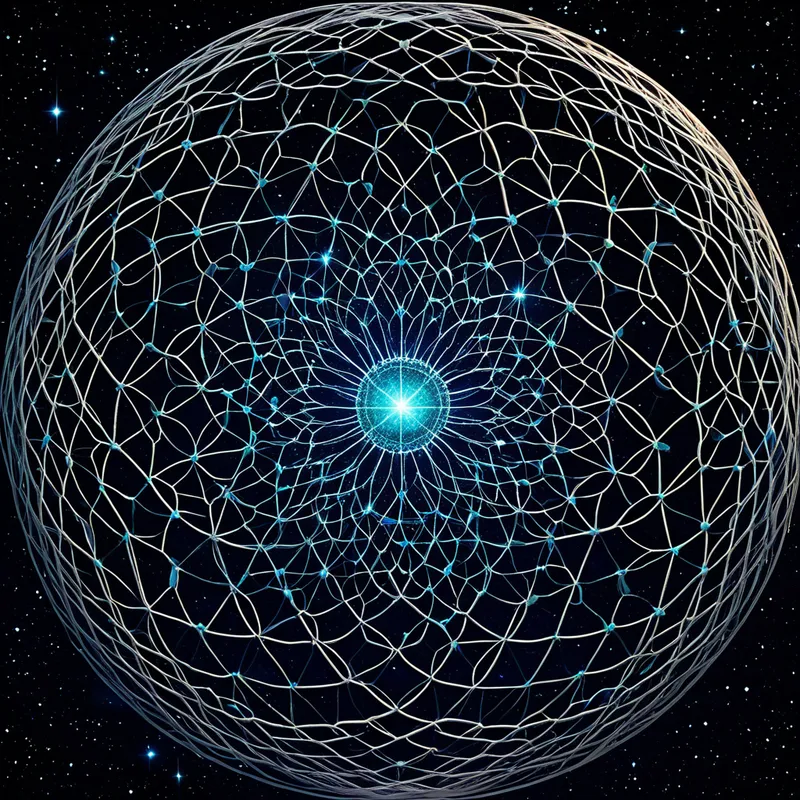
A cosmic net of infinite jewels, each reflecting all others, symbolizing the profound, luminous interdependence of all things in the universe.
The Tale of The Net of Indra
In the fathomless vaults of cosmic possibility, before time was measured in breaths or heartbeats, there existed a realm of luminous architecture. Here, in the celestial palace of [Indra](/myths/indra “Myth from Hindu culture.”/), the thunder-wielder, a mystery was woven not from thread, but from light and intention.
The great god, in his sovereignty, desired a testament to the true nature of his dominion—not one of mere power, but of profound, intricate relationship. He summoned the divine artisans, the [Vishvakarma](/myths/vishvakarma “Myth from Hindu culture.”/), and gave them a command that echoed through the halls of creation: “Weave me a net. But let it be a net unlike any other. Let it span the entirety of the heavens, from the highest peak of [Mount Meru](/myths/mount-meru “Myth from Hindu culture.”/) to the deepest foundations of the worlds. And at every crossing of every strand, place a perfect jewel.”
The artisans labored in the silence before sound. They drew strands from the essence of space itself—silvery, tensile lines of potentiality. And at each nexus, each point where possibility intersected with possibility, they set a gem. These were not ordinary stones. Each was a Cintamani, a jewel of pure consciousness, flawless and brilliantly faceted, catching the primordial light that suffused all things.
The work was completed. Indra descended from his throne to behold it. What he saw stole the thunder from his hands. The net was infinite, extending in all directions, beyond sight, beyond comprehension. And each jewel, each singular point of brilliance, held a marvel. Gazing into any one gem, Indra saw reflected within it, perfectly and completely, every other jewel in the infinite net. And within each of those reflected jewels, he could see, again perfectly, the reflections of all the others. Reflection within reflection, world within world, a luminous, recursive infinity where the one contained the all, and the all was present in the one.
A profound stillness settled over the god. The conflict was not of battle, but of perception. The rising action was the dawning realization, the vertigo of true seeing. The resolution was a silent, awe-struck understanding. The palace, the heavens, his very self—all were held within this glittering, interdependent web. He was not merely a ruler looking upon his dominion; he was a node in the divine matrix, both the seer and a facet of what was seen. The myth ends not with a bang, but with the eternal, humming resonance of that vision—a truth hanging in the cosmic air, waiting to be glimpsed by any who dare to look deeply enough.
Cultural Origins & Context
The imagery of the [Net of Indra](/myths/net-of-indra “Myth from Buddhist culture.”/) finds its most eloquent expressions within the Mahayana and <abbr title=“The “Great Vehicle” branch of Buddhism, which includes schools like Zen and Pure Land”>Vajrayana Buddhist traditions, particularly in the Avatamsaka [Sutra](/myths/sutra “Myth from Hindu culture.”/) (Flower Garland [Sutra](/myths/sutra “Myth from Hindu culture.”/)). This sutra is a vast, poetic compilation that presents a universe of radical interdependence. The Net was not a myth told around a fire for entertainment, but a profound pedagogical device used by philosophers and monks to illustrate the doctrine of Pratityasamutpada.
Its societal function was transformative. In monastic debates and meditative contemplation, the Net served as a visual and conceptual model to dismantle the illusion of separate, enduring selves. It taught that just as each jewel’s existence and brilliance is contingent on the presence and reflection of all others, so too is every being, every thought, and every event inextricably linked in a dynamic web of co-arising. It was a tool to cultivate wisdom (seeing the interconnected whole) and compassion (understanding that the suffering or joy of one is the suffering or joy of the network).
Symbolic Architecture
The Net is the ultimate [symbol](/symbols/symbol “Symbol: A symbol can represent an idea, concept, or belief, serving as a powerful tool for communication and understanding.”/) of the [universe](/symbols/universe “Symbol: The universe symbolizes vastness, interconnectedness, and the mysteries of existence beyond the individual self.”/) as a single, living organism of [consciousness](/symbols/consciousness “Symbol: Consciousness represents the state of awareness and perception, encompassing thoughts, feelings, and experiences.”/). It represents a holographic [paradigm](/symbols/paradigm “Symbol: A fundamental model or framework in arts and music that shapes creative expression, perception, and cultural understanding.”/), where the part contains the [information](/symbols/information “Symbol: Information signifies knowledge, communication, and the processing of facts or insights.”/) of the whole. Each jewel is a unique individual—a person, a [moment](/symbols/moment “Symbol: The symbol of a ‘moment’ embodies the significance of transient experiences that encapsulate emotional depth or pivotal transformations in life.”/), a [galaxy](/symbols/galaxy “Symbol: Represents vastness, cosmic order, and the interconnectedness of all things. Symbolizes both infinite potential and the feeling of being a small part of something greater.”/)—yet its [identity](/symbols/identity “Symbol: Identity represents the sense of self, encompassing personal beliefs, cultural background, and social roles.”/) is utterly relational, defined by and defining everything else.
The universe is not a collection of objects, but a communion of subjects. To see oneself as a separate jewel is the primal illusion; to see oneself as a jewel reflecting all others is the dawn of enlightenment.
The Net itself symbolizes the structured, manifest world—the laws of [physics](/symbols/physics “Symbol: Physics in dreams represents the desire to understand life’s fundamental rules, patterns, and predictable outcomes through playful exploration.”/), [karma](/myths/karma “Myth from Hindu culture.”/), and [relationship](/symbols/relationship “Symbol: A representation of connections we have with others in our lives, often reflecting our emotional state.”/) that form the lattice of [reality](/symbols/reality “Symbol: Reality signifies the state of existence and perception, often reflecting one’s understanding of truth and life experiences.”/). The Jewels represent the sentient beings and phenomena that inhabit this [structure](/symbols/structure “Symbol: Structure in dreams often symbolizes stability, organization, and the framework of one’s life, reflecting how one perceives their environment and personal life.”/). The act of [Reflection](/symbols/reflection “Symbol: Reflection signifies self-examination, awareness, and the search for truth within oneself.”/) is the core dynamic: it signifies [perception](/symbols/perception “Symbol: The process of becoming aware of something through the senses. In dreams, it often represents how one interprets reality or internal states.”/), consciousness, and the non-dual [truth](/symbols/truth “Symbol: Truth represents authenticity, honesty, and the quest for knowledge beyond mere appearances.”/) that subject and object are mutually arising facets of the same [reality](/symbols/reality “Symbol: Reality signifies the state of existence and perception, often reflecting one’s understanding of truth and life experiences.”/). There is no “outside” to this net; even the [observer](/symbols/observer “Symbol: An observer represents contemplation, self-awareness, and the act of witnessing one’s experiences.”/) is a jewel within it, gazing at the reflections that include their own gaze.
The Dreamer’s Resonance
When this myth activates in the modern [psyche](/myths/psyche “Myth from Greek culture.”/), it often manifests in dreams not of literal nets and gems, but of profound, sometimes overwhelming, connectivity. One might dream of their nervous system expanding to become a city’s power grid, feeling every light switch flick on. Another might dream of speaking and hearing their words echoed back in a thousand different languages simultaneously, or of looking into a mirror to see not their own face, but a rapidly shifting mosaic of faces—strangers, loved ones, historical figures—all looking back with recognition.
Somatically, this can feel like a dissolution of ego-boundaries, a psychic “opening up” that can be both ecstatic and terrifying. It signals a psychological process where the dreamer’s unconscious is pushing against a rigid, isolated sense of self. The psyche is attempting to integrate the shadowy truth of our profound interdependence, breaking down the walls of a fortress-ego to reveal the flowing network beneath. It is the dream equivalent of the universe whispering, “You are not alone, because alone is an impossibility.”

Alchemical Translation
The individuation process, the journey toward psychic wholeness, is mirrored perfectly in the journey from seeing a single jewel to comprehending the Net. Initially, we are identified with our own jewel—our ego, our personal history, our isolated suffering and joy. This is a necessary stage, the crafting of a coherent self.
The alchemical struggle begins when life—through crisis, love, loss, or insight—polishes the facets of our jewel to a high sheen, and we begin to see reflections. We see our mother’s frown in our own, our culture’s values in our judgments, the ecosystem’s health in our body. This can cause a “shattering” of the old, isolated self-image. The work of transmutation is to hold this terrifying, beautiful vision without retreating into the comfort of separation.
Individuation is not the perfection of a single, isolated gem. It is the conscious, willing participation of that gem in the infinite reflection, realizing that its unique brilliance is its gift to the whole, and the whole is the source of its light.
To integrate the Net is to move from ego-consciousness to what Jung might call Self-consciousness. The modern individual’s [triumph](/myths/triumph “Myth from Roman culture.”/) is not to become the ruler of the net, but to become a lucid jewel within it. It means taking responsibility not only for one’s own actions, but for the quality of one’s reflections—the thoughts, words, and deeds that ripple through the entire web. It is the alchemy of turning isolation into communion, transforming the leaden weight of separateness into the gold of conscious, sacred relationship with all that is.
Associated Symbols
Explore related symbols from the CaleaDream lexicon: