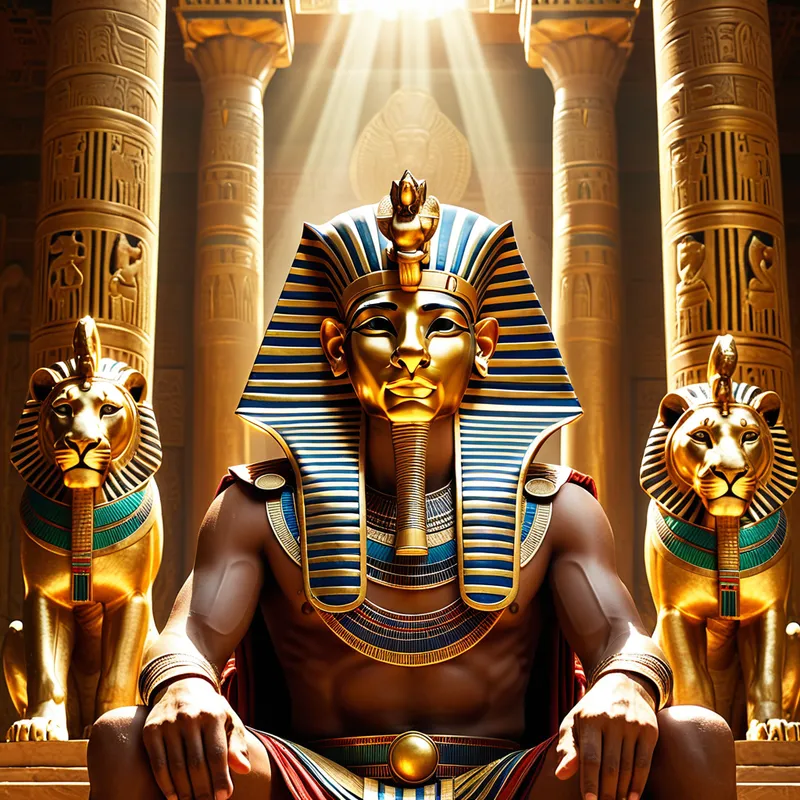
The Nemes Headdress Myth Meaning & Symbolism
A myth of the Pharaoh's striped headdress, woven from the sun's rays and the Nile's silt, binding mortal ruler to celestial duty.
The Tale of The Nemes Headdress
Before the first stone of the first pyramid was laid, when [the world](/myths/the-world “Myth from Tarot culture.”/) was still soft from the breath of Nun, the gods walked the black earth of Kemet. The sun, Ra, sailed his barque across [the sky](/myths/the-sky “Myth from Persian culture.”/)-vault, but his light was a lawless fire. It scorched [the desert](/myths/the-desert “Myth from Biblical culture.”/) and hid in the deep river, leaving the Two Lands in a dance of harsh brilliance and profound shadow. There was no bridge between the blazing realm above and the fertile mud below. The people huddled, their kings mortal and fleeting, their prayers lost between the unyielding sky and the whispering earth.
Then, from the silent council of the gods, a decree echoed in the hall of Khnum. A sovereign was needed—not a god remote in the heavens, nor a man rooted solely in the mud, but a living knot to bind them. The task fell to Tayt, the weaver of cosmic cloth. She descended to the bank of the great river at the precise moment when Ra’s first ray, a spear of molten gold, pierced [the horizon](/myths/the-horizon “Myth from Various culture.”/) and touched the dark, life-giving silt left by the Hapy.
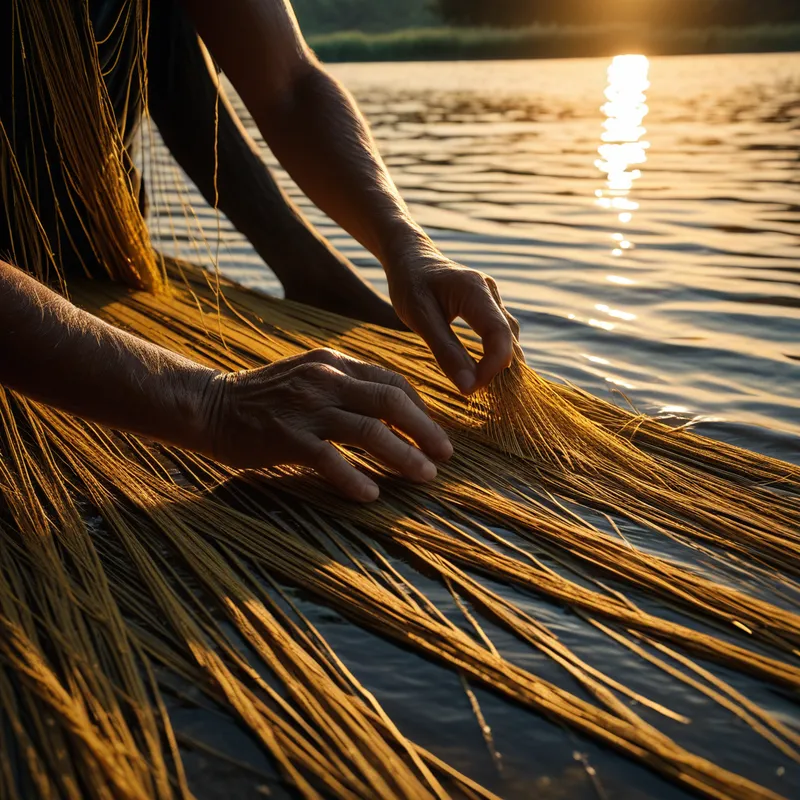
This meeting of fire and earth, of light and matter, was her loom. With fingers that moved like the shuttles of destiny, she began to weave. She took the sun’s ray and spun it into a thread of incorruptible gold. She took the rich, black silt and formed it into a strand of deepest indigo. Back and forth, over and under, she wove them together—stripe of celestial light, stripe of terrestrial darkness. The rhythm was the heartbeat of the cosmos itself.
She wove not a garment for the body, but a mantle for the essence of rule. The fabric grew, forming a headcloth that would cover [the crown](/myths/the-crown “Myth from Various culture.”/), with two stiffened lappets to fall forward over the shoulders, and a long, pleated tail to drape down the back. As she tied the final symbolic knot, the fabric stiffened, not with starch, but with purpose. It became the Nemes Headdress.
It was presented not to a man, but to the idea of kingship. The first [Pharaoh](/myths/pharaoh “Myth from Egyptian culture.”/) who knelt to receive it did not feel cloth upon his brow, but the crushing weight of the sky and the deep, pulling root of [the earth](/myths/the-earth “Myth from Hindu culture.”/). He felt the searing gaze of Ra and the cool, patient pulse of the Nile within his own skull. The Nemes was a yoke and a crown in one. It marked him as the living horizon, the Akhet, where heaven and earth met in his very person. His every word now carried the authority of Ma’at—cosmic order—and his shoulders bore the duty to maintain the balance between the two worlds, lest chaos return.
Cultural Origins & Context
The myth of the Nemes Headdress’s divine origin is not found in a single [papyrus](/myths/papyrus “Myth from Egyptian culture.”/) but is woven into the very fabric of Pharaonic iconography and ritual. It was a “living myth,” performed daily. Every depiction of a Pharaoh in statue, relief, or painting—from Narmer to Ramesses II—wearing the striped headdress was a re-telling of this story. It was the priests, the “Servants of the God,” who were the myth-keepers, enacting the symbolism in coronation rites where the new king was literally invested with the regalia of his dual nature.
Its societal function was foundational. The Nemes was the ultimate symbol of [the Pharaoh](/myths/the-pharaoh “Myth from Egyptian culture.”/)’s divine kingship, the visual proof of his role as the sole intermediary between the gods and humanity. It communicated a sacred contract to every subject: the ruler’s authority was not mere political power, but a cosmological necessity. The stability of the Nile’s flood, the regularity of the seasons, and the victory over chaos depended on the Pharaoh properly embodying the balance represented by the stripes of his headdress. It was a myth that justified hierarchy by framing it as a sacred, burdensome service essential for universal harmony.
Symbolic Architecture
The Nemes is a map of a reconciled [cosmos](/symbols/cosmos “Symbol: The entire universe as an ordered, harmonious system, often representing the totality of existence, spiritual connection, and the unknown.”/) worn upon the head, the seat of [consciousness](/symbols/consciousness “Symbol: Consciousness represents the state of awareness and perception, encompassing thoughts, feelings, and experiences.”/) and [identity](/symbols/identity “Symbol: Identity represents the sense of self, encompassing personal beliefs, cultural background, and social roles.”/). Its [symbolism](/symbols/symbolism “Symbol: The use of symbols to represent ideas or qualities, often conveying deeper meanings beyond literal interpretation. In dreams, it’s the language of the unconscious.”/) is an [architecture](/symbols/architecture “Symbol: Architecture in dreams often signifies structure, stability, and the framing of personal identity or life’s journey.”/) of [integration](/symbols/integration “Symbol: The process of unifying disparate parts of the self or experience into a cohesive whole, often representing psychological wholeness or resolution of internal conflict.”/).
The ruler is not the one who stands above, but the one who stands between, holding the tension of opposites until they become the pillars of his throne.
The alternating [stripes](/symbols/stripes “Symbol: Stripes represent duality, boundaries, and movement, often symbolizing order versus chaos or societal roles versus individuality.”/) of gold and blue/black are its primary [language](/symbols/language “Symbol: Language symbolizes communication, understanding, and the complexities of expressing thoughts and emotions.”/). They represent the fundamental dualities over which the Pharaoh presides: the Sun (Ra) and the Nile (Hapy), the Desert (Deshret) and the Fertile Land (Kemet), the Sky (Nut) and the [Earth](/symbols/earth “Symbol: The symbol of Earth often represents grounding, stability, and the physical realm, embodying a connection to nature and the innate support it provides.”/) (Geb), and ultimately, the Divine and the [Human](/symbols/human “Symbol: The symbol of a human represents individuality, complexity of emotions, and social relationships.”/). The Nemes does not erase these opposites; it binds them in a stable, repeating [pattern](/symbols/pattern “Symbol: A ‘Pattern’ in dreams often signifies the underlying structure of experiences and thoughts, representing both order and the repetitiveness of life’s situations.”/). The Pharaoh’s [psyche](/myths/psyche “Myth from Greek culture.”/) is thus the loom where these forces are woven into a functional unity.
The rigid, framed [structure](/symbols/structure “Symbol: Structure in dreams often symbolizes stability, organization, and the framework of one’s life, reflecting how one perceives their environment and personal life.”/) of the headdress signifies the containment and channeling of these immense powers. It is a psychological [vessel](/symbols/vessel “Symbol: A container or structure that holds, transports, or protects something essential, representing the self, emotions, or life journey.”/). The [uraeus](/myths/uraeus “Myth from Egyptian culture.”/)—the rearing cobra often attached to the [brow](/symbols/brow “Symbol: The brow represents thought, expression, and perception. It is the seat of intellect and emotional display.”/)—adds the element of awakened, protective, and sometimes destructive power (embodied by the [goddess](/symbols/goddess “Symbol: The goddess symbolizes feminine power, divinity, and the nurturing aspects of life, embodying creation and wisdom.”/) [Wadjet](/myths/wadjet “Myth from Egyptian culture.”/)), a reminder that the integrated sovereign must also wield focused force to defend the order he embodies.
The Dreamer’s Resonance
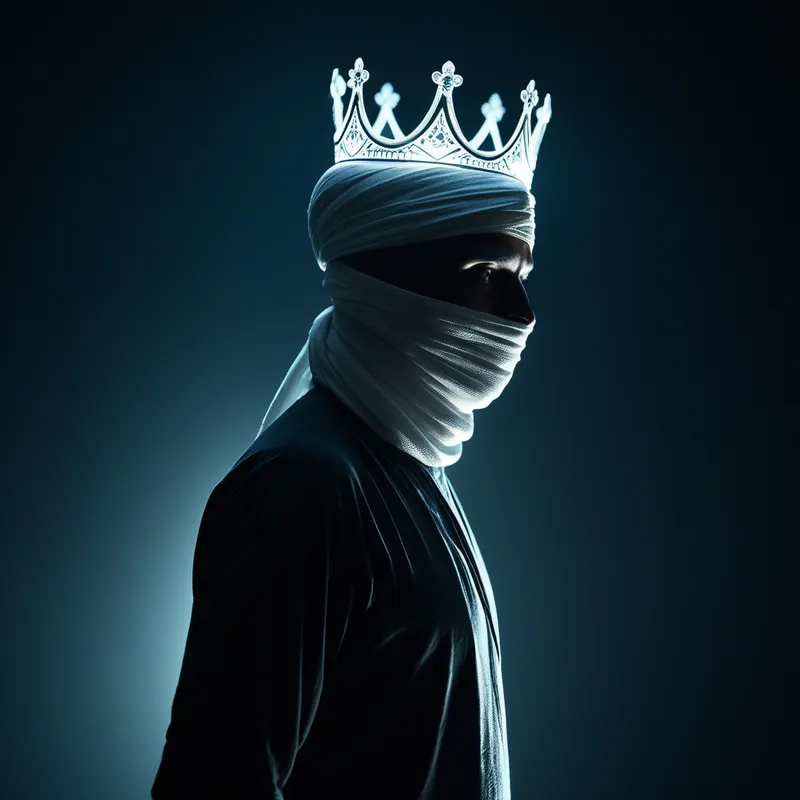
When the Nemes Headdress appears in a modern dream, it rarely arrives as a museum artifact. It manifests as a sensation of weight and demarcation. One might dream of wearing a helmet that is both terribly heavy and brilliantly luminous, or of having one’s head tightly wrapped in bandages that are striped with light and shadow. The dreamer often feels a profound ambivalence: a sense of elevated purpose coupled with crushing isolation.
This dream signals a psychological process of confronting the archetype of the Sovereign. The psyche is grappling with the burden of true authority, responsibility, and the need to integrate conflicting aspects of [the self](/myths/the-self “Myth from Jungian culture.”/) into a cohesive, functioning whole. The somatic feeling of weight is [the ego](/myths/the-ego “Myth from Jungian culture.”/) feeling the pressure of this larger, archetypal role. It is the dream of the individual being called to “rule” their own internal kingdom—to make conscious choices, establish inner order, and bear the loneliness that often accompanies leadership and self-definition. The stripes may represent specific, unresolved opposites in the dreamer’s life (work/rest, logic/intuition, strength/vulnerability) that demand reconciliation.
Alchemical Translation
The myth of the Nemes Headdress is a precise alchemical manual for the process of psychic individuation—becoming the sovereign of one’s own soul. The alchemical operation it models is coagulatio: the bringing together of disparate, often opposing, elements to form a new, enduring substance.
Individuation is the self-weaving of the Nemes: the conscious labor of taking the solar light of our conscious ideals and the chthonic mud of our unconscious instincts, and binding them into the striped fabric of a mature personality.
[The first stage](/myths/the-first-stage “Myth from Alchemical culture.”/) is the recognition of the opposites (the separate rays of sun and piles of silt). For the modern individual, this is acknowledging the warring factions within: the spiritual seeker and the material being, the compassionate heart and the ambitious will. The “weaving” is the daily, often arduous, work of holding these tensions without allowing one to negate the other. It is letting one’s career (solar, structured) be informed by one’s creativity (chthonic, fluid), or letting one’s relationships (earthly, nurturing) be guided by one’s principles (celestial, absolute).
Wearing the “inner Nemes” is the result. It is the achieved state where these opposites are not just managed, but are seen as necessary components of a complete identity. The individual becomes their own Akhet. They no longer feel torn by contradictions but feel structured by them. The weight remains—consciousness is always a burden—but it becomes the dignified weight of self-governance and authentic existence. The ultimate [triumph](/myths/triumph “Myth from Roman culture.”/) in this psychic myth is not conquest, but the capacity to contain the full spectrum of one’s being, thereby achieving a personal Ma’at. The ruler is crowned from within.
Associated Symbols
Explore related symbols from the CaleaDream lexicon: