The Necklace of Harmonia Myth Meaning & Symbolism
A divine wedding gift, forged by a god, becomes a generational curse, binding its bearers to a fate of ruin until its final, mysterious dissolution.
The Tale of The Necklace of Harmonia
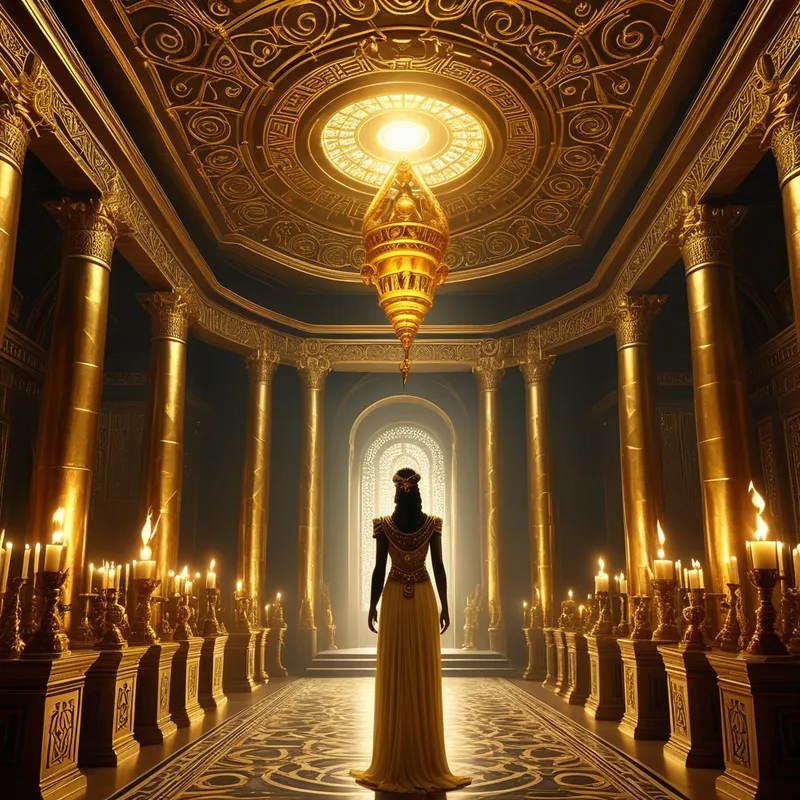
Listen, and hear the story of a gift that was a doom, of beauty that was a blight. It begins not with a hero’s shout, but with a wedding song. The air in Thebes was thick with incense and the honeyed scent of ambrosia, for a union was being forged between earth and heaven. Cadmus, [the dragon](/myths/the-dragon “Myth from Chinese culture.”/)-slayer, founder of cities, was to wed [Harmonia](/myths/harmonia “Myth from Greek culture.”/), daughter of Ares and Aphrodite. The gods themselves descended, their chariots painting [the sky](/myths/the-sky “Myth from Persian culture.”/) with light.
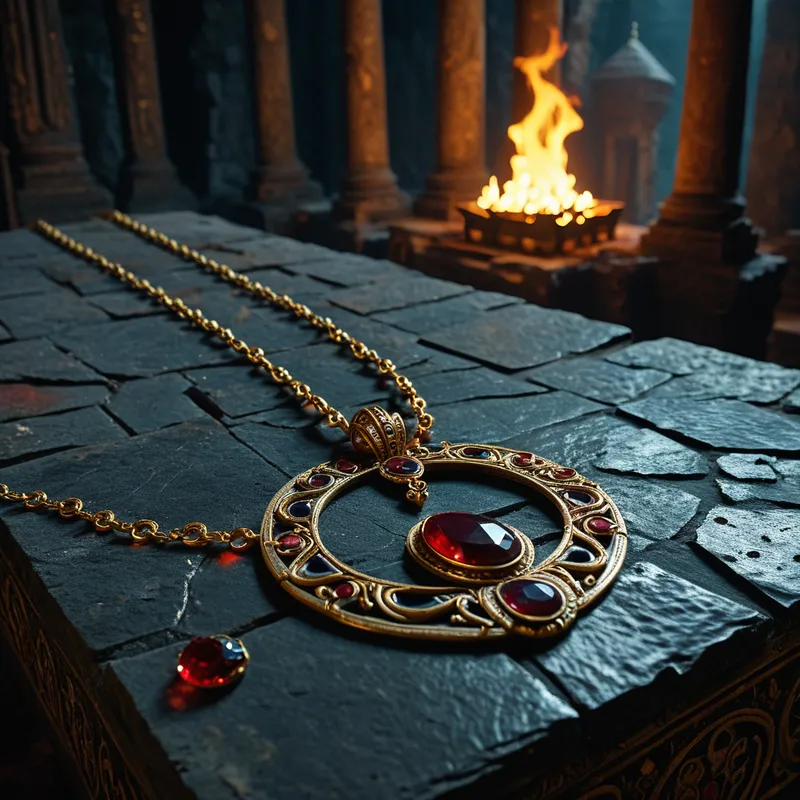
But one god arrived with a heavier step. [Hephaestus](/myths/hephaestus “Myth from Global/Universal culture.”/), the great artificer, limped into the hall. His heart, still smoldering from the infidelity of his own wife, Aphrodite, looked upon this child of that union. In his hands, he carried his masterpiece: a necklace. It was not mere gold. It was sunlight captured in wire, woven with a skill no mortal eye could follow. Set within were gems that held the deep fire of [the earth](/myths/the-earth “Myth from Hindu culture.”/) and the cold glitter of the stars—a [thing](/myths/thing “Myth from Norse culture.”/) of breathtaking, terrible beauty. It was a bridal gift for Harmonia.
A hush fell. The necklace was placed around the bride’s slender neck. It rested there, cool and heavy. The wedding feast resumed, but the music now seemed to hold a minor key beneath its joy. For the gift was not born of blessing, but of a god’s smoldering resentment. The splendor of the necklace was a cage; its perfection, a curse.
And so the poison seeped into the bloodline. The glorious house of Cadmus, which should have stood for ages, was shaken by storm after storm. Their children—Semele, Autonoe, Agave, Dionysus—met fates of fire, madness, and dismemberment. The necklace passed from hand to hand, a glittering heirloom of catastrophe. It adorned Eriphyle, who sent her husband to his death for its sake. It was carried to war, plundered from temples, and dedicated anew, its path a scarlet thread of betrayal, greed, and ruin through the generations.
The curse ran its course like a fever, burning through lineage until it reached a final, sacred fever-break. The necklace, steeped in so much mortal suffering, was brought at last to [the temple](/myths/the-temple “Myth from Jewish culture.”/) of Apollo at Delphi. And there, the story does not end with a bang, but with a mysterious dissolution. Some say it was placed in the keeping of [the temple](/myths/the-temple “Myth from Jewish culture.”/) priests. Others whisper that the earth itself opened and swallowed the cursed gold, or that it was melted down and its essence transmuted in a divine fire. The physical object vanished from the tales of men, its curse finally spent, its long, painful journey through the generations complete.
Cultural Origins & Context
This myth is not a single, fixed story from one source, but a haunting refrain woven through the broader tapestry of Theban cycle legends. It is found in fragments and references in the works of poets like Hesiod and tragedians like Euripides</ab- br>, and later systematized by mythographers like Apollodorus. Its function was multifaceted. On one level, it served as a divine explanation for the profound and repeated tragedies of the House of Cadmus, a family saga that provided the raw material for so much Greek tragedy. The necklace was the tangible symbol of a “miasma,” a pollution or curse that could afflict a family line.
Furthermore, it acted as a profound cultural caution. In a society deeply concerned with lineage, inheritance, and the sins of the fathers, the myth gave form to the fear that prosperity and beauty—even divine gifts—could conceal a fatal flaw. It warned of the dangers of coveted objects, of the corruption that comes with ill-gotten treasure, and of the inescapable weight of familial destiny. The necklace was a narrative device that connected disparate tragedies across generations, creating a coherent, if grim, cosmology of cause and effect within the heroic age.
Symbolic Architecture
At its core, the [Necklace](/symbols/necklace “Symbol: A necklace signifies personal identity, the connections we maintain, and the adornment of the self.”/) of Harmonia is an archetypal [symbol](/symbols/symbol “Symbol: A symbol can represent an idea, concept, or belief, serving as a powerful tool for communication and understanding.”/) of the poisoned inheritance. It represents the beautiful, burdensome, and often destructive legacies we receive from our ancestors—not just [material](/symbols/material “Symbol: Material signifies the tangible aspects of life, often representing physical resources, desires, and the physical world’s influence on our existence.”/) [wealth](/symbols/wealth “Symbol: Wealth in dreams often represents abundance, security, or inner resources, but can also symbolize burdens, anxieties, or moral/spiritual values.”/), but psychological patterns, unresolved traumas, and familial curses.
The most exquisite gifts are often prisons wrought in gold. We mistake their shine for blessing, not seeing the chain that fastens us to another’s unfinished story.
The necklace is forged by Hephaestus, the divine craftsman. This is critical. It is not a crude [weapon](/symbols/weapon “Symbol: A weapon in dreams often symbolizes power, aggression, and the need for protection or defense.”/), but a masterpiece. The [curse](/symbols/curse “Symbol: A supernatural invocation of harm or misfortune, often representing deep-seated fears, guilt, or perceived external malevolence.”/) is not in ugliness, but in seductive, perfect [beauty](/symbols/beauty “Symbol: This symbol embodies aesthetics, harmony, and the appreciation of life’s finer qualities.”/). This speaks to the [nature](/symbols/nature “Symbol: Nature symbolizes growth, connectivity, and the primal forces of existence.”/) of psychological inheritance: the patterns we inherit are often the “best” or only ways our ancestors knew to survive—be they patterns of ambition, stoicism, [passion](/symbols/passion “Symbol: Intense emotional or physical desire, often linked to love, creativity, or purpose. Represents life force and deep engagement.”/), or [resentment](/symbols/resentment “Symbol: A deep-seated emotional bitterness from perceived unfairness or injury, often festering silently and poisoning relationships.”/). They are adaptive masterpieces for their time, but become maladaptive curses in a new context.
Harmonia, whose name means “union” or “[concord](/symbols/concord “Symbol: A musical term for harmonious agreement between notes, representing balance, unity, and peaceful resolution in dreams.”/),” is the first to wear it. The union of opposites (the mortal Cadmus and the divine Harmonia) is immediately shadowed by a symbol of discord. This reflects the psychological [truth](/symbols/truth “Symbol: Truth represents authenticity, honesty, and the quest for knowledge beyond mere appearances.”/) that any new [synthesis](/symbols/synthesis “Symbol: The process of combining separate elements into a unified whole, representing integration, resolution, and the completion of a personal journey.”/), any new stage of [life](/symbols/life “Symbol: The symbol of ‘Life’ represents a journey of growth, interconnectedness, and existential meaning, encompassing both the joys and challenges that define human experience.”/) or [relationship](/symbols/relationship “Symbol: A representation of connections we have with others in our lives, often reflecting our emotional state.”/), must eventually confront the unresolved material from the past that it carries within it.
The Dreamer’s Resonance
When this myth stirs in the modern unconscious, it rarely appears as a literal necklace. The dreamer may find themselves in a beautiful but oppressive house they have inherited, unable to leave. They may be given a sumptuous gift that fills them with dread, or they may discover a family heirloom that seems to pulse with a strange energy. Somatic sensations are key: a feeling of exquisite weight around the neck or chest, a cloying sweetness that turns to ash in the mouth, or the chilling touch of cold, perfect metal on the skin.
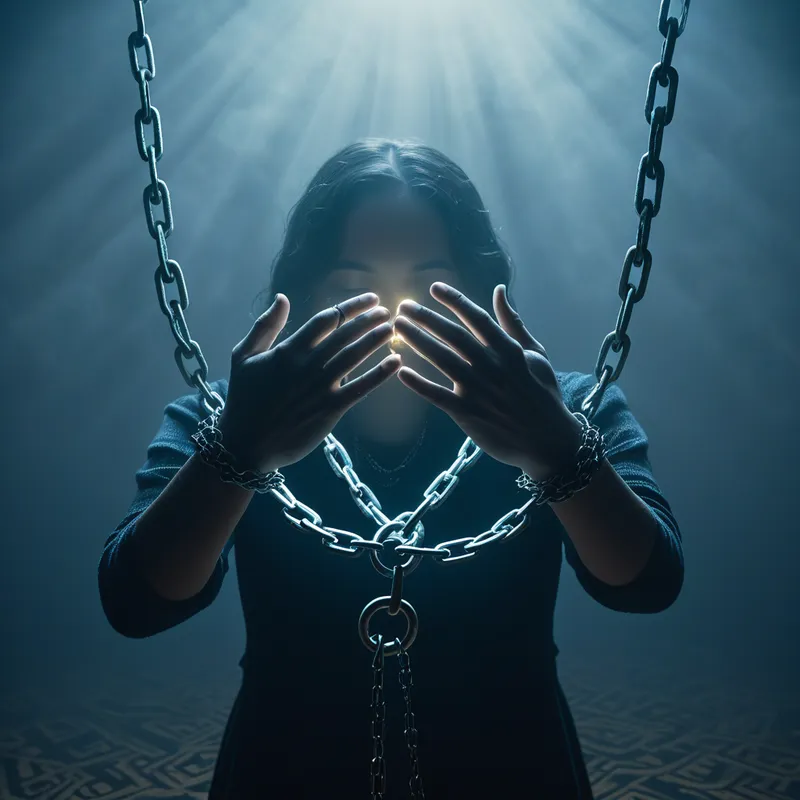
Psychologically, this dream pattern signals an encounter with the burden of transgenerational [psyche](/myths/psyche “Myth from Greek culture.”/). The dreamer is at a point where they are becoming conscious of a pattern—of addiction, of failed relationships, of self-sabotage, of a particular flavor of anxiety—that does not feel entirely their own. It feels inherited, foreign, yet intimately bound to their identity. The dream is the psyche’s way of objectifying this burden, of showing the dreamer the “beautiful curse” they have been wearing all along, so that they may begin the work of seeing it, feeling its weight, and ultimately, deciding its fate.
Alchemical Translation
The myth of the Necklace provides a stark but complete map for the alchemical process of psychic transmutation, or individuation. [The first stage](/myths/the-first-stage “Myth from Alchemical culture.”/), [nigredo](/myths/nigredo “Myth from Alchemical culture.”/) (blackening), is the initial gift—the shining object that contains the hidden poison. This is the unconscious identification with our inheritance; we wear it proudly, not knowing it is the source of our suffering.
The long, bloody journey of the necklace through generations represents the mortificatio (mortification)—the painful, repetitive suffering as the curse works itself out through fate and unconscious action. This is the stage of life where the same painful patterns recur, where we feel doomed by our “family history.”
The final act—the dedication of the necklace to Apollo at Delphi—is the crucial turn. Delphi is the site of “Know Thyself.” This is the moment of conscious illuminatio (illumination). The cursed object is no longer worn, traded, or fought over; it is brought into the light of consciousness and surrendered to a higher principle (Apollo, representing light, order, and self-knowledge).
The curse is not lifted by being destroyed, but by being seen, consecrated, and transformed in the sacred fire of conscious understanding.
Its subsequent disappearance—whether into the earth or a divine fire—symbolizes the albedo (whitening) and [rubedo](/myths/rubedo “Myth from Alchemical culture.”/) (reddening), the final stages of transmutation. The specific, toxic form of the inheritance is dissolved. Its elemental essence—the raw psychic energy, [the passion](/myths/the-passion “Myth from Christian culture.”/), the talent, even the pain—is not lost, but reintegrated. The gold of the necklace returns to the earth from which it came, or is recast. Psychologically, this is the process where we stop being victims of a familial curse and become stewards of a familial complexity. We transform a fate into a history, and a burden into a source of depth. The curse, when fully metabolized by consciousness, becomes wisdom.
Associated Symbols
Explore related symbols from the CaleaDream lexicon: