The Navagraha Myth Meaning & Symbolism
The story of the nine celestial forces, born from cosmic conflict, who govern destiny and illuminate the soul's journey through time and karma.
The Tale of The Navagraha
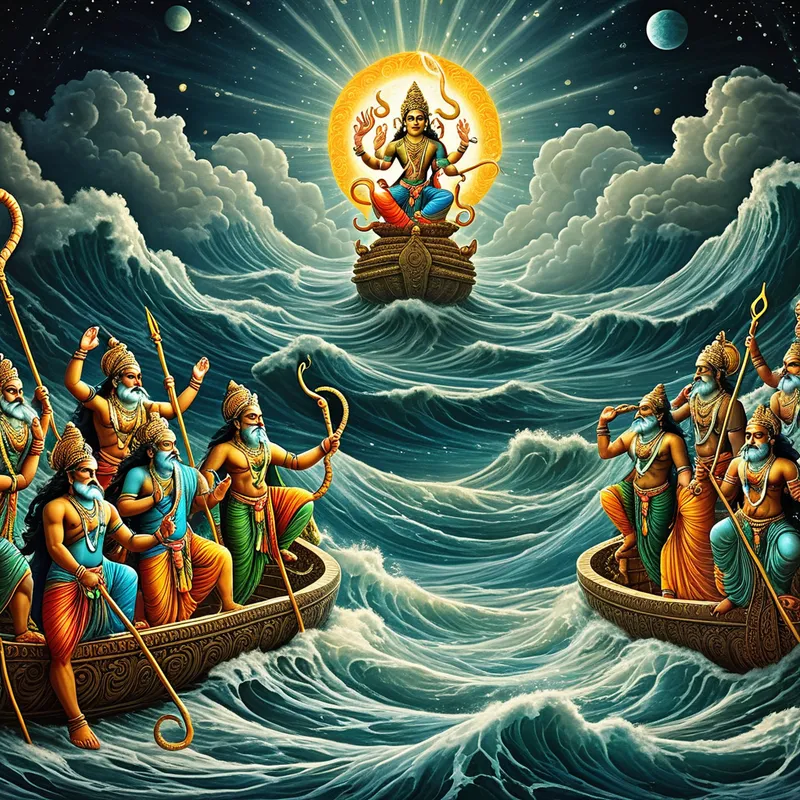
Listen, and hear the tale written not on palm leaves, but in the very turning of the heavens. In the age before ages, when the cosmos was a soup of potential, a great strife arose. The Devas and the Asuras, locked in eternal opposition, sought the nectar of immortality, Amrita. They agreed to churn the cosmic ocean, Samudra Manthan, using the serpent-king Vasuki as the rope and the mighty mountain Mandara as the churn.
The churning was a cataclysm of creation. From the frothing, milky depths, wonders and terrors emerged—the wish-fulfilling cow, the deadly poison Halahala, the goddess of fortune Lakshmi. But as the churn turned, grinding time and space, something else was born. Not from the water, but from the very act of friction between order and chaos, light and shadow, aspiration and resistance.
First came Surya, a blazing orb of conscious will, riding his chariot drawn by seven steeds, his light the first decree of “I Am.” Then arose Chandra, cool and reflective, his luminous face waxing and waning with the tides of feeling. From the fiery core of conflict sprang Mangal, clad in red, his energy raw and assertive. The swift messenger Budha manifested, weaving patterns of thought and communication.
The great guru Brihaspati emerged, radiating wisdom and expansion, while his counterpart, the luminous Shukra, embodied desire, art, and the power of material attraction. Then, from a deeper, slower rhythm, came Shani, his gaze heavy with the weight of consequence, teaching through limitation.
But the churning was not yet complete. The demon Rahu stole a drop of Amrita. The preserver Vishnu, in his form as Mohini, severed Rahu’s head before the nectar could pass his throat. Thus, two more forces were cast into the sky: Rahu, the ascending shadowy head, hungry and insatiable, and Ketu, the descending tail, mystical and releasing.
Nine lights, nine rhythms. They were not placed in the sky; they were the sky’s governing principles. The great deity Brahma bestowed upon them sovereignty over the destinies of all beings born under their watch. They became the Navagraha, the sovereigns of fate, whose dance across the Rashis writes the story of every soul in the language of light, time, and karma.
Cultural Origins & Context
The myth of the Navagraha is not a single story from one text, but a cosmological framework woven from the threads of Vedic observation, Puranic narrative, and early astronomical science. Its origins lie in the meticulous sky-watching of ancient Bharat, where the movement of celestial bodies was directly correlated with terrestrial rhythms—seasons, tides, and the cycles of life.
The societal function was profound and dualistic. On one hand, it was a system of astrology (Jyotisha), a practical tool for kings to time coronations and wars, for farmers to sow and reap, and for individuals to understand their predispositions. On the other, it was a theological model, personifying cosmic forces as deities to be propitiated. Temples dedicated to the Navagraha, often as subsidiary shrines, became places where devotees could engage with the specific energies influencing their lives, seeking to harmonize with, rather than merely submit to, celestial decree. The myth was passed down through priestly lineages, astrological manuals (Jatakas), and temple iconography, embedding the idea that human life is a microcosm reflecting a macrocosmic, intelligible order.
Symbolic Architecture
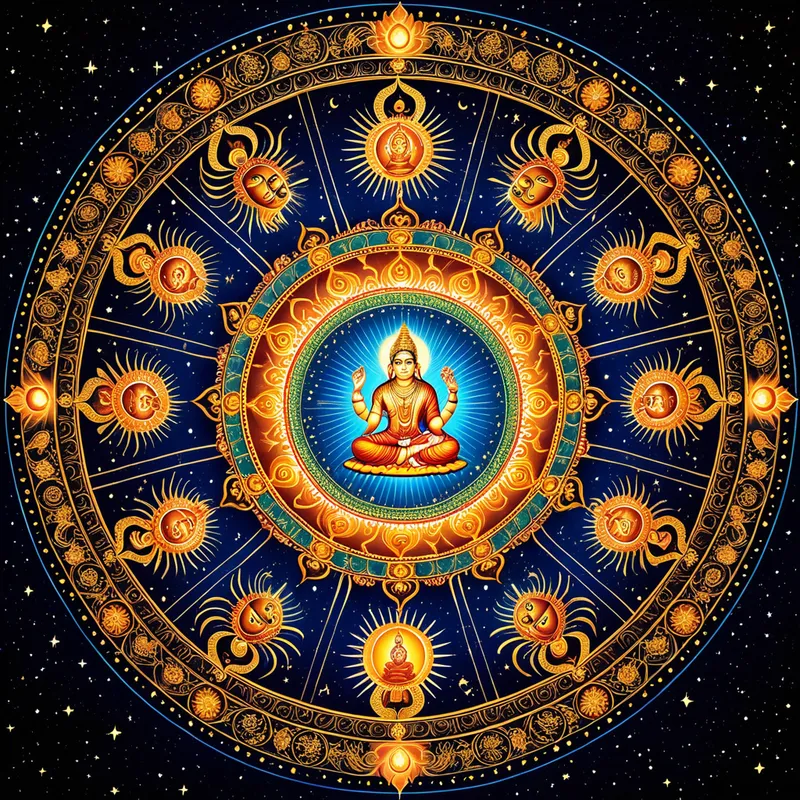
The Navagraha represent the archetypal architecture of a conscious universe. They are not random planets but a complete psychological ecosystem. Surya is the archetypal Self, the central luminary of consciousness and vitality. Chandra is the receptive, reflective unconscious, the realm of emotion and memory. The remaining seven govern the core complexes and drives that shape the personality: Mangal (assertion, courage, anger), Budha (intellect, communication, adaptability), Brihaspati (wisdom, morality, growth), Shukra (love, beauty, valuation), Shani (discipline, limitation, depth), with Rahu and Ketu as the lunar nodes, representing the points of intersection between the soul’s past and its destiny.
They are the nine faces of fate, not as blind chance, but as the inherent logic of a soul’s journey through time—karma made visible as celestial motion.
Crucially, they operate as a mandala, a circle of wholeness. No single Graha is entirely “good” or “evil”; each possesses a necessary, if sometimes challenging, function. Shani’s restrictions build the resilience that Brihaspati’s wisdom requires. Rahu’s obsessive hunger can fuel the drive for achievement that Surya embodies. They symbolize the necessity of engaging with all facets of experience to achieve integration.
The Dreamer’s Resonance
When the pattern of the Navagraha appears in modern dreams, it seldom manifests as nine clear figures. Instead, one dreams of being governed by multiple, conflicting clocks; of a sky with several suns and moons casting contradictory shadows; or of being in a room with nine doors, each emitting a different colored light or emotional tone.
This dream imagery signals a somatic and psychological process of confronting one’s own complex fate—the internalized “planets” of one’s character. It is the psyche grappling with the multiplicity of its own drives. A dream of a harsh, glaring light (Surya in imbalance) might correlate with burnout or ego inflation. Dreams of being stuck in mud or heavy chains often mirror the Saturnine process of confronting unavoidable responsibility or past karma. The appearance of a mesmerizing but elusive beauty (Shukra) or a sudden, disruptive technological insight (Rahu/Ketu) points to the activation of these archetypal energies within the dreamer’s life. The dream is the native language of this internal celestial council, reporting on the state of the inner kingdom.
Alchemical Translation
The individuation process modeled by the Navagraha myth is the alchemical art of becoming the sovereign of one’s own inner cosmos. The initial state is one of being “lived by” these forces—reacting to Martian anger, being swept by Venusian desire, crushed by Saturnine duty. The conflict of the Samudra Manthan is internalized: the churning is the friction of conscious effort (Deva) against resistant habits and complexes (Asura).
The goal is not to eliminate any Graha, but to integrate each into a conscious mandala of the Self. This is the psychic transmutation. The heat of Mangal’s anger is alchemized into the courage for necessary action. The cold gaze of Shani is transformed into the discipline for deep, meaningful work. The insatiable hunger of Rahu is redirected from worldly consumption to spiritual thirst. One moves from being a subject of fate to a co-creator with it.
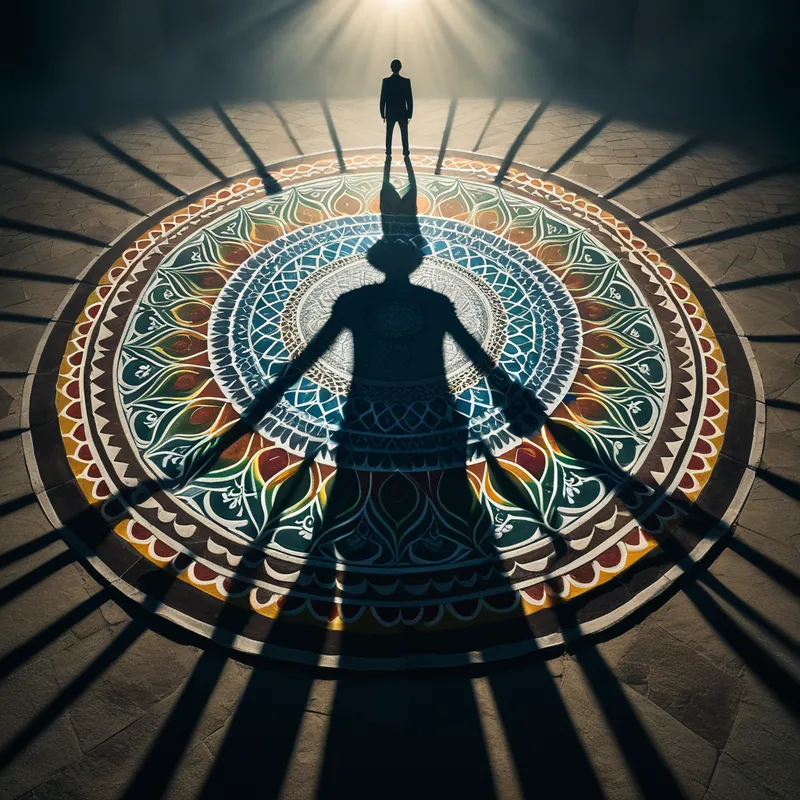
The ultimate alchemy is to sit at the center of your own Navagraha mandala, not ruled by the planets, but in conscious relationship with them, your life the unique hymn composed by their celestial harmony.
This is the profound promise of the myth: that by understanding and honoring these nine fundamental rhythms within, we do not escape our destiny, but we meet it with consciousness, transforming a predestined path into a sacred journey. We cease to be merely born under stars; we learn to converse with them.
Associated Symbols
Explore related symbols from the CaleaDream lexicon: