The myth of Hypnos Myth Meaning & Symbolism
The myth of the god Hypnos, who dwells in a twilight cave, wielding the power to soothe gods and mortals with the gentle touch of sleep and dreams.
The Tale of The myth of Hypnos
In the silent, breathless space between the setting sun and the rising moon, there is a kingdom unseen by waking eyes. It lies not across the wine-dark sea, nor atop the cloud-wreathed peak of Olympus. It dwells in the very threshold of perception, in a cave where light forgets its name and shadows are born soft and deep. This is the realm of Hypnos.
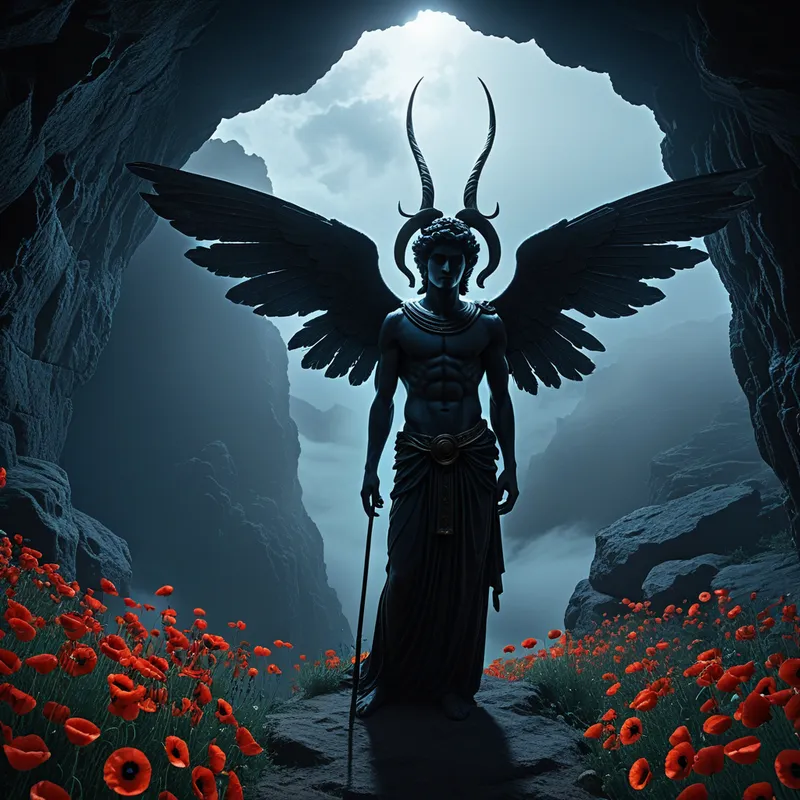
He is a god of gentle mien, with wings darker than a midnight raven, yet softer than the first touch of dusk. His voice is the sigh of a settling world, his touch the weight of a thousand unspoken thoughts. His palace is a cavern of forgetting, where the river Lethe whispers at its mouth, and its walls are hung with curtains of deepest twilight.
He does not rule with thunder or flame, but with an invitation whispered into the ear of the world. When the great Zeus thunders in rage, his lightning fracturing the sky, it is Hypnos who is summoned. The god of sleep approaches not with a warrior’s stance, but with the humility of essential truth. He speaks of rest, of the quiet needed to hold a universe together. Sometimes, he must be persuaded, his power so great that even the King of Gods must offer gifts—a gracious throne, a promised bride—to receive the blessing of his touch.
And to mortals, he comes unbidden, a merciful shadow. He descends upon the weary soldier standing guard, his limbs aching with the memory of battle. The man feels a sudden, profound heaviness, a warmth that starts at his crown and flows down like a velvet tide. His spear slips from fingers gone slack; his knees buckle not in fear, but in release. Hypnos catches him, lowering him onto a bed of phantom poppies and black ewe’s wool. With a brush of his fingers, he closes eyelids scarred by the sun’s glare, and under his palm, the frantic drum of the heart slows to the deep, rolling rhythm of the sea at rest. The world of toil, pain, and relentless time dissolves. In its place, Hypnos pours from his horn a draft of silent darkness, or sometimes, if he wills it, a shimmering mist from which figures form—loved ones lost, battles won, fears made flesh, or desires given form. These are the gifts of his twin children, the Oneiroi, who flutter from the cave to walk the winding paths of the sleeping mind.
His power is absolute, yet it is a sovereignty of surrender. He is the great leveler, before whom hero and slave, god and mortal, must eventually bow. For Hypnos does not conquer; he envelops. He ends the day not with a clash, but with a caress, drawing the tapestry of consciousness closed so that the loom of life may be repaired in the secret dark.

Cultural Origins & Context
The myth of Hypnos originates in the rich tapestry of ancient Greek cosmology, a culture deeply concerned with ordering the chaos of existence into personified forces. Hypnos is not a major Olympian, but a primordial daimon, a fundamental power. His earliest mentions appear in Hesiod’s Theogony, which catalogues the birth of the gods, and he is vividly depicted in Homer’s Iliad, where he is enlisted to lull Zeus to sleep.
This myth was not a central cult narrative with grand temples, but a pervasive cultural understanding passed down through epic poetry and later philosophical and literary works. It functioned as an explanation for a universal, daily mystery: the phenomenon of sleep and dreams. By personifying sleep, the Greeks could negotiate with it, understand its caprices, and integrate it into their worldview. Hypnos, and his twin brother Thanatos (Death), represented the two great, gentle transitions every life must face. The myth served as a reminder of a profound truth: that even the most powerful being is subject to the natural, rhythmic laws of existence, of which sleep is the most intimate and regular ambassador.
Symbolic Architecture
Hypnos represents the necessary descent, the conscious ego’s nightly journey into the nourishing, chaotic, and creative waters of the unconscious. He is the personification of the threshold itself.
He is not the dream, but the gatekeeper to the dream; not the content of the unconscious, but the state of consciousness that allows it to speak.
His dark, soft wings symbolize the enveloping, non-judgmental nature of this state—it covers and comforts, but also obscures and isolates from the waking world. The poppies and the horn of oblivion are emblems of this merciful anesthesia, the letting-go of daytime identities, worries, and linear logic. His cave, adjacent to the underworld river Lethe, signifies that to enter the realm of dreams, one must first drink from the waters of forgetfulness, temporarily releasing the grip on waking memory and ego.
Psychologically, Hypnos is the archetype of surrender as strength. In a culture (both ancient and modern) that prizes wakefulness, action, and control, Hypnos champions the inverse. His power lies in his ability to stop action, to dissolve control. He represents the vital psychic function of rest, incubation, and passive reception—without which consciousness becomes brittle, sterile, and burned out.
The Dreamer’s Resonance
When the pattern of Hypnos manifests in modern dreams, it is rarely as a literal winged figure. It appears somatically and atmospherically. The dreamer may experience:
- The Overwhelming Descent: A dream of being irresistibly, peacefully pulled underwater, into a deep, warm earth, or wrapped in a profound, velvety darkness. This is the somatic memory of surrender, the psyche enacting the myth of being touched by Hypnos.
- The Liminal Space: Dreams of waiting in tranquil anterooms, floating in silent, starry voids, or standing at the mouth of a comforting cave. These are dreams of being in transition, having left the waking world but not yet engaged with the narrative drama of the deep unconscious. The dreamer is in Hypnos’s realm, in the state of sleep itself.
- Encounter with a Gentle, Shadowy Figure: A presence in the dream that is not threatening, but insists on quiet, rest, or cessation of activity. This figure may soothe an anxious part of the dreamer, or simply enforce a stillness that the waking ego resists.
These dreams signal a psychological process of necessary decompression. The psyche is forcing a retreat, a healing disengagement. It is often a sign that the conscious mind has been overbearing, hyper-vigilant, or creatively depleted, and the Self is invoking the mythic function of Hypnos to restore balance through enforced rest.

Alchemical Translation
The individuation process is not a relentless ascent into light. It is a spiral journey that requires regular, rhythmic descents into darkness for nourishment and reconfiguration. The myth of Hypnos models the crucial nigredo phase of this alchemy—the blackening, the dissolution, the return to the primal massa confusa.
The modern seeker often misunderstands the path, believing growth is only found in striving, seeking, and overcoming. Hypnos teaches that the deepest growth is sometimes found in yielding, receiving, and being overcome.
To integrate Hypnos is to perform a sacred ritual: the conscious cultivation of surrender. This is the alchemical “solve”—the dissolution of the rigid ego. It is the practice of allowing the horn of oblivion to pour its draft, to temporarily forget who you are supposed to be, what you are supposed to do. In this space, the obsessive narratives of the personal identity soften. The psychic energy withdrawn from the world turns inward, bathing the roots of the Self.
This is not escapism, but essential maintenance. It is in Hypnos’s cave that the shattered pieces of the day are gathered and the soul’s loom is re-threaded. The triumph in this myth is not an act of will, but an act of allowance. The modern individual learns that to truly hold power, one must know how to legitimately lay it down. To be sovereign in the waking world, one must regularly pay homage to the gentle, winged king of the threshold, and find in his silent realm the forgotten elixir that makes consciousness, and indeed life itself, possible again.
Associated Symbols
Explore related symbols from the CaleaDream lexicon: