The mustard seed parable - sma Myth Meaning & Symbolism
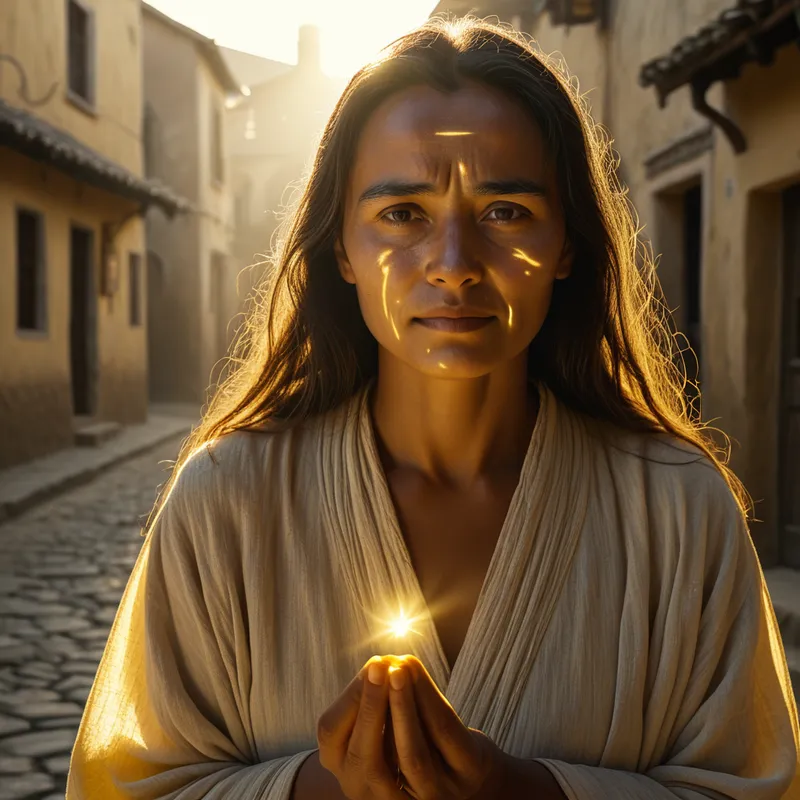
A grieving mother seeks a mustard seed from a home untouched by death, discovering the universality of loss and the seed of awakening within sorrow.
The Tale of The Mustard Seed
The world is heavy. It is a weight upon the chest, a silence where laughter once lived. In a small house of clay and straw, a woman named Kisa Gotami cradles the cold, still form of her only child. The air, once sweet with the scent of his hair, is now thick with the scent of absence. Her wails are not human sounds; they are the earth itself cracking open. She refuses the final rites. She will not let the pyre take him. Clutching the small body to her breast, she stumbles into the village lane, her eyes wild moons of madness, demanding of every soul she meets: “Give me medicine for my child! There must be a cure!”
The villagers shrink away, whispering of her broken mind. But one elder, his own eyes pools of long-remembered sorrow, does not turn away. He points a gnarled finger toward the grove on the outskirts of the village. “There is a healer there,” he says, his voice like dry leaves. “A sage who dwells under the Bodhi tree. Perhaps he knows of a medicine no other possesses.”
Driven by a hope that is itself a kind of agony, Kisa Gotami staggers to the grove. There, seated in the profound peace of one who has seen the end of all suffering, is the Tathagata. She falls at his feet, her precious burden laid before him. “Great Healer,” she gasps, her voice raw. “Bring my son back to life. You have power over life and death. Give me the medicine.”
The sage looks at her, and his gaze holds not pity, but a boundless, quiet knowing. “I can help you,” he says, his voice a calm river. “But you must bring me one ingredient. Go into the village and fetch me a handful of mustard seed.”
A wild, desperate joy floods her. Such a simple thing! She moves to rise, but his next words root her to the earth. “But it must come from a household,” he continues, “where no one has ever died. Not a father, not a mother, not a child, not a servant. The seed must be untouched by death.”
Hope, now a frantic bird, beats in her chest. She runs. She knocks on the first door. A woman answers, her hands dusty with flour. “Please, a mustard seed! For my child!” The woman’s face softens, and she turns to fetch it. But Kisa remembers the condition. “Wait—has anyone ever died in this home?” The woman’s eyes cloud. “What a question,” she sighs. “My husband’s father died last monsoon, right there in the corner room.” Kisa’s heart clenches. She turns away.
Door after door. At every threshold, the same plea, the same question. At every threshold, the same answer, spoken with a sigh, a tear, a distant look: “My daughter…” “My brother…” “My wife in childbirth…” The afternoon sun slants long. The frantic bird in her chest grows still, its wings heavy. The small body in her arms grows heavier still, not with life, but with a truth she can no longer outrun.
As twilight paints the sky in hues of ash and rose, she stands in the empty lane. She has traversed the entire village. She has held a mirror to every heart and seen the same reflection: a scar where love once was. She has not found a single mustard seed that meets the condition. She has found, instead, the condition of the world.
Slowly, with a gravity that has replaced her madness, she returns to the grove. She lays her child’s body gently at the feet of the sage. She does not ask for medicine. She simply says, “I have brought no seed. For the thing you asked for does not exist.”
The Tathagata nods. “So you have learned, Kisa Gotami, that the law of death is sovereign. It visits every household. Your sorrow is not a private curse, but the shared inheritance of all who love.” In that moment, holding the emptiness of her hands, holding the universality of her grief, the first, tiny seed of understanding is planted. She asks for the teachings. She asks to see the path that leads beyond the reach of death. And from the barren soil of her utter loss, something new—a resolve as small, and as potent, as a mustard seed—begins to stir.
Cultural Origins & Context
This parable, known as the story of Kisa Gotami and the Mustard Seed, originates from the early Buddhist textual tradition, specifically the Pali Canon. It is a Jataka-style teaching tale, designed not as historical record but as a vehicle for profound psychological and ethical instruction. Passed down orally for centuries by monks and nuns within the Sangha, it was a tool for teaching laypeople and new initiates alike.
Its societal function was multifaceted. For a culture deeply concerned with the problem of dukkha, it served as a powerful, non-intellectual gateway to understanding the Buddha’s First Noble Truth: that life is inherently marked by suffering and loss. It democratized grief, moving it from a personal failing or unique tragedy to a universal human condition. The story was a communal ritual in narrative form, acknowledging shared vulnerability and redirecting the energy of paralyzing personal sorrow toward the universal path of liberation. It transformed the isolating experience of death into a catalyst for communal spiritual seeking.
Symbolic Architecture
The myth is a perfect symbolic engine for the awakening of consciousness from the prison of personal identification. Every element is an archetypal truth dressed in the garments of simple story.
Kisa Gotami is the human soul in its raw, identified state—the ego that believes its pain is unique, its loss a special punishment. Her frantic search is the psyche’s attempt to find an exception to a universal law, to bargain with reality itself.
The Dead Child represents not just personal attachment, but any cherished condition, identity, or hope that we believe constitutes our self. Its loss is the inevitable dissolution of all conditioned things, the shock that initiates the spiritual crisis.
The Mustard Seed is the quintessential symbol of potential, but here, its condition transforms it. The search for the “untainted” seed is the search for an existence free from the law of impermanence (anicca). The impossible quest proves that such a state cannot be found in the realm of the conditioned, the world of houses and families and gathered things.
The medicine is not found in the seed, but in the fruitless search for it. The cure for personal grief is the realization of its universality.
The Village is the world, the collective human experience. Door by door, Kisa integrates the shadow of mortality that every household carries but seldom speaks of aloud. This is the process of moving from personal unconsciousness to an awareness of the collective human condition.
The Sage (The Buddha) represents the awakened consciousness, the Self that can hold the truth of suffering without being shattered by it. He does not offer false comfort or magic; he offers a task that is itself the teaching—a guided descent into reality.

The Dreamer’s Resonance
When this myth pattern stirs in the modern dreamer, it often signals a profound somatic and psychological encounter with the reality of loss and the end of naiveté. One might not dream of a literal child or mustard seed, but of a desperate, futile search for a lost object of immense personal value in a labyrinthine city where every door opened reveals a stranger weeping. The dream somatic signature is one of heaviness—a leaden chest, slow, trudging movement, and a climax not of finding, but of exhausted surrender.
Psychologically, this dream marks the ego’s confrontation with an absolute limit. It is the process of accepting the unacceptable. The dreamer is undergoing the death of a deeply held self-concept—perhaps as someone exempt from tragedy, as a caregiver who can always fix things, or as an individual whose love can shield them from life’s harsh laws. The dream is the psyche’s way of administering the bitter medicine of existential truth, initiating the transition from a psychology based on personal exception to one grounded in shared human fate. The grief, in the dream and upon waking, is no longer just personal; it becomes archetypal, connecting the dreamer to the timeless human river of sorrow and resilience.

Alchemical Translation
The parable models the complete alchemical process of psychic transmutation, or individuation, for the modern individual. It begins with the nigredo, the blackening: the crushing, isolating despair of Kisa Gotami, where all meaning is dissolved in the acid of loss. This is the necessary death of the old, identified self.
The sage’s instruction initiates the albedo, the whitening: the purposeful, painful work. The search for the mustard seed is the conscious engagement with the shadow of impermanence. Each refused door is an integration. The dreamer, like Kisa, must consciously approach the “houses” of their life—their relationships, achievements, and beliefs—and ask the terrifying question: “Is this permanent? Has death touched here?” The answer, of course, is always yes. Every success fades, every relationship changes, every body ages. This systematic disillusionment is not nihilism; it is the burning away of illusion.
The climax at twilight is the citrinitas, the yellowing, or the dawning of intellectual insight. The realization that “the thing you asked for does not exist” is the moment the ego surrenders its futile project of constructing a deathless life in a dying world. It is the understanding of the First Noble Truth at a cellular level.
The seed of the new Self is not planted until the soil of the old self is thoroughly turned by the plough of unbearable truth.
Finally, her request for the teachings marks the beginning of the rubedo, the reddening, or the creation of the philosophical gold. The energy once bound up in resisting a personal fate is now freed to pursue a universal path. The small, hard seed of her resolve—to understand, to practice, to awaken—is now planted in the fertile ground of reality, not fantasy. For the modern individual, this translates to the movement from “Why me?” to “What now?” It is the shift from being a victim of circumstance to a student of the human condition. The transformed individual does not cease to feel, but they cease to be drowned by feeling. They carry their mustard seed of sorrow, but now they know it contains the map to a freedom greater than any house untouched by death could ever provide.
Associated Symbols
Explore related symbols from the CaleaDream lexicon: